CE Board Exam Randomizer

⬅ Back to Subject Topics

Bolted Connections

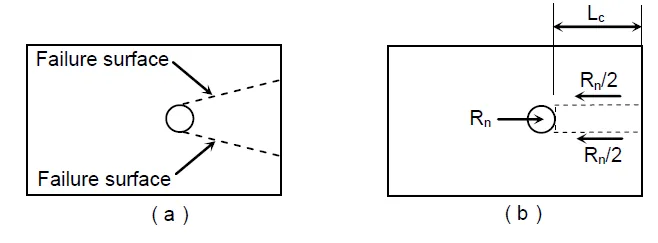
In the previous sections, we have already discussed the failure modes based on the tension of the plate (gross area, net area, and staggered connections), as well as block shear. Here, we will discuss the bearing of the plate, which is the shear tear out at the end of a connected element, and the effects of torsion on bolts due to eccentric loadings.
Concept

From the idealized failure surface, the total nominal strength is:

$$ R_n = 1.2 L_c t F_u \;\; \le \;\; 2.4 d t F_u $$

Where:

For LRFD:

$$ \phi R_n = 0.75 R_n \quad ; \quad \phi = 0.75 $$

For ASD:

$$ \frac{R_n}{\Omega} = \frac{R_n}{2} \quad ; \quad \Omega = 2.00 $$

Spacing and Edge - Distance Requirements

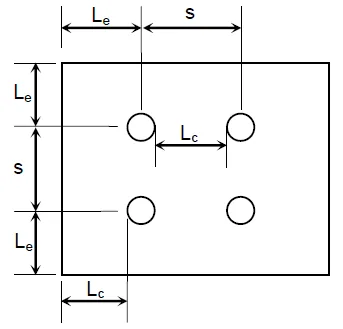
Minimum spacing, S, and edge distance, Le, in any direction, both in the line of force and transverse to the line of force.
Concept
$$ s \ge 2 \tfrac{2}{3} d \quad (\text{preferred } 3d) $$
Concept

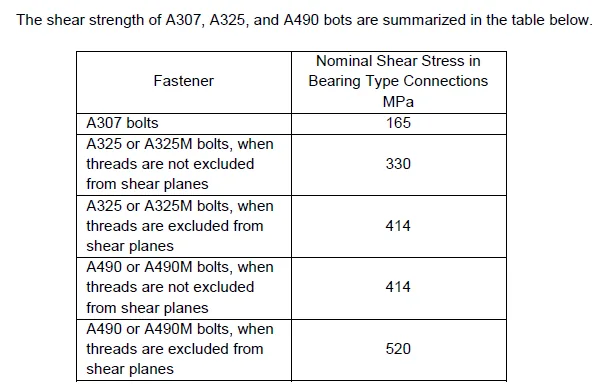
Bolt shear strength

$$ R_n=F_{nv}A_b $$ $$ A_b=\frac{\pi d_b^2}{4} $$

For LRFD:

$$ \phi R_n = 0.75 F_{nv} A_b \quad ; \quad \phi = 0.75 $$

For ASD:

$$ \frac{R_n}{\Omega} = \frac{F_{nv} A_b}{2} = 0.50 F_{nv} A_b \quad ; \quad \Omega = 2.00 $$

Other bearing-strength cases from NSCP/AISC notes

$$ R_n=1.5L_ctF_u \le 3.0dtF_u \quad \text{when hole deformation at service load is not a design consideration} $$ $$ R_n=1.0L_ctF_u \le 2.0dtF_u \quad \text{for long-slotted holes perpendicular to the load} $$

Combined bolt shear and tension

$$ f_v=\frac{V}{A_b}, \qquad f_t=\frac{T}{A_b} $$ $$ F'_{nt}=1.3F_{nt}-\frac{F_{nt}}{\phi F_{nv}}f_v \le F_{nt} \quad \text{(LRFD)} $$ $$ f_t \le \phi F'_{nt}, \qquad f_v \le \phi F_{nv} $$

Eccentric Bolted Connections (Elastic Analysis)

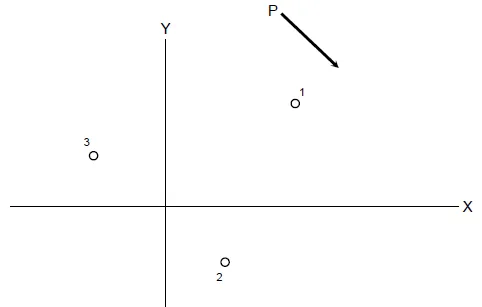
Consider the bolted connection acted by a force P as shown.
Concept

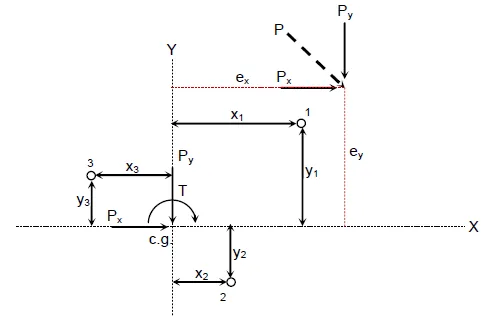
1. Resolve P into components Px and Pyand construct the equivalent loading
2. Locate the center of gravity of the bolt group. For symmetrical arrangements of bolts, the center of gravity is located at the geometric center. For non=symmetrical arrangements, it can be located by using Varignon's Theorem
3. The equivalent effect is that the system of bolts is acted by direct shears Px and Py and a torsional moment T at the center of gravity.

Equivalent Loading
Concept

Bolt Group: Direct Shear + Torsion (Procedure)

  1. For direct shear loads, distribute equally among the bolts:
    $$ P_{Dx} = \frac{P_x}{n}, \qquad P_{Dy} = \frac{P_y}{n} $$
    where $n$ = number of bolts.
  2. Compute the torsional moment about the bolt group centroid:
    $$ T = P_x e_y + P_y e_x $$
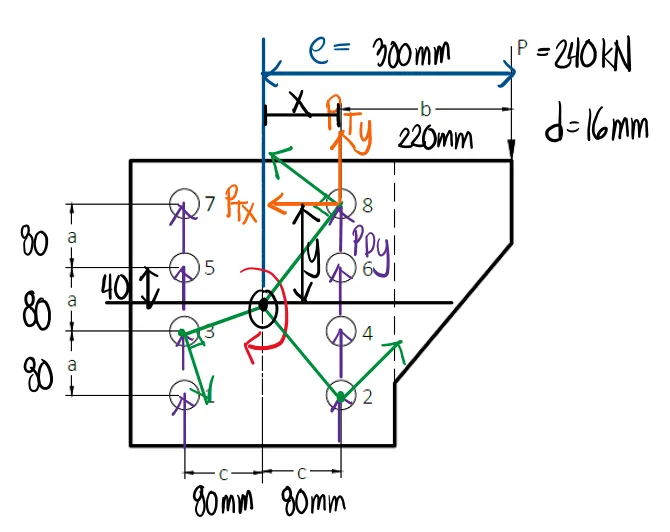
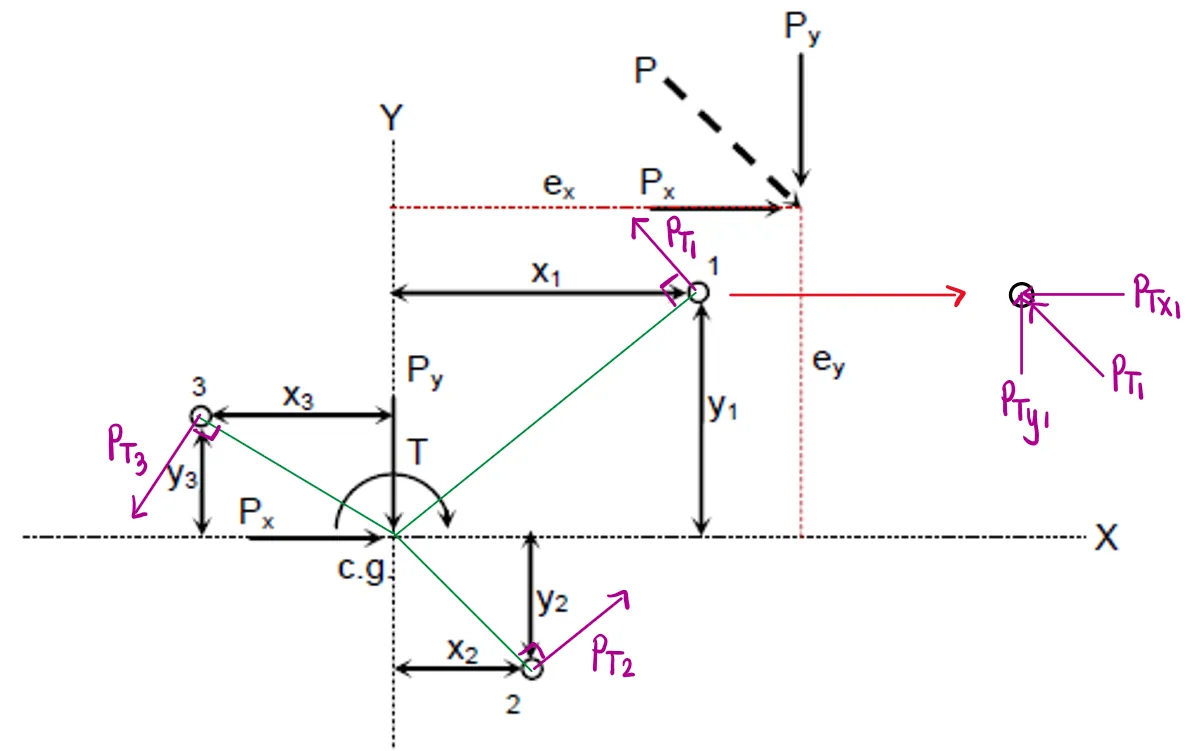
  3. The most stressed bolt is where the forces due to direct shear and torsion are of similar directions. Forces due to direct shear have the same directions as the components of the applied force. For the forces due to torsion, draw lines (indicated as green lines) from the c.g. going to the center of each bolt. Next, draw forces perpendicular to such line (indicated as purple lines) that cause a rotation opposite to the torsional moment.

    Since the torsional moment is clockwise, the forces, PT1, PT2, and PT3 must cause a counterclockwise rotation.
  4. Concept
  5. Consider bolt 1. The torsion-induced load on bolt 1 is $P_T$, resolved into components:
    $$ P_{Tx1} = \frac{T\,y_1}{\sum (x^2 + y^2)}, \qquad P_{Ty1} = \frac{T\,x_1}{\sum (x^2 + y^2)} $$
    Define the polar moment of the bolt group:
    $$ J = \sum (x^2 + y^2) $$
  6. Select the bolt with the maximum combined shear (direct + torsion). The total resultant on that bolt is:
    $$ P = \sqrt{\left(P_{Tx} + P_{Dx}\right)^2 + \left(P_{Ty} + P_{Dy}\right)^2} $$
Concept Concept Concept

Problem: Eccentrically Loaded Bolted Connection

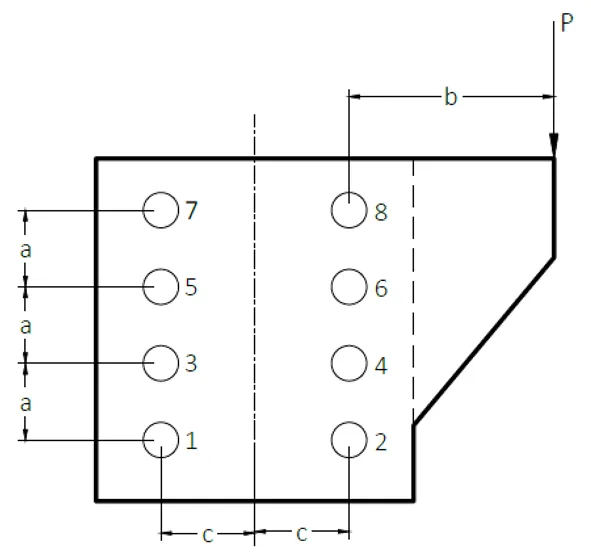
For the bolted connection shown below, use the following data:

Bolted Connections (Combined Shear and Torsion) | Principles of Steel Design – Problem 1: – Diagram
  1. Which of the following most nearly gives the direct shear stress of each bolt in megapascals?
    1. 136.30
    2. 149.20
    3. 178.80
    4. 189.10
  2. Which of the following most nearly gives the reaction of bolt #8 in kN?
    1. 133
    2. 110
    3. 122
    4. 105
  3. When the reaction of the most stressed bolt is 180 kN, compute the required diameter of the most stressed bolt if its allowable shear stress is limited to 300 MPa.
    1. 36
    2. 32
    3. 25
    4. 28
Bolted Connections (Combined Shear and Torsion) | Principles of Steel Design – Problem 1: – Diagram

Use direct shear plus torsional shear about the centroid of the bolt group.

$$ J=\sum x^2+\sum y^2 $$ $$ J=8(80)^2+4(40)^2+4(120)^2=115200\text{ mm}^2 $$

Direct shear per bolt:

$$ P_{Dy}=\frac{240}{8}=30\text{ kN} $$ $$ \tau_D=\frac{240(1000)}{8\left(\frac{\pi}{4}\right)(16)^2}=149.208\text{ MPa} $$ $$ \tau_D\approx 149.20\text{ MPa} $$

The eccentric load produces a clockwise torsional moment about the bolt-group centroid. The torsional force at each bolt is taken perpendicular to the straight line from the centroid to that bolt, and its direction is chosen so the bolt group develops a resisting rotation opposite to the rotation caused by the load.

For bolt #8, the eccentricity is 300 mm, so the torsional moment is:

$$ T=240(1000)(300)=72000000\text{ N-mm} $$ $$ P_{Tx}=\frac{T(120)}{J}=75000\text{ N} $$ $$ P_{Ty}=\frac{T(80)}{J}=50000\text{ N} $$ $$ R_8=\frac{\sqrt{P_{Tx}^2+(P_{Dy}+P_{Ty})^2}}{1000} $$ $$ R_8=\frac{\sqrt{75000^2+(30000+50000)^2}}{1000}=109.659\text{ kN} $$ $$ R_8\approx 110\text{ kN} $$

Required diameter when the most stressed bolt carries 180 kN:

$$ 300=\frac{180(1000)}{\frac{\pi}{4}d^2} $$ $$ d=\sqrt{\frac{4(180)(1000)}{300\pi}}=27.64\text{ mm} $$ $$ d\approx 28\text{ mm} $$

Answers: a. B. 149.20; b. B. 110; c. D. 28.

Problem:

Refer to the image shown:

Bolted Connections (Combined Shear and Torsion) | Principles of Steel Design – Problem 2: – Diagram Bolted Connections (Combined Shear and Torsion) | Principles of Steel Design – Problem 2: – Diagram Bolted Connections (Combined Shear and Torsion) | Principles of Steel Design – Problem 2: – Diagram

See images:

Bolted Connections (Combined Shear and Torsion) | Principles of Steel Design – Problem 2: – Diagram Bolted Connections (Combined Shear and Torsion) | Principles of Steel Design – Problem 2: – Diagram Bolted Connections (Combined Shear and Torsion) | Principles of Steel Design – Problem 2: – Diagram Bolted Connections (Combined Shear and Torsion) | Principles of Steel Design – Problem 2: – Diagram

Problem:

Refer to the image shown:

Bolted Connections (Combined Shear and Torsion) | Principles of Steel Design – Problem 3: – Diagram Bolted Connections (Combined Shear and Torsion) | Principles of Steel Design – Problem 3: – Diagram Bolted Connections (Combined Shear and Torsion) | Principles of Steel Design – Problem 3: – Diagram

See images:

Bolted Connections (Combined Shear and Torsion) | Principles of Steel Design – Problem 3: – Diagram Bolted Connections (Combined Shear and Torsion) | Principles of Steel Design – Problem 3: – Diagram Bolted Connections (Combined Shear and Torsion) | Principles of Steel Design – Problem 3: – Diagram Bolted Connections (Combined Shear and Torsion) | Principles of Steel Design – Problem 3: – Diagram

Problem:

Refer to the image shown:

Bolted Connections (Combined Shear and Torsion) | Principles of Steel Design – Problem 4: – Diagram Bolted Connections (Combined Shear and Torsion) | Principles of Steel Design – Problem 4: – Diagram Bolted Connections (Combined Shear and Torsion) | Principles of Steel Design – Problem 4: – Diagram

See images:

Bolted Connections (Combined Shear and Torsion) | Principles of Steel Design – Problem 4: – Diagram Bolted Connections (Combined Shear and Torsion) | Principles of Steel Design – Problem 4: – Diagram Bolted Connections (Combined Shear and Torsion) | Principles of Steel Design – Problem 4: – Diagram Bolted Connections (Combined Shear and Torsion) | Principles of Steel Design – Problem 4: – Diagram

Problem:

Refer to the image shown:

Bolted Connections (Combined Shear and Torsion) | Principles of Steel Design – Problem 5: – Diagram Bolted Connections (Combined Shear and Torsion) | Principles of Steel Design – Problem 5: – Diagram Bolted Connections (Combined Shear and Torsion) | Principles of Steel Design – Problem 5: – Diagram

See images:

Bolted Connections (Combined Shear and Torsion) | Principles of Steel Design – Problem 5: – Diagram Bolted Connections (Combined Shear and Torsion) | Principles of Steel Design – Problem 5: – Diagram Bolted Connections (Combined Shear and Torsion) | Principles of Steel Design – Problem 5: – Diagram Bolted Connections (Combined Shear and Torsion) | Principles of Steel Design – Problem 5: – Diagram

Problem:

Refer to the image shown:

Bolted Connections (Combined Shear and Torsion) | Principles of Steel Design – Problem 6: – Diagram Bolted Connections (Combined Shear and Torsion) | Principles of Steel Design – Problem 6: – Diagram Bolted Connections (Combined Shear and Torsion) | Principles of Steel Design – Problem 6: – Diagram

See images:

Bolted Connections (Combined Shear and Torsion) | Principles of Steel Design – Problem 6: – Diagram Bolted Connections (Combined Shear and Torsion) | Principles of Steel Design – Problem 6: – Diagram Bolted Connections (Combined Shear and Torsion) | Principles of Steel Design – Problem 6: – Diagram Bolted Connections (Combined Shear and Torsion) | Principles of Steel Design – Problem 6: – Diagram

Problem:

Refer to the image shown:

Bolted Connections (Combined Shear and Torsion) | Principles of Steel Design – Problem 7: – Diagram Bolted Connections (Combined Shear and Torsion) | Principles of Steel Design – Problem 7: – Diagram Bolted Connections (Combined Shear and Torsion) | Principles of Steel Design – Problem 7: – Diagram

See images:

Bolted Connections (Combined Shear and Torsion) | Principles of Steel Design – Problem 7: – Diagram Bolted Connections (Combined Shear and Torsion) | Principles of Steel Design – Problem 7: – Diagram Bolted Connections (Combined Shear and Torsion) | Principles of Steel Design – Problem 7: – Diagram Bolted Connections (Combined Shear and Torsion) | Principles of Steel Design – Problem 7: – Diagram

Problem:

Refer to the image shown:

Bolted Connections (Combined Shear and Torsion) | Principles of Steel Design – Problem 8: – Diagram Bolted Connections (Combined Shear and Torsion) | Principles of Steel Design – Problem 8: – Diagram Bolted Connections (Combined Shear and Torsion) | Principles of Steel Design – Problem 8: – Diagram

See images:

Bolted Connections (Combined Shear and Torsion) | Principles of Steel Design – Problem 8: – Diagram Bolted Connections (Combined Shear and Torsion) | Principles of Steel Design – Problem 8: – Diagram Bolted Connections (Combined Shear and Torsion) | Principles of Steel Design – Problem 8: – Diagram Bolted Connections (Combined Shear and Torsion) | Principles of Steel Design – Problem 8: – Diagram

Exam Generator Problems

Additional board-style practice items for this topic.

Question Bank: q34

PSAD - Steel Design / Bolted Connections / Engr. Janclyde Espinosa (Clidez)

CE Board November 2024
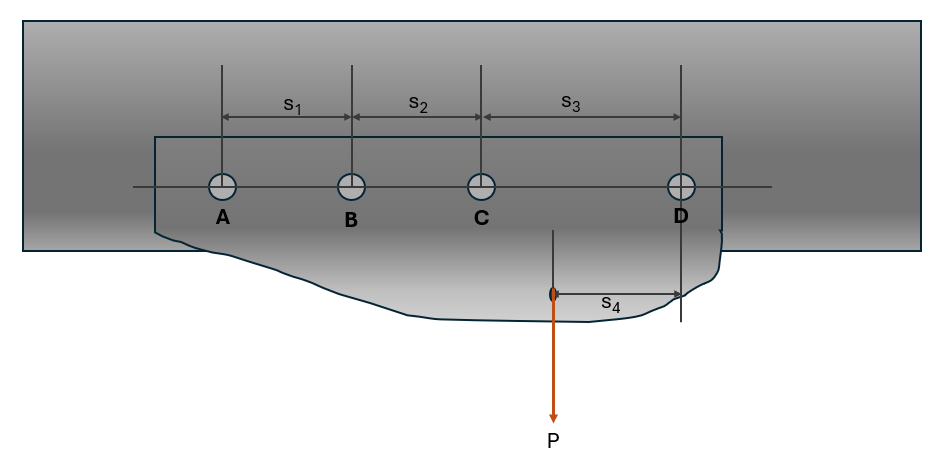
A gusset plate is bolted to a larger plate by four 20-mm-diameter bolts in single shear as shown.
Given:
P=30kN
s1=s2=150mm; s3=250mm; s4=200mm

q34

Calculate the shear stress (MPa) in bolt D.

  1. 41.2
  2. 23.9
  3. 29.5
  4. 25.9

Calculate the shear stress (MPa) in bolt B.

  1. 18.1
  2. 23.9
  3. 24.6
  4. 29.3

What is the maximum value of P acting at the centroid of the bolt group if the allowable shear stress of the bolt is Fv=99MPa.

  1. 124
  2. 15
  3. 60
  4. 72

Solution pending in psadquestions/q34.json.

Question Bank: q39

PSAD - Steel Design / Bolted Connections / Engr. Janclyde Espinosa (Clidez)

A bolted connection uses A325 bolts in a friction type connection with an allowable shear stress of 145MPa. If P=150kN,

q39

Which of the following most nearly gives the polar moment of inertia of the bolt groups in mm3?

  1. 82838
  2. 71775
  3. 85677
  4. 93455

Which of the following most nearly gives the maximum reaction of the bolts in kN?

  1. 30.4
  2. 36.8
  3. 32.6
  4. 31.2

Which of the following most nearly gives the reaction of bolt A in kN?

  1. 28.6
  2. 26.1
  3. 26.5
  4. 30.4

Solution pending in psadquestions/q39.json.

Question Bank: q149

PSAD - Steel Design / Bolted Connections / Engr. Janclyde Espinosa (Clidez)

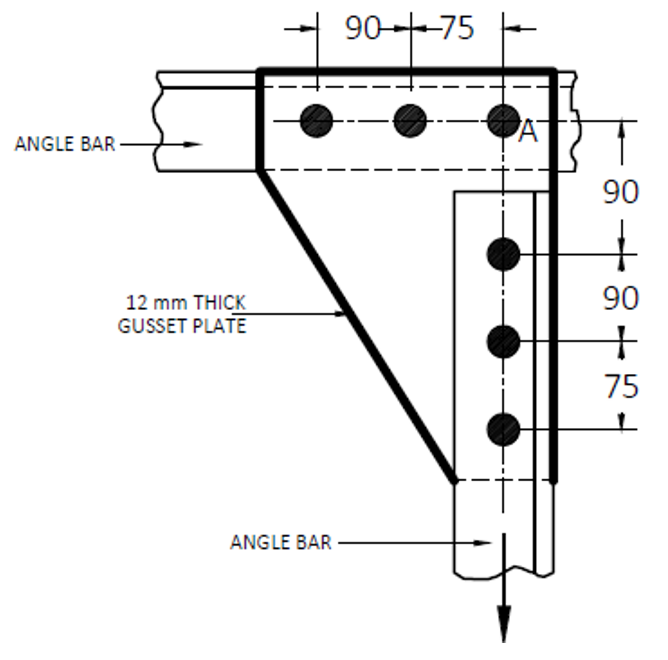
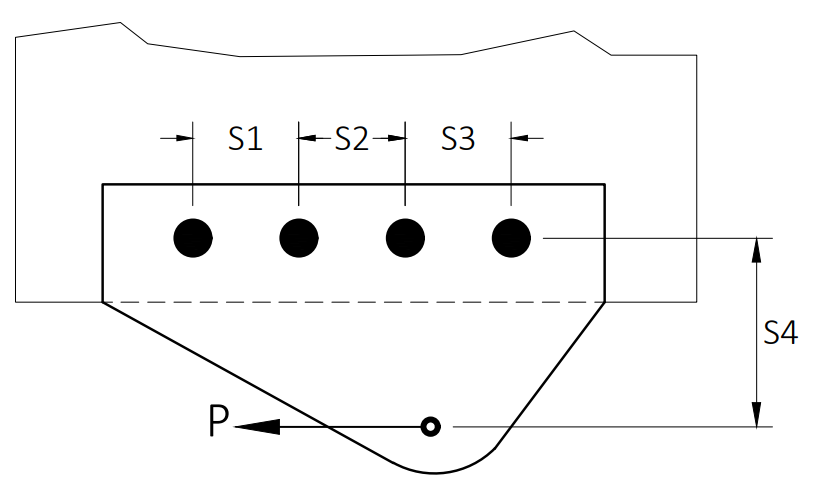
The gusset plate connection shows four 16-mm diameter bolts supporting the load P.
Given:
P = 37.5kN
S1=S2=S3 = 75mm
S4 = 100mm

q149

Determine the maximum shear stress (MPa) developed in the bolts.

  1. 88
  2. 116
  3. 97
  4. 102

Determine the minimum shear stress (MPa) developed in the bolts.

  1. 53
  2. 64
  3. 42
  4. 36

The allowable bolt shear stress is 50MPa. Determine the minimum required bolt diameter (mm) to prevent overstressing.

  1. 22
  2. 32
  3. 28
  4. 16

Part 1.

P = 37.5 kN; bolt dia = 16 mm; 4 bolts in a vertical line; $S_1=S_2=S_3=75$ mm; eccentricity $e=S_4=100$ mm.
Bolt areas: $A_b = \frac{\pi(16)^2}{4} = 201.06 \text{ mm}^2$
Direct shear: $V_d = \frac{P}{4} = \frac{37{,}500}{4} = 9{,}375 \text{ N per bolt}$
Centroid at mid-height; bolt distances from centroid: $r_1=r_4=112.5$ mm; $r_2=r_3=37.5$ mm.
Moment: $M = P \times e = 37{,}500 \times 100 = 3{,}750{,}000 \text{ N·mm}$
$\sum r^2 = 2(112.5^2 + 37.5^2) = 2(12{,}656.25+1{,}406.25) = 28{,}125 \text{ mm}^2$
Torsional force on bolt 1 (top): $T_1 = \frac{M \cdot r_1}{\sum r^2} = \frac{3{,}750{,}000 \times 112.5}{28{,}125} = 15{,}000 \text{ N}$ (horizontal)
Resultant (top/bottom bolt): $R_\max = \sqrt{V_d^2 + T_1^2} = \sqrt{9375^2+15000^2} = 17{,}688 \text{ N}$
$\tau_\max = \frac{R_\max}{A_b} = \frac{17{,}688}{201.06}$
$\boxed{\approx 88 \text{ MPa}}$

Part 2.

Torsional force on bolt 2 (middle): $T_2 = \frac{3{,}750{,}000 \times 37.5}{28{,}125} = 5{,}000 \text{ N}$
$R_\min = \sqrt{9375^2+5000^2} = 10{,}625 \text{ N}$
$\tau_\min = \frac{10{,}625}{201.06}$
$\boxed{\approx 53 \text{ MPa}}$

Part 3.

The critical bolt force is 17,688 N (from the top/bottom bolt, unchanged).
For $\tau_{\text{allow}} = 50$ MPa:
$\frac{\pi d^2}{4} = \frac{R_\max}{\tau_{\text{allow}}} = \frac{17{,}688}{50} = 353.76 \text{ mm}^2$
$d = \sqrt{\frac{4 \times 353.76}{\pi}} = \sqrt{450.4} = 21.2 \text{ mm}$
Use next standard size: $\boxed{d = 22 \text{ mm}}$

Question Bank: t36

PSAD - Steel Design / Bolted Connections / Civil Engineering Refresher

An 80 kN load acts on a 38 mm diameter bolt.

Calculate the tensile stress in the body of the bolt.

  1. 70.5 MPa
  2. 99.5 MPa
  3. 40.3 MPa
  4. 80.0 MPa

If the 38 mm bolt from Question 51 has 32 mm root threads, determine the tensile stress at the root.

  1. 99.5 MPa
  2. 70.5 MPa
  3. 125.0 MPa
  4. 80.0 MPa

For the bolt head in Question 51 (60 mm hexagonal), calculate the compressive stress at the head bearing surface.

  1. 40.3 MPa
  2. 70.5 MPa
  3. 99.5 MPa
  4. 55.2 MPa

Part 1.

$A = \frac{\pi}{4}(38)^2 = 1134 \text{ mm}^2$.
$\sigma = \frac{P}{A} = \frac{80000}{1134}$
$\boxed{= 70.5 \text{ MPa}}$

Part 2.

$A_{root} = \frac{\pi}{4}(32)^2 = 804.2 \text{ mm}^2$.
$\sigma = \frac{80000}{804.2}$
$\boxed{= 99.5 \text{ MPa}}$

Part 3.

Hexagon (60 mm across flats): $a = \frac{60}{\sqrt{3}} = 34.64$ mm; $A_{hex} = \frac{3\sqrt{3}}{2}a^2 = 3118 \text{ mm}^2$.
Bearing area $= A_{hex} - A_{bolt} = 3118 - 1134 = 1984 \text{ mm}^2$.
$\sigma = \frac{80000}{1984}$
$\boxed{= 40.3 \text{ MPa}}$
Scroll to zoom