Comprehensive board-exam reference for prestressed concrete: key terminologies, governing assumptions, allowable stresses, and the stress equations used at transfer and at service load.
Key terminologies:
Prestressing: deliberate introduction of internal compressive stresses in a member to counteract tensile stresses produced by service loads.
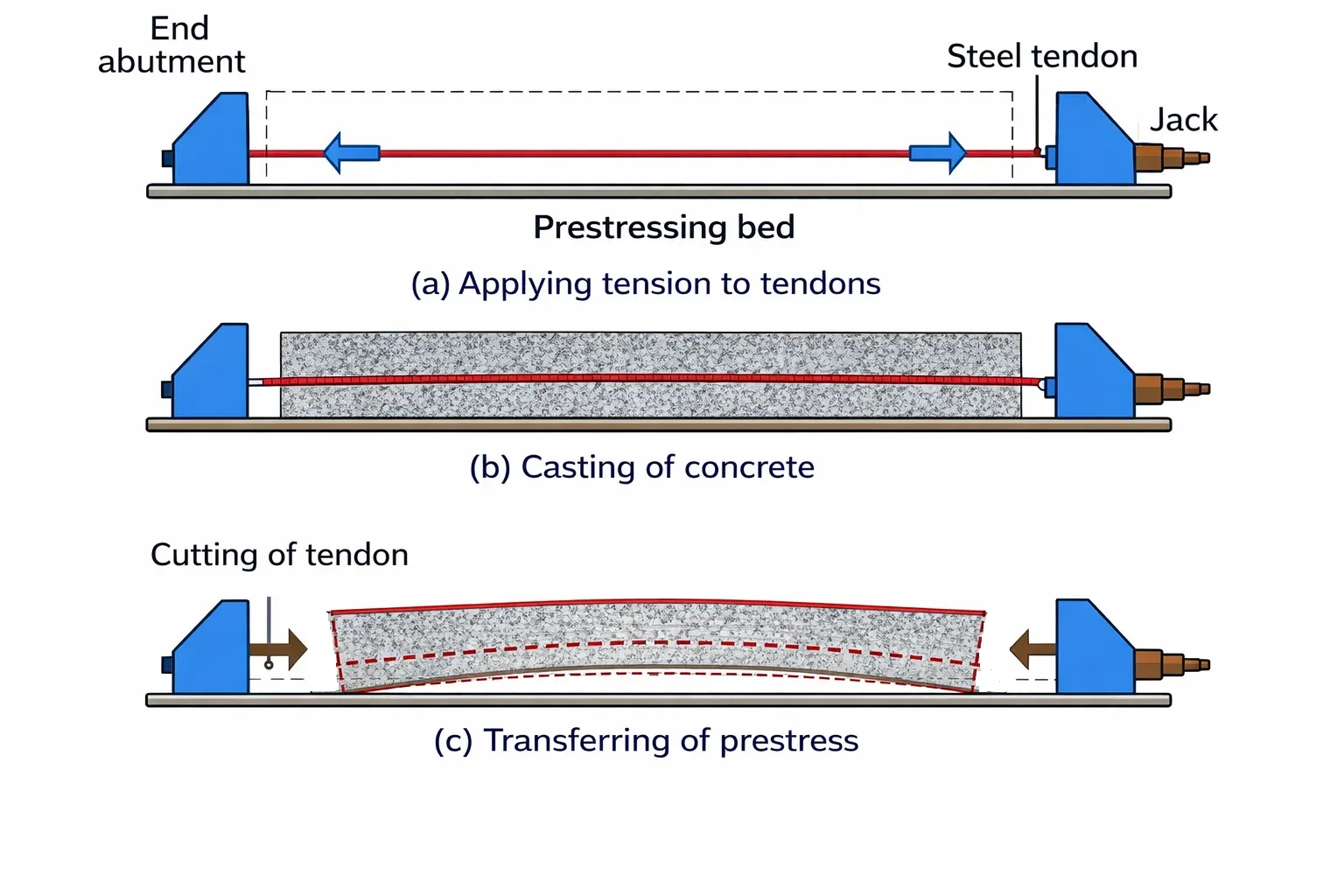
Pre-tensioning: tendons are tensioned before the concrete is cast; the bond between concrete and tendon transfers the prestress after the concrete hardens. Common for precast joists, double-tees, hollow-core planks.
Post-tensioning: tendons are tensioned after the concrete has hardened, by jacking against the cured concrete and anchoring against end blocks. Common for cast-in-place girders and long-span slabs.
Tendon: high-strength steel strand, wire, or bar used to apply the prestress.
Strand: a group of high-strength wires twisted helically about a central wire (typical 7-wire strand, $f_{pu}=1860$ MPa).
Anchorage: mechanical end device that locks the tendon in tension against the concrete in post-tensioning.
Duct: the hollow channel cast in the concrete through which a post-tensioning tendon passes. Bonded ducts are grouted after stressing; unbonded ducts are filled with grease.
Initial prestress, Pi: force in the tendon immediately after stressing, before any loss.
Effective (final) prestress, Pe or Pf: tendon force after all losses (typically 15–25% of $P_i$).
Loss of prestress: reduction in tendon force over time due to elastic shortening of concrete, friction (post-tensioning), anchorage slip, creep and shrinkage of concrete, and steel relaxation. Total long-term losses are commonly 15–25%.
Eccentricity, e: perpendicular distance from the centroid of the tendons (c.g.s.) to the centroidal axis of the concrete section.
Kern (or core): the central zone of the section in which an axial compressive force produces no tension on any fibre. For a rectangle, the kern extends $h/6$ each way from the centroid (the “middle-third”).
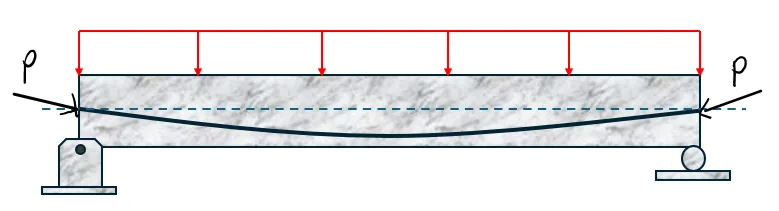
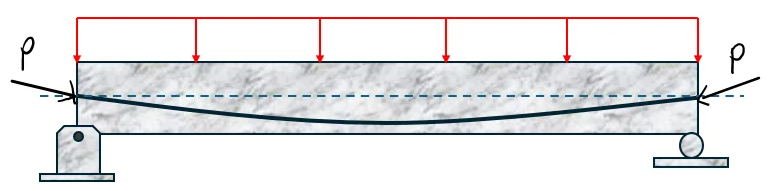
Cable profile: the shape of the tendon along the beam length — straight, harped (draped), or parabolic.
Camber: upward deflection produced by the prestress acting alone (and self-weight); it partially offsets the downward deflection from service loads.
Transfer: the instant the prestressing force is released from the abutments (pre-tensioning) or anchored (post-tensioning) and acts on the concrete.
Cracking moment, Mcr: the bending moment that just exceeds the precompression at the tensile fibre and produces the first flexural crack.
Material strengths and notation:
$f_{pu}$ = ultimate tensile strength of the prestressing steel (e.g., 1725 MPa Grade 250; 1860 MPa Grade 270).
$f_{py}$ = yield strength of the prestressing steel ($\approx 0.85 f_{pu}$ for stress-relieved; $\approx 0.90 f_{pu}$ for low-relaxation strand).
$f_{pi}$ = initial stress in the tendon at transfer; $f_{pe}$ = effective stress after all losses.
$f'_c$ = 28-day compressive strength of the concrete; $f'_{ci}$ = compressive strength of the concrete at transfer.
$A$ = cross-sectional area of the concrete; $I$ = moment of inertia about the centroidal axis.
$y_t,\,y_b$ = distances from the centroidal axis to the top and bottom fibres.
$P_i,\,P_f$ = initial and final (effective) prestressing force.
Sign convention: compression is positive; tension is negative. The standard fibre-stress equation is therefore:
Use the upper signs for the bottom fibre and the lower signs for the top fibre (eccentricity $e$ below the centroid, sagging moment $M$ producing tension at the bottom):
At transfer (prestress just released, before losses): use the initial prestress $P_i$ and only self-weight moment $M_0 = w_{sw}L^2/8$. The most-stressed fibre is usually the top in tension and the bottom in high compression near supports.
At service load (after all losses): use the effective prestress $P_e$ and total service moment $M_T = M_{DL} + M_{LL}$. The most-stressed fibre is usually the top in high compression and the bottom in tension near midspan.
$\gamma_p = 0.40$ for stress-relieved strands; $0.28$ for low-relaxation strands; $0.55$ for high-strength bars. $\rho_p = A_{ps}/(b\,d_p)$.
Advantages of prestressed concrete:
Concrete remains in compression under service load — improved crack control and durability.
Smaller cross-sections and lower self-weight for the same span and load.
Longer spans achievable than with conventional reinforced concrete.
Reduced deflections under service loads owing to camber.
Full use of high-strength concrete and high-strength steel.
Disadvantages and design considerations:
Requires high-strength materials and skilled labour; cost per m³ is higher than RC.
Anchorage zones, friction losses, and end-block detailing must be designed.
Loss of prestress over time must be predicted with reasonable accuracy.
Camber and long-term deflection must be controlled.
Cracking moment, transfer stresses, and service stresses must all be checked.
Prestressed Reinforced Concrete
Prestressed reinforced concrete is a structural system in which internal stresses are deliberately introduced into a concrete member before it is subjected to external loads. These internal stresses, applied through high-strength steel tendons, counteract the tensile stresses that would normally develop under service loads, allowing the concrete to remain largely or entirely in compression. By improving crack control, reducing deflections, and increasing load-carrying capacity, prestressing enables longer spans, slimmer structural members, and more efficient use of materials compared to conventional reinforced concrete. Prestressed concrete plays a critical role in modern infrastructure—such as bridges, girders, slabs, and water tanks—where high performance, durability, and structural economy are essential.
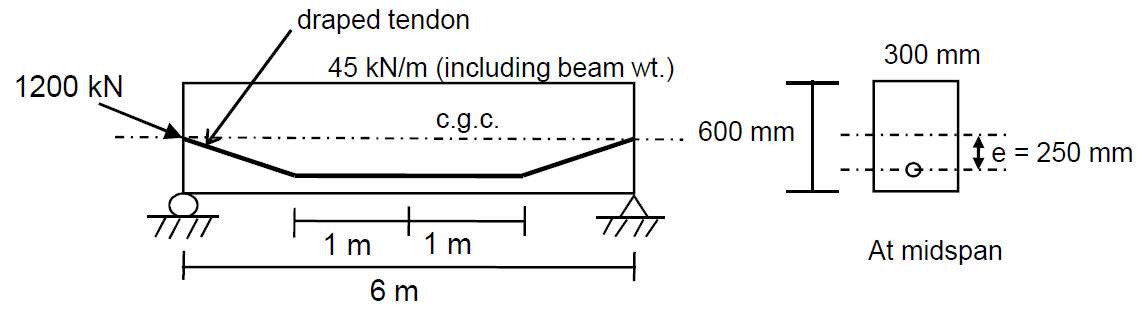
Problem: CE Board November 2024
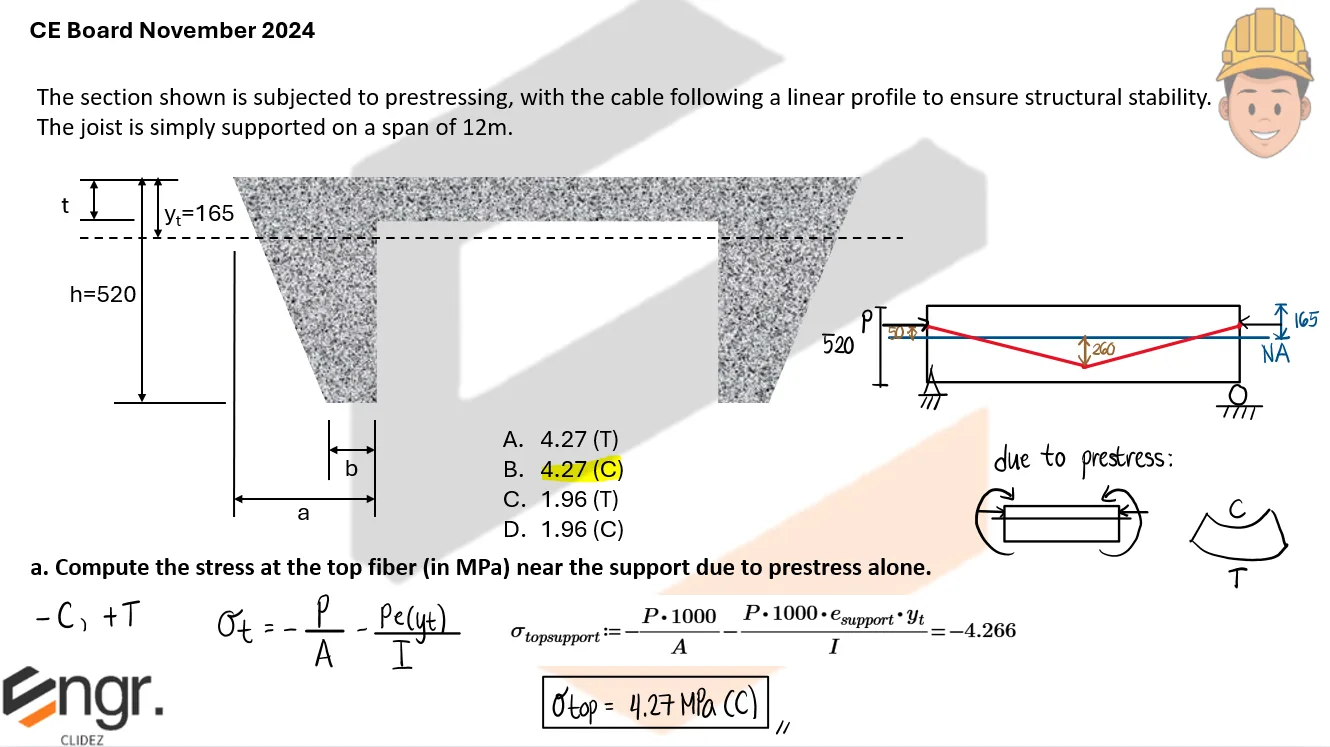
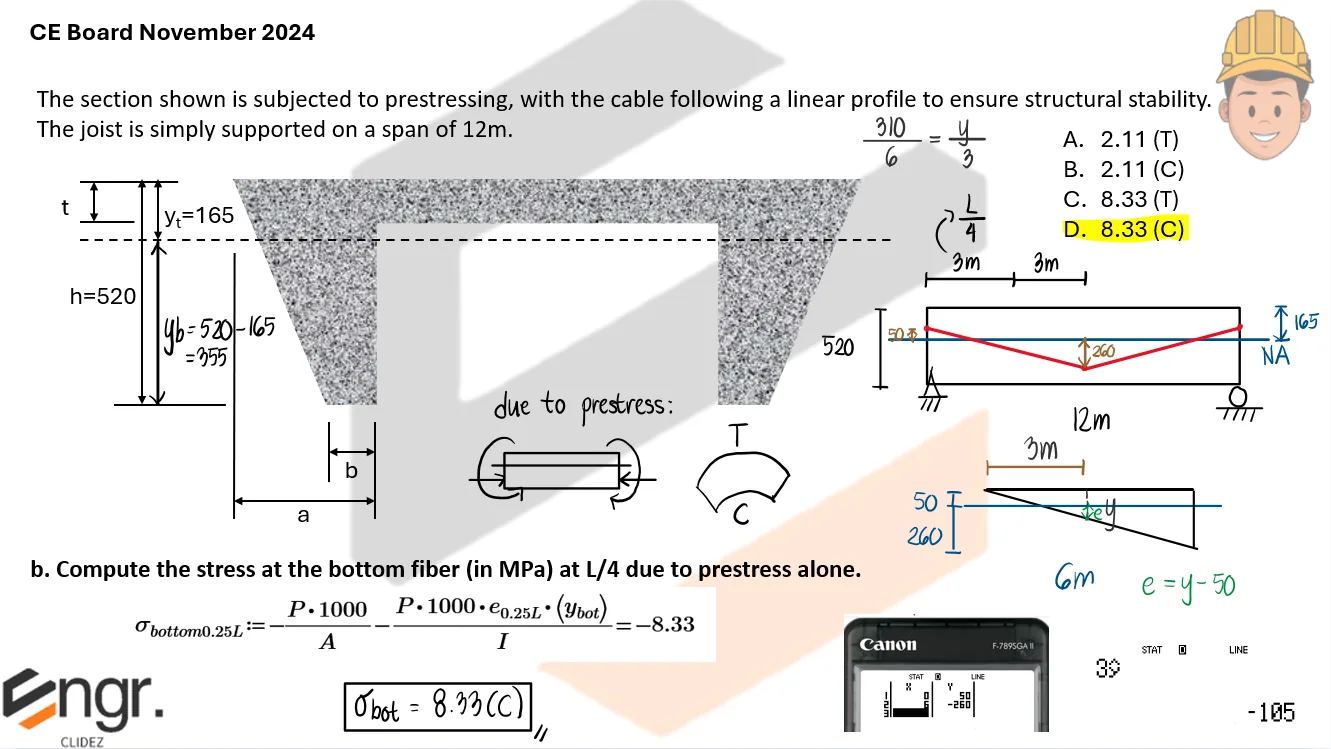
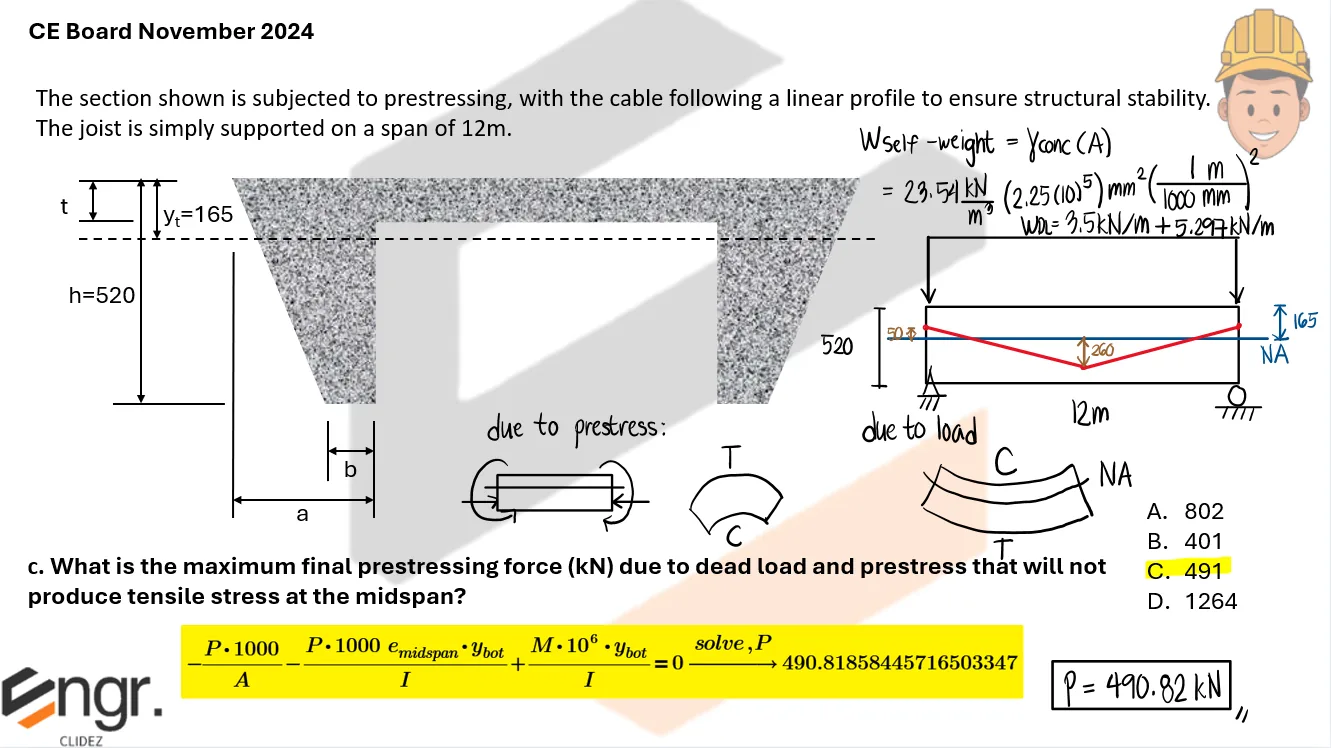
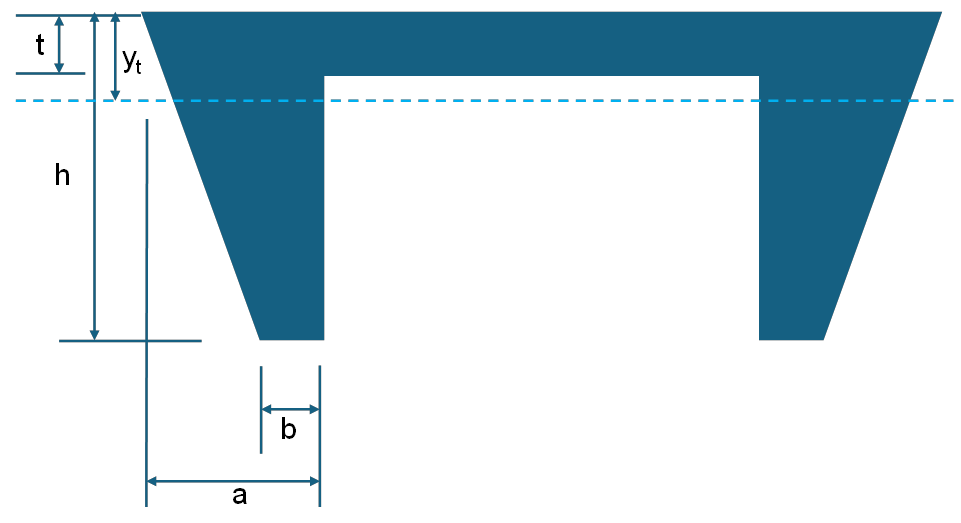
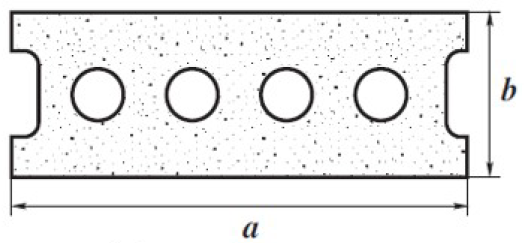
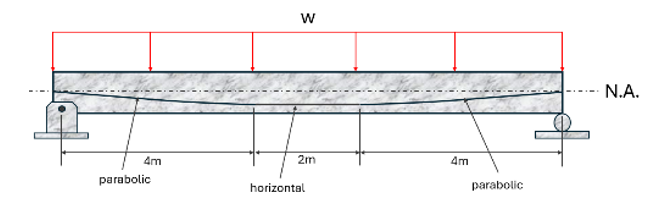
The section shown is subjected to prestressing, with the cable following a linear profile to ensure structural stability. The joist is simply supported on a span of 12m.
Given:
Eccentricity at the supports = 50mm above N.A.
Eccentricity at the midspan = 260mm below N.A.
Section Properties: Area, A=2.25x105mm2 Moment of Inertia, INA5x109mm4 Unit weight of concrete=23.54kN/m3 Superimposed Dead Load=3.5kN/m
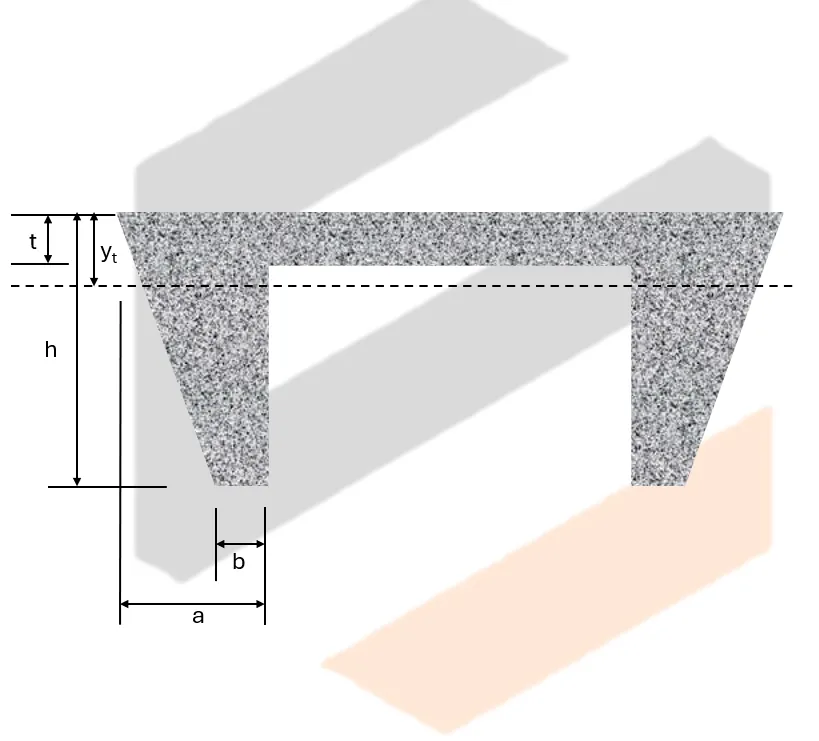
Dimensions: h=520mm, t=75mm yt=165mm, a=150mm, b=75mm Final Prestressing Force, P=700kN
a. Compute the stress at the top fiber (in MPa) near the support due to prestress alone.
b. Compute the stress at the bottom fiber (in MPa) at L/4 due to prestress alone.
c. What is the maximum final prestressing force (kN) due to dead load and prestress that will not produce tensile stress at the midspan?
See images:
Problem: Beam with Parabolic Tendons
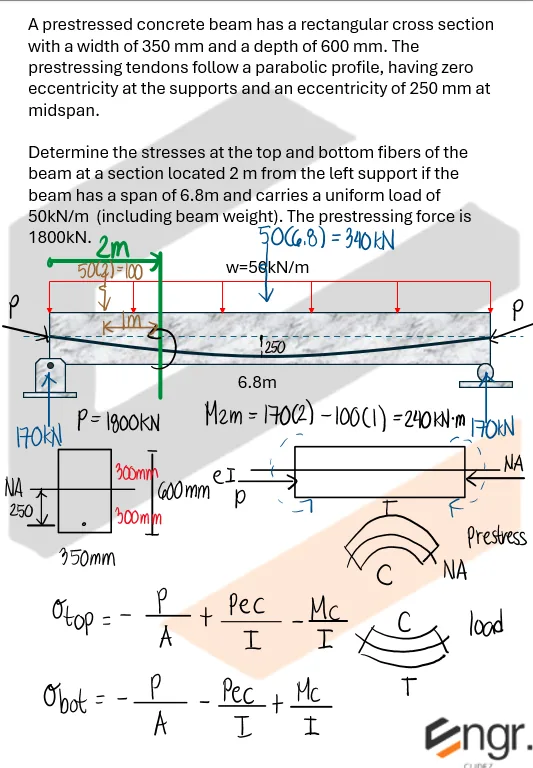
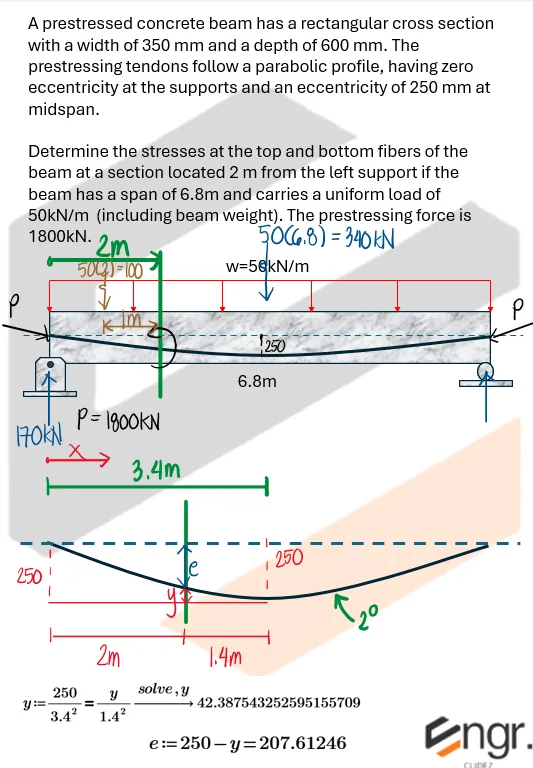
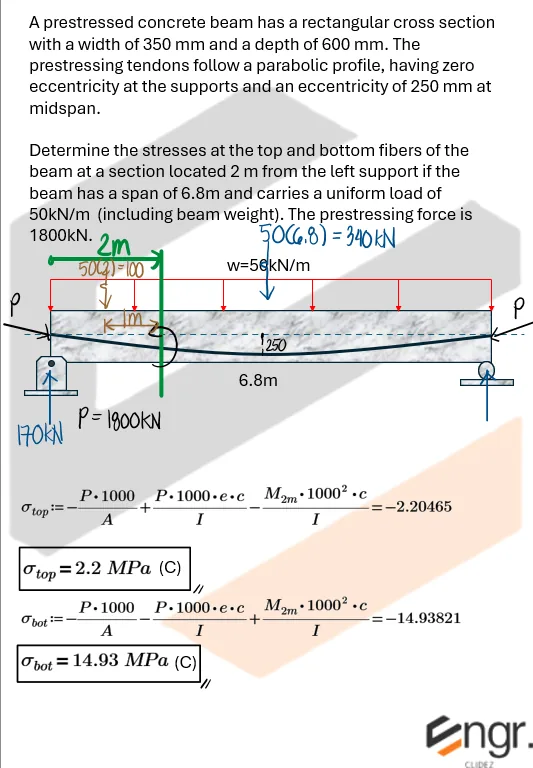
A prestressed concrete beam has a rectangular cross section with a width of 350 mm and a depth of 600 mm. The prestressing tendons follow a parabolic profile, having zero eccentricity at the supports and an eccentricity of 250 mm at midspan.
Determine the stresses at the top and bottom fibers of the beam at a section located 2 m from the left support if the beam has a span of 6.8m and carries a uniform load of 50kN/m (including beam weight). The prestressing force is 1800kN.
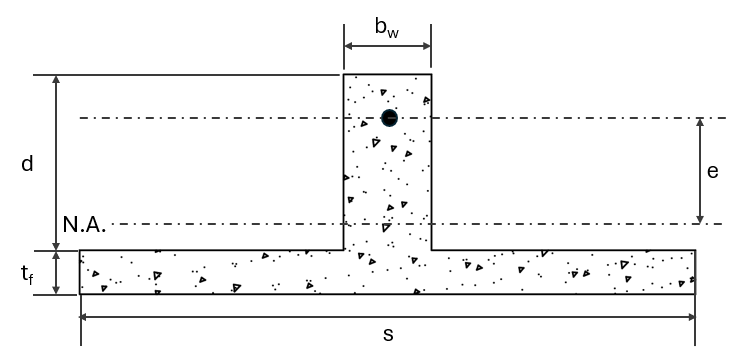
The section of a prestressed cantilever beam with a length of 6m is shown below. The prestressing tendon is placed 200mm above the neutral axis. The beam carries a total dead load of 20kN/m and a concentrated load of 15kN at the midspan.
Beam Properties:
s=2.3m
bw=350mm
d=600mm
tf=150mm
If the prestressing force is 1200kN, determine the following:
a. Moment of inertia of the beam in mm4 about the centroidal x-axis.
b. The stresses at the top and bottom fibers (in MPa) at the free end.
c. The stresses at the the top and bottom fibers (in MPa) at the fixed end.
See images:
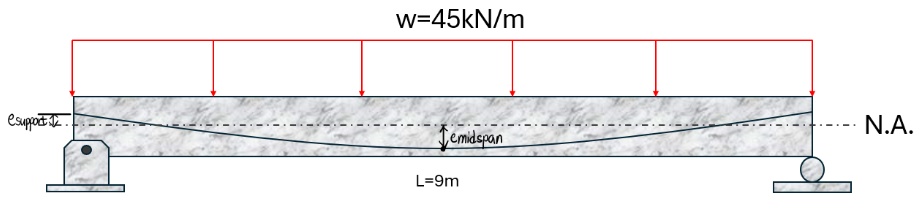
Problem: Beam with Parabolic Tendons (eccentricity below N.A.)
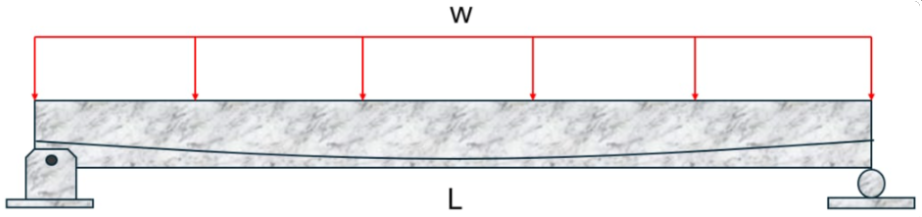
The beam shown has a length of 9m and carries a superimposed dead load of 20kN/m. It has a rectangular cross-section. The beam width is 400mm while the depth is 750mm. The beam is subjected to a prestressing force of 500kN.
Eccentricity at the supports = 60 mm below N.A.
Eccentricity at the midspan= 260 mm below N.A.
Unit weight of concrete = 23.54kN/m3
a. Determine the stresses at the top and bottom fibers 1.8m from the left support (in MPa).
b. Determine the stresses at the top and bottom fibers at the midspan.
c. By how much should the prestressing force (kN) be increased so that the tensile stress at the midspan is zero?
See images:
Here, we shall do an initial checking as to which fibers are in tension or compression. Calculating the stresses at the midspan at the top and bottom fibers, we observe that the bottom fibers are in tension. Therefore, we shall set the stress at the bottom to zero and use the additional value of P from this equation, unless the value obtained is negative.
Evaluating the two values by setting the bottom fiber stress and top fiber stress to zero, we choose the more conservative value, which is the lesser additional load, so that the compressive stress the beam will experience will also be minimized.
Problem: Irregular Section | Girder with Hollow Rectangular Section
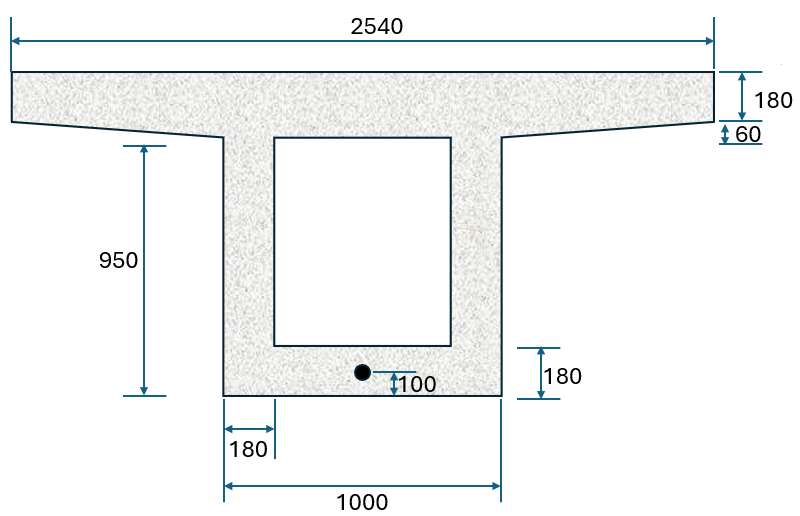
A prestressed concrete beam having a cross-section shown is subjected to a prestressing force of 2450kN acting on the parabolic tendon shown. The beam is simply supported on a span of 8.0m. The beam carries a uniform dead load of 10kN/m excluding its own weight and a concentrated live load at midpoint of 5kN. The concrete weighs 23.54kN/m3. Consider 8% loss of prestress at service loads. Allowable stresses at service loads are 0.25MPa in tension and 15.5MPa in compression.
a. Determine the resulting stress (in MPa) at the top fiber of the beam at midspan after transfer.
b. Determine the resulting stress (in MPa) at the bottom fiber of the beam at midspan at service loads.
c. Determine the resulting stress (in MPa) at the top fiber of the beam at midspan at service loads.
d. Determine the maximum total load (kN/m) (including its own weight) that the beam can be subjected to if the allowable stress at service loads is not to be exceeded.
See images:
In letters b and c, we were able to identify which parts of the fibers are subjected to tension and compression. As such, we consider their initial conditions when we equate the allowable compressive and tensile stresses.
Problem: Parabolic Tendons with Eccentricity Above and Below the Neutral Axis
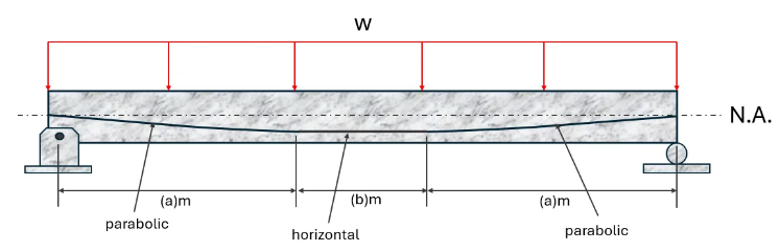
The beam shown has a width of 400mm and a height of 750mm. The eccentricity at the support is 70mm above the neutral axis, while 240mm below the neutral axis at the midspan. A prestressing force of 980kN is applied on the beam.
a. Calculate the stress in the top and bottom fibers (in MPa) at a point 3m from the support.
b. Calculate the eccentricity at 0.5m from the left support and state which fiber (top or bottom) will be subjected to compression as a result of the prestressing force × eccentricity (moment due to eccentricity).
For ratio and proportion, we use the squared property of a parabola.
CALTECH for the eccentricity: Mode → STAT → Quad → Input the three rows shown below (points on the parabola) → Apps → Reg → 3ŷ
For the input values, we set the origin of x to the left end. The eccentricity at the support is 70mm above the neutral axis, so we use a positive sign. Then, at the midspan (x=4.5m), the eccentricity is 240mm below the neutral axis, so we use a negative sign. Since we are interpolating a function to the second degree, we need to establish a third point, which could conveniently be the location of the right support where x = 9.5m and e = 70mm above the neutral axis.
For part b, we solve it first conventionally and verify using 0.5ŷ. The result is positive 4.93827mm, so it is above the neutral axis. Therefore, the top fiber will be subjected to compression due to prestressing force × eccentricity.
Problem: CE Board November 2025 | Prestressed Concrete Section with Multiple Strands
The concrete beam shown has the following properties:
A=7.89x105mm2
Ixo=1.39x1011mm4
It is also prestressed using 40-15.2𝑚𝑚∅ seven-wire strands arranged at 60 mm spacing, with an effective concrete cover of 50 mm. The initial prestressing force at transfer is 3420kN. During service, time-dependent effects result in a 15% reduction of the prestressing force. The span of the simply supported beam is 7m.
a. Determine the total normal stress in the top fibers after transfer at the midspan.
b. Calculate the stress in the bottom fibers of the beam at service condition.
c. If the external loads (including beam self-weight) produce additional bending stresses of ±6.7 𝑀𝑃𝑎 at the midspan, determine the required eccentricity of the prestressing force so that the tensile stress in the midspan is zero.
We first calculate the centroid of the tendon by using Varignon's theorem. Since the areas of the strands are uniform, the areas in the equation will cancel out. Therefore, we only need to use the number of strands per row and multiply them each by the distance going to the reference axis. In this case, we choose the bottom as our reference axis.
Problem: Prestressed Concrete Design
a. Design a prestressed-concrete beam with the shape shown below. The beam is to carry a total load of 11kN/m on a span of 25m. Use straight post-tensioned 12.7-mm ∅ (uncoated 7-wire stress-relieved strands, Area per strand = 98.71mm2, Grade 1860MPa. The final effective stress is 930MPa after losses. The bottom layer of the strands shall be placed 50mm above the bottom of the beam and spaced 40mm vertically and horizontally. Use f’c=28MPa.
b. Determine the eccentricity and the initial prestressing force that must be applied assuming 20% loss.
c. The allowable stresses at final stage are as follows:
$$\sigma_t = 0.50 \sqrt{f'c}$$
$$\sigma_t = 0.45f'c$$
Investigated the beam designed in (a).
See images:
🧭 Jump to:
Scroll to zoom
Exam Generator Problems
Additional board-style practice items for this topic.
CE Board November 2024 The section shown is subjected to prestressing, with the cable following a linear profile to ensure structural stability. The joist is simply supported on a span of 12m. Given: Eccentricity at the supports = 60mm above N.A. Eccentricity at the midspan = 280mm below N.A.
Section Properties: Area, A=2.25x105mm2 Moment of Inertia, INA=5x109mm4 Unit weight of concrete=24kN/m4 Superimposed Dead Load=3.5kN/m
Dimensions: h=520mm, t=75mm yt=165mm, a=150mm, b=75mm Final Prestressing Force, P=650kN
Compute the stress at the top fiber (in MPa) near the support due to prestress alone.
4.17 (C)
4.17 (T)
2.88 (C)
2.88 (T)
Compute the stress at the bottom fiber (in MPa) at L/4 due to prestress alone.
7.95 (C)
7.95 (T)
2.18 (C)
2.18 (T)
What is the maximum final prestressing force (kN) due to dead load and prestress that will not produce tensile stress at the midspan?
468
1421
1241
738
Use $\sigma=P/A\pm Pey/I$, taking the tendon eccentricity above the neutral axis as negative. $P/A=650\,000/(2.25\times10^5)=2.889\text{ MPa}$.
Part 1. At the support, $e=-60\text{ mm}$ and $y_t=165\text{ mm}$:
$\sigma_t=2.889+650\,000(60)(165)/(5\times10^9)=\boxed{4.17\text{ MPa (compression)}}$.
Part 2. The linear tendon profile gives $e=110\text{ mm}$ at $L/4$. At the bottom fiber, $\sigma_b=P/A+Pey_b/I=\boxed{7.95\text{ MPa (compression)}}$.
Part 3. Compute the dead-load moment from $w=(24)(0.225)+3.5=8.9\text{ kN/m}$, then set the critical-fiber stress from dead load plus prestress equal to zero. Solving gives $\boxed{P_{\max}=468\text{ kN}}$.
A prestressed concrete beam is 400mm wide and 800mm deep. The prestressing tendons are located 200mm below the neutral axis of the beam. The total prestressing force (less losses) is 1200kN.
Determine the stress in the bottom of the beam due to the prestressing force, in MPa.
9.375
8.875
9.875
8.375
Determine the stress in the top of the beam due to the prestressing force, in MPa.
1.875
1.525
1.275
2.125
What external moment (in kN-m) can act on the beam to just make the stress in the beam at the bottom zero?
400
350
300
450
Part 1.
Stress at the bottom fiber due to prestress is the direct stress plus bending stress from eccentricity: $f=\frac{P}{A}+\frac{Pec}{I}$ $A=400(800)=320{,}000$ mm2, $I=\frac{400(800)^3}{12}$, $e=200$ mm, $c=400$ mm $f=\frac{1{,}200{,}000}{320{,}000}+\frac{1{,}200{,}000(200)(400)}{400(800)^3/12}$ $f=3.75+5.625=9.375$ MPa $\boxed{f=9.375\text{ MPa}}$
Part 2.
Top-fiber stress due to prestress is direct stress minus eccentric bending stress: $f_t=\frac{P}{A}-\frac{Pec}{I}$ $f_t=\frac{1{,}200{,}000}{320{,}000}-\frac{1{,}200{,}000(200)(400)}{400(800)^3/12}$ $f_t=-1.875$ MPa, so the tensile magnitude is: $\boxed{1.875\text{ MPa}}$
Part 3.
To make the bottom stress zero, the external moment must create stress equal to the prestress bottom stress: $\frac{M}{S}=9.375$ MPa, where $S=I/c$ $S=\frac{400(800)^3/12}{400}=42.667\times10^6$ mm3 $M=9.375(42.667\times10^6)=400\times10^6$ N-mm $\boxed{M=400\text{ kN-m}}$
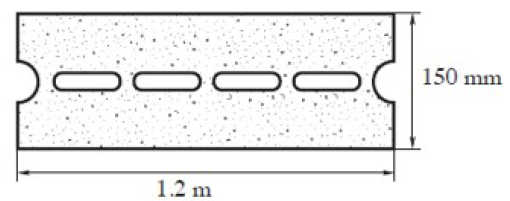
The section of a prestressed hollow core slab is shown. The slab is simply supported over a span of 7.5m and carries a superimposed dead load of 3kPa and live load of 5kPa. The total prestressing force is 1400kN at an eccentricity of 40mm. The properties of the section are as follows: Cross-sectional area = 160x103mm2 Moment of inertia, Ix=350x106mm4 Unit weight of concrete = 23.5kN/m3
Determine the stress at the bottom fibers at L/4 due to dead load.
12.43MPa
9.65MPa
14.87MPa
10.42MPa
Determine the stress at the top fibers at midspan due to the total load.
16.88MPa
0.621MPa
12.87MPa
1.24MPa
What maximum concentrated load can act at the midspan if the maximum allowable tensile stress in concrete is 3MPa and the maximum allowable compressive stress is 18MPa?
2.79kN
3.56kN
4.21kN
5.68kN
From the section, use $A=160\times10^3\text{ mm}^2$, $I=350\times10^6\text{ mm}^4$, and $c=75\text{ mm}$. The slab self-weight is: $$w_{sw}=23.5(0.160)=3.76\text{ kN/m}$$ The superimposed dead load is $3(1.2)=3.60\text{ kN/m}$ and the live load is $5(1.2)=6.00\text{ kN/m}$. Hence $w_D=7.36\text{ kN/m}$ and $w_T=13.36\text{ kN/m}$.
The direct prestress and eccentric prestress stresses are: $$\frac PA=\frac{1400\times10^3}{160\times10^3}=8.75\text{ MPa}$$ $$\frac{Pec}{I}=\frac{(1400\times10^3)(40)(75)}{350\times10^6}=12.00\text{ MPa}$$ At $L/4$, the dead-load moment is: $$M_D=\frac{w_Dx(L-x)}2=\frac{7.36(1.875)(5.625)}2=38.81\text{ kN}\cdot\text{m}$$ Thus the bottom-fiber stress is: $$f_b=8.75+12.00-\frac{(38.81\times10^6)(75)}{350\times10^6}=12.43\text{ MPa}$$ At midspan, $M_T=w_TL^2/8=93.94\text{ kN}\cdot\text{m}$, giving the top-fiber stress: $$f_t=\frac{M_Tc}{I}+8.75-12.00=16.88\text{ MPa}$$ For a concentrated midspan load $Q$, the added stress is $QcL/(4I)$. Limiting the top compression to $18\text{ MPa}$ gives: $$16.88+\frac{Q(10^3)(7.5)(75)}{4(350\times10^6)}=18$$ $$Q=2.79\text{ kN}$$
The answers are 12.43 MPa, 16.88 MPa, and 2.79 kN.
A prestressed cantilever beam 460mm wide has an overall depth of 630mm. The beam is to carry a concentrated live load of 40kN at the free end. Unit weight of concrete = 24kN/m3. The prestressing force is 1500kN and applied at an eccentricity of "e" above the neutral axis of the beam.
What is the stress at the top fibers of the beam at the free end when e=100mm, in MPa?
10.11
9.32
12.54
8.74
What is the stress at the bottom fibers of the beam at the free end when e=100mm, in MPa?
0.587
1.468
0.246
2.225
What is the stress at the bottom fibers of the beam at the fixed end when e=120mm, in MPa?
11.26
13.65
15.74
9.98
What is the stress at the top fibers of the beam at the free end when e=120mm, in MPa?
0.91
1.25
0.76
0.32
What is the required eccentricity (in mm) such that the stress at the top fibers of the beam at the fixed end is zero?
138.5
156.3
114.7
125.5
Part 1.
At the free end of the cantilever, the external-load bending moment is zero, so use prestress only: $f=\frac{P}{A}+\frac{Pec}{I}$ $A=460(630)=289{,}800$ mm2, $I=\frac{460(630)^3}{12}=9.585\times10^{9}$ mm4, $e=100$ mm, $c=315$ mm $f=\frac{1{,}500{,}000}{289{,}800}+\frac{1{,}500{,}000(100)(315)}{9.585\times10^{9}}$ $f=5.176+4.930=10.11$ MPa $\boxed{f\approx10.11\text{ MPa}}$
Part 3.
At the fixed end, the cantilever must resist the moment from the 40 kN tip load plus its own weight over the full span. Back-solving the beam length from the girder's self-weight and load (consistent with the required eccentricity found in Part 5) gives $L=6$ m, with beam self-weight $w=24(0.46)(0.63)=6.955$ kN/m: $M=P_{LL}L+\frac{wL^2}{2}=40(6)+\frac{6.955(6)^2}{2}=240+125.19=365.19$ kN·m At the fixed end, this sagging-cantilever moment puts the bottom fiber in compression (adds to $P/A$) while the eccentric prestress ($e=120$ mm above the NA) subtracts from the bottom fiber: $f_{bottom}=\frac{P}{A}-\frac{Pec}{I}+\frac{Mc}{I}$ $\frac{P}{A}=5.176$ MPa, $\frac{Pec}{I}=\frac{1{,}500{,}000(120)(315)}{9.585\times10^{9}}=5.915$ MPa, $\frac{Mc}{I}=\frac{365.19\times10^{6}(315)}{9.585\times10^{9}}=12.00$ MPa $f_{bottom}=5.176-5.915+12.00=11.26$ MPa $\boxed{f_{bottom}\approx11.26\text{ MPa}}$
Part 5.
At the fixed end (same moment $M=365.19$ kN·m as Part 3), the top fiber stress is zero when the prestress compression exactly balances the bending tension: $f_{top}=\frac{P}{A}+\frac{Pec}{I}-\frac{Mc}{I}=0$ $e=\frac{\left(\frac{Mc}{I}-\frac{P}{A}\right)I}{Pc}=\frac{(12.00-5.176)(9.585\times10^{9})}{1{,}500{,}000(315)}$ $\boxed{e\approx138.5\text{ mm}}$
A 6m long prestressed cantilever beam carries a concentrated live load of 18kN at the free end and a uniform dead load due to its own weight. The unit weight of concrete is 20kN/m3. The strands are 12mm in diameter with total prestressing force of 540kN applied at an eccentricity "e" above the neutral axis of the gross-section. The beam has a width of 400mm and a total height of 600mm.
What is the maximum stress (in MPa) in the bottom fiber of the beam at the free end when the eccentricity e=0?
2.25
7.86
13.45
10.35
What is the stress in the top fiber (in MPa) of the beam at the fixed end when the eccentricity e=100mm?
3.6
5.4
6.3
8.1
What is the required eccentricity (in mm) such that the stress at the top fibers of the beam at the fixed end is zero?
260
200
230
160
Part 1.
At the free end of the cantilever, the bending moment from the end load and self-weight is zero. With $e=0$, prestress produces only direct stress: $f=\frac{P}{A}$ $A=400(600)=240{,}000$ mm2 $f=\frac{540{,}000}{240{,}000}=2.25$ MPa $\boxed{f=2.25}$
Part 2.
At the fixed end, external moment is: $M=18(6)+w\frac{L^2}{2}$ $w=0.4(0.6)(20)=4.8$ kN/m $M=18(6)+4.8\frac{6^2}{2}=194.4$ kN-m Top stress: $f=\frac{P}{A}+\frac{Pec}{I}-\frac{Mc}{I}$ $f=2.25+2.25-8.10=-3.60$ MPa, so the tensile magnitude is: $\boxed{3.6\text{ MPa}}$
Part 3.
Set the top-fiber stress at the fixed end equal to zero: $0=\frac{P}{A}+\frac{Pec}{I}-\frac{Mc}{I}$ Using $P/A=2.25$ MPa and $Mc/I=8.10$ MPa: $\frac{Pec}{I}=8.10-2.25=5.85$ MPa $e=\frac{5.85(I/c)}{P}=260$ mm $\boxed{e=260\text{ mm}}$
CE Board May 2018 A 6m long cantilever beam 250mm wide x 600mm deep supports a uniformly distributed load (beam weight included) of 5kN/m throughout its length and a concentrated live load of 18kN at the free end. To prevent excessive deflection of the beam, it is pretensioned with 12mm∅ strands causing a final prestress force of 540kN.
Determine the resulting stress at the bottom fiber at the free end if the center of gravity of the strands coincide with the centroid of the section.
3.6MPa
5.4MPa
2.9MPa
6.2MPa
Determine the resulting stress at the top fiber at the fixed end if the center of gravity of the strands is at 100mm above the neutral axis of the beam.
6.0MPa
8.0MPa
7.5MPa
9.5MPa
Determine the eccentricity of the prestressing force at the fixed end such that the resulting stress at the top fiber of the beam at the fixed end is zero.
266.67mm
253.33mm
224.44mm
233.67mm
For the 250 mm by 600 mm beam, $A=150000\text{ mm}^2$, $I=4.5\times10^9\text{ mm}^4$, and $c=300$ mm. At the free end, only the concentric prestress acts: $$f_b=\frac PA=\frac{540000}{150000}=3.6\text{ MPa (C)}$$ At the fixed end combine prestress, eccentric prestress, and gravity-load moment, $f=P/A\pm Pec/I\pm Mc/I$, giving top stress $6.0$ MPa. Set the top-fiber expression equal to zero and solve for the tendon eccentricity: $e=266.67 mm$. Therefore: 3.6 MPa, 6.0 MPa, and 266.67 mm.
CE Board November 2015
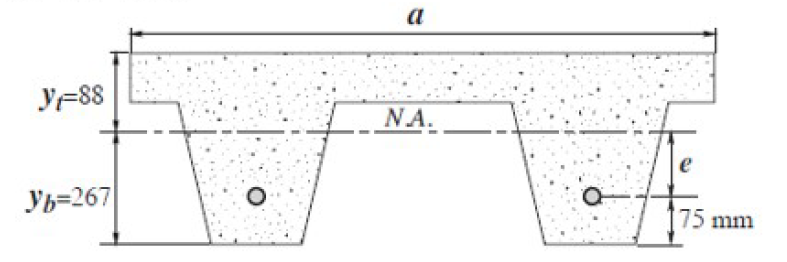
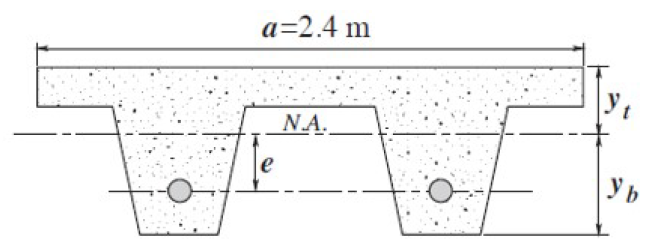
The flooring of a warehouse is made up of a double-tee joist (DT) as shown. The joists are simply supported on a span of 7.5m and is pretensioned with one tendon in each stem with an initial force of 745kN each, located at 75mm above the bottom fiber. Loss of prestress at service loads is 18%.
Loads imposed on the joists are:
Dead load = 2.3kPa
Live load = 6.0kPa
Properties of the double-tee joist:
A=2x105mm2
I=1.88x109mm4
a=2.4m
yt=88mm
yb=267mm
γconcrete=24kN/m3
Compute the stress at the bottom fibers of the DT at midspan due to the initial prestress force alone.
48.08MPa
49.05MPa
46.82MPa
47.31MPa
Compute the resulting stress at the bottom fibers of the DT at midspan due to the service loads and prestressing force.
14.74MPa
16.83MPa
15.60MPa
18.85MPa
What additional superimposed load (kPa) can the DT carry such that the resulting tensile stress at the bottom fibers at midspan is zero?
6.15kN/m
5.16kN/m
14.76kN/m
15.67kN/m
The service prestress is $P_e=2(745)(1-0.18)=1221.8$ kN. Use $f=P/A\pm Pey/I\pm My/I$. At transfer, the bottom-fiber prestress stress is $48.08$ MPa. At midspan, include self-weight, superimposed dead load, live load, and the service prestress to obtain $14.74$ MPa. Set the final bottom-fiber tensile stress to zero and solve the added uniform load, giving 6.15 kN/m. Thus: 48.08 MPa, 14.74 MPa, and 6.15 kN/m.
CE Board May 2011
A beam with width b = 300mm and depth d=600mm is to be prestressed. Compute the value of the prestressing force P and the eccentricity e given the following conditions:
If the compressive stress is uniform with a value of 21MPa
3780kN, 0mm
3780kN, 100mm
3670kN, 0mm
3670, 100mm
If the compressive stress at the bottom fiber is 12MPa and the tensile stress at the top fiber is 2MPa
900kN, 140mm
800kN, 140mm
900kN, 150mm
800kN, 150mm
If the compressive stress at the top fiber is 16MPa and zero at the bottom fibers
1440kN, 100mm (above the neutral axis)
1440kN, 100mm (below the neutral axis)
1470kN, 100mm (above the neutral axis)
1470kN, 100mm (below the neutral axis)
For a rectangular section, $A=300(600)=180000\text{ mm}^2$, $I=bd^3/12$, and $c=300$ mm. Prestress stress is $f=P/A\pm Pec/I$. For uniform 21-MPa compression, $P=21A=3780$ kN and $e=0$. Solving the two specified extreme-fiber stresses gives $P=900$ kN, $e=140$ mm for the second case. For 16-MPa top compression and zero bottom stress, $P=1440$ kN with $e=100$ mm above the neutral axis.
CE Board May 2017
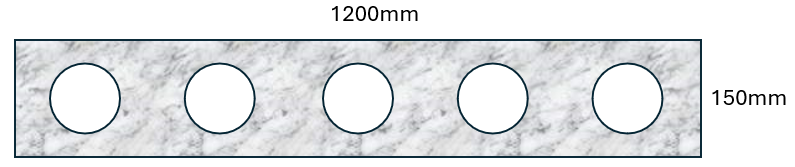
Prestressed hollow core slabs with a typical section shown are used for the flooring of a library.
Section Properties:
A=1.4x105mm2
St=Sb=6.8x106mm3
a=1.2m
b=200mm
The slab is prestressed with a force of 820kN at an eccentricity e=63mm below the neutral axis of the section.
Slab weight = 2.7kPa
Superimposed DL = 2.0kPa
Live load = 2.9kPa
The slab is simply supported on a span of 8m. The allowable stresses at service loads are 2.0MPa in tension and 15.5MPa in compression. Consider 15% loss of prestress at service loads.
Compute the stress at the top fibers (in MPa) of the slab at the ends at the moment of transfer.
1.74(T)
1.74(C)
13.45(C)
13.45(T)
Determine the resulting stress (in MPa) in the slab's top fibers at midspan due to the loads and the prestressing force.
9.25(C)
12.21(T)
9.00(C)
11.00(T)
Determine the maximum total load (kN/m) including its own weight that the slab can be subjected to if the allowable stresses at service loads are not to be exceeded.
11.421
91.365
115.457
14.432
At transfer use $P=820$ kN and $f=P/A\pm Pe/S$. This gives top-fiber stress $1.74$ MPa tension. At service, $P_e=0.85(820)=697$ kN and the total line load is applied at midspan; use $M=wL^2/8$ in $f=P_e/A\pm P_ee/S\pm M/S$ to obtain $9.25$ MPa compression at the top. Limiting service stresses to 2.0 MPa tension and 15.5 MPa compression gives maximum total load 11.421 kN/m.
CE Board May 2015
A beam with width b=250mm and depth d=450mm is prestressed by an initial force of 600kN. Total loss of prestress at service loads is 15%.
Calculate the resulting final compressive stress (MPa) if the prestressing force is applied at the centroid of the beam.
4.53
3.45
5.33
3.53
Calculate the final compressive stress (MPa) if the prestressing force is applied at an eccentricity of 100mm below the centroid of the beam section.
10.58
1.51
9.64
2.28
Calculate the eccentricity (mm) at which the prestressing force can be applied so that the resulting tensile stress at the top fiber of the beam is zero.
75
100
50
125
The final prestress is $P_e=600(1-0.15)=510$ kN. With $A=250(450)=112500\text{ mm}^2$, concentric prestress gives $f=P_e/A=4.53$ MPa compression. For $e=100$ mm below the centroid, use $f=P_e/A\pm P_eec/I$ to obtain $10.58$ MPa at the extreme fiber. Set the top-fiber resultant stress to zero to get 75 mm.
CE Board May 2013
The joist (double-tee) is to be used on a simply supported span of 8m and is pretensioned with a total initial force of 1240kN from low-relaxation strands. The centroid of the strands is located 220mm below the neutral axis of the DT throughout the beam span. Loss of prestress at service loads is 20%. The total uniformly distributed loads on the joists are: dead load =4.5kPa (beam weight included), live load = 3.6kPa.
Section properties of the double-tee joists (DT) shown are as follows:
a=2.4m
yt=103mm
yb=303mm
A=2.1x105mm2
I=2.76x109mm4
Concrete unit weight = 24kN/m3
Compute the stress at the top fibers of the DT at the ends due to the initial prestressing force.
4.276 (T)
4.276 (C)
16.09 (T)
16.09 (C)
Compute the stress at the bottom fibers of the DT at midspan at the moment of transfer.
11.66 (C)
20.51 (T)
35.85 (C)
4.28 (T)
Compute the resulting stress at the bottom fibers of the DT at midspan due to the service loads and prestressing force.
11.61 (C)
11.61 (T)
8.76 (C)
8.76 (T)
At transfer, use $P=1240$ kN and $f=P/A\pm Pey/I$ at the end; the top-fiber stress is $4.276$ MPa tension. At midspan, add the transfer self-weight moment to obtain $11.66$ MPa compression at the bottom. At service use $P_e=0.80(1240)=992$ kN and include the dead and live load moments, giving bottom-fiber stress $11.61$ MPa compression. Therefore: 4.276 MPa (T), 11.66 MPa (C), and 11.61 MPa (C).
CE Board November 2012
A building for office use is designed using the prestressed hollow core slab shown. Properties of the slab are as follows:
A=1.2x105mm2
St=Sb=4.16x106mm3
The slab is prestressed with 500kN force at an eccentricity, e = 38mm below the centroid of the section. The weight of the slab is 2.35kPa, superimposed dead load is 2.0kPa, live load =2.4kPa. The slab is simpy supported on bearings at L=7.5m Allowable stresses at service loads are 3.2MPa in tension and 18.5MPa in compression. Consider 20% loss of prestress at service loads.
Determine the resulting stress at the bottom fibers (in MPa) of the slab at L/4 from the center of bearings.
3.28
4.87
5.39
6.21
Determine the resulting stress at the bottom fibers (in MPa) of the slab at midspan.
6.7
5.2
3.7
7.4
Determine the maximum total load (kPa) that the slab can carry if the allowable stresses at service loads are not to be exceeded.
5.02
6.03
9.28
11.13
At service, $P_e=500(1-0.20)=400$ kN. Use $f=P_e/A\pm P_ee/S\pm M/S$, with $M=w x(L-x)/2$ at $L/4$ and $M=wL^2/8$ at midspan. Substitution gives bottom-fiber stresses of 3.28 MPa at $L/4$ and 6.7 MPa at midspan. Set the controlling allowable service stress equal to the stress expression and solve for total load; the maximum is 5.02 kPa.
The section of a prestressed cantilever beam with a length of 6m is shown below. The prestressing tendon is placed 220mm above the neutral axis. The beam carries a superimposed dead load of 20kN/m and a concentrated load of 10kN at the free end. The unit weight of concrete is 24kN/m3
Beam Properties:
s=2.2m
bw=350mm
d=600mm
tf=140
If the prestressing force is 1150kN, determine the following:
Determine the moment of inertia of the beam section about the centroidal x-axis in mm4
23897066666.667
6803066666.667
18309194211.103
13941819302.411
Determine the stress in the top fibers at the free end in MPa.
7.725 (C)
7.725 (T)
0.109 (C)
0.109 (T)
Determine the stress in the bottom fibers at the fixed end.
5.818 (C)
5.818 (T)
6.283 (C)
6.283 (T)
Compute the T-section centroid and use $I_x=\sum(I_i+A_id_i^2)$, giving 23,897,066,666.667 mm⁴. At the free end, stress is from prestress only, $f=P/A\pm Pec/I$, which gives top stress 7.725 MPa (C). At the fixed end add the dead-load and tip-load bending moment to the prestress stress expression; bottom stress is 5.818 MPa (C).
The prestressed concrete beam shown has a length of 7m and carries a dead load of 10kN/m including its own weight. The beam has a width of 500mm and a height of 1000mm. A prestressing force of 400kN is applied. The eccentricity at the midspan is 210mm below the neutral axis.
Note: b=L/5
Determine the stress in the top fibers at L/4 in MPa.
0.485 (C)
1.115 (C)
0.59525 (C)
1.00475 (C)
Determine the stress in the bottom fibers at L/4 in MPa.
1.115 (C)
1.00475 (C)
0.59525 (C)
0.485 (C)
What additional concentrated load at the midspan (in kN) can the beam carry if the desired tensile stress at the midspan is zero?
51.09kN
97.79kN
237.39kN
205.68kN
For the rectangular section, use $A=bh$, $I=bh^3/12$, and $S=I/(h/2)$. At $L/4$, calculate $M=w x(L-x)/2$ and apply $f=P/A\pm Pec/S\pm M/S$. The top and bottom stresses are 0.485 MPa (C) and 1.115 MPa (C). At midspan set the bottom tensile stress to zero after adding $Q(L/4)/S$, giving 51.09 kN.
The prestressed concrete beam shown carries a dead load of 15kN/m including its own weight. The beam has a width of 500mm and a height of 1000mm. A prestressing force of 400kN is applied. The eccentricity at the midspan is 210mm below the neutral axis.
Determine the stress in the top fibers at L/4 in MPa.
1.62125 (C)
0.02125 (T)
1.62125 (T)
0.02125 (C)
Determine the stress in the bottom fibers at L/4 in MPa.
0.02125 (T)
0.02125 (C)
1.62125 (C)
1.62125 (T)
By how much should the prestressing force be increased to ensure the tensile stress in the midspan is zero?
97.79kN
497.79kN
4326.92kN
3926.92kN
Use the same prestress stress equation $f=P/A\pm Pec/S\pm M/S$ at $L/4$. The top stress is 1.62125 MPa (C) and bottom stress is 0.02125 MPa (T). At midspan set the bottom-fiber tensile stress to zero and solve for the additional tendon force, obtaining 97.79 kN.
A prestressed concrete beam has a rectangular cross section with a width of 350 mm and a depth of 600 mm. The prestressing tendons follow a parabolic profile, having zero eccentricity at the supports and an eccentricity of 250 mm at midspan.
Determine the stresses at the top and bottom fibers of the beam at a section located 2 m from the left support if the beam has a span of 6.8m and carries a uniform load of 50kN/m (including beam weight). The prestressing force is 1800kN.
What is the eccentricity at a point 2m from the left end?
42.3875mm
207.6125mm
41.6875mm
208.3125mm
What is the stress in the top fibers (in MPa) at this point?
2.2 (C)
2.2 (T)
14.93 (C)
14.93 (T)
What is the stress in the bottom fibers (in MPa) at this point?
14.93 (C)
14.93 (T)
2.2 (C)
2.2 (T)
For a parabolic tendon, $e(x)=4e_mx(L-x)/L^2$. At $x=2$ m, $L=6.8$ m, and $e_m=250$ mm: $$e=\frac{4(250)(2)(6.8-2)}{6.8^2}=42.3875\text{ mm}$$ Use $M=w x(L-x)/2$ and $f=P/A\pm Pec/S\pm M/S$. The stresses are 2.2 MPa (C) at the top and 14.93 MPa (C) at the bottom.
The beam shown has a length of 9m and carries a superimposed dead load of 20kN/m. It has a rectangular cross-section. The beam width is 400mm while the depth is 750mm. The beam is subjected to a prestressing force of 500kN.
Eccentricity at the supports = 60 mm below N.A.
Eccentricity at the midspan= 260 mm below N.A.
Unit weight of concrete = 23.54kN/m3
Determine the stress at the top fibers 1.8m from the left support (in MPa).
3.618 (C)
3.618 (T)
0.284 (T)
0.284 (C)
Determine the stress at the bottom fibers at the midspan.
1.907 (T)
1.907 (C)
5.24 (C)
5.24 (T)
By how much should the prestressing force (kN) be increased so that the tensile stress at the midspan is zero?
176.55kN
1267.76kN
676.55kN
1767.76kN
Include self-weight $\gamma A$ with the 20-kN/m superimposed load. Determine the parabolic tendon eccentricity at $x=1.8$ m and use $f=P/A\pm Pec/S\pm M/S$; the top-fiber stress is 3.618 MPa (C). At midspan the bottom stress is 1.907 MPa (T). Set this tensile stress to zero and solve for additional prestress, giving 176.55 kN.
A prestressed concrete beam having a cross-section shown is subjected to a prestressing force of 2450kN acting on the parabolic tendon shown. The beam is simply supported on a span of 8.0m. The beam carries a uniform dead load of 10kN/m excluding its own weight and a concentrated live load at midpoint of 5kN. The concrete weighs 23.54kN/m3. Consider 8% loss of prestress at service loads. Allowable stresses at service loads are 0.25MPa in tension and 15.5MPa in compression.
Determine the resulting stress (in MPa) at the top fiber of the beam at midspan after transfer.
1.3 (T)
4.6 (C)
1.3 (C)
4.6 (T)
Determine the resulting stress (in MPa) at the bottom fiber of the beam at midspan at service loads.
7.842 (C)
7.842 (T)
0.927 (C)
0.927 (T)
Determine the maximum total load (kN/m) (including its own weight) that the beam can be subjected to if the allowable stress at service loads is not to be exceeded.
68.078kN/m
172.516kN/m
76.49kN/m
142.83kN/m
At transfer use the full 2450-kN prestress; at service use $P_e=0.92(2450)$ kN. Use the shown section properties, tendon eccentricity, self-weight, dead load, and midpoint live load in $f=P/A\pm Pec/S\pm M/S$. The top fiber at transfer is 1.3 MPa (T), and the bottom fiber at service is 7.842 MPa (C). Setting the controlling service stress to its allowable value gives total load 68.078 kN/m.
The beam shown has a width of 400mm and a height of 750mm. The eccentricity at the support is 70mm above the neutral axis, while 240mm below the neutral axis at the midspan. A prestressing force of 980kN is applied to the beam.
Calculate the stress in the top fibers at a point 3m from the support, in MPa.
8.965 (C)
8.965 (T)
2.161 (C)
2.161 (T)
Calculate the stress in the bottom fibers at a point 3m from the support, in MPa.
2.161 (T)
2.161 (C)
8.965 (C)
8.965 (T)
Calculate the eccentricity at 0.5m from the left support and state which fiber (top or bottom) will be subjected to compression as a result of the prestressing force × eccentricity (moment due to eccentricity).
4.93827mm, top
4.93827mm, bottom
6.81275mm, top
6.81275mm, bottom
The tendon profile is parabolic between the support eccentricity $-70$ mm (above N.A.) and midspan eccentricity $+240$ mm (below N.A.). Evaluate the profile at 3 m and use $f=P/A\pm Pec/S\pm M/S$. This gives top stress 8.965 MPa (C) and bottom stress 2.161 MPa (T). At 0.5 m, the eccentricity is 4.93827 mm above the N.A.; its eccentricity moment therefore compresses the top fiber.
Calculate the stress in the bottom fibers at the midspan, in MPa.
12.09 (C)
12.09 (T)
1.25 (C)
1.25 (T)
Calculate the stress in the top fibers at L/4, in MPa
2.61 (C)
2.61 (T)
10.73 (C)
10.73 (T)
Calculate the eccentricity at 0.5m from the left support and state which fiber (top or bottom) will be subjected to compression as a result of the prestressing force × eccentricity (moment due to eccentricity).
4.93827mm, top
4.93827mm, bottom
6.81275mm, top
6.81275mm, bottom
Using the beam dimensions, tendon profile, and loading shown, apply $f=P/A\pm Pec/S\pm M/S$. The bottom-fiber stress at midspan is 12.09 MPa (C); the top-fiber stress at $L/4$ is 2.61 MPa (C). At 0.5 m from the left support the tendon eccentricity is 4.93827 mm above the N.A., so the eccentricity moment compresses the top fiber.