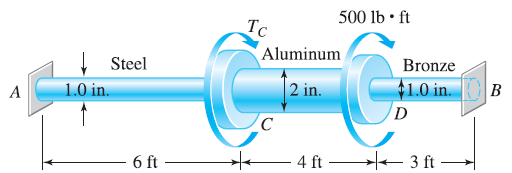
Both applied torques act in the same rotational sense. Since the shaft is fixed at A and B, it is statically indeterminate to the first degree. Release the support at B and take its reaction torque $R_B$ as the redundant.
The shaft data in consistent inch-pound units are
$$L_s=6(12)=72\ \text{in.},\quad L_{Al}=4(12)=48\ \text{in.},\quad L_b=3(12)=36\ \text{in.},$$ $$G_s=12\times10^6\ \text{psi},\quad G_{Al}=4\times10^6\ \text{psi},\quad G_b=6\times10^6\ \text{psi}.$$
For a solid circular shaft,
$$J=\frac{\pi d^4}{32}.$$
Thus,
$$J_s=J_b=\frac{\pi(1)^4}{32}=0.098175\ \text{in.}^4,$$ $$J_{Al}=\frac{\pi(2)^4}{32}=1.570796\ \text{in.}^4.$$
Rotation with support B released. The two applied torques produce internal torques of 750 lb-ft in segment AC, 500 lb-ft in segment CD, and zero in segment DB. Hence,
$$\theta_{B,L}=\frac{(750)(12)(72)}{J_sG_s}+\frac{(500)(12)(48)}{J_{Al}G_{Al}}.$$
The redundant torque $R_B$, acting opposite the applied torques, produces
$$\theta_{B,R}=-(R_B)(12)\left(\frac{72}{J_sG_s}+\frac{48}{J_{Al}G_{Al}}+\frac{36}{J_bG_b}\right).$$
Because support B is fixed, its total rotation must be zero:
$$\theta_{B,L}+\theta_{B,R}=0.$$
Canceling the common factor of 12 and substituting the shaft properties,
$$R_B=\frac{750\left(\frac{72}{J_sG_s}\right)+500\left(\frac{48}{J_{Al}G_{Al}}\right)}{\frac{72}{J_sG_s}+\frac{48}{J_{Al}G_{Al}}+\frac{36}{J_bG_b}},$$ $$R_B=382.353\ \text{lb-ft}.$$
Overall torque equilibrium gives the reaction magnitude at A:
$$R_A+R_B=250+500,$$ $$R_A=750-382.353=367.647\ \text{lb-ft}.$$
The final internal torque magnitudes are therefore
$$T_s=R_A=367.647\ \text{lb-ft},$$ $$T_{Al}=|R_A-250|=117.647\ \text{lb-ft},$$ $$T_b=R_B=382.353\ \text{lb-ft}.$$
Maximum shear stresses. For a solid circular shaft,
$$\tau_{\max}=\frac{Tc}{J}=\frac{16T}{\pi d^3},$$
where torque is converted to lb-in.
For the 1-in-diameter steel segment,
$$\tau_s=\frac{16(367.647)(12)}{\pi(1)^3}=22{,}469\ \text{psi}\approx22{,}500\ \text{psi}.$$
For the 1-in-diameter bronze segment,
$$\tau_b=\frac{16(382.353)(12)}{\pi(1)^3}=23{,}368\ \text{psi}\approx23{,}400\ \text{psi}.$$
For the 2-in-diameter aluminum segment,
$$\tau_{Al}=\frac{16(117.647)(12)}{\pi(2)^3}=898.8\ \text{psi}\approx898\ \text{psi}.$$
Therefore, using the answer-bank rounding,
$$\boxed{\tau_s\approx22{,}500\ \text{psi}}$$ $$\boxed{\tau_b\approx23{,}400\ \text{psi}}$$ $$\boxed{\tau_{Al}\approx898\ \text{psi}}$$