
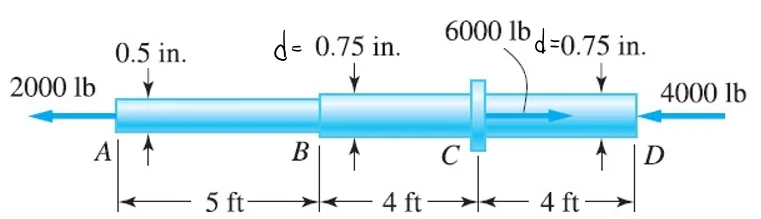
The steel propeller shaft ABCD carries the axial loads shown. Determine the change in length of the shaft caused by these loads.


See images:
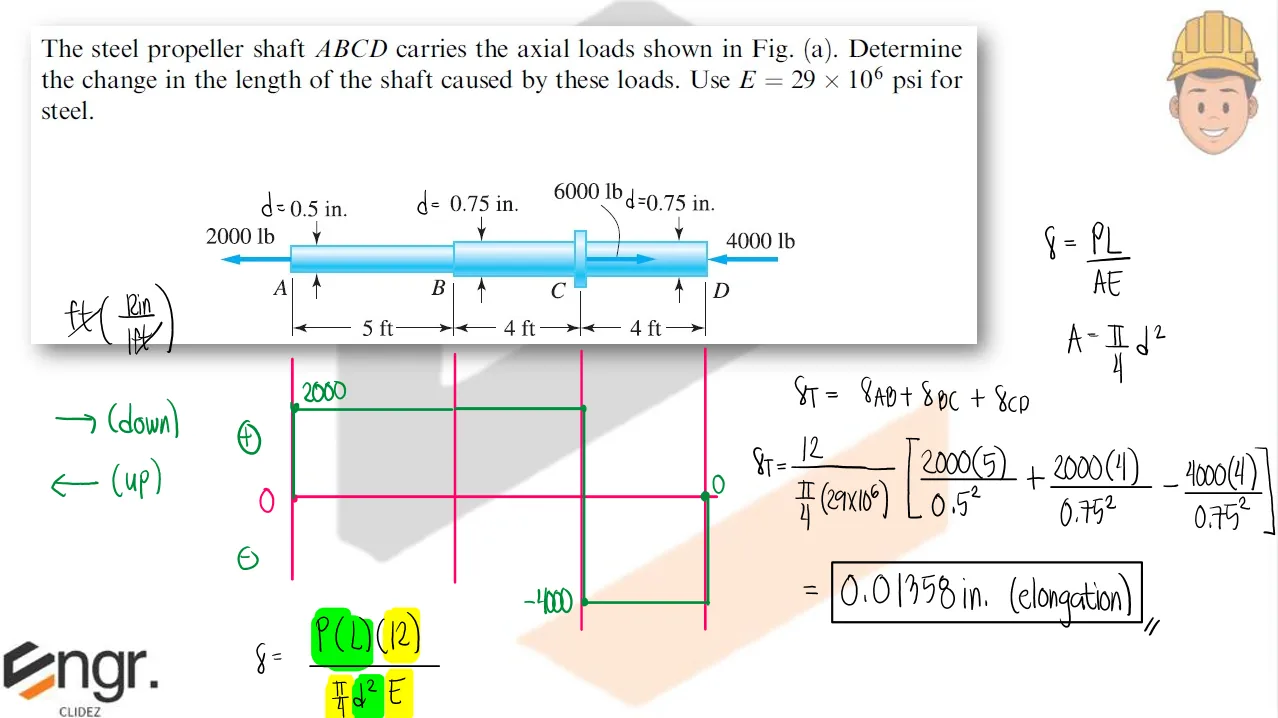


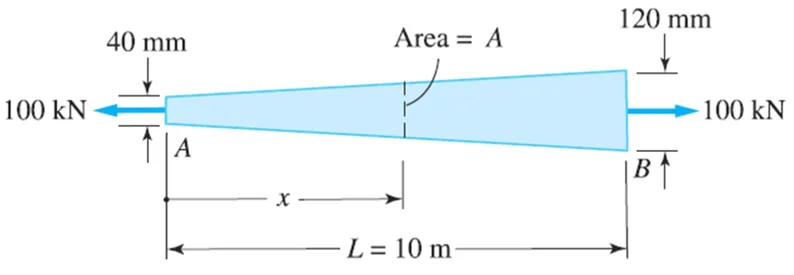
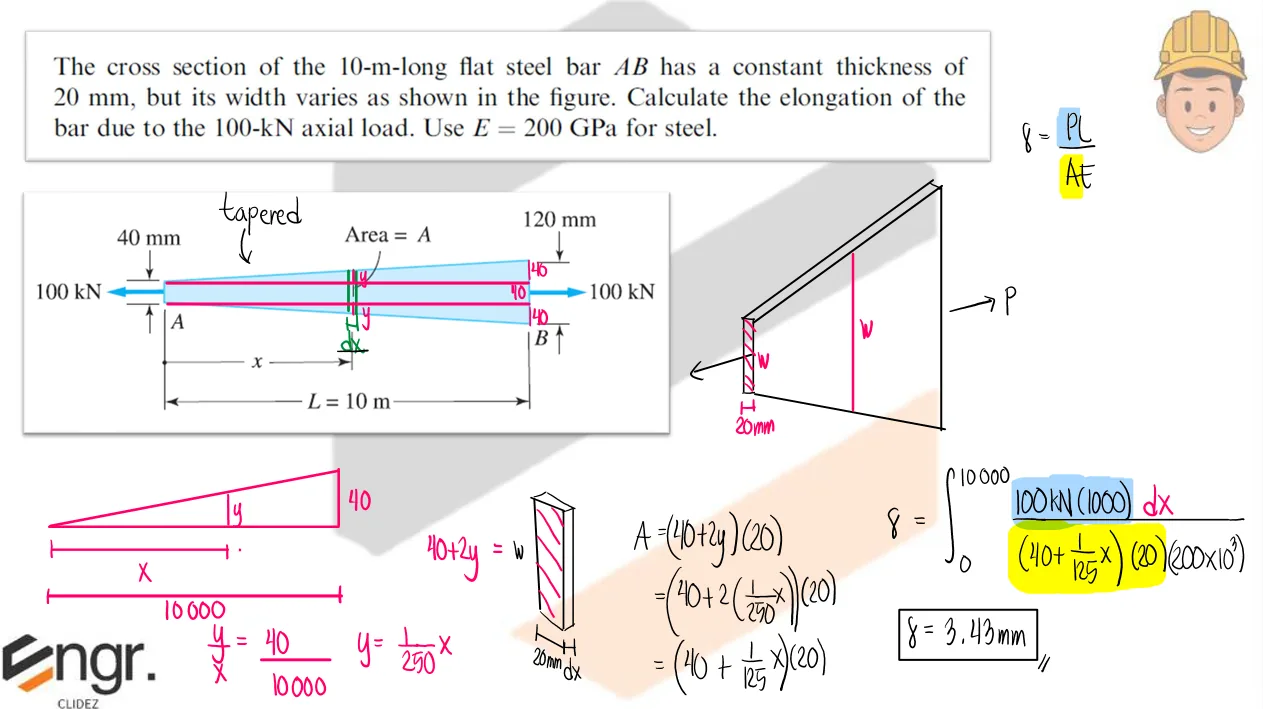
The cross section of the 10-m-long flat steel bar AB has a constant thickness of 20mm, but its width varies as shown in the figure. Calculate the elongation of the bar due to the 100-kN axial load. Use E=200GPa for steel.


See images:


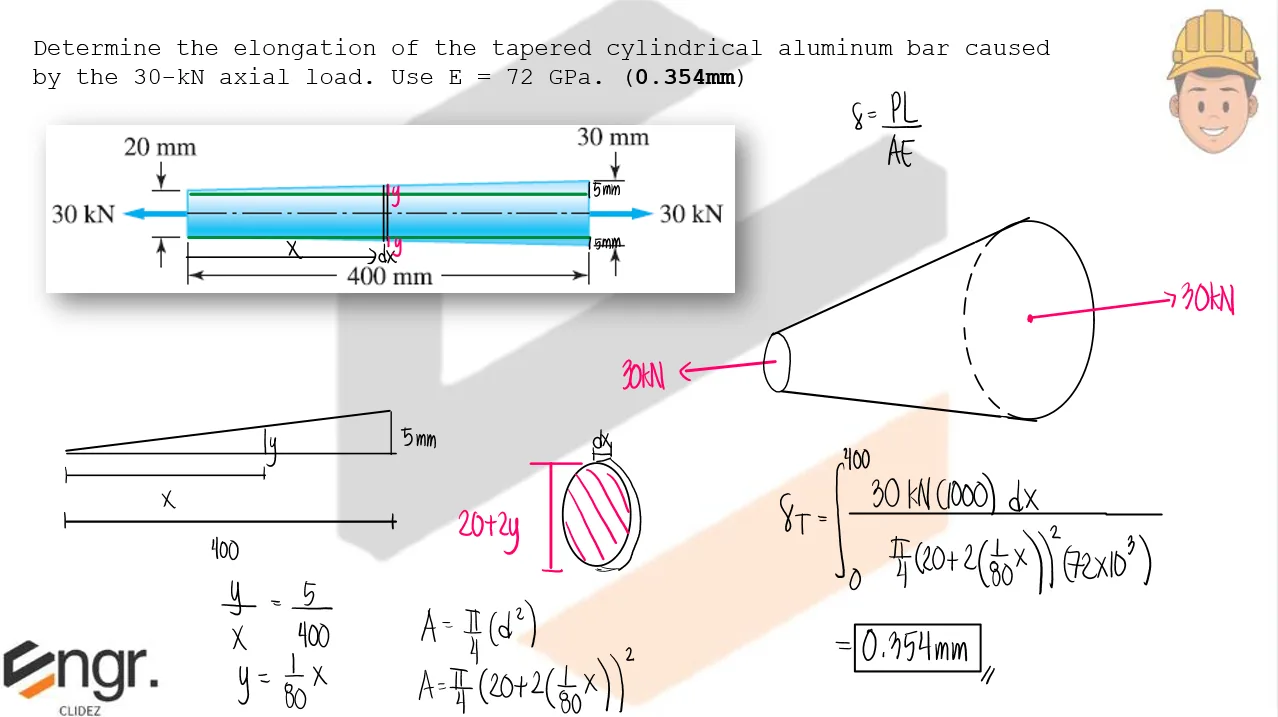
Determine the elongation of the tapered cylindrical aluminum bar caused by the 30-kN axial load. Use E = 72GPa.
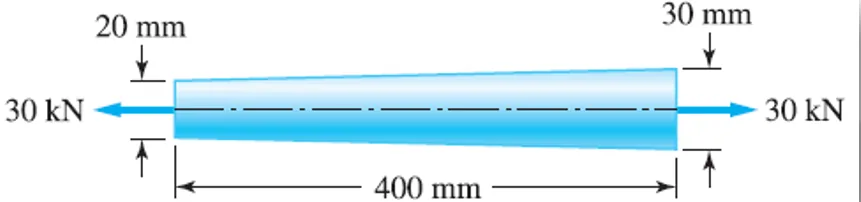


See images:


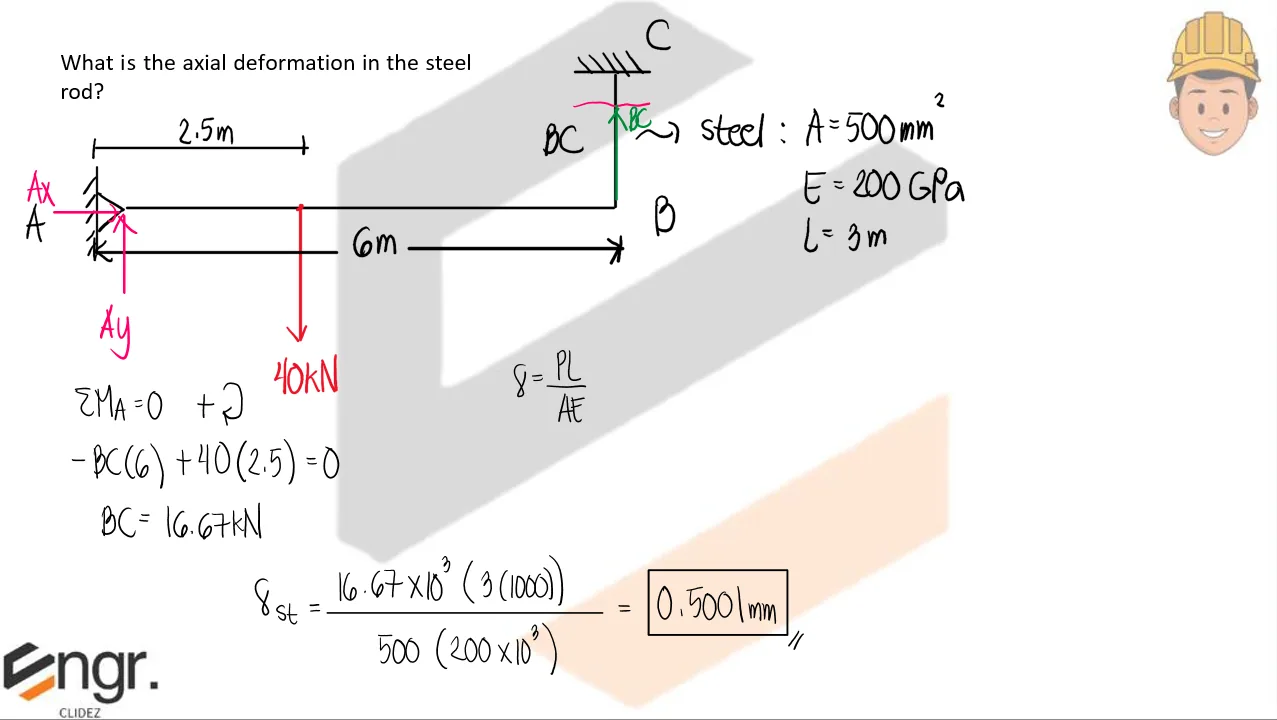
Determine the axial deformation in the steel rod.
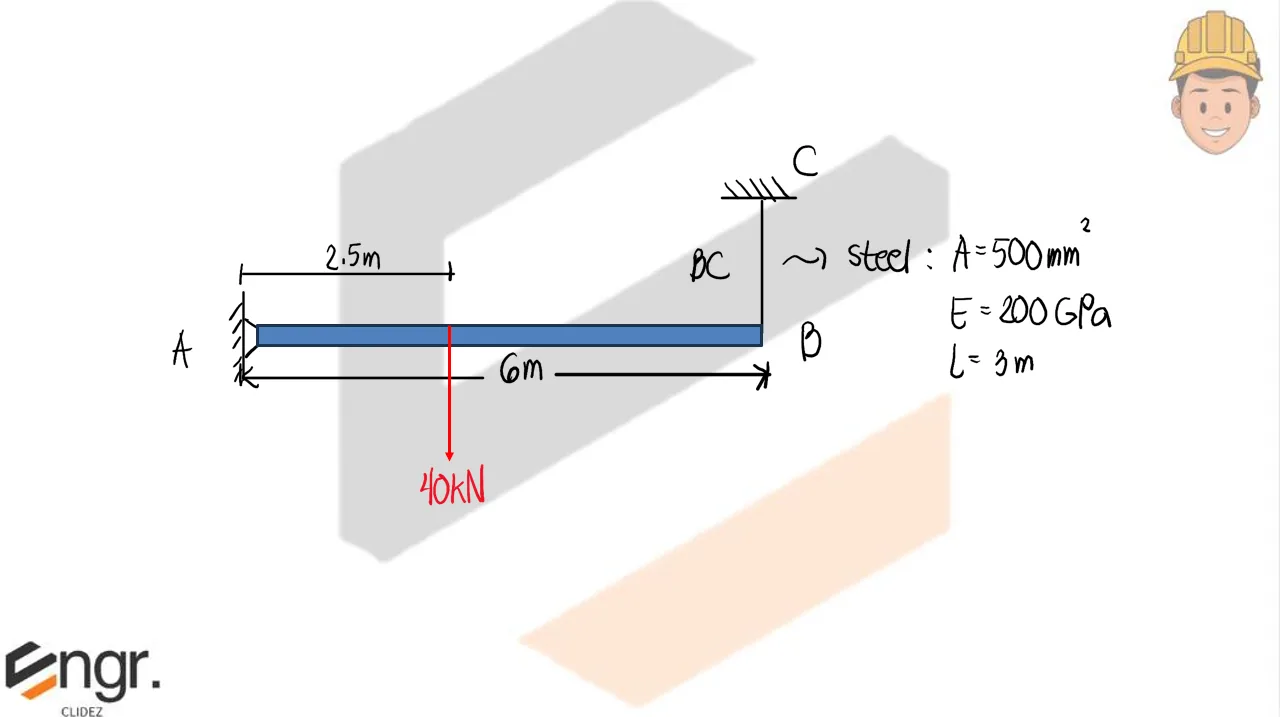


See images:


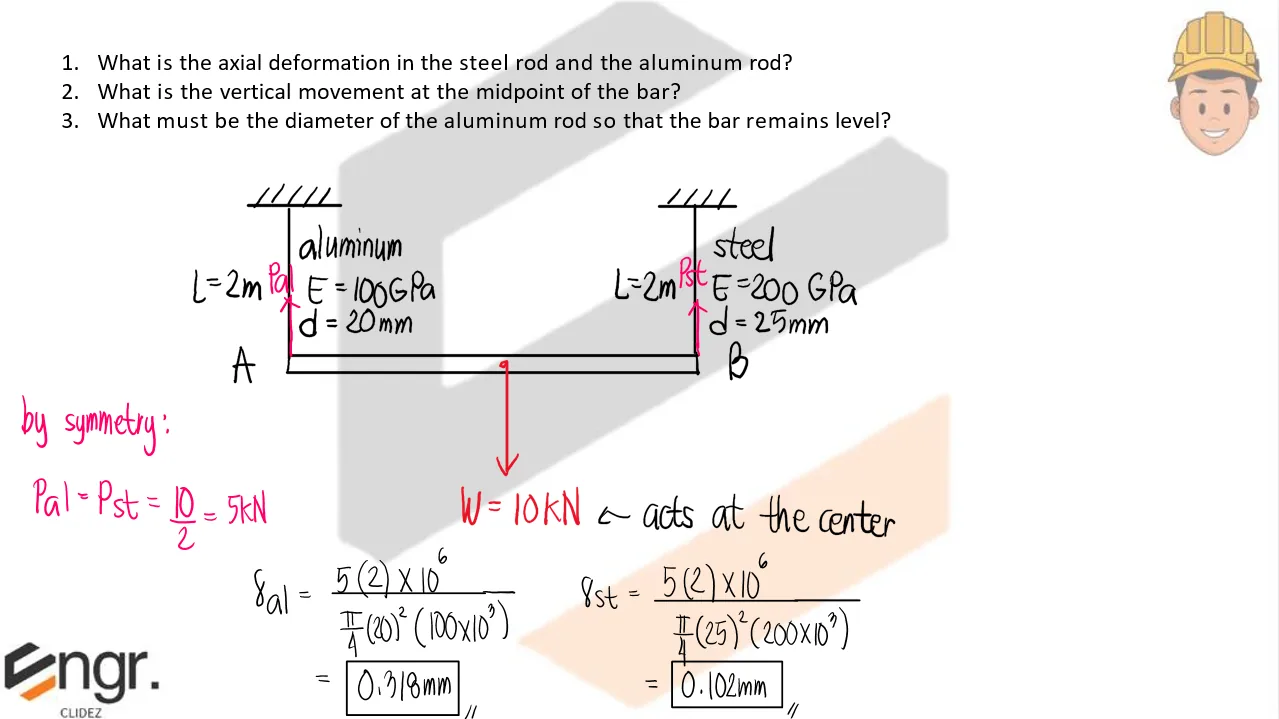
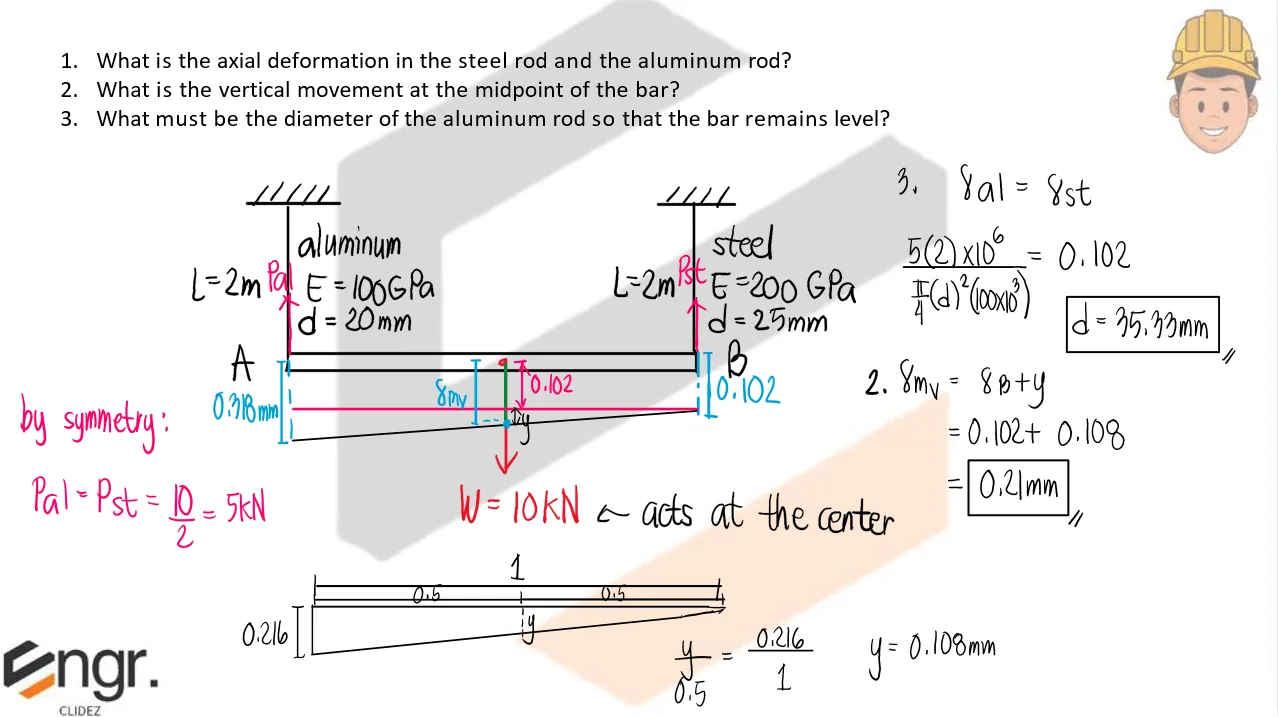
A rigid bar AB is supported at its ends by an aluminum and steel rod, respectively, at the left and right supports, respectively. If the bar weighs 10kN and given the following properties:
Aluminum: E=100GPa, d=20mm, L=2m
Steel: E=200GPa, d=25mm, L=2m
Determine the following:
a. What is the axial deformation in the steel rod and the aluminum rod?
b. What is the vertical movement at the midpoint of the bar?
c. What must be the diameter of the aluminum rod so that the bar remains level?


See images:


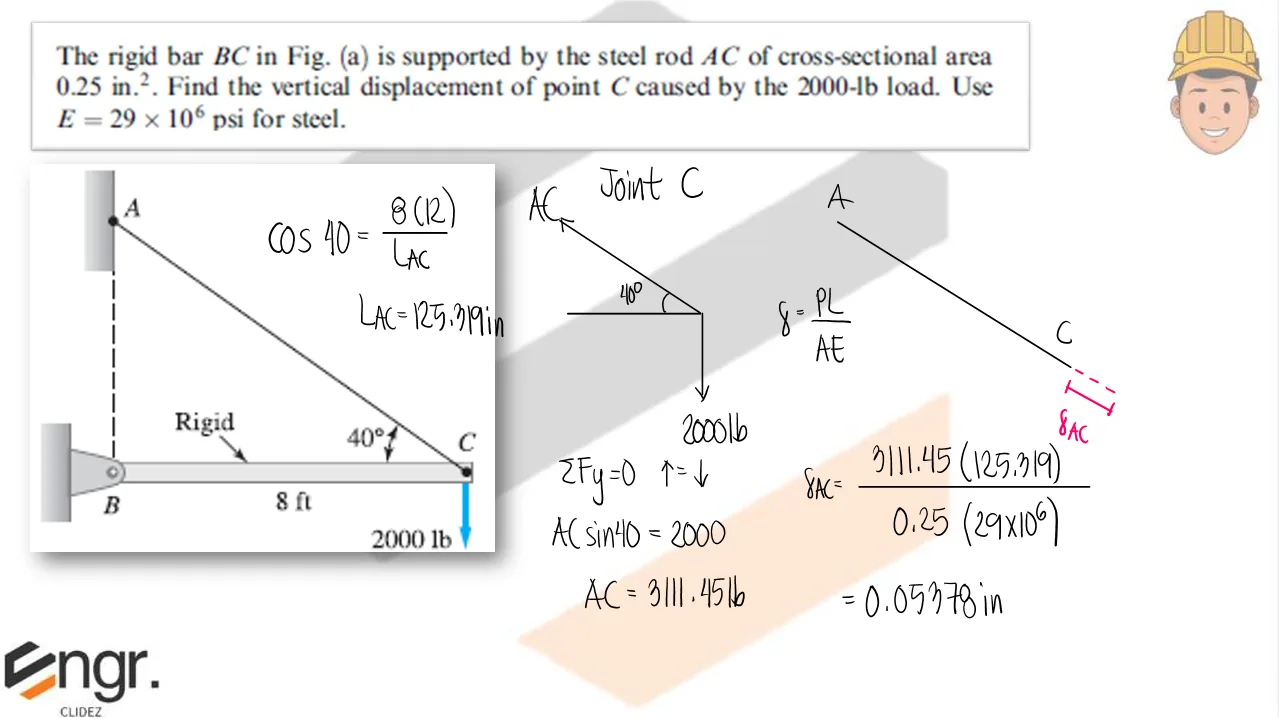
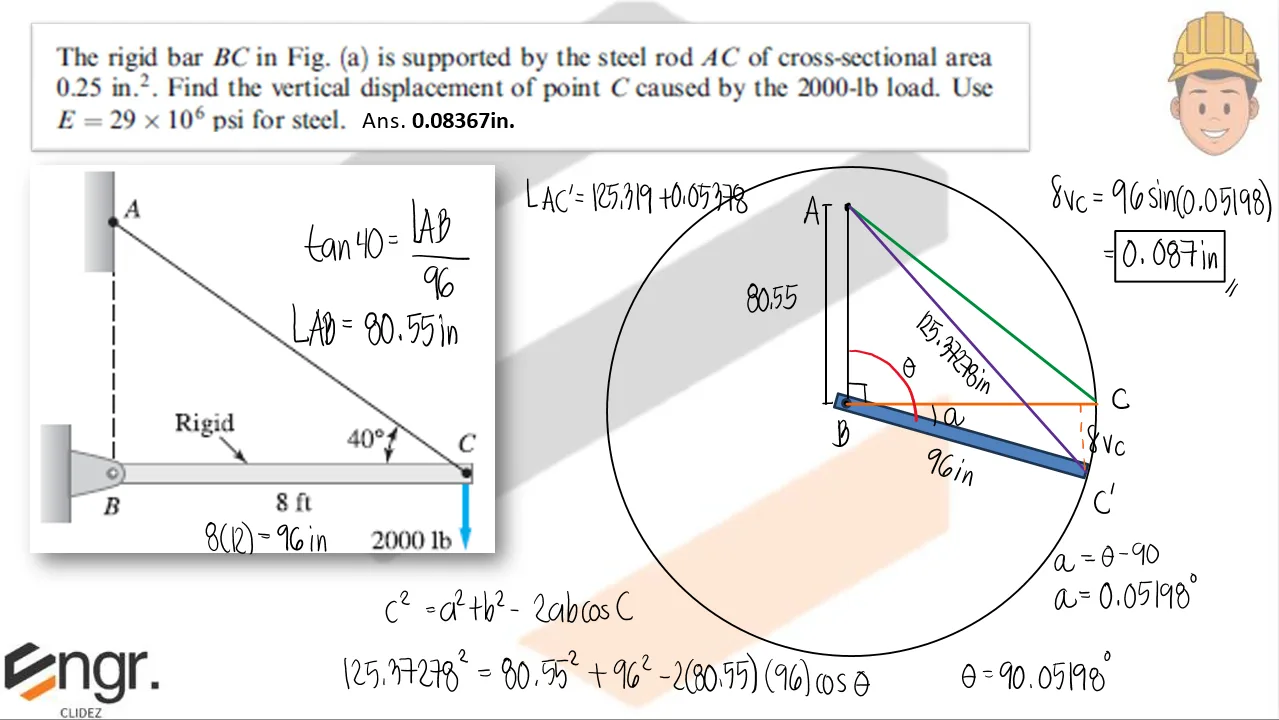
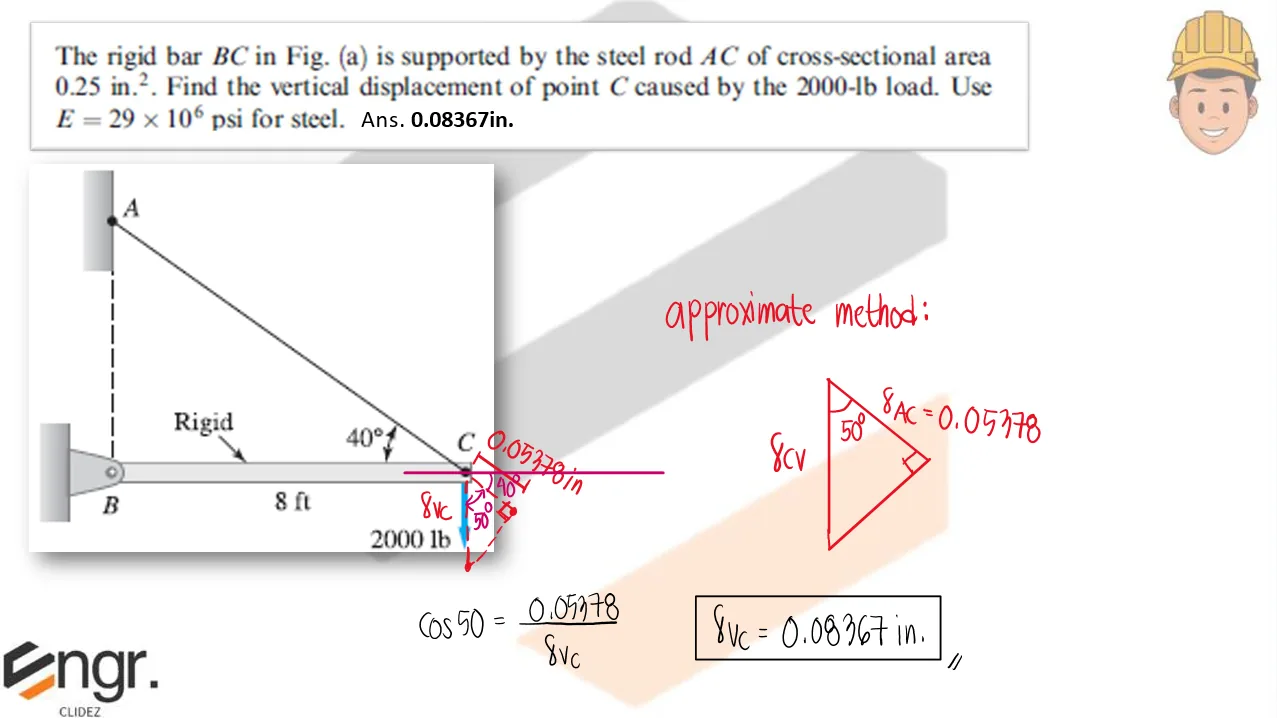
The rigid bar BC is supported by the steel rod AC of cross-sectional area 0.25in2. Find the vertical displacement of point C caused by the 2000-lb load. Use E=29x106psi for steel.
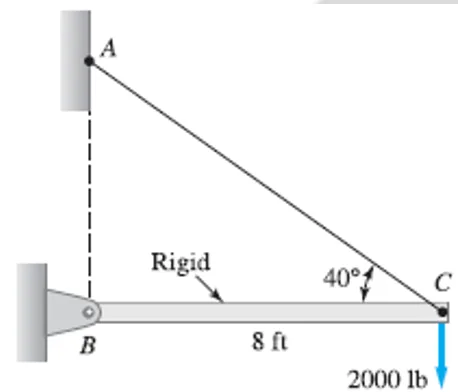


See images:

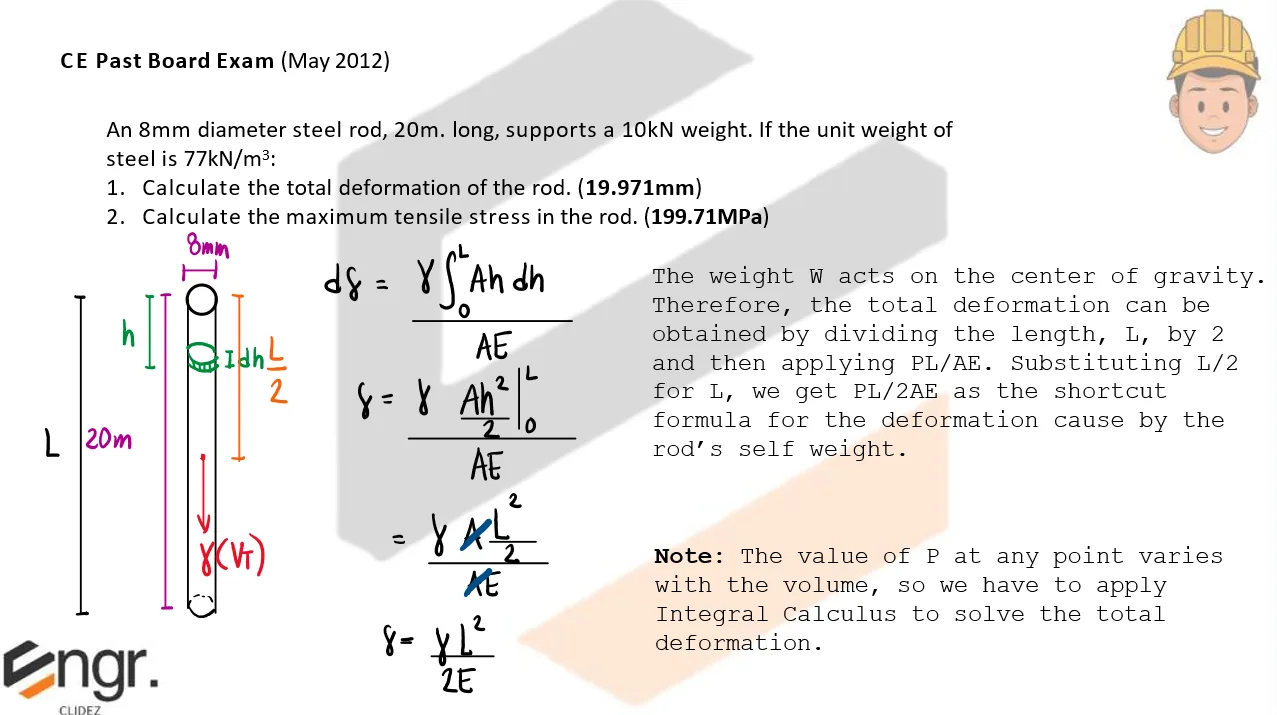
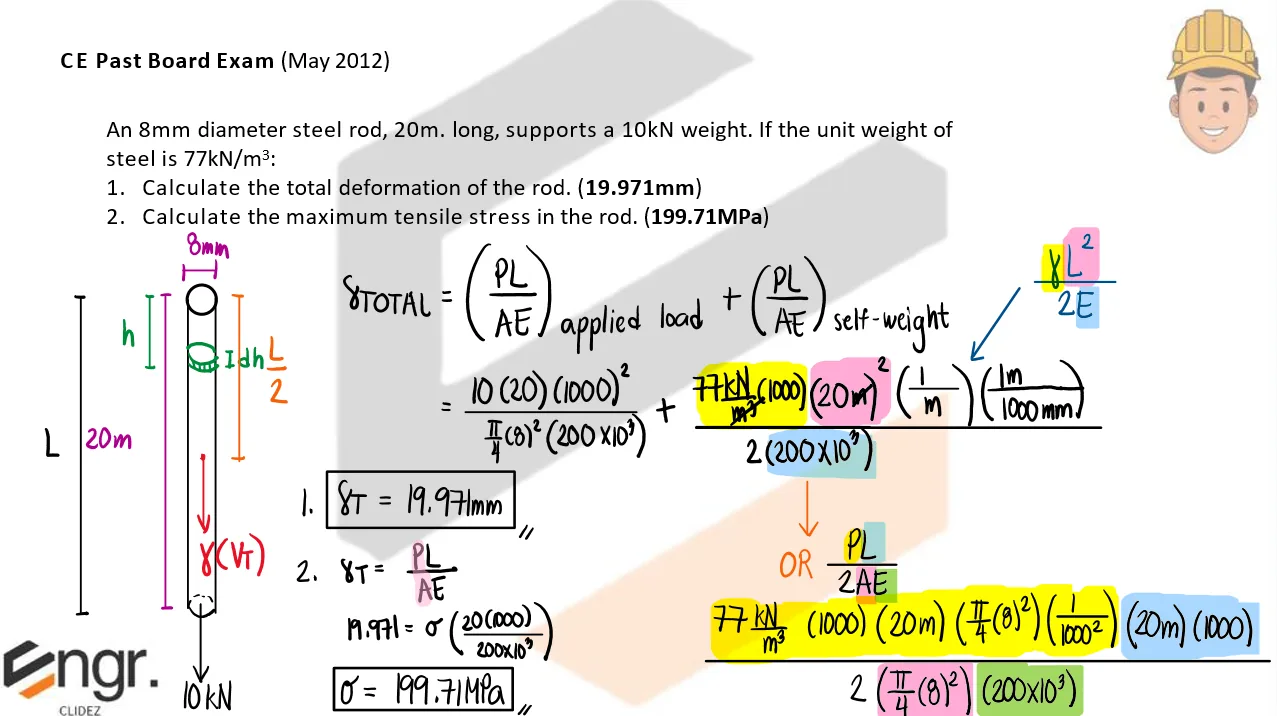
An 8mm diameter steel rod, 20m. long, supports a 10kN weight. If the unit weight of steel is 77kN/m3,
a. Calculate the total deformation of the rod.
b. Calculate the maximum tensile stress in the rod.


See images:


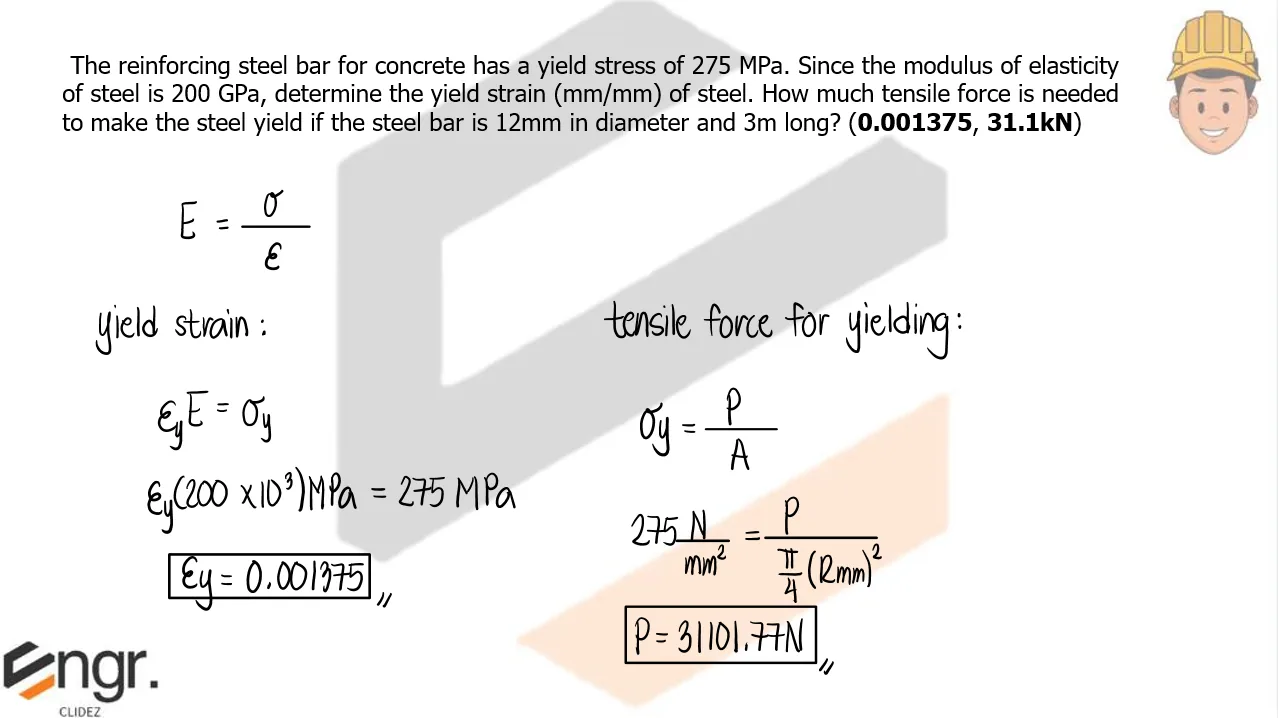
The reinforcing steel bar for concrete has a yield stress of 275MPa. Since the modulus of elasticity of steel is 200GPa, determine the yield strain of steel. How much tensile force is needed to make the steel yield if the steel bar is 12mm in diameter and 3m long?


See images:


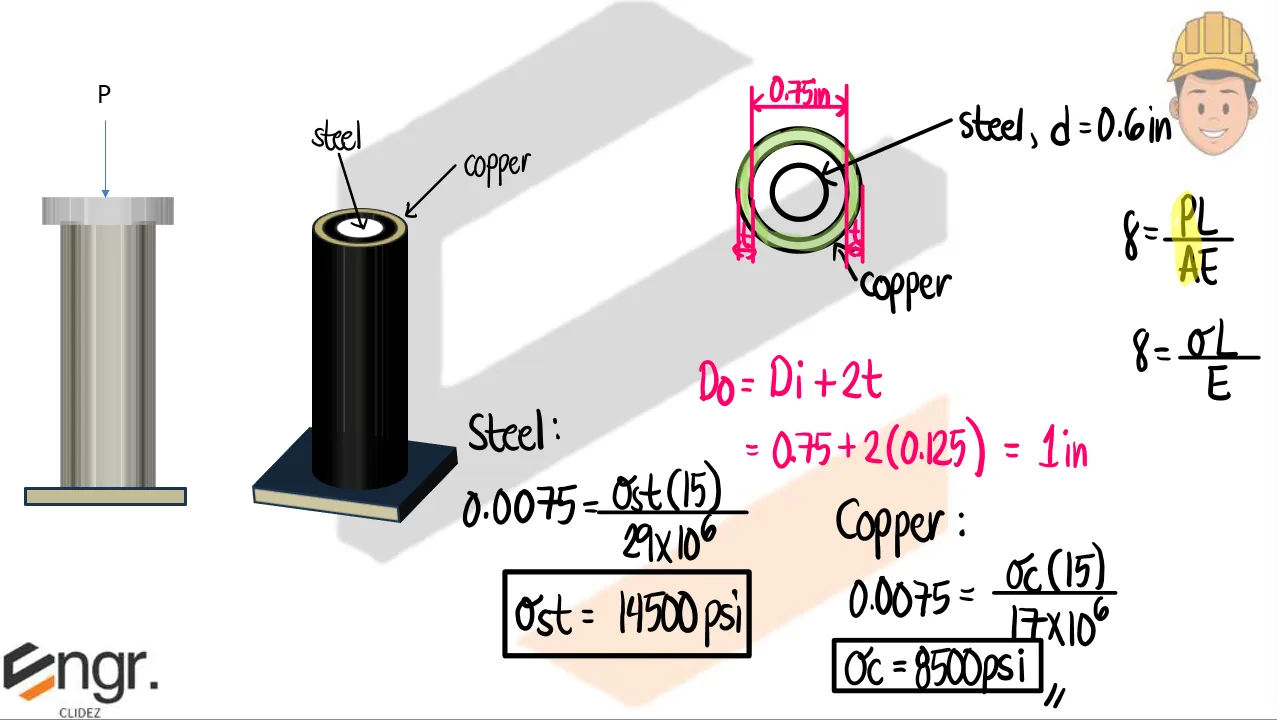
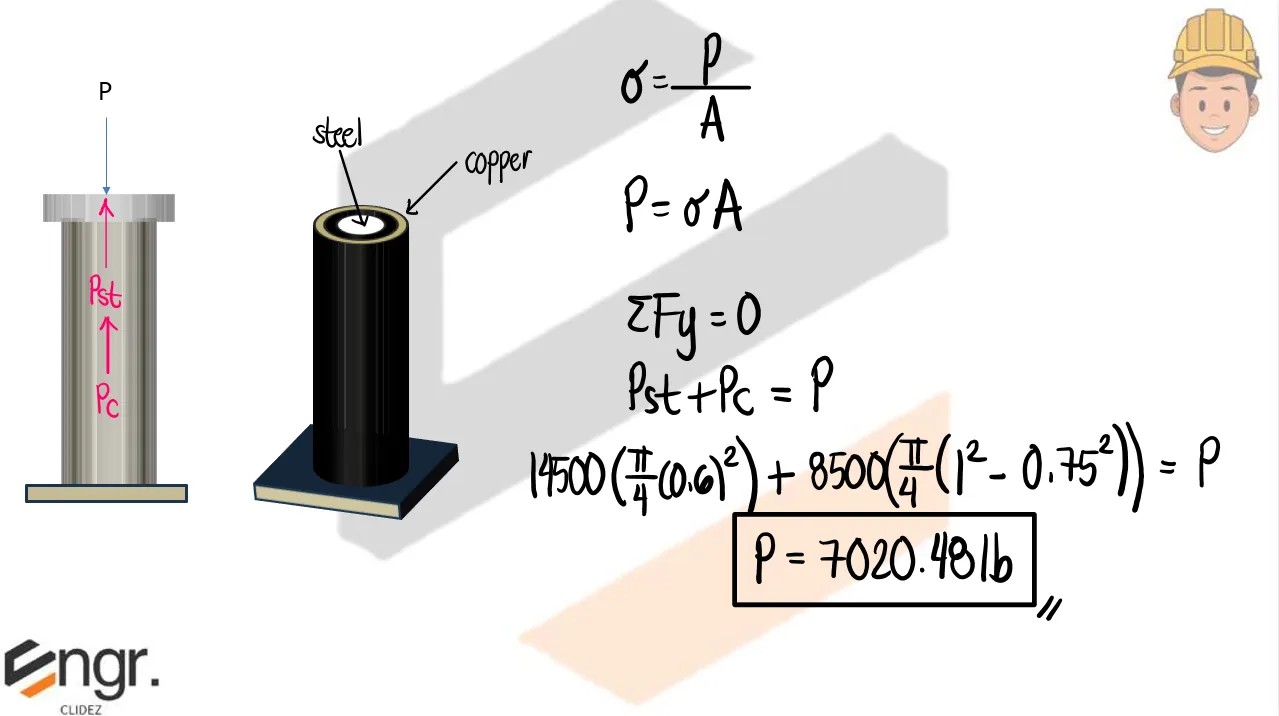
The steel rod is placed inside the copper tube, the length of each being exactly 15in. If the assembly is compressed by 0.0075in., determine the stress in each component and the applied force P. The moduli of elasticity are 29x106psi for steel and 17x106psi for copper. The diameter of the steel rod is 0.6in. The inner diameter of the copper tube is 0.75in and its thickness is 0.125in.
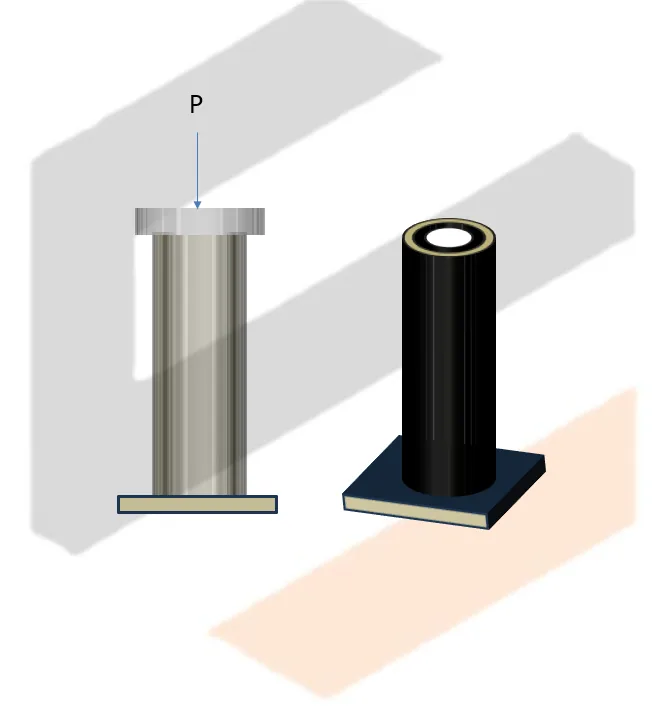
See images:


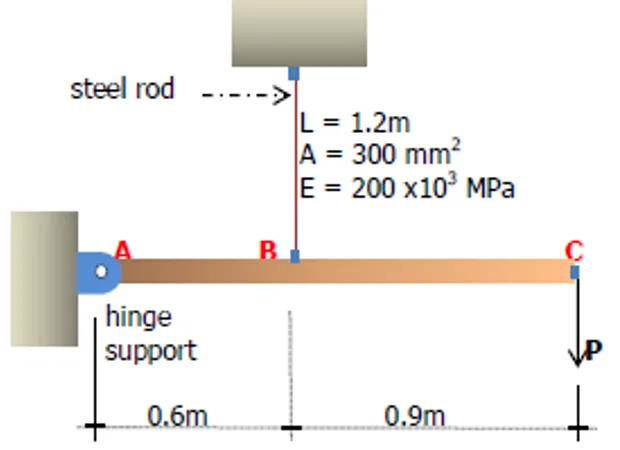
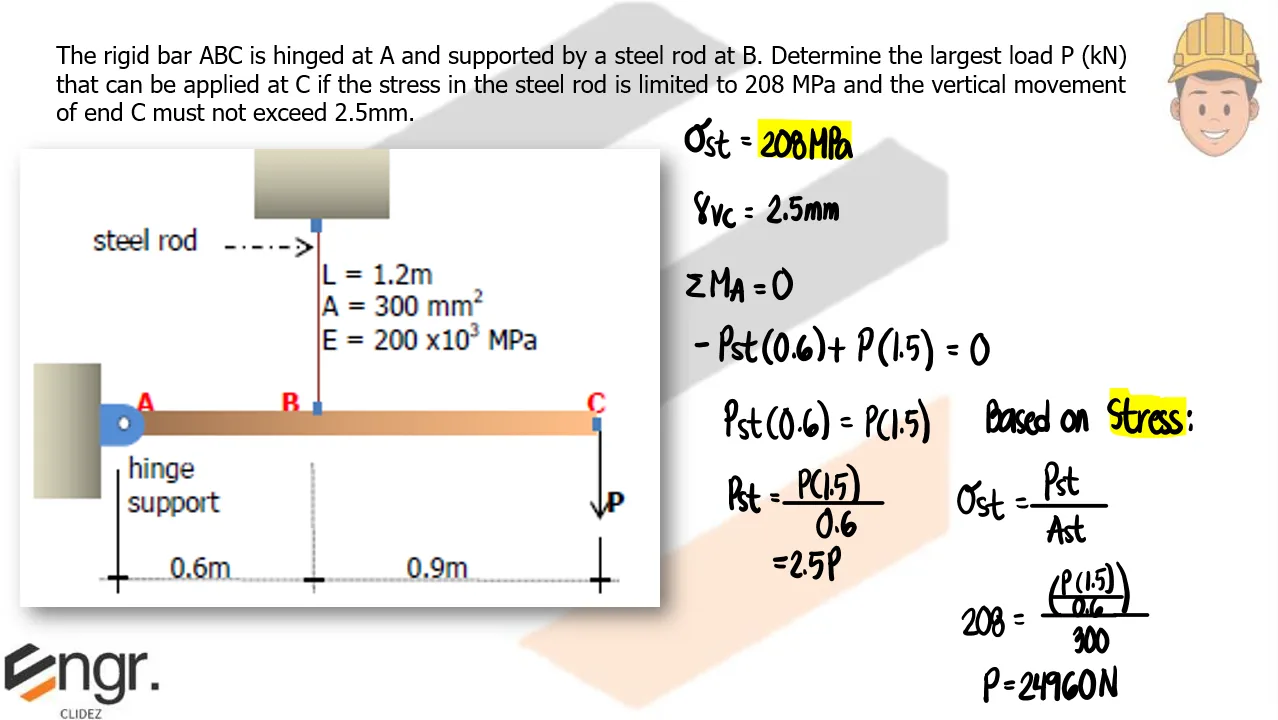
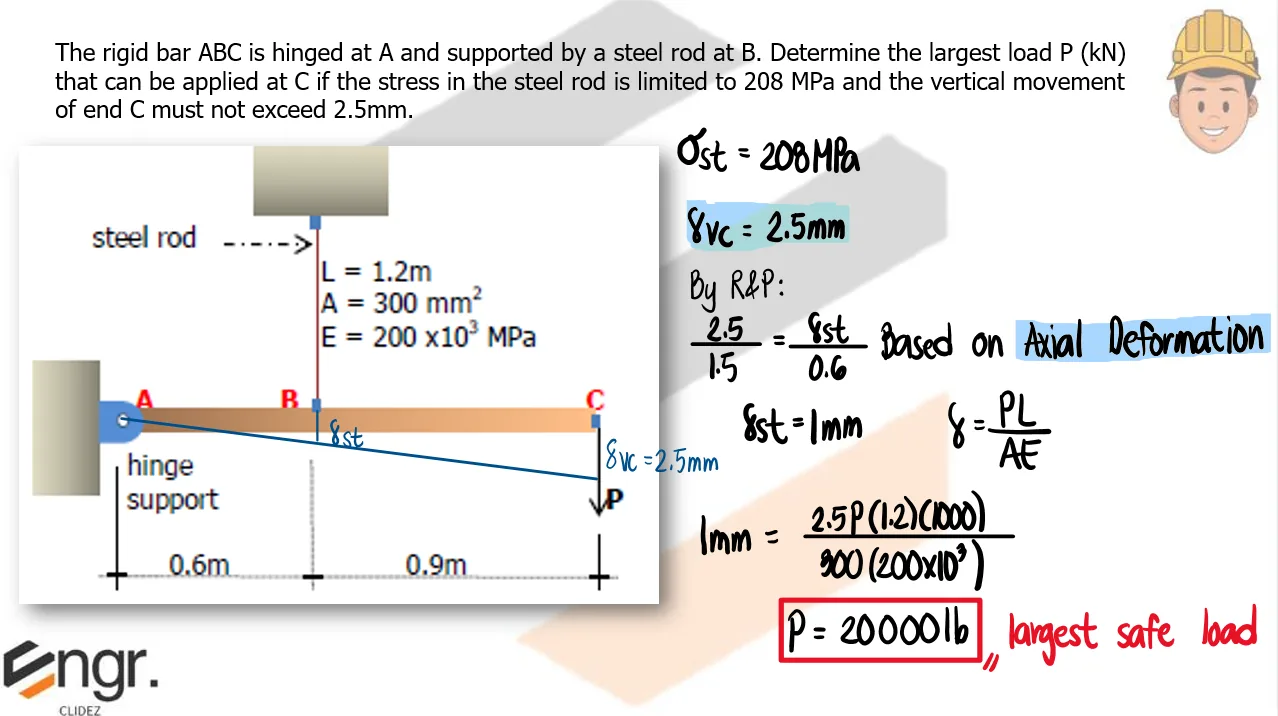
The rigid bar ABC is hinged at A and supported by a steel rod at B. Determine the largest load P (kN) that can be applied at C if the stress in the steel rod is limited to 208 MPa and the vertical movement of end C must not exceed 2.5mm.
See images:


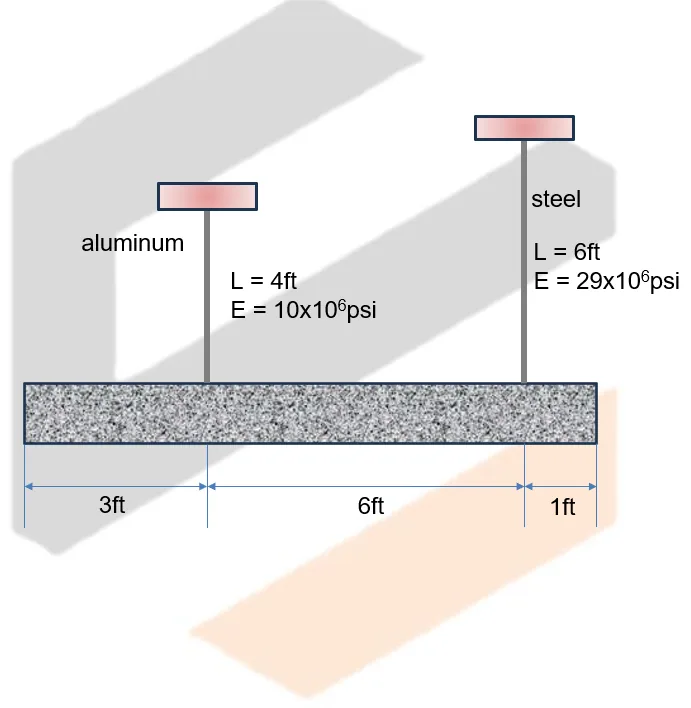
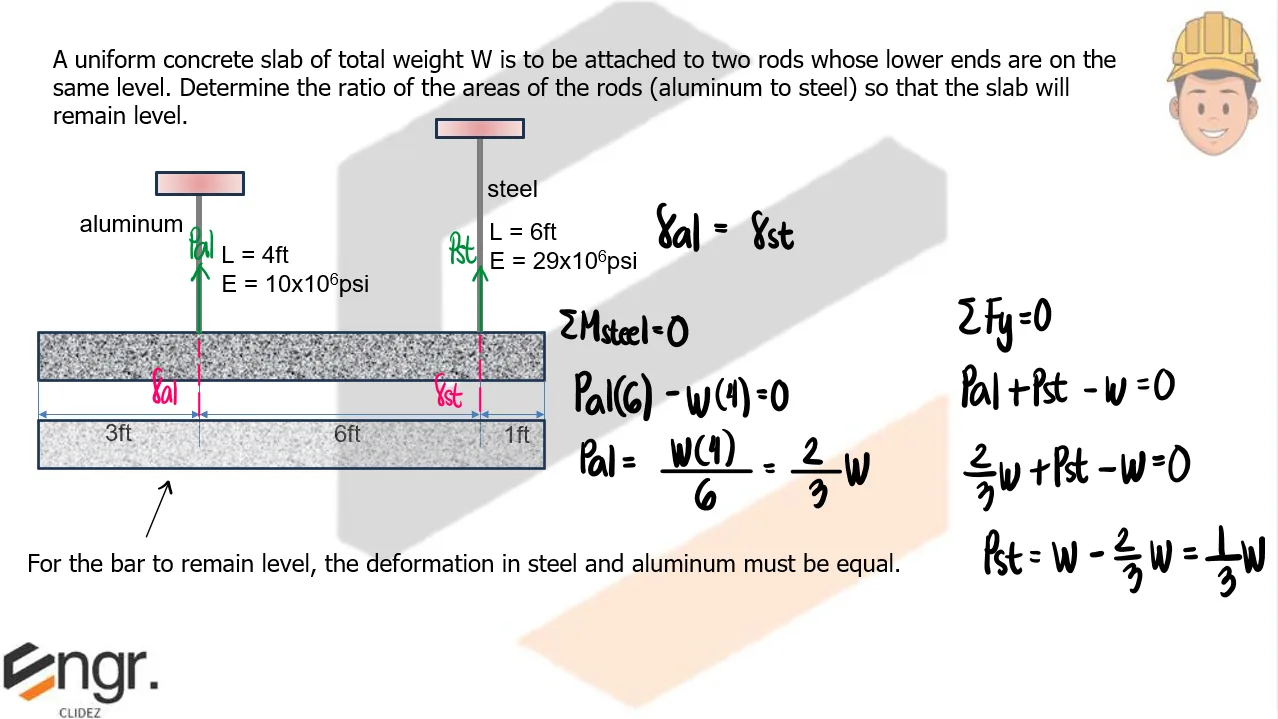
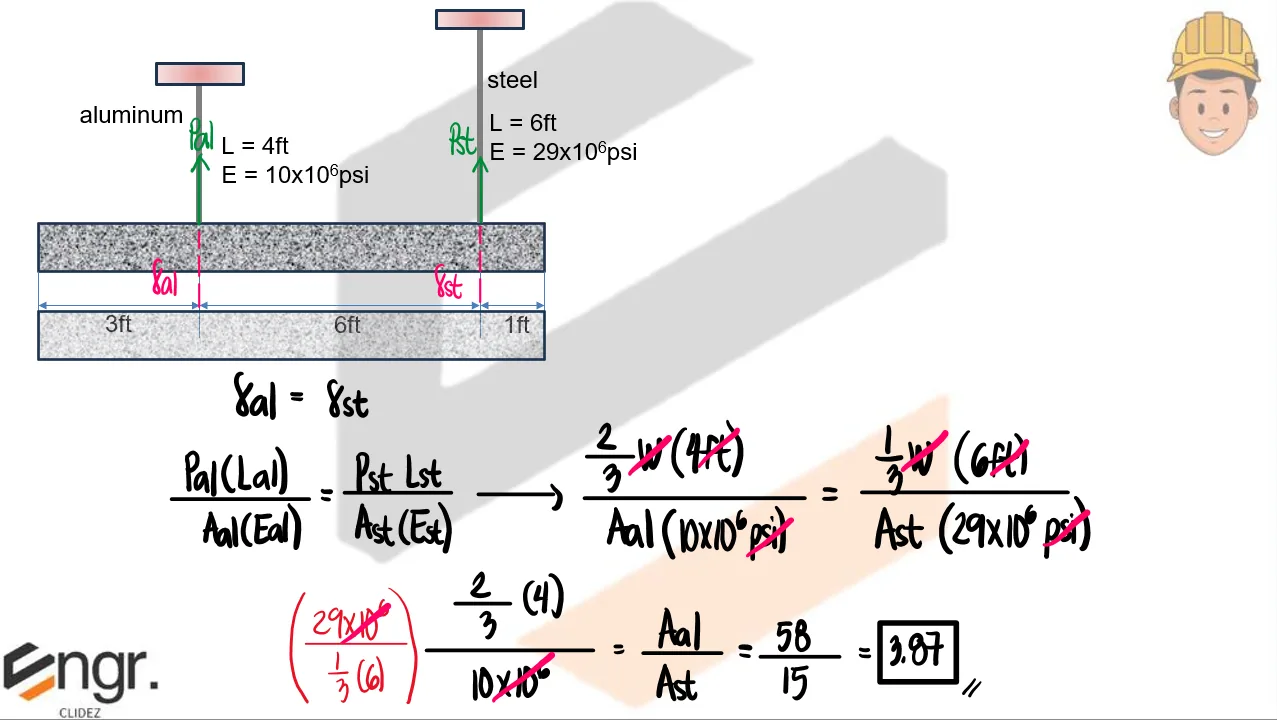
A uniform concrete slab of total weight W is to be attached to two rods whose lower ends are on the same level. Determine the ratio of the areas of the rods (aluminum to steel) so that the slab will remain level.
See images:


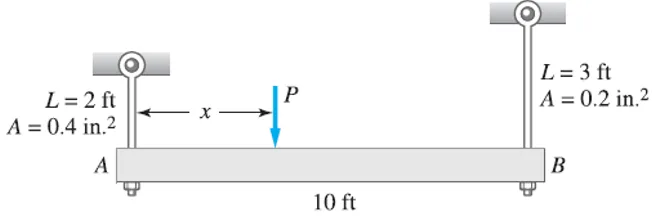
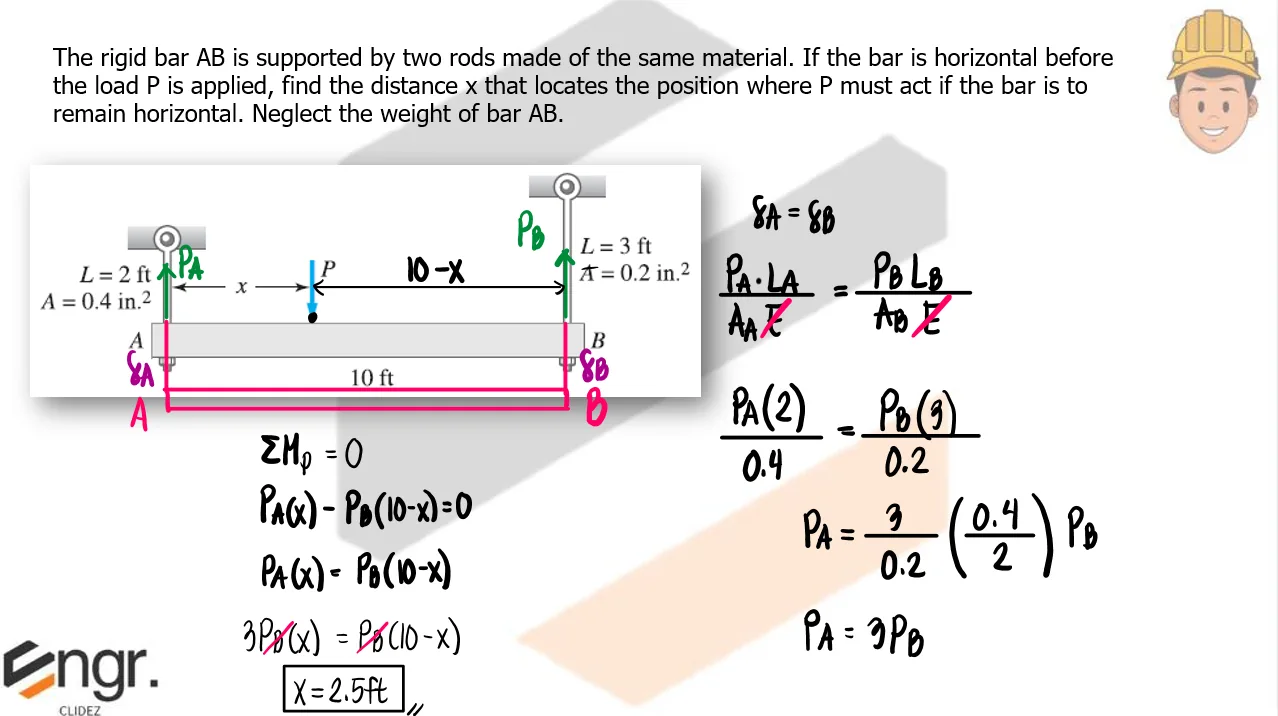
The rigid bar AB is supported by two rods made of the same material. If the bar is horizontal before the load P is applied, find the distance x that locates the position where P must act if the bar is to remain horizontal. Neglect the weight of bar AB.
See images:


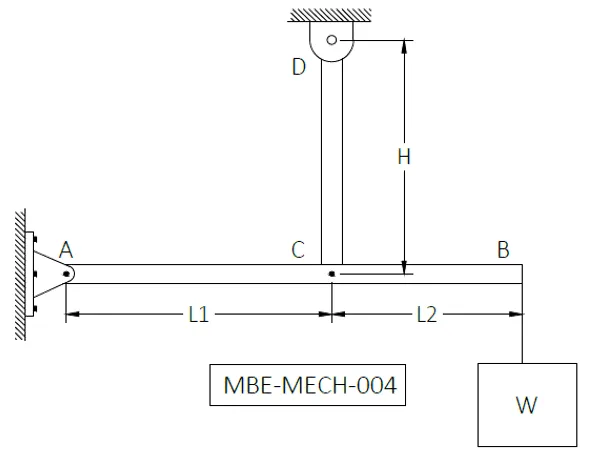
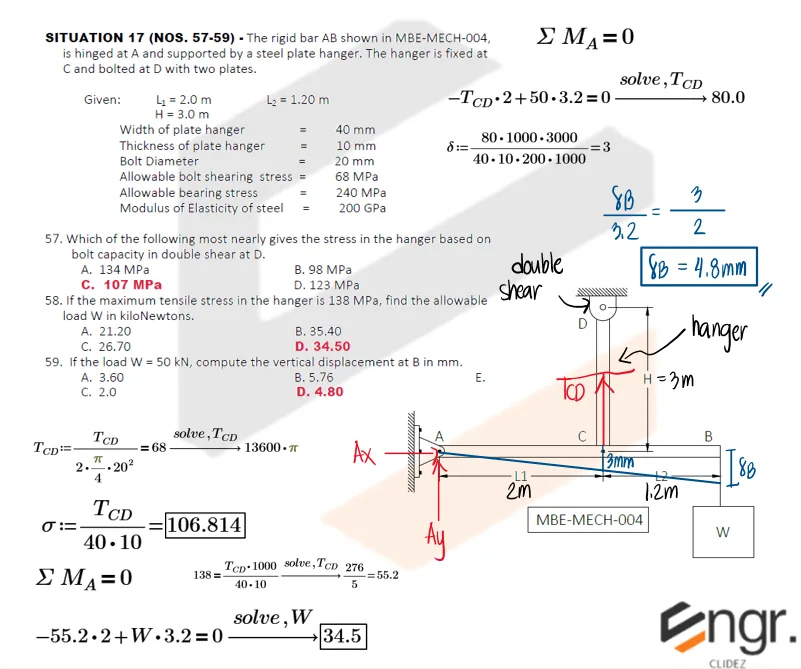
The rigid bar AB shown below is hinged at A and supported by a steel plate hanger. The hanger is fixed at C and bolted at D with two plates.
Given:
See images:
Additional board-style practice items for this topic.
CE Board Nov. 2024
A flagpole is supported by four flexible steel cables. At the top of the pole, a force of 10kN is applied toward the positive x-direction. The diameter of cable AE is 16mm.
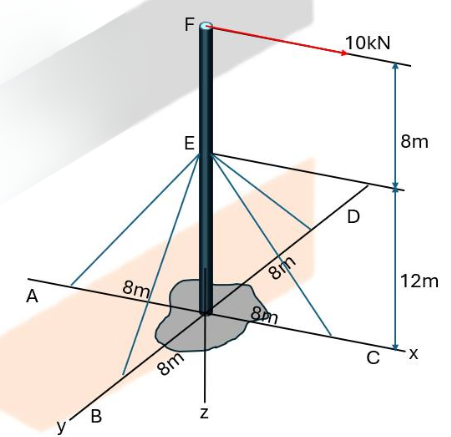
Calculate the tensile stress in cable AE.
What is the elongation (mm) of cable AE if the stress in the cable is 240MPa?
If the elongation of cable AE is 25mm, determine the horizontal displacement at F.
CE Board November 2010
Six steel cables are supporting a circular heavy moulding of diameter 2m from an overhead point. If the moulding weighs 2.5kN/m and the attachment point is 3m above it, determine the following:
Find the tension in each steel wire.
What is the minimum diameter of the wire that will not exceed the allowable stress of 124MPa?
If the wire has a diameter of 10mm, find the vertical displacement of the moulder.
A hollow cast iron pole has an outside diameter of 450-mm and an inside diameter of 350-mm. It is subjected to a compressive force of 1200kN. The length of the column is 1.2m, and it is braced against buckling and bending. Let E =100 GPa.
What is the resulting stress due to the compressive force?
What is the total contraction (mm) of the member due to the compressive force?
Determine the load in kN that will cause a strain of 0.0003mm/mm.
Part 1.
$A = \frac{\pi}{4}(D_o^2 - D_i^2) = \frac{\pi}{4}(450^2-350^2) = \frac{\pi}{4}(80{,}000) \approx 62{,}832 \text{ mm}^2$Part 2.
$E_{\text{cast iron}} = 100{,}000 \text{ MPa}$; $L = 1200 \text{ mm}$Part 3.
For strain $\varepsilon = 0.0003$:A cantilever beam has a height "h" equal to 1/8 of the length "L". It carries a uniform load over the entire span. The beam is a steel wide flange section with E=28x106psi and has an allowable bending stress of 17500 psi in both tension and compression.
Calculate the ratio of the deflection at the free end to the length, assuming that the beam carries the maximum allowable load.
For the assembly shown,
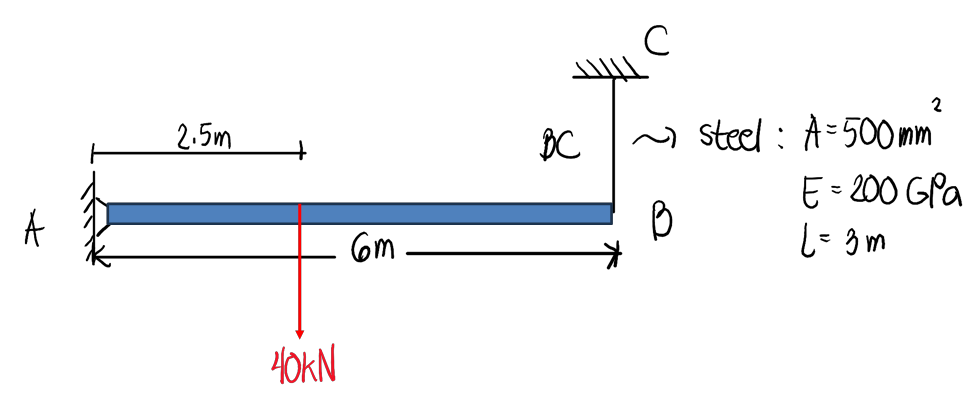
Determine the force in the steel cable, BC.
Determine the stress in the steel cable.
Determine the deformation of the steel rod.
If P=50kN and the cross-sectional area of all members is 1200mm2,
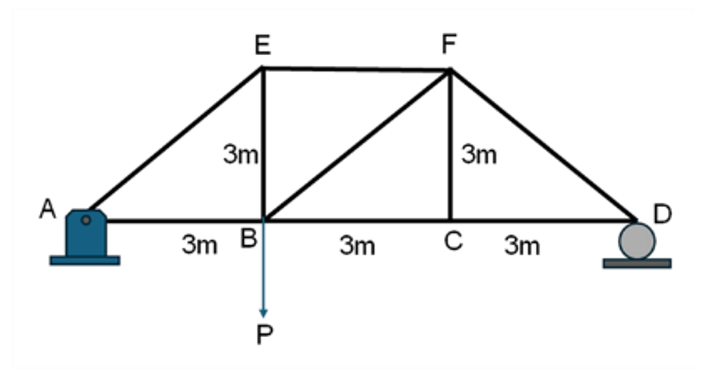
Determine the stress in member BF in MPa.
Determine the stress in member EF in MPa.
Assume that a 20-mm-diameter rivet joins the plates that are each 110mm wide and 16mm thick.
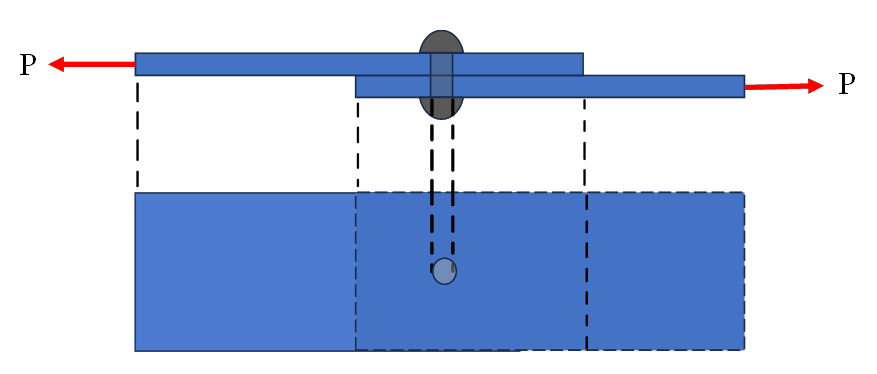
Determine the shear stress of the bolt if P=10kN
Determine the bearing stress of the bolt if P=10kN.
Determine the largest average tensile stress in the plate.
A copper wire having diameter d = 3 mm is bent into a circle and held with the ends just touching. If the maximum permissible strain in the copper is 0.0024, what is the shortest length L of wire that can be used?
Answer:
A polyamide polymer bar has a cross-section of 45mmx45mm and a length of 200mm. The length elongates 3mm when a load of 360kN is applied.
Determine the modulus of elasticity.
The figure shows a pellet about to be fired from a sling. The total unstretched length of the rubber band is 60mm. The rubber band elongates 1mm for every 15N force.
Given:
a = 100mm
b = 40mm
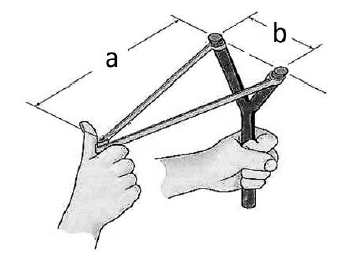
As the pellet is about to be released, how much is the total elongation of the rubber band?
What is the force exerted on each leg of the rubber band?
Determine the pulling force.
A hollow cast-iron pole has an outside diameter of 450mm and an inside diameter of 350mm. It is subjected to a compressive force of 1200 kN (weight included) throughout its length of 1.2m. The pole is braced to prevent bending and buckling. E = 100 GPa
What is the resulting stress due to the compression force, in MPa?
Calculate the total contraction of the member due to the compressive force.
Find the load that would result to a total compressive strain of 0.003 mm/mm.
A 12 mm diameter steel bar (L = 18 m) has an allowable stress of 138 MPa.
Find the safe load W it can carry.
For the bar in Question 48, find the safe load W if the allowable elongation is 10 mm (E = 200 GPa).
Calculate the total strain in the 12 mm steel bar from Question 48 if a load of 20 kN is applied.
Part 1.
$A = \frac{\pi}{4}(12)^2 = 113.1 \text{ mm}^2$.Part 2.
$\delta = \frac{WL}{AE} \Rightarrow W = \frac{\delta A E}{L}$Part 3.
$\sigma = \frac{P}{A} = \frac{20000}{113.1} = 176.8$ MPa.