$$\text{When} \frac{d}{t}\ge 20 $$
Where d = diameter of the vessel and t=thickness of the wall
The stresses between the inner and outer surfaces of the wall vary by less than 5%.This is what we generally consider a thin-walled pressure vessel.
Circumferential/Tangential Stress
Longitudinal Stress
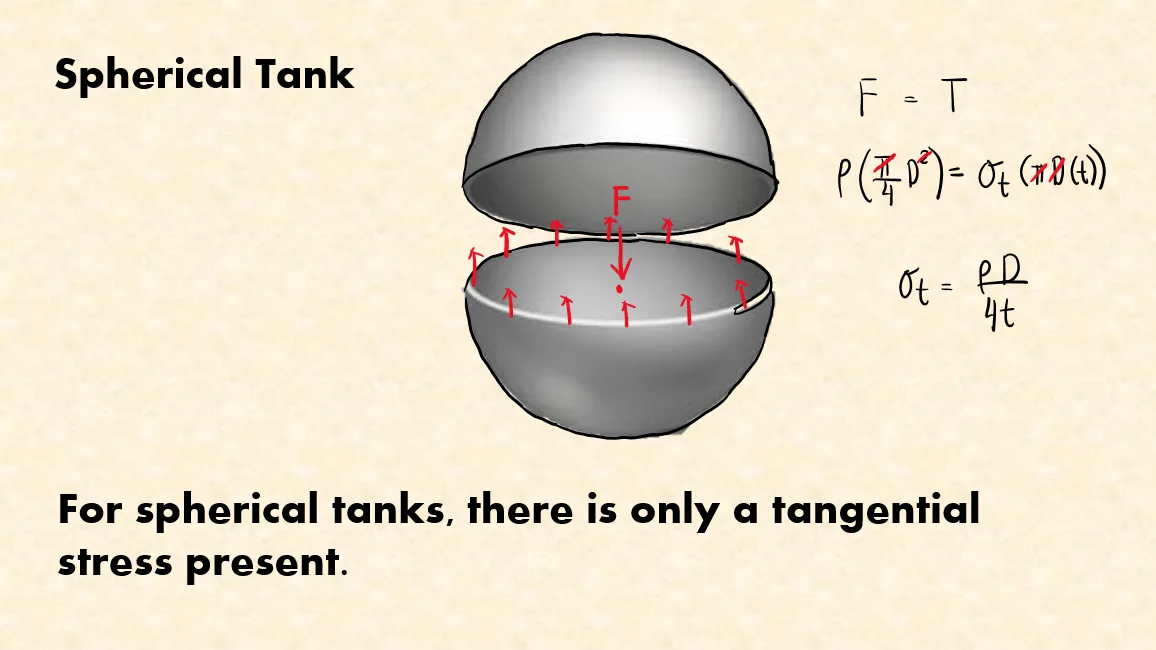
Thin-walled Spherical Vessels
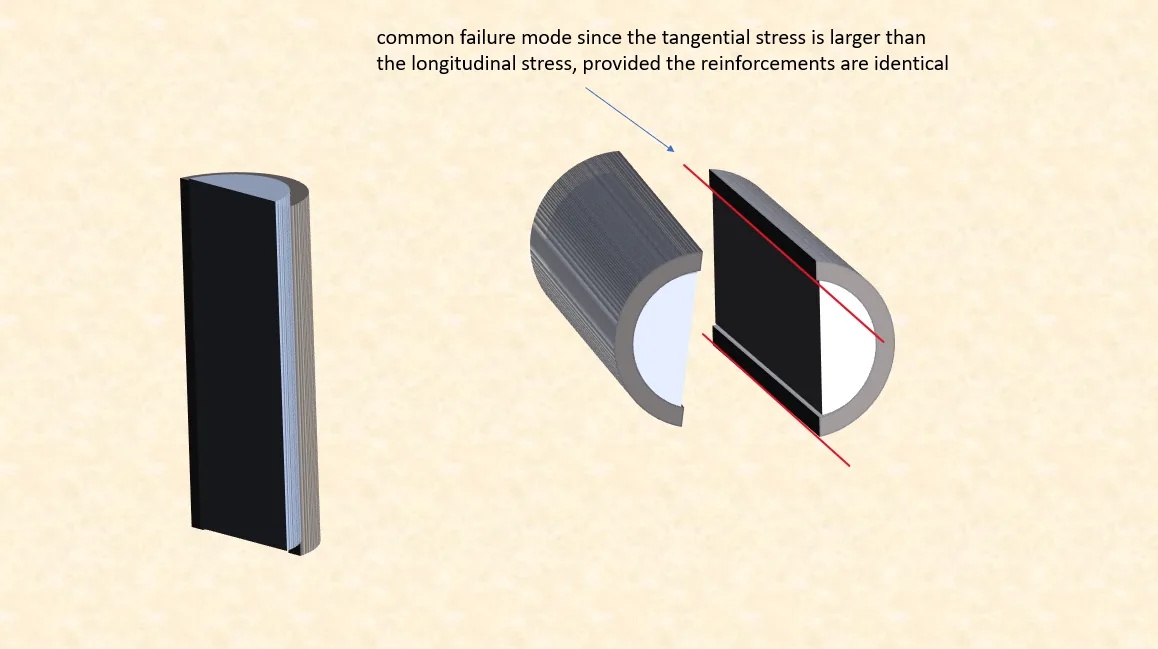
Common Failure Mode
The derived formulas here are exclusively for cylindrical and spherical thin-walled pressure vessels. In practical applications, thin-walled tanks do not always follow this configuration. As such, it is important to equip oneself with the nature of the derivation of the formulas above that utilize the concept of simple stresses (axial).
Advertisement
Problem:
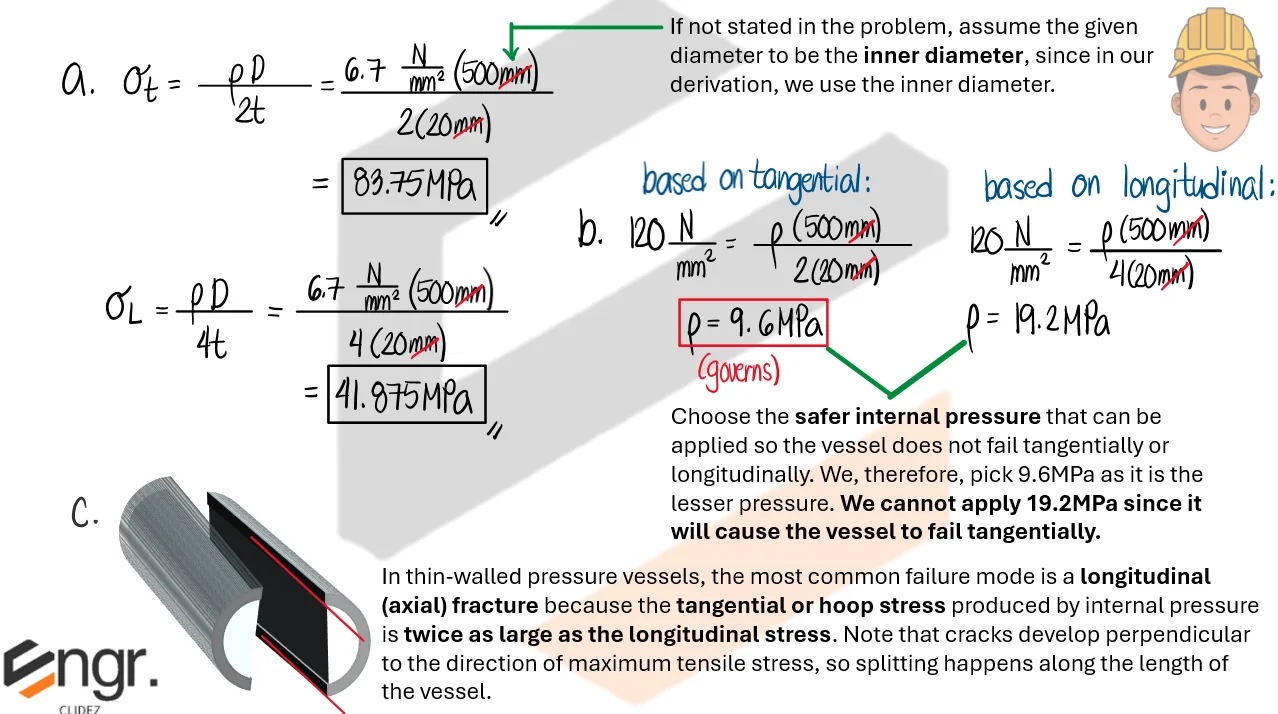
A cylindrical steel pressure vessel 500mm in diameter with a wall thickness of 20mm is subjected to an internal pressure of 6.7MN/m2.
a. Calculate the tangential and longitudinal stresses in the steel.
b. To what value may the internal pressure be increased if the stress in the steel is limited to 120MN/m2?
c. If the internal pressure were increased until the vessel would burst, sketch the type of fracture that would occur.
Check d/t:
d=500mm
t=20mm
$$\frac{d}{t}=\frac{500}{20}=25$$
Since $\frac{d}{t}\ge25\text{, we consider this a thin-walled pressure vessel}$
For practical purposes, we will deal with thin-walled pressure vessels only in this section, including the succeeding problems.
Problem:
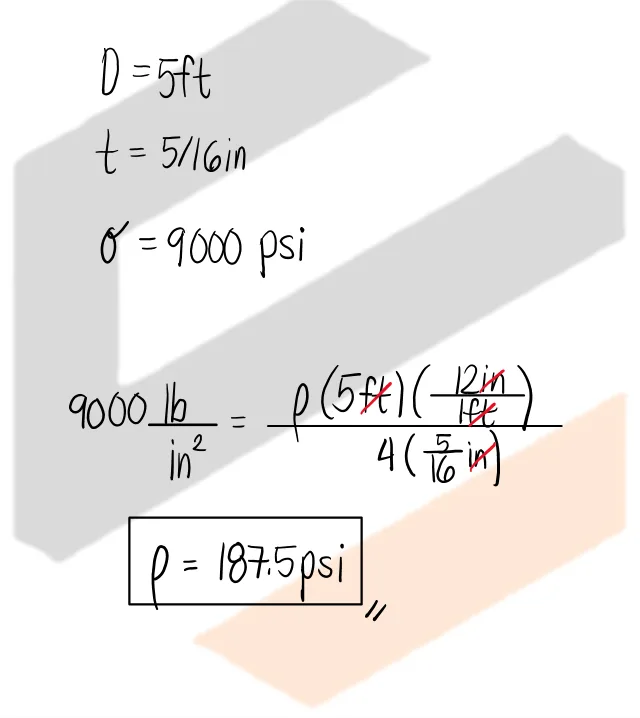
The wall thickness of a 5-ft diameter spherical tank is 5/16 inch. Claculate the allowable internal pressure if the stress is limited to 9000psi.
Problem:
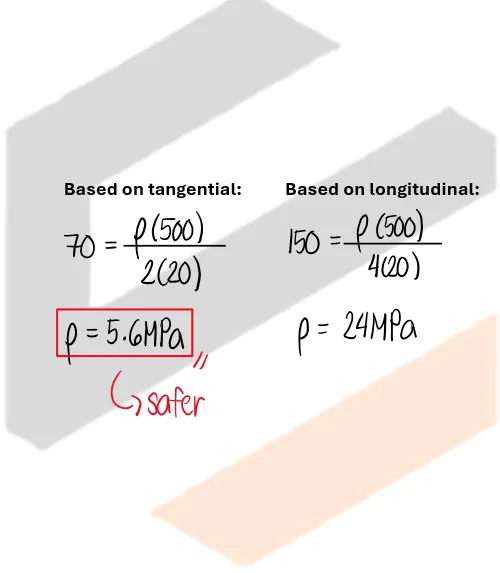
A cylindrical pressure vessel is fabricated from steel plating that has a thickness of 20mm. The diameter of the pressure vessel is 500mm and its length is 3.0m. Determine the maximum internal pressure that can be applied if the longitudinal stress is limited to 150 MPa, and the circumferential stress is limited to 70 MPa.
See images:
Problem:
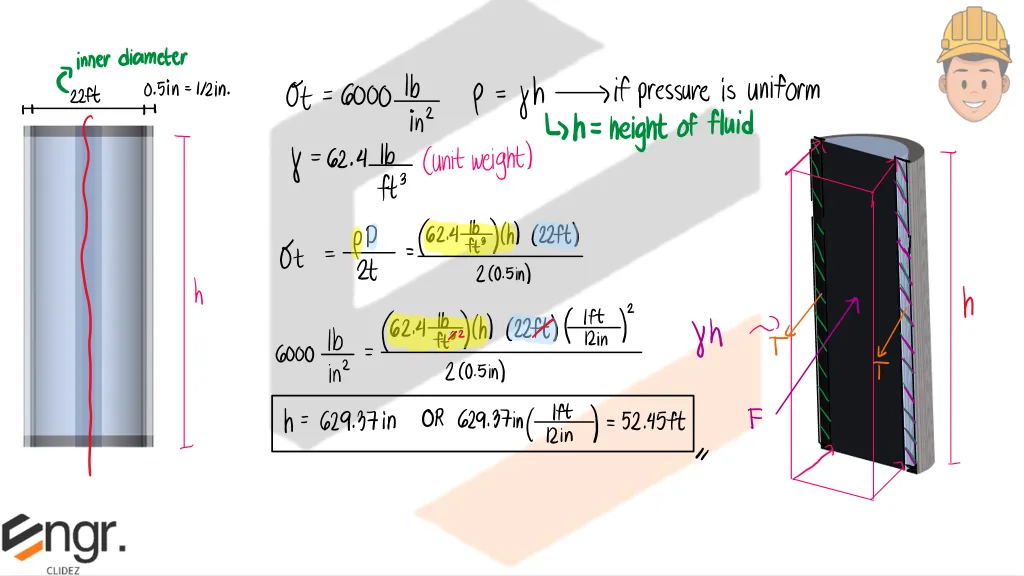
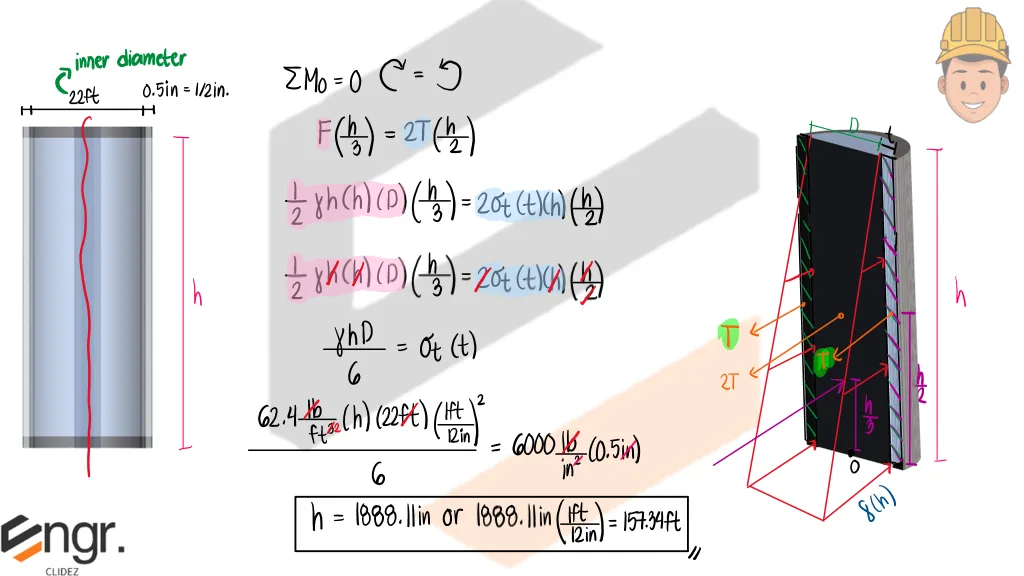
A water tank, 22 ft in diameter, is made from steel plates that are 1/2 in. thick. Find the maximum height to which the tank may be filled if the circumferential stress is limited to 6000 psi. The specific weight of water is 62.4 lb/ft3.
a. Assuming uniform pressure.
b. Considering the actual triangular pressure distribution of water.
Assuming uniform pressure:
Considering the actual triangular pressure:
Notice that comparing the heights when the pressure is uniform and when the pressure is triangular, the value of the height when the pressure is triangular is thrice that of the height when the pressure is assumed to be uniform. 52.45ft(3)=157.35ft.
Problem:
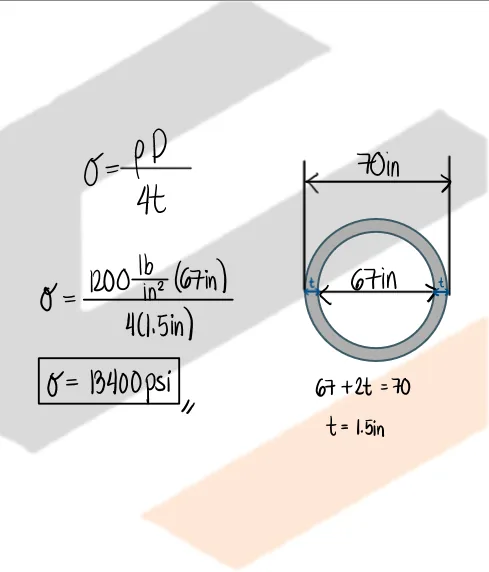
A spherical shell with 70-in. outer diameter and 67-in. inner diameter contains helium at a pressure of 1200psi. Compute the stress in the shell.
See images:
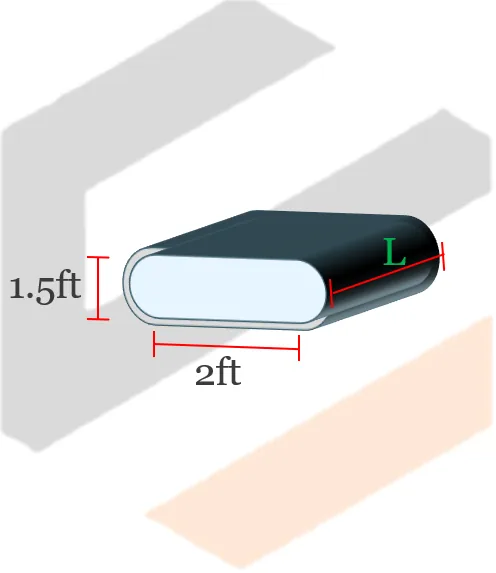
Problem:
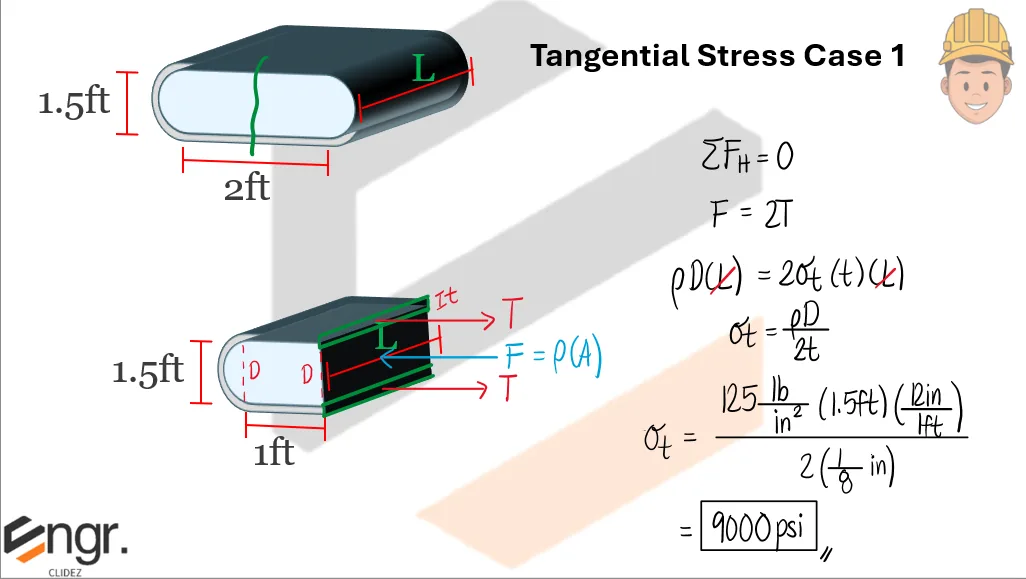
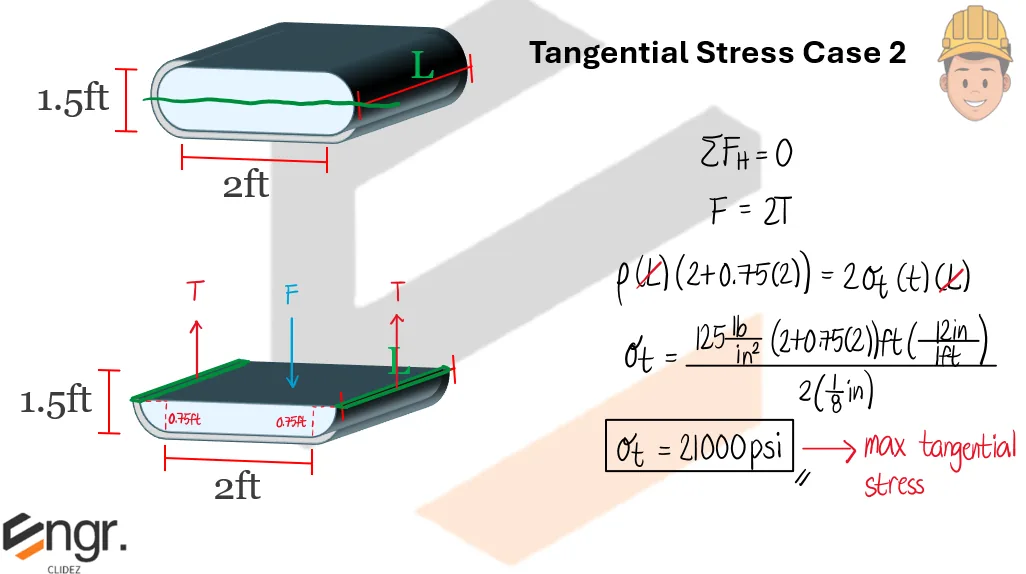
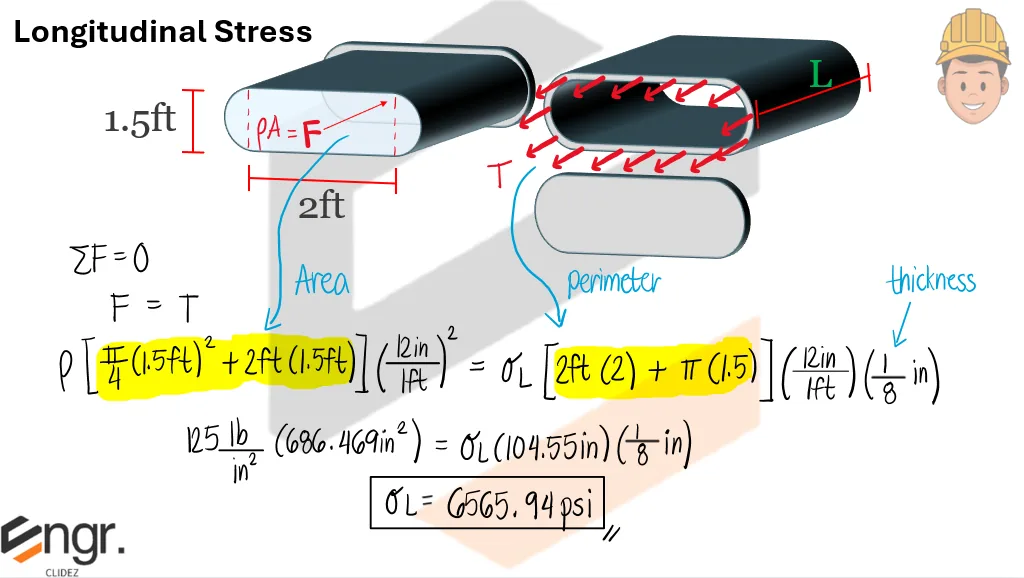
The tank shown is fabricated from 1/8-in steel plate. Calculate the maximum longitudinal and circumferential stress caused by an internal pressure of 125 psi.
See images:
-->
🧭 Jump to:
Scroll to zoom
Exam Generator Problems
Additional board-style practice items for this topic.
The hoop stress in a thin-walled cylindrical pressure vessel is given by:
Answer:
pD/2t
pD/4t
pR/2t
pR/4t
### Hoop stress in a thin cylindrical pressure vessel
Make a longitudinal cut through the cylinder. The pressure force tending to split the vessel is
$$F_p=pD(L).$$
The two wall sections resist this with tensile force
$$F_r=2tLsigma_h.$$
Equating the forces,
$$pDL=2tLsigma_h.$$
After cancelling $L$,
$$\boxed{\sigma_h=\frac{pD}{2t}}.$$
This is the hoop, or circumferential, stress; it is twice the longitudinal stress for a closed thin cylinder.
The longitudinal stress in a thin-walled cylindrical pressure vessel is:
Answer:
Half of the hoop stress
Equal to the hoop stress
Four times the hoop stress
Twice the hoop stress
### Longitudinal stress
For a closed thin cylindrical vessel,
$$\sigma_h=\frac{pD}{2t},\qquad \sigma_L=\frac{pD}{4t}.$$
Therefore,
$$\sigma_L=\frac12\sigma_h.$$
The longitudinal stress is $\boxed{\text{half of the hoop stress}}$.
A cylindrical pressure vessel is fabricated from steel plating that has a thickness of 6mm. The length of the
pressure vessel is 4 meters and its diameter is 1 meter. Determine the maximum internal pressure that can be
applied if the longitudinal stress is limited to 140MPa and the circumferential stress is limited to 150MPa.
Answer:
1.8MPa
1.68MPa
3.36MPa
3.6MPa
### Maximum internal pressure
Check both allowable stresses. From hoop stress,
$$p_h=\frac{2tsigma_h}{D}=\frac{2(6)(150)}{1000}=1.80 \text{MPa}.$$
From longitudinal stress,
$$p_L=\frac{4tsigma_L}{D}=\frac{4(6)(140)}{1000}=3.36 \text{MPa}.$$
The smaller allowable pressure governs:
$$\boxed{p_{\max}=1.8 \text{MPa}}.$$
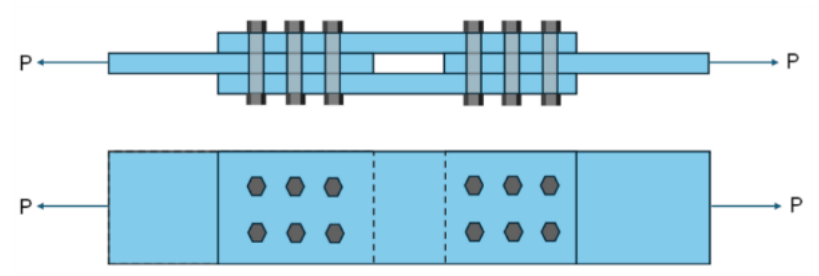
In computing for bolt shear stress, the load P is divided by how many bolt areas in the figure shown?
Answer:
12
3
6
24
### Bolt shear area
The connection contains six bolts, and each bolt is in double shear. Thus the load is shared by
$$6(2)=\boxed{12}$$
bolt shear areas. The average bolt shear stress is therefore $\tau=P/[12(\pi d^2/4)]$.
A steel tire, 12mm thick, 120mm wide, and with an inside diameter of 800mm, is heated and shrunk onto a steel wheel 800.5mm in diameter. Neglect the deformation of the wheel. The modulus of elasticity of steel is 200GPa.
What is the tensile stress (MPa) in the tire?
123.15
112.45
95.31
134.32
What is the compressive pressure (MPa) between the tire and the wheel, in MPa?
3.7
4.2
5.9
6.1
If the allowable tensile stress on the steel tire is 124MPa, determine its thickness (mm) to resist a pressure of 1.5MPa.
4.84
3.87
4.23
6.89
Part 1.
The wheel is assumed rigid, so the tire strain is based on the required expansion over the mean diameter: $D_m=800+12=812$ mm $\epsilon=\frac{800.5-800}{812}=0.0006158$ $\sigma=E\epsilon=200{,}000(0.0006158)=123.15$ MPa $\boxed{\sigma=123.15\text{ MPa}}$
Part 2.
For a thin tire, hoop stress and contact pressure are related by: $\sigma=\frac{pr}{t}$ $p=\frac{\sigma t}{r}=\frac{123.15(12)}{400}=3.69$ MPa $\boxed{p\approx3.7\text{ MPa}}$
Part 3.
Required thickness from hoop stress: $\sigma=\frac{pr}{t}$ so $t=\frac{pr}{\sigma}$ $t=\frac{1.5(400)}{124}=4.84$ mm $\boxed{t=4.84\text{ mm}}$
A steel tank with an outside diameter of 600mm has a wall thickness of 8mm. The tank is used as a storage of gas under a pressure of 2.2MPa.
Determine the value of the tangential stress (MPa) in the tank wall.
80.3
83.2
89.4
90.2
Determine the value of the longitudinal stress (MPa) in the tank wall.
40.2
43.1
38.5
34.7
Compute the bursting force in Newton per linear mm of the tank.
1285N/mm
5236N/mm
3215N/mm
4875N/mm
If the allowable tensile stress in the wall is 124MPa, to what value (MPa) may the gas pressure be increased?
3.397
2.873
3.765
4.123
Part 1.
For a thin cylindrical tank, tangential or hoop stress is: $\sigma_t=\frac{pd}{2t}$ Use inside diameter $d=600-2(8)=584$ mm: $\sigma_t=\frac{2.2(584)}{2(8)}=80.3$ MPa $\boxed{\sigma_t=80.3\text{ MPa}}$
Part 2.
For a thin cylindrical tank, longitudinal stress is half the hoop stress: $\sigma_l=\frac{pd}{4t}$ $\sigma_l=\frac{2.2(584)}{4(8)}=40.2$ MPa $\boxed{40.2\text{ MPa}}$
Part 3.
Bursting force per unit length for a cylindrical shell is: $F=pD$ Using the inside diameter $D=584$ mm: $F=2.2(584)=1284.8$ N/mm $\boxed{1285\text{N/mm}}$
Part 4.
Use allowable hoop stress: $\sigma_t=\frac{pd}{2t}$ so $p=\frac{2t\sigma_t}{d}$ $p=\frac{2(8)(124)}{584}=3.397$ MPa $\boxed{p=3.397\text{ MPa}}$
A water tank is 6 meters tall and 2m in diameter. The unit weight of water is 9.81kN/m3.
If the tank wall is 3mm thick, compute the depth of water in the tank if the maximum tensile stress of the wall is 8.2MPa.
2.51
2.89
3.65
4.85
If the allowable tensile stress of the tank wall is 35MPa, which of the following gives the minimum wall thickness (mm) considering water pressure only?
2.0
1.5
2.5
1.0
Part 1.
Maximum hoop stress at depth $h$ is: $\sigma_t=\frac{pd}{2t}=\frac{\gamma h d}{2t}$ Solving for $h$: $h=\frac{\sigma_t(2t)}{\gamma d}$ $h=\frac{8.2\times10^6(2)(0.003)}{9810(2)}=2.51$ m $\boxed{h=2.51}$
Part 2.
For full tank depth $h=6$ m, pressure at the bottom is $p=\gamma h$. Required thickness: $t=\frac{pd}{2\sigma}=\frac{\gamma h d}{2\sigma}$ $t=\frac{9810(6)(2)}{2(35\times10^6)}=0.00168$ m $=1.68$ mm Use the next available thickness from the choices. $\boxed{2.0\text{ mm}}$
A pressure vessel 500 mm in diameter is to be
fabricated from steel plating. The allowable stress is 138 MPa.
The vessel is to be cylindrical and will be subjected to an
internal pressure of 4 MPa. Which of the following gives the
required thickness (mm) of the plate?
8
6
10
4
What is the required plate thickness (mm) of the vessel if it is
to be spherical and will be subjected to an internal pressure of
4 MPa?
4
6
8
10
Which of the following gives the maximum internal pressure
(MPa) that a cylindrical vessel, 12 mm thick can be subjected
to, if the allowable steel stress is 120 MPa?
5.8
11.5
4.5
9.3
For a thin cylindrical vessel, $\sigma_h=pD/(2t)$; for a sphere, $\sigma=pD/(4t)$. Thus $t_{cyl}=4(500)/[2(138)]=8$ mm and $t_{sph}=4(500)/[4(138)]=4$ mm. For a 12-mm cylinder, $p=2t\sigma/D=2(12)(120)/500=5.8$ MPa. Therefore: 8 mm, 4 mm, and 5.8 MPa.
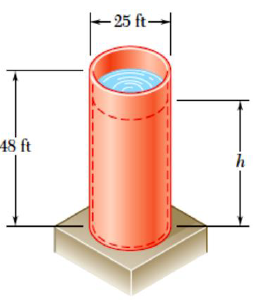
The unpressurized
cylindrical storage tank shown has
a 5mm wall thickness and is made
of steel having a 414 MPa ultimate
strength in tension.
Determine the maximum
height h in ft to which it can be filled
with water if a factor of safety
of 4.0 is desired.
13.8
13.2
14.4
12.4
When the tank is filled to capacity, determine the maximum
normal stress in the cylindrical wall.
109.36
82.02
27.34
54.68
When the tank is filled to capacity, determine the maximum
shearing stress in the cylindrical wall.
54.68
109.36
82.02
27.34
At the tank bottom, $p=\gamma h$ and the controlling hoop stress is $\sigma_h=pD/(2t)$. With allowable stress $414/4=103.5$ MPa, solving for $h$ gives $h=13.8$ ft. At capacity the maximum normal (hoop) stress is $109.36$ MPa; the maximum in-plane shear is half the difference of the principal membrane stresses, $54.68$ MPa. Therefore: 13.8 ft, 109.36 MPa, and 54.68 MPa.
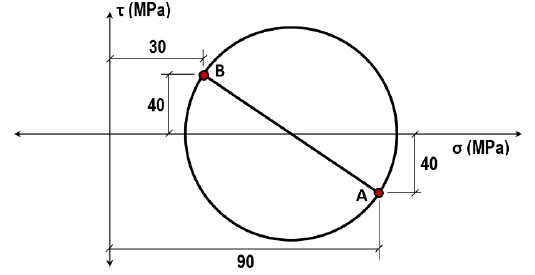
An open-ended thin-walled cylinder is subjected to an
internal pressure, ρ and an axial force, F. The resulting tensile
stresses are in the Mohr’s Circle shown. The
cylinder has a diameter of 500 mm and thickness of 3 mm.
Determine the internal pressure in MPa.
0.12
0.36
1.08
0.48
What is the axial force?
518
141
283
424
Find the maximum shear stress.
50
60
30
40
Read the two principal normal stresses from the given Mohr circle. The hoop stress is related to pressure by $\sigma_h=pD/(2t)$, and the axial stress is $\sigma_a=F/(\pi Dt)$. Substitution of $D=500$ mm and $t=3$ mm gives $p=0.12$ MPa and $F=518$ kN. The Mohr-circle radius gives $\tau_{max}=50$ MPa. Therefore: 0.12 MPa, 518 kN, and 50 MPa.