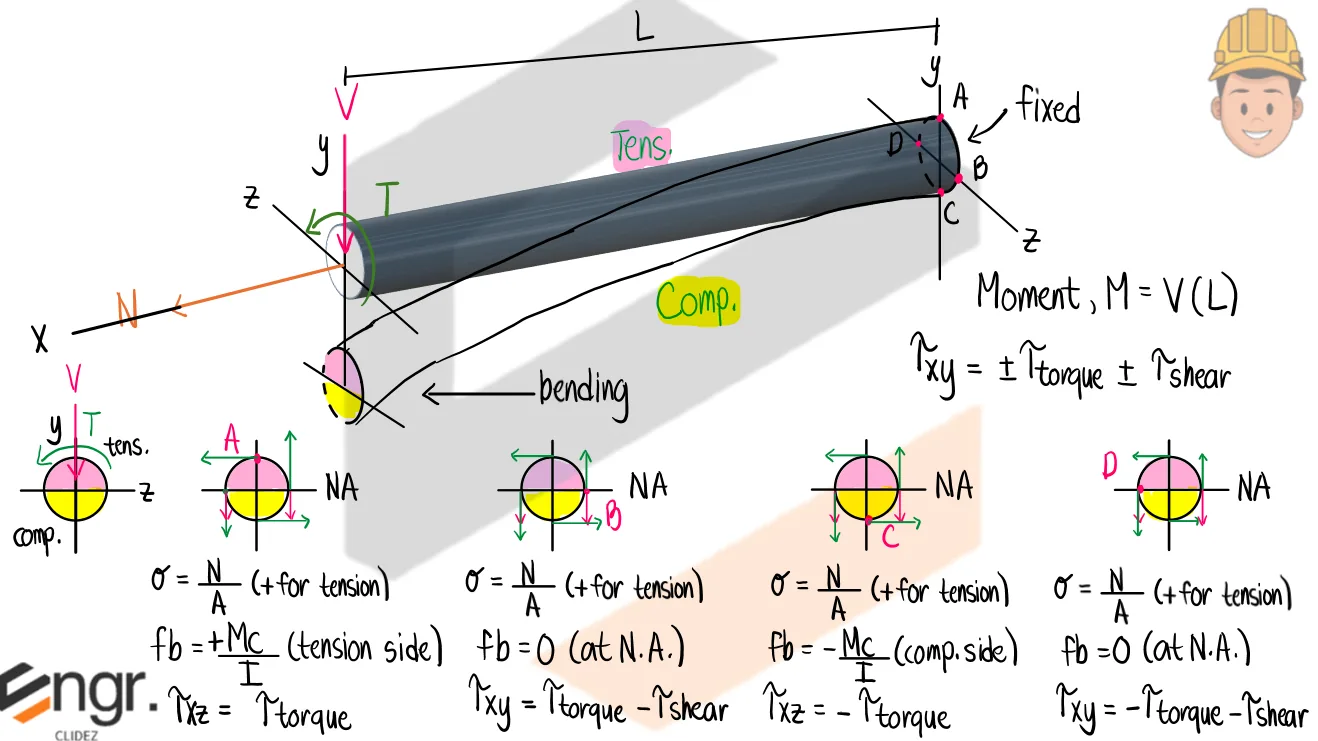
A wood cantilever beam of rectangular cross-section and length L = 2.0m supports an inclined load P = 575N at its free end. Determine the maximum tensile stress and the angle of the neutral axis from the horizontal. Given: b × h = 80mm x 140mm; α=30°. Determine also the minimum compressive stress at the corners.
1. Nature of the Problem
The load is inclined on the face of the cross-section. Therefore, it has
two transverse components:
$$
P_z = P\cos\alpha
$$
$$
P_y = P\sin\alpha
$$
These two components cause bending about two centroidal axes of the
rectangular section. The horizontal component bends the beam about the
vertical centroidal axis, while the vertical component bends the beam about
the horizontal centroidal axis.
2. Section Properties
For a rectangular cross-section, the centroidal moments of inertia are:
$$
I_y = \frac{hb^3}{12}
$$
$$
I_z = \frac{bh^3}{12}
$$
Substituting b = 80 mm and h = 140 mm:
$$
I_y = \frac{140(80)^3}{12}
= 5.973 \times 10^6 \ \text{mm}^4
$$
$$
I_z = \frac{80(140)^3}{12}
= 18.293 \times 10^6 \ \text{mm}^4
$$
3. Maximum Tensile Stress
The maximum tensile stress occurs at the corner where the bending stresses
from the two moment components add.
The bending stress due to a rectangular section can also be written using
the section modulus form:
$$
f_b = \frac{6M}{bd^2}
$$
For the given inclined force, the two moment components are produced by
$P\cos30^\circ$ and $P\sin30^\circ$. Since the cantilever length is
2.0 m = 2000 mm, the combined maximum tensile stress is:
$$
f_{bt}
=
\frac{6(P\cos30^\circ)(2000)}{140(80)^2}
+
\frac{6(P\sin30^\circ)(2000)}{80(140)^2}
$$
$$
f_{bt}
=
\frac{6(575\cos30^\circ)(2000)}{140(80)^2}
+
\frac{6(575\sin30^\circ)(2000)}{80(140)^2}
$$
$$
f_{bt}
=
8.86942 \ \text{MPa}
$$
Therefore:
$$
\boxed{f_{bt} = 8.87 \ \text{MPa}}
$$
4. Meaning of the Neutral Axis
The neutral axis is the line on the cross-section where the bending stress
is zero. On one side of this line, the section is in tension. On the other
side, the section is in compression.
Since the load is inclined, the beam bends about both centroidal axes. As a
result, the neutral axis is not simply horizontal or vertical. It becomes an
inclined line passing through the centroid of the cross-section.
The phrase angle of the neutral axis from the horizontal means the
angle measured from the horizontal centroidal axis of the cross-section to
the neutral axis.
5. Why the Slope is y/z
The neutral axis is drawn on the cross-section. In this cross-section, the
horizontal coordinate is z, and the vertical coordinate is y.
For any line drawn on a coordinate plane, the slope is:
$$
\text{slope}
=
\frac{\text{vertical change}}{\text{horizontal change}}
$$
Since the vertical coordinate is y and the horizontal coordinate is
z, the slope of the neutral axis is:
$$
m = \frac{y}{z}
$$
Also, the slope of a line is related to its angle from the horizontal by:
$$
m = \tan\theta
$$
Therefore, for the neutral axis:
$$
\tan\theta = \frac{y}{z}
$$
6. Neutral Axis Equation
The general flexural stress equation for biaxial bending is:
$$
f_b
=
\frac{M_z}{I_z}y
+
\frac{M_y}{I_y}z
$$
Along the neutral axis, the bending stress is zero:
$$
0
=
\frac{M_z}{I_z}y
+
\frac{M_y}{I_y}z
$$
Rearranging:
$$
\frac{M_z}{I_z}y
=
-\frac{M_y}{I_y}z
$$
$$
\frac{y}{z}
=
-\frac{M_y I_z}{M_z I_y}
$$
The negative sign only indicates the direction of the slope. For the angle
magnitude of the neutral axis from the horizontal:
$$
\tan\theta
=
\left|\frac{y}{z}\right|
=
\frac{M_y I_z}{M_z I_y}
$$
7. Substitution for the Neutral Axis Angle
The moment components are proportional to the force components:
$$
M_y = (P\cos30^\circ)L
$$
$$
M_z = (P\sin30^\circ)L
$$
Therefore:
$$
\tan\theta
=
\frac{
\dfrac{(P\cos30^\circ)(2000)}{\dfrac{140(80)^3}{12}}
}{
\dfrac{(P\sin30^\circ)(2000)}{\dfrac{80(140)^3}{12}}
}
$$
The common terms P and 2000 cancel, so:
$$
\tan\theta
=
\frac{
\dfrac{\cos30^\circ}{\dfrac{140(80)^3}{12}}
}{
\dfrac{\sin30^\circ}{\dfrac{80(140)^3}{12}}
}
$$
$$
\theta
=
\tan^{-1}\left(\frac{49\sqrt{3}}{16}\right)
$$
$$
\theta = 79.32376^\circ
$$
Therefore:
$$
\boxed{\theta = 79.3^\circ}
$$
8. Final Answers
$$
\boxed{f_{bt,\max} = 8.87 \ \text{MPa}}
$$
$$
\boxed{\theta = 79.3^\circ \text{ from the horizontal}}
$$
Board Exam Reminder
Do not confuse the load angle with the neutral axis angle. The load is
inclined at 30°, but the neutral axis is inclined at
79.3° from the horizontal. They are different because the
rectangular section has unequal moments of inertia about its two centroidal
axes.
8. Corner Stresses and Minimum Compressive Stress
The maximum tensile stress occurs at the corner where the two bending stress
components add as tension. The maximum compressive stress occurs at the
opposite corner where the two bending stress components add as compression.
However, the other two corners are mixed-stress corners. At these corners,
one bending component gives tension while the other gives compression.
Therefore, the stresses are obtained by subtracting the two component
stresses.
$$
f_1 =
\frac{6(P\cos30^\circ)(2000)}{140(80)^2}
$$
$$
f_1 =
\frac{6(575\cos30^\circ)(2000)}{140(80)^2}
=
6.669 \ \text{MPa}
$$
$$
f_2 =
\frac{6(P\sin30^\circ)(2000)}{80(140)^2}
$$
$$
f_2 =
\frac{6(575\sin30^\circ)(2000)}{80(140)^2}
=
2.200 \ \text{MPa}
$$
Thus, the four corner stresses are:
$$
f_A = +f_1 + f_2
=
6.669 + 2.200
=
+8.869 \ \text{MPa}
$$
$$
f_B = -f_1 - f_2
=
-6.669 - 2.200
=
-8.869 \ \text{MPa}
$$
$$
f_C = +f_1 - f_2
=
6.669 - 2.200
=
+4.469 \ \text{MPa}
$$
$$
f_D = -f_1 + f_2
=
-6.669 + 2.200
=
-4.469 \ \text{MPa}
$$
Therefore, the maximum tensile stress is:
$$
\boxed{f_{t,\max} = 8.87 \ \text{MPa}}
$$
The maximum compressive stress is:
$$
\boxed{f_{c,\max} = -8.87 \ \text{MPa}}
$$
If the question asks for the minimum compressive stress among the corner
stresses, use the smaller negative value:
$$
\boxed{f_{c,\min} = -4.47 \ \text{MPa}}
$$
In magnitude form:
$$
\boxed{f_{c,\min} = 4.47 \ \text{MPa compression}}
$$
If the question instead asks for the minimum tensile stress among the corner
stresses, use the smaller positive value:
$$
\boxed{f_{t,\min} = 4.47 \ \text{MPa}}
$$
Note that if the entire cross-section is considered, the stress becomes zero
along the neutral axis. Therefore, the theoretical minimum compression in the
section is zero at the neutral axis. But among the corner stresses, the
minimum compressive stress is 4.47 MPa compression.