CE Board Exam Randomizer

⬅ Back to Subject Topics

Curvature and Refraction

Concept Concept Concept Concept Concept Concept Concept Concept Concept

Problem:

Refer to the image shown:

Curvature and Refraction | Fundamentals of Surveying – Problem 1: – Diagram Curvature and Refraction | Fundamentals of Surveying – Problem 1: – Diagram Curvature and Refraction | Fundamentals of Surveying – Problem 1: – Diagram

See images:

Curvature and Refraction | Fundamentals of Surveying – Problem 1: – Diagram Curvature and Refraction | Fundamentals of Surveying – Problem 1: – Diagram Curvature and Refraction | Fundamentals of Surveying – Problem 1: – Diagram Curvature and Refraction | Fundamentals of Surveying – Problem 1: – Diagram

Problem:

Refer to the image shown:

Curvature and Refraction | Fundamentals of Surveying – Problem 2: – Diagram Curvature and Refraction | Fundamentals of Surveying – Problem 2: – Diagram Curvature and Refraction | Fundamentals of Surveying – Problem 2: – Diagram

See images:

Curvature and Refraction | Fundamentals of Surveying – Problem 2: – Diagram Curvature and Refraction | Fundamentals of Surveying – Problem 2: – Diagram Curvature and Refraction | Fundamentals of Surveying – Problem 2: – Diagram Curvature and Refraction | Fundamentals of Surveying – Problem 2: – Diagram

Problem:

Refer to the image shown:

Curvature and Refraction | Fundamentals of Surveying – Problem 3: – Diagram Curvature and Refraction | Fundamentals of Surveying – Problem 3: – Diagram Curvature and Refraction | Fundamentals of Surveying – Problem 3: – Diagram

See images:

Curvature and Refraction | Fundamentals of Surveying – Problem 3: – Diagram Curvature and Refraction | Fundamentals of Surveying – Problem 3: – Diagram Curvature and Refraction | Fundamentals of Surveying – Problem 3: – Diagram Curvature and Refraction | Fundamentals of Surveying – Problem 3: – Diagram

Problem:

Refer to the image shown:

Curvature and Refraction | Fundamentals of Surveying – Problem 4: – Diagram Curvature and Refraction | Fundamentals of Surveying – Problem 4: – Diagram Curvature and Refraction | Fundamentals of Surveying – Problem 4: – Diagram

See images:

Curvature and Refraction | Fundamentals of Surveying – Problem 4: – Diagram Curvature and Refraction | Fundamentals of Surveying – Problem 4: – Diagram Curvature and Refraction | Fundamentals of Surveying – Problem 4: – Diagram Curvature and Refraction | Fundamentals of Surveying – Problem 4: – Diagram

Problem:

Refer to the image shown:

Curvature and Refraction | Fundamentals of Surveying – Problem 5: – Diagram Curvature and Refraction | Fundamentals of Surveying – Problem 5: – Diagram Curvature and Refraction | Fundamentals of Surveying – Problem 5: – Diagram

See images:

Curvature and Refraction | Fundamentals of Surveying – Problem 5: – Diagram Curvature and Refraction | Fundamentals of Surveying – Problem 5: – Diagram Curvature and Refraction | Fundamentals of Surveying – Problem 5: – Diagram Curvature and Refraction | Fundamentals of Surveying – Problem 5: – Diagram

Problem:

Refer to the image shown:

Curvature and Refraction | Fundamentals of Surveying – Problem 6: – Diagram Curvature and Refraction | Fundamentals of Surveying – Problem 6: – Diagram Curvature and Refraction | Fundamentals of Surveying – Problem 6: – Diagram

See images:

Curvature and Refraction | Fundamentals of Surveying – Problem 6: – Diagram Curvature and Refraction | Fundamentals of Surveying – Problem 6: – Diagram Curvature and Refraction | Fundamentals of Surveying – Problem 6: – Diagram Curvature and Refraction | Fundamentals of Surveying – Problem 6: – Diagram

Problem:

Refer to the image shown:

Curvature and Refraction | Fundamentals of Surveying – Problem 7: – Diagram Curvature and Refraction | Fundamentals of Surveying – Problem 7: – Diagram Curvature and Refraction | Fundamentals of Surveying – Problem 7: – Diagram

See images:

Curvature and Refraction | Fundamentals of Surveying – Problem 7: – Diagram Curvature and Refraction | Fundamentals of Surveying – Problem 7: – Diagram Curvature and Refraction | Fundamentals of Surveying – Problem 7: – Diagram Curvature and Refraction | Fundamentals of Surveying – Problem 7: – Diagram

Problem:

Refer to the image shown:

Curvature and Refraction | Fundamentals of Surveying – Problem 8: – Diagram Curvature and Refraction | Fundamentals of Surveying – Problem 8: – Diagram Curvature and Refraction | Fundamentals of Surveying – Problem 8: – Diagram

See images:

Curvature and Refraction | Fundamentals of Surveying – Problem 8: – Diagram Curvature and Refraction | Fundamentals of Surveying – Problem 8: – Diagram Curvature and Refraction | Fundamentals of Surveying – Problem 8: – Diagram Curvature and Refraction | Fundamentals of Surveying – Problem 8: – Diagram

Exam Generator Problems

Additional board-style practice items for this topic.

Question Bank: t56

MSTE - Surveying / Curvature and Refraction / Civil Engineering Refresher

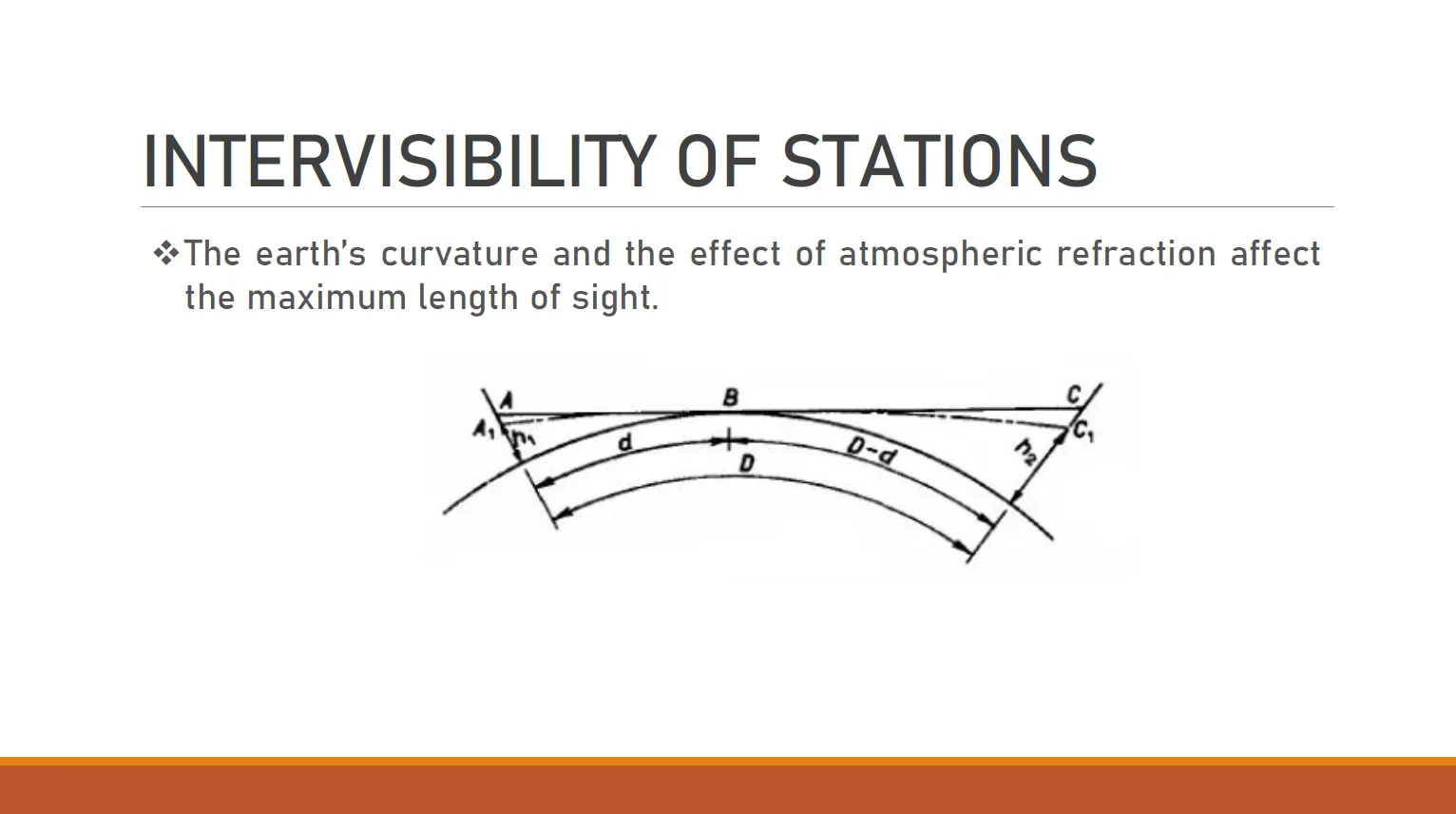
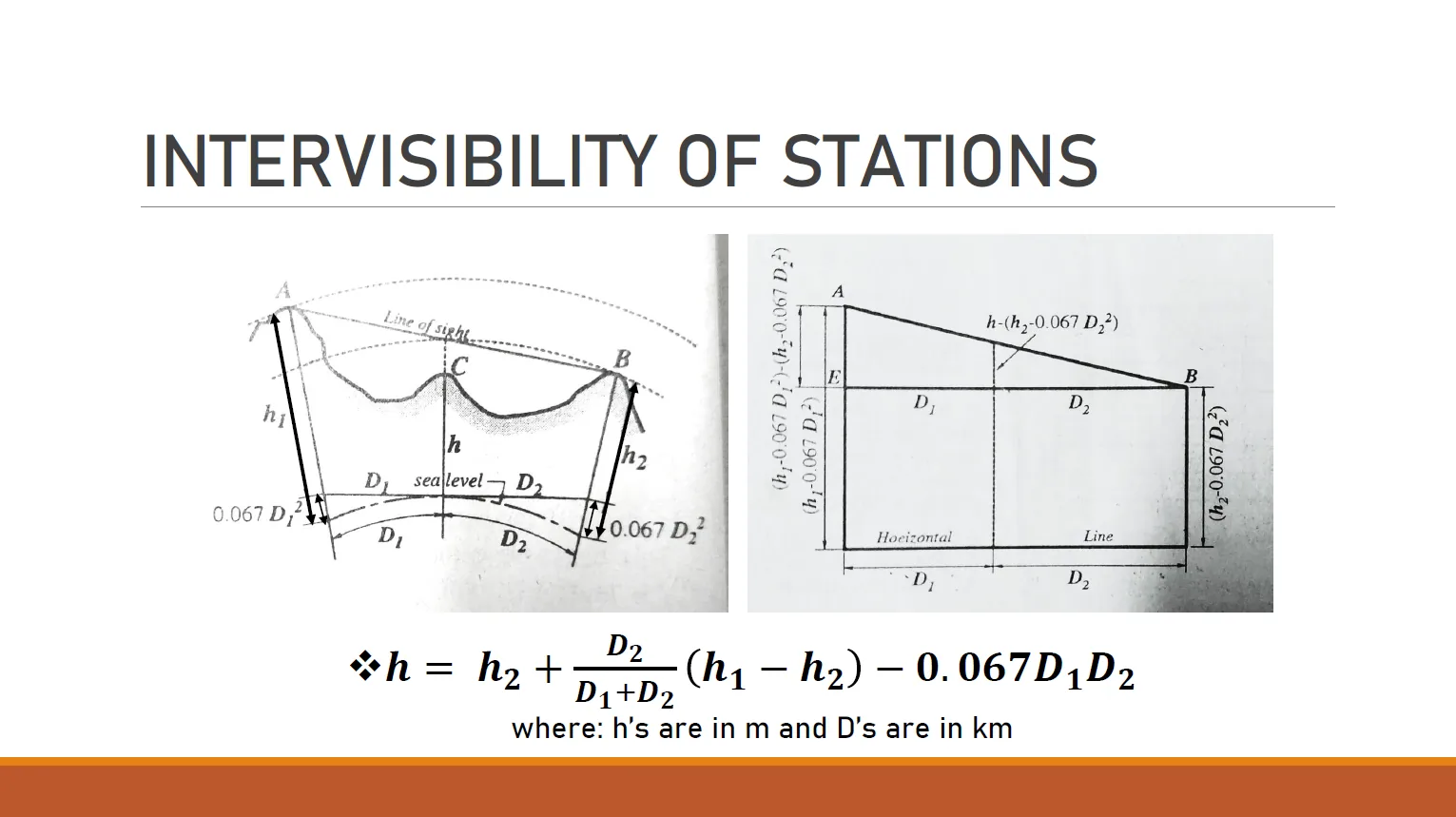
Two hills 90 km apart have elevations 60 m and 200 m. Find the minimum tower height at B to be visible from A.

  1. 41.60 m
  2. 35.20 m
  3. 48.10 m
  4. 20.65 m
Combined curvature + refraction: $h = 0.067D^2$ ($h$ in m, $D$ in km).
$D_A = \sqrt{\frac{60}{0.067}} = 29.9$ km. Remaining $= 90 - 29.9 = 60.1$ km.
$h_B = 0.067(60.1)^2 = 242$ m.
Tower $= 242 - 200$
$\boxed{\approx 41.60 \text{ m}}$

Question Bank: w88

MSTE - Surveying / Curvature and Refraction / MSTE November 2019

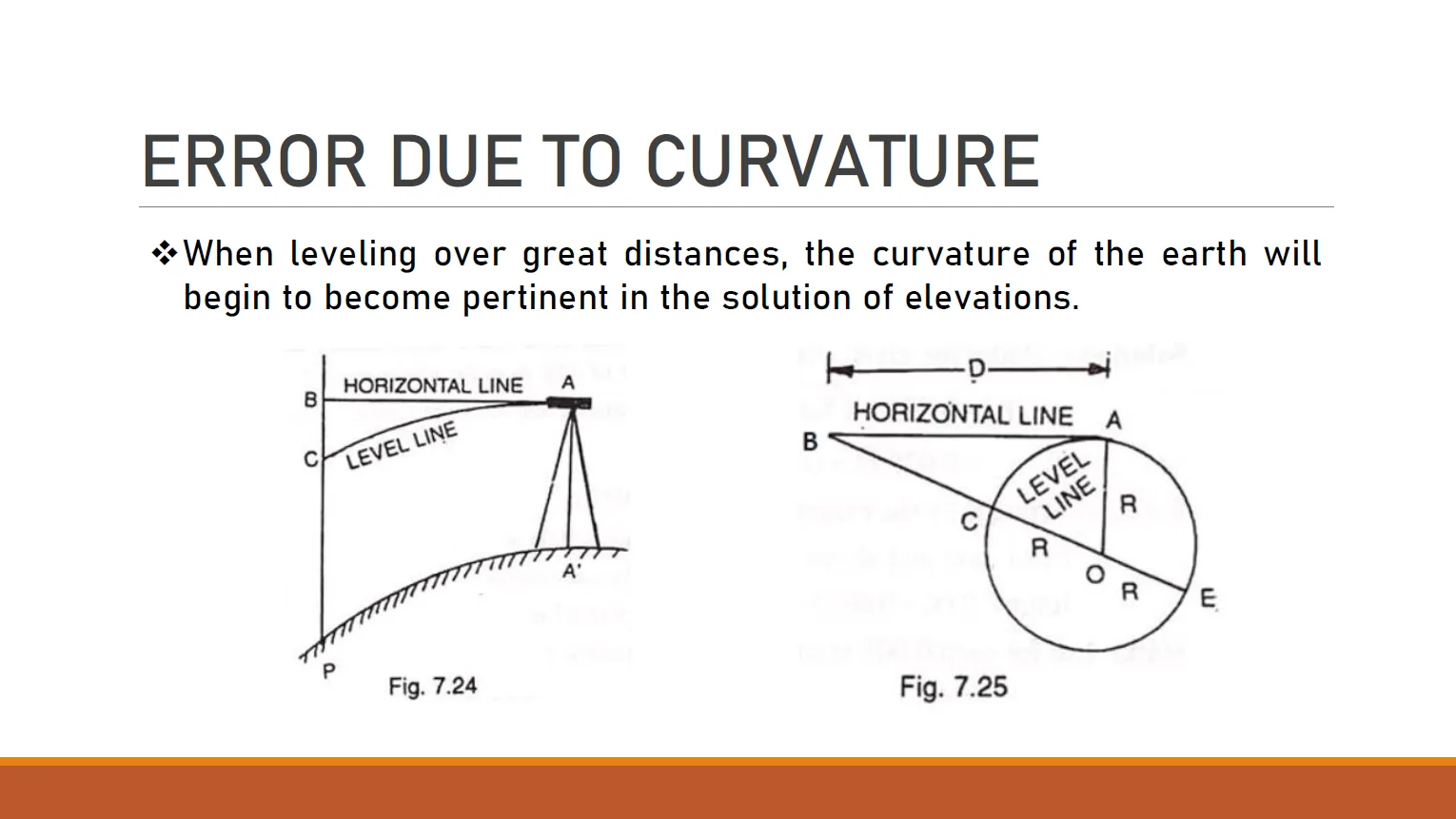
The slope distance and zenith angle between points $A$ and $B$ were observed with a total station instrument as 9585.26 feet and $81^\circ 42' 20''$, respectively. The H.I. and rod readings $r$ were equal. If the elevation of $A$ is 1238.42 ft, compute the elevation of $B$, considering the effect of curvature and refraction. Hint: $H_{cr} = 0.0206M^2$ where $M$ is in thousands of feet.
  1. 2,621 feet
  2. 2,612 feet
  3. 1,632 feet
  4. 2,623 feet
Vertical angle $\alpha = 90^\circ - 81^\circ 42' 20'' = 8^\circ 17' 40''$.
Horizontal distance: $M = 9585.26\cos 8^\circ 17' 40'' = 9{,}484.996$ ft.
Vertical rise: $h = 9585.26\sin 8^\circ 17' 40'' = 1{,}382.77$ ft.
Curvature–refraction correction: $H_{cr} = 0.0206\left(\dfrac{9484.996}{1000}\right)^2 = 1.853$ ft.
Since H.I. $= r$, those terms cancel:
Elev $B = 1238.42 + H_{cr} + h = 1238.42 + 1.853 + 1382.77$
$\boxed{\text{Elev }B = 2{,}623.04\text{ ft} \approx 2{,}623\text{ feet}}$
Scroll to zoom