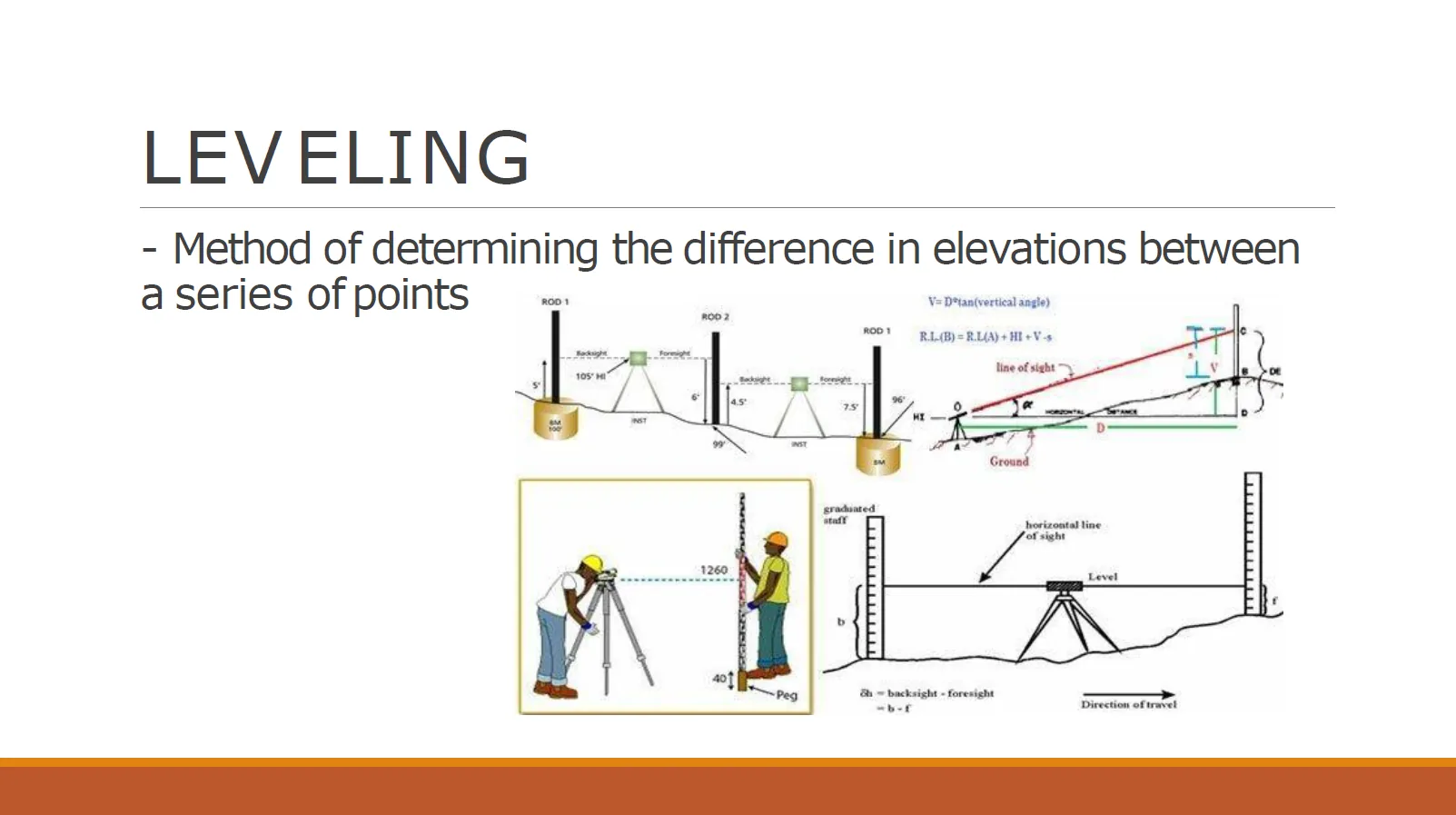
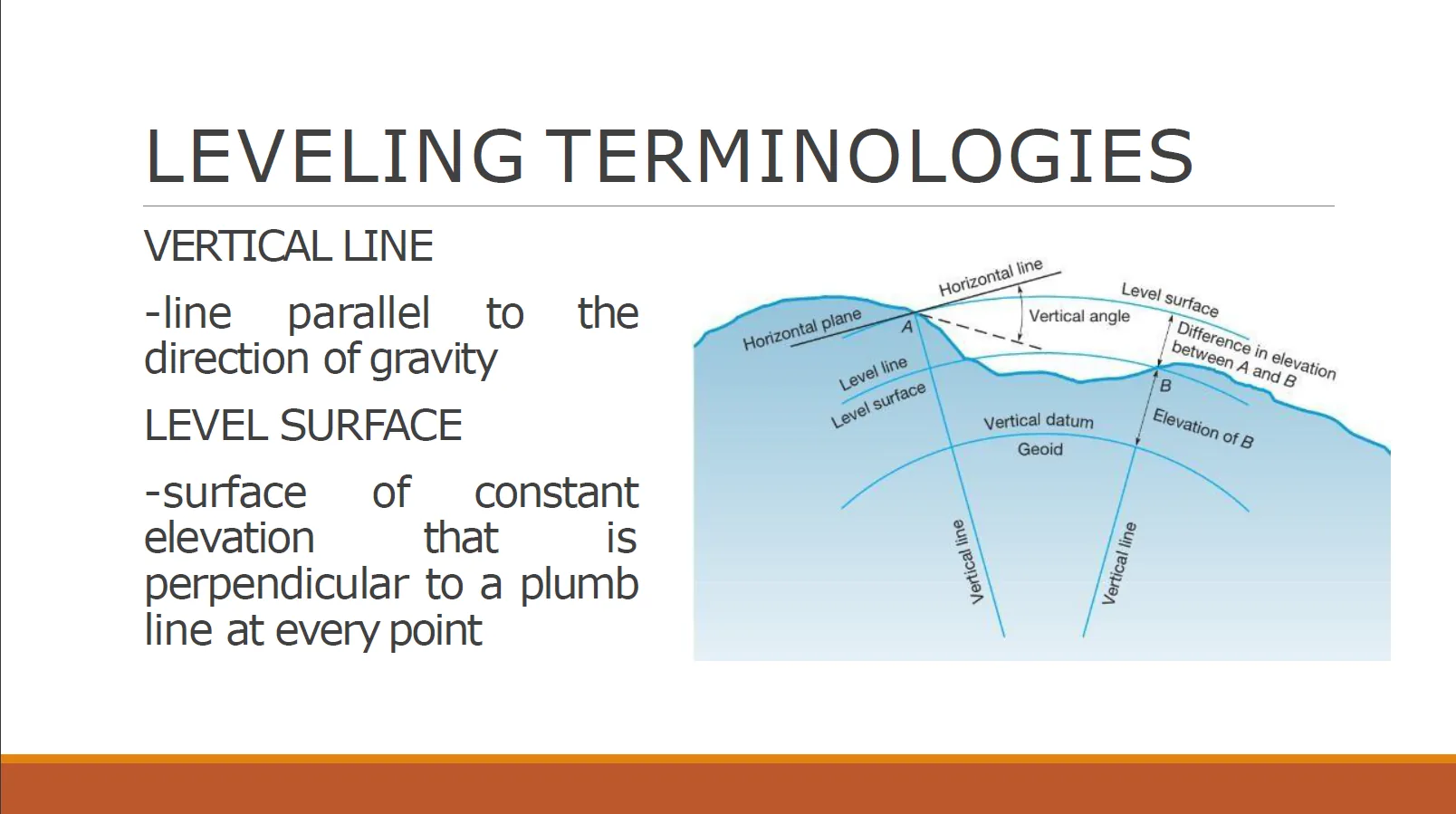
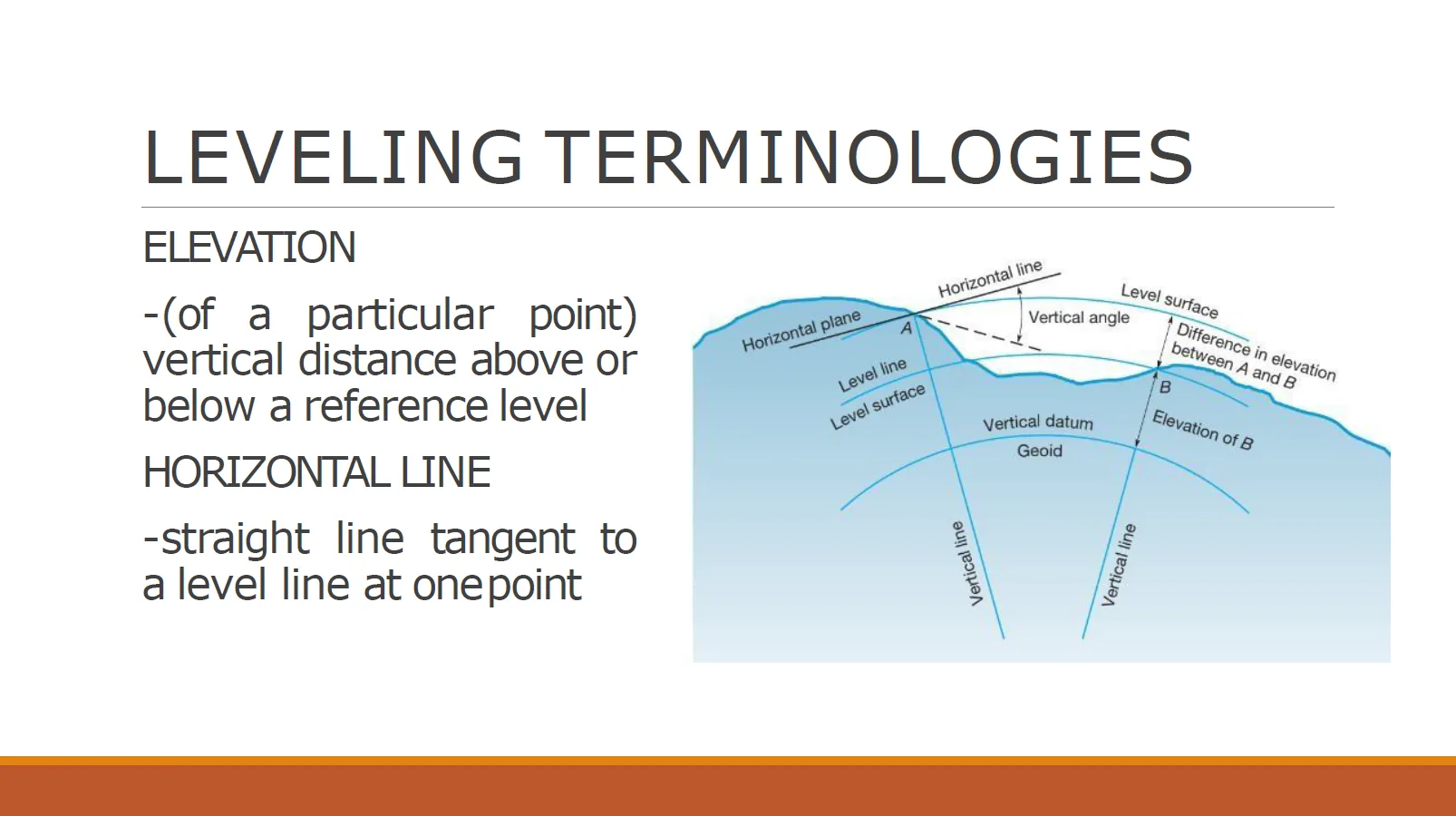
Leveling
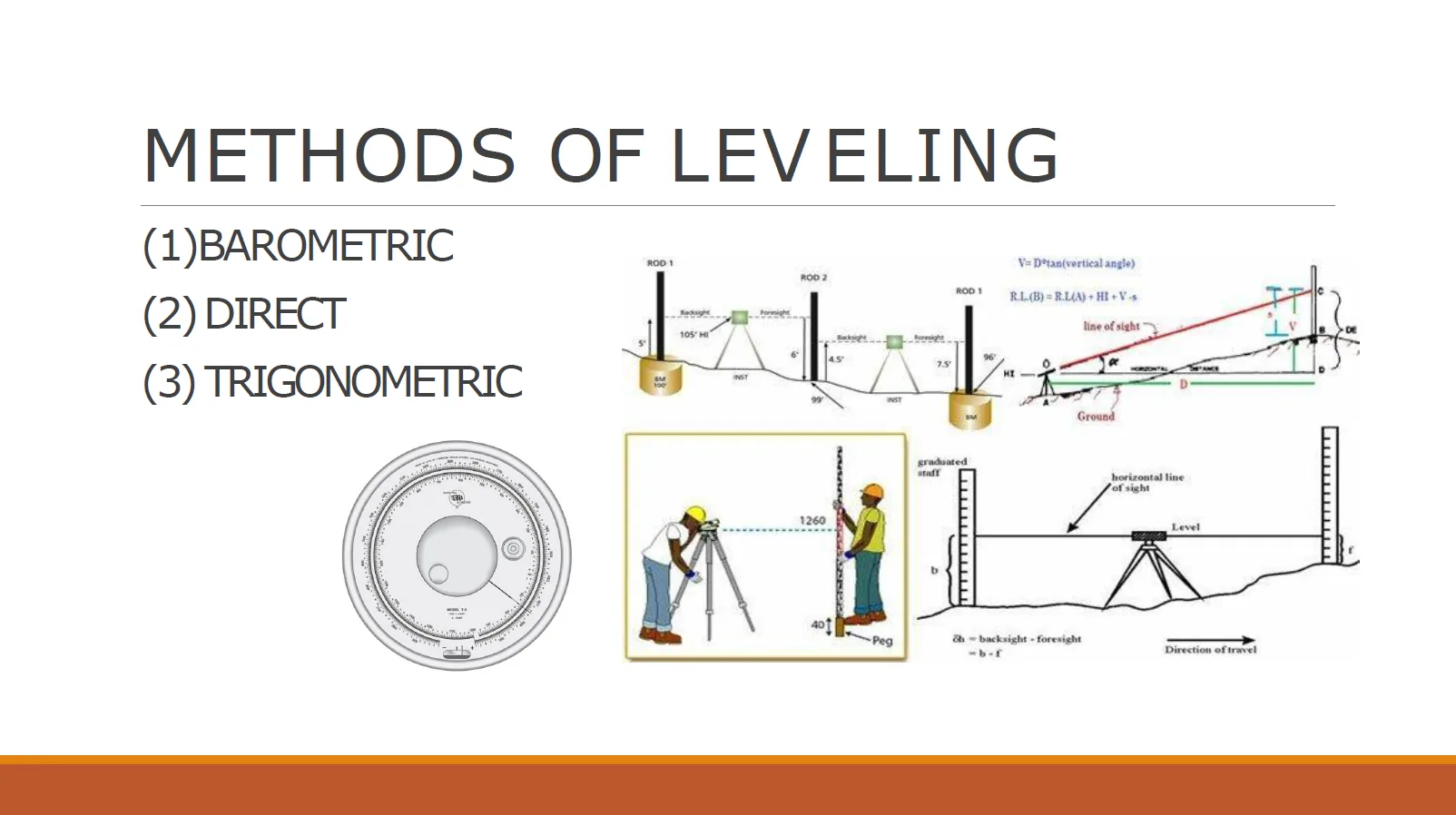

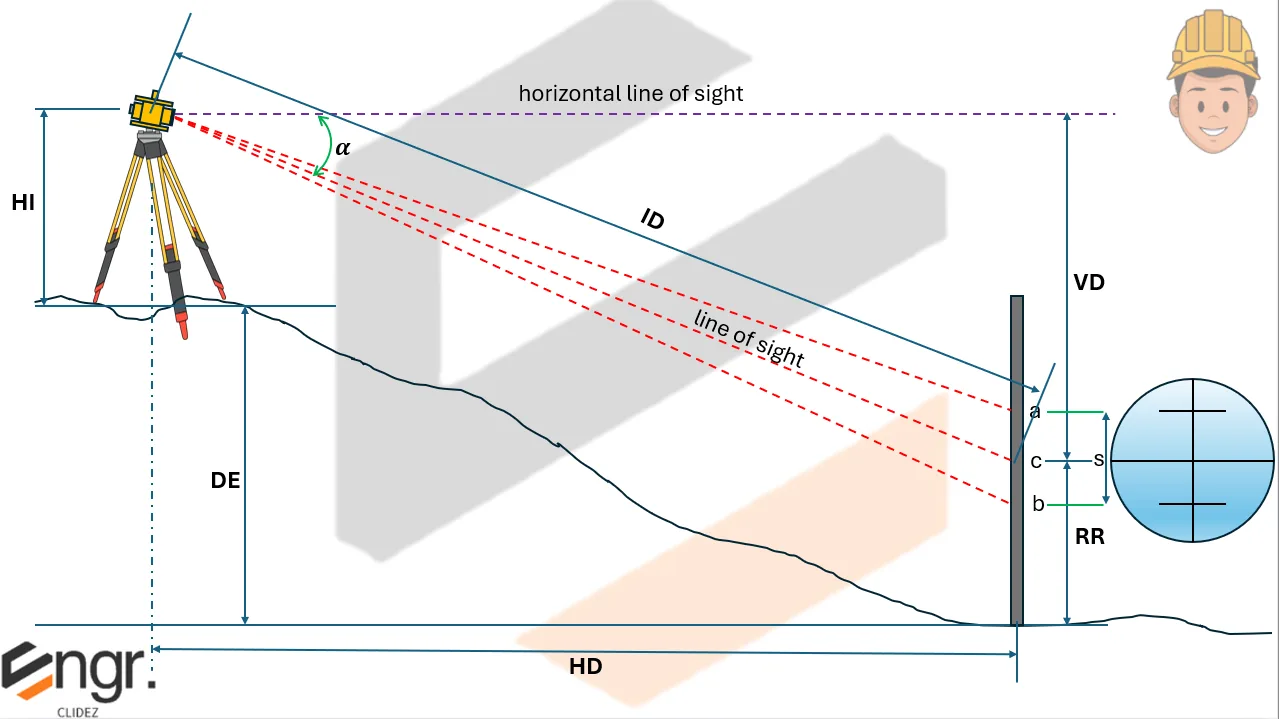
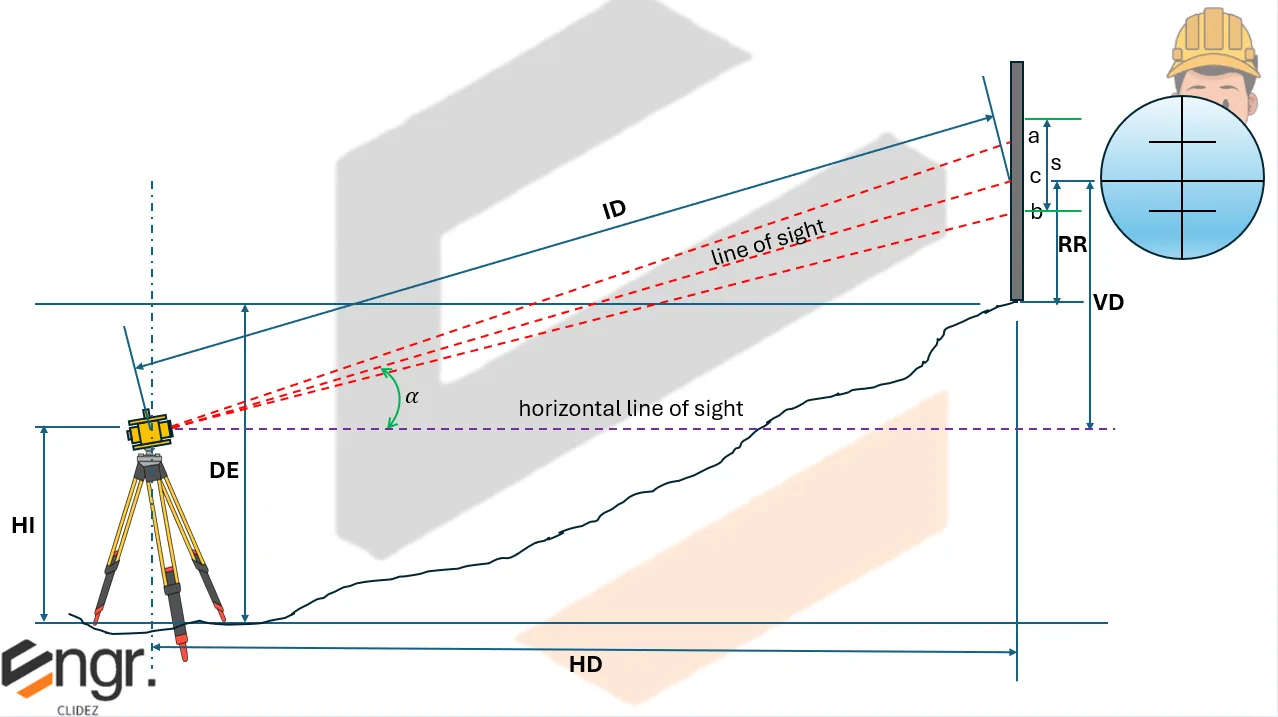
f=focal length
C=f+c=stadia constant
i=distance between stadia hairs
The upper and lower stadia hair readings on a stadia rod held at station B were observed as 3.50m and 1.00m, respectively, with the use of a transit with an internal focusing telescope. The stadia interval factor is 99.50. The height of the instrument above station A is 1.45m and the rod reading is taken at 2.25m. If the vertical angle observed is -23°34', determine the:
a. Horizontal distance from the instrument to the station sighted
b. Vertical distance from the instrument to the station sighted
c. Inclined distance from the instrument to the station sighted
d. Difference in elevation between stations A and B
e. Elvation of station B if the elevation of station A is 155.54m amsl.


a. 208.99m
b. 91.16m
c. 228m
d. 91.96m
e. 63.58m


A transit with a stadia constant equal to 0.30 is used to determine the horizontal distance between points B and C, with a stadia intercept reading of 1.85m. The distance BC is equal to 182.87m.
a. Compute the stadia interval factor of the instrument.
b. Using the same instrument, the difference in elevation between B and D is to be determined. The stadia intercept reading is 2.42m at D at a vertical angle of 6°30'. The height of the instrument is 1.50, and the rod reading at D is 2.36m. Compute the difference in elevation of B and D.


See images:


Additional board-style practice items for this topic.
A level rod reading changes from 1.93 to 2.01 m over 100 m after 5 tube spaces. Find the radius of curvature (1 space = 0.6 mm).
Leveling BM1 to BM2 (30 km), sight is inclined 0.003 m up per 100 m. Recorded BM2 is 274.11 m. Find corrected elevation.
Solution pending in psadquestions/t59.json.
A bubble tube reading changes 0.08 m over 100 m with 6 spaces. Find the sensitivity in seconds.
A line of levels 9.36 km is run to check the elevation of BM2 which has been found to be 24.258 m, with BM1 of elevation at sea level (reference datum). If the backsight and foresight distances are consistently 110 m and 70 m, respectively, determine the corrected elevation of BM2 considering the effects of curvature and refraction of the earth.
Solution pending in psadquestions/t1120.json.
In the two-peg test of a dumpy level, the following observations were taken: Instrument at X (Rod Reading on X = 1.506, Rod Reading on Y = 2.024); Instrument at Y (Rod Reading on X = 0.815, Rod Reading on Y = 1.449). What is the correct difference in elevation between X and Y?
Solution pending in psadquestions/t1122.json.
Given the following field notes for a differential leveling. All units are in meters. [Station BM1: BS v, HI 236.46, Elev 235.21; Station A: BS 0.98, HI 235.99, FS 1.45, Elev w; Station B: BS x, HI 234.30, FS 2.12, Elev 233.87; Station C: BS 0.23, HI 232.66, FS 1.87, Elev 232.43; Station D: BS 0.45, HI y, FS 1.32, Elev 231.34; Station E: BS 0.76, HI 230.23, FS 2.32, Elev z; Station F: BS 0.21, HI 228.63, FS 1.81, Elev 228.42; Station BM2: FS 2.34, Elev 226.29].
What is the value of x?
What is the value of y?
What is the value of z?
Solution pending in psadquestions/t1123.json.
Answer the following questions:
This type of leveling is used to produce ground profiles for use in the design of roads, railways and pipelines.
Survey line at the high water mark on navigable lakes and streams; the line at which continuous vegetation ends and sandy or muddy shore begins.
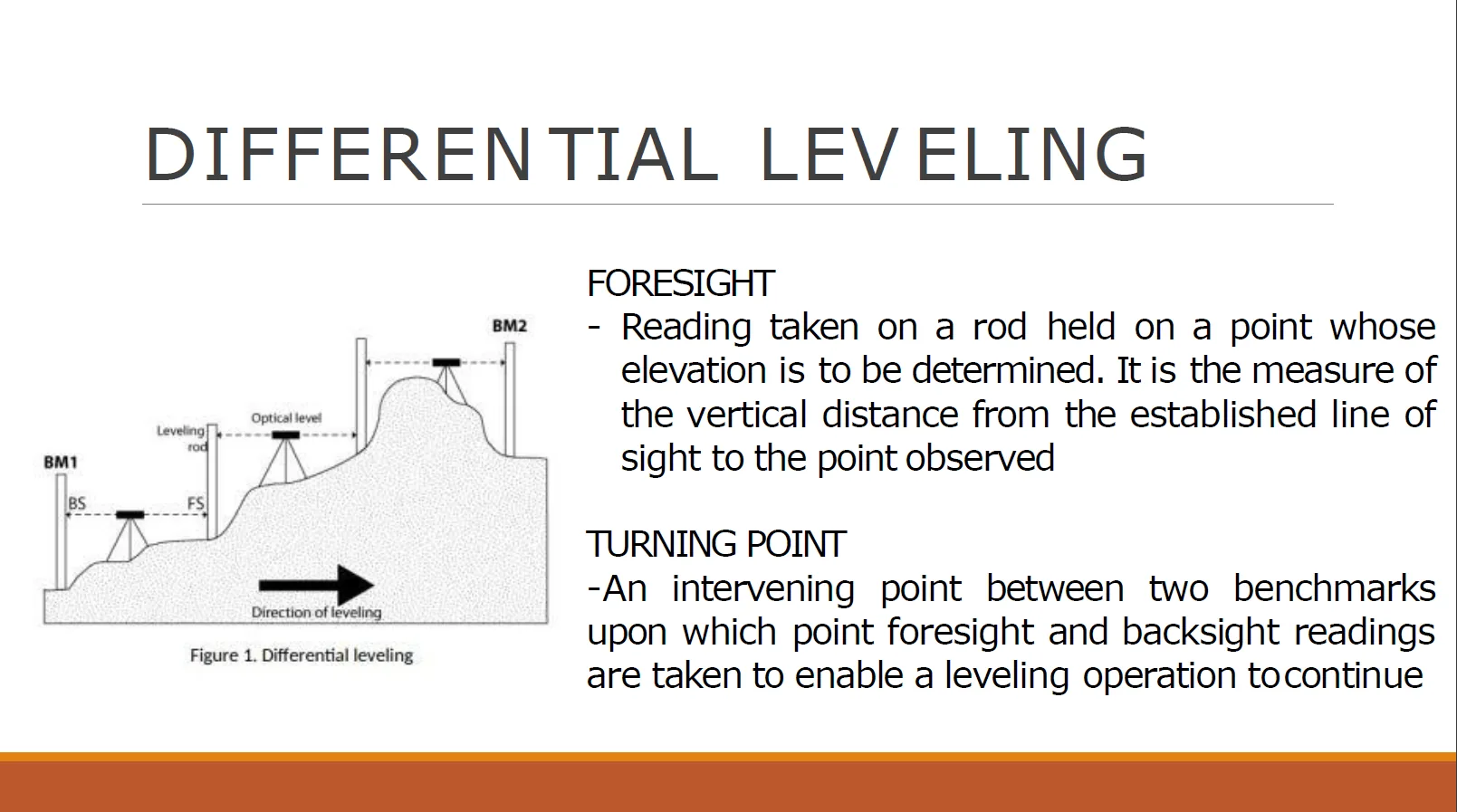
Fixed point or object, often temporary in character, used in leveling where the rod is held first for a foresight and then for a backsight.
The highest point reached by an astronomical object.
Solution pending in psadquestions/t1184.json.
Fixed point or object, often temporary in character, used in leveling where the rod is held first for a foresight and then for a backsight.
Solution pending in psadquestions/t1349.json.