CE Board Exam Randomizer

⬅ Back to Subject Topics

Departures and Latitudes
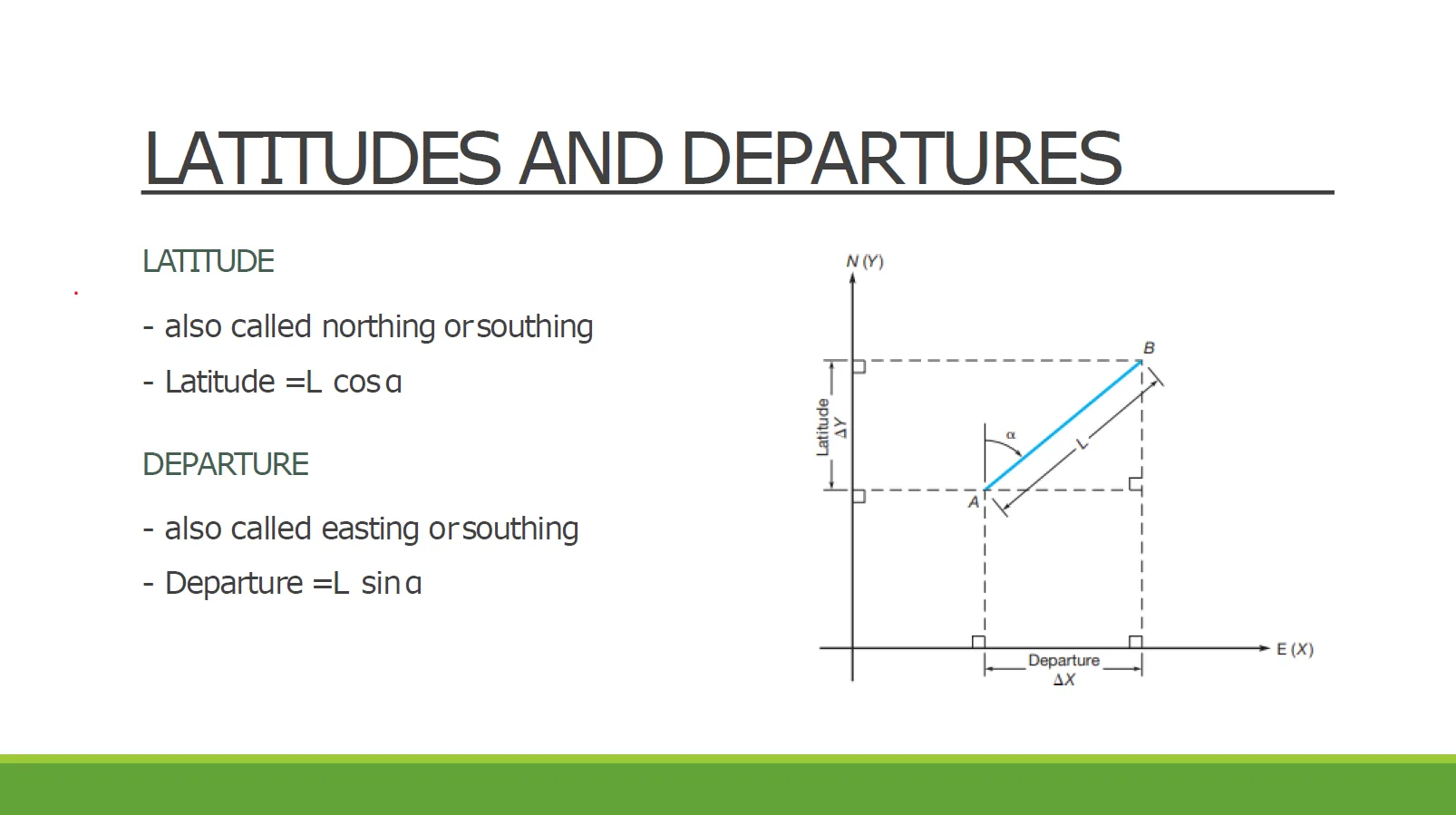
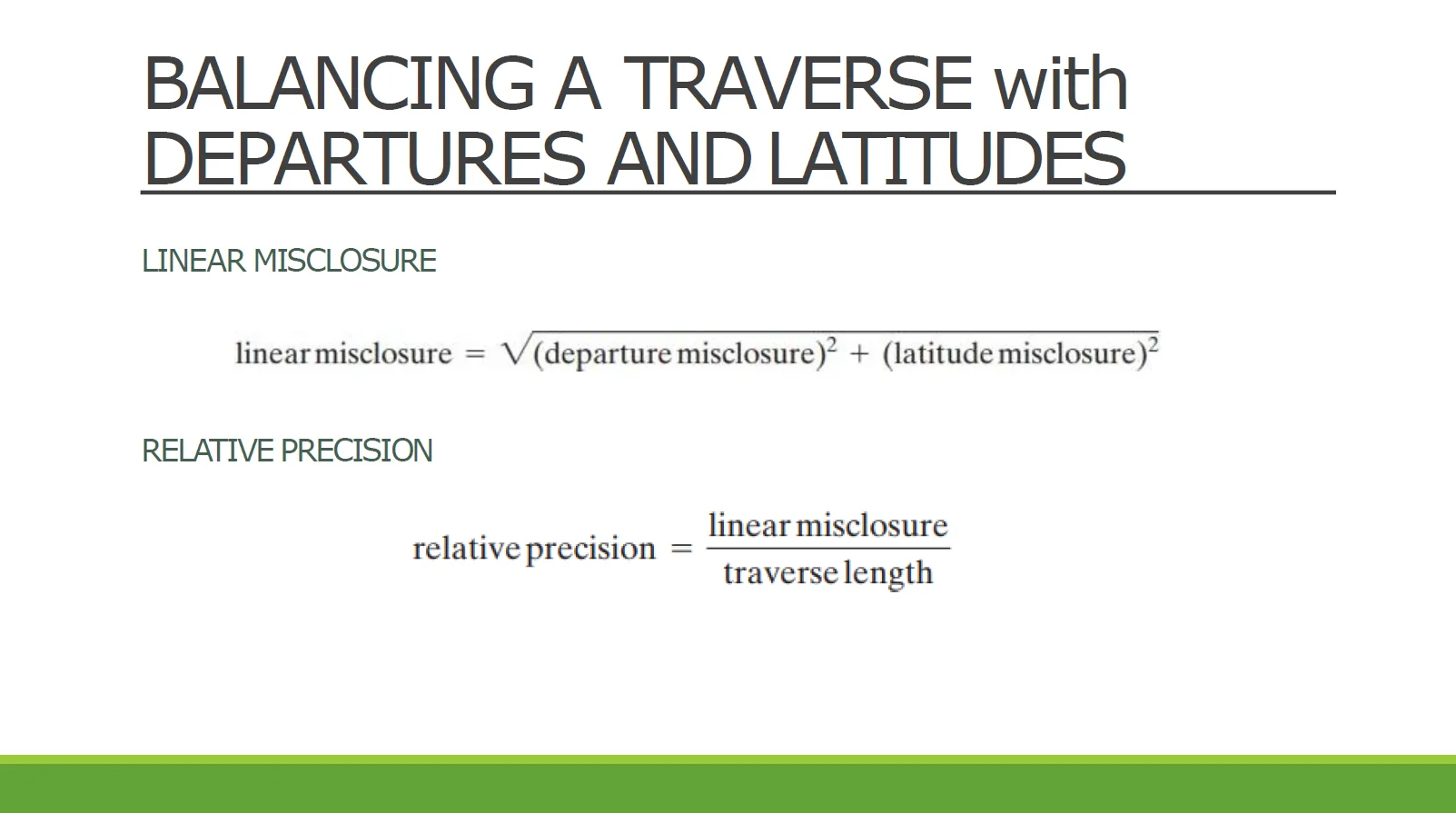
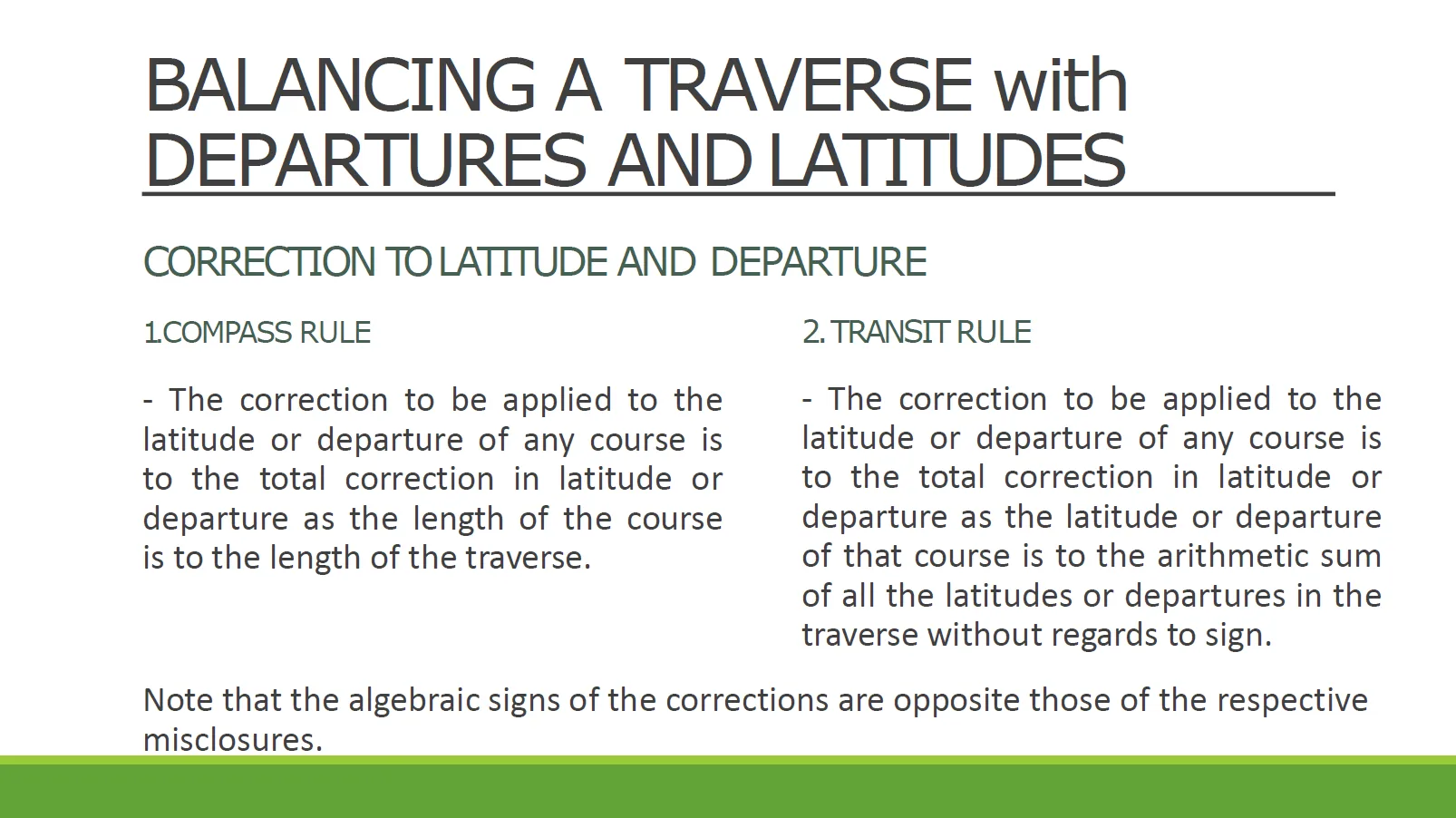
Concept Concept Concept Concept Concept Concept Concept Concept Concept

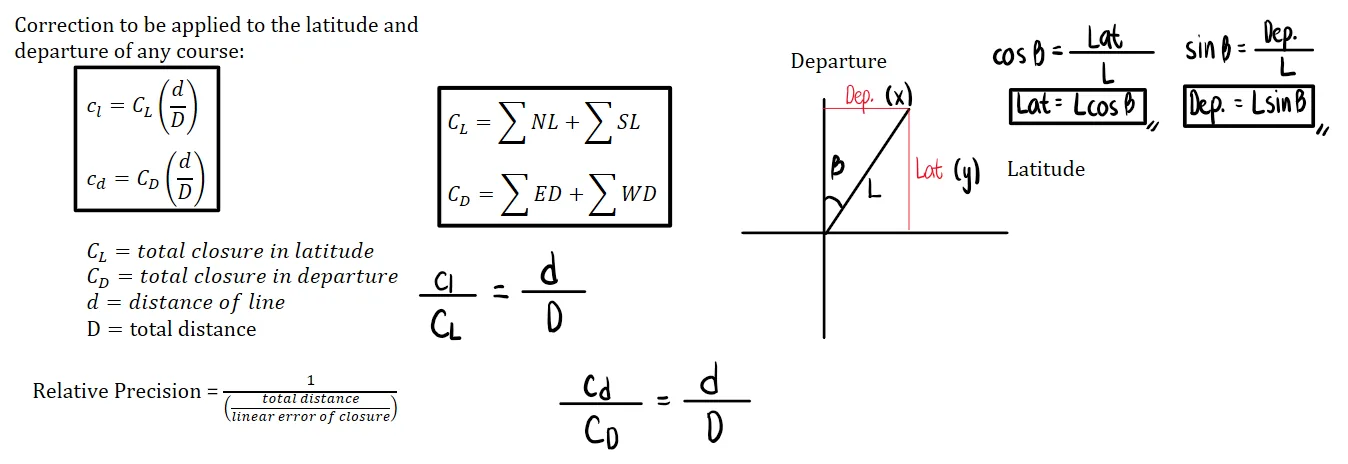
Correction Formula for Compass Rule

Concept

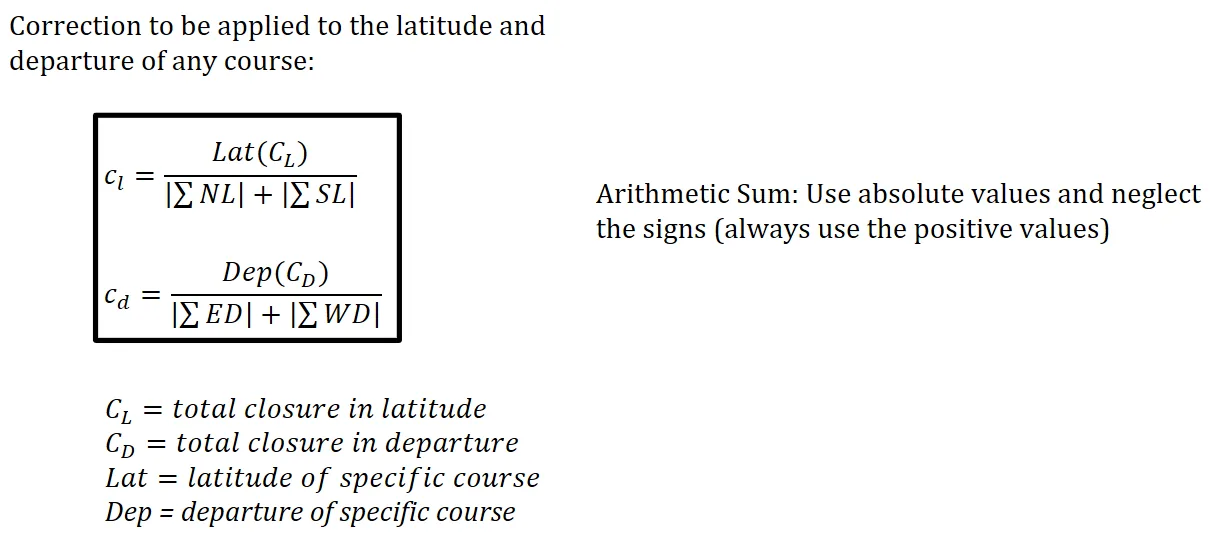
Correction Formula for Transit Rule

Concept

Problem: Compass Rule | Correction of Distances and Bearings

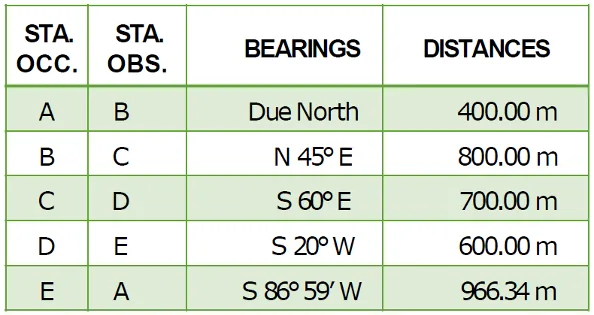
From the field notes of a closed traverse shown:
a. Compute the error of closure
b. Compute the relative precision of the traverse
c. Compute the adjusted distances and bearings of the lines using the compass rule

Departures and Latitudes | Fundamentals of Surveying – Problem 1: Compass Rule | Correction of Distances and Bearings – Diagram Departures and Latitudes | Fundamentals of Surveying – Problem 1: Compass Rule | Correction of Distances and Bearings – Diagram Departures and Latitudes | Fundamentals of Surveying – Problem 1: Compass Rule | Correction of Distances and Bearings – Diagram
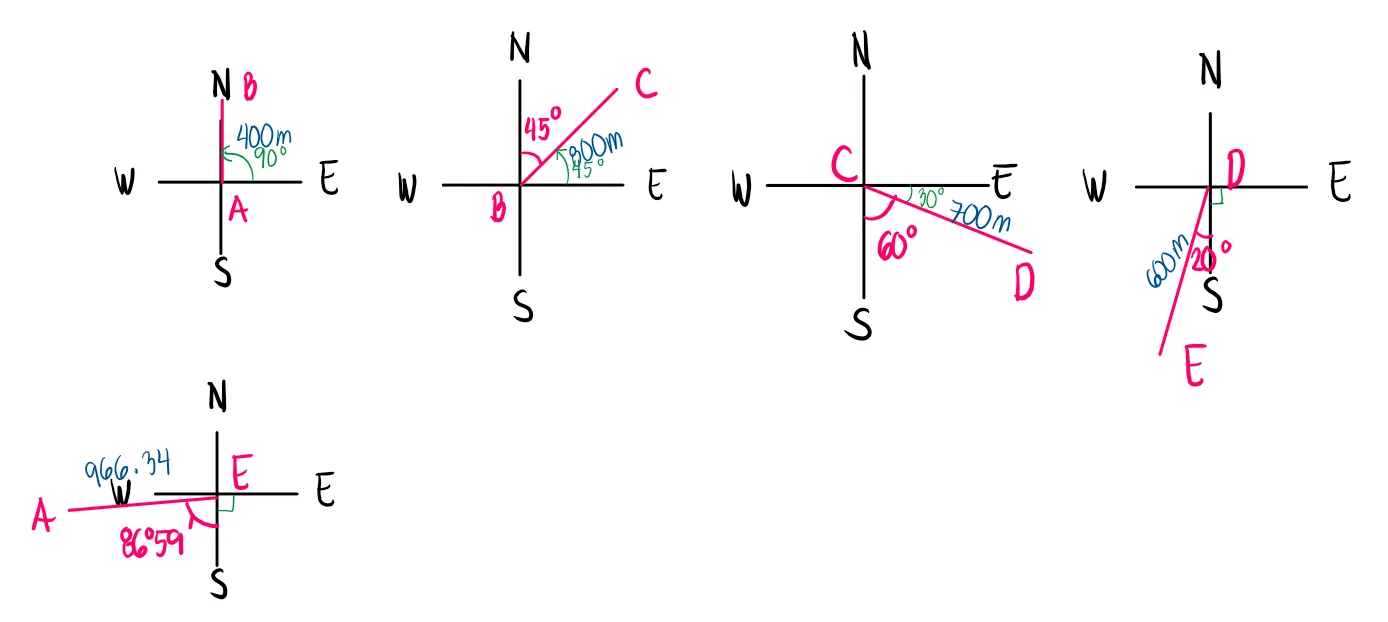
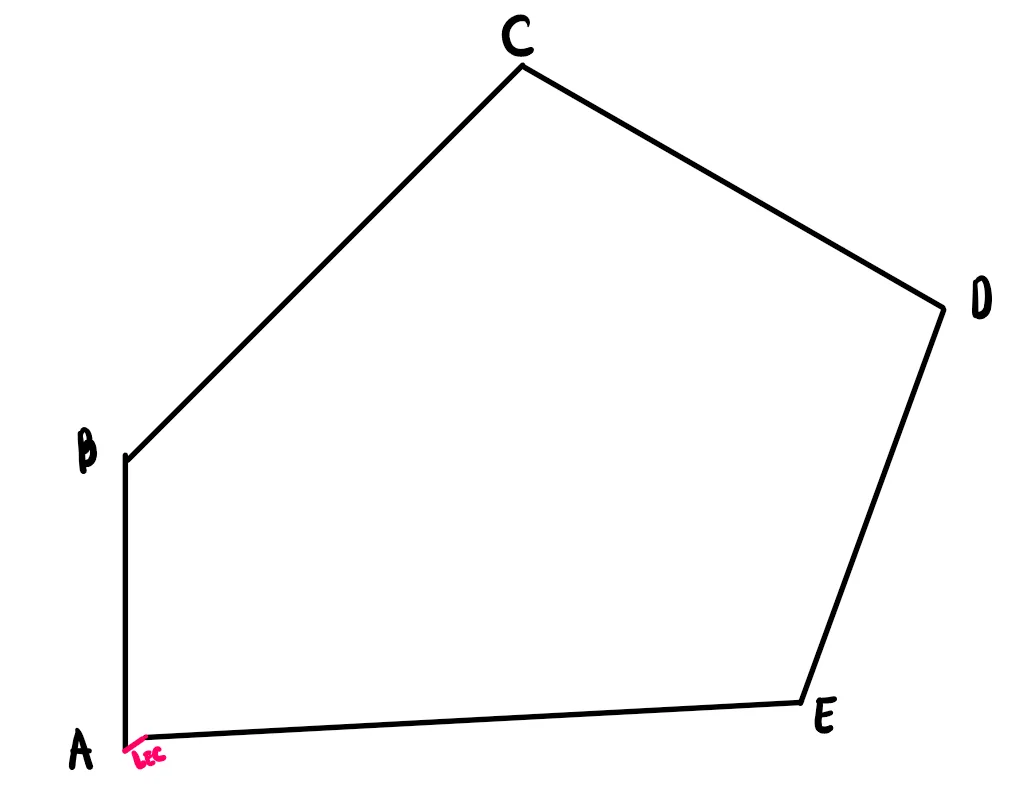
To model our figure, let us first sketch each line separately.

Departures and Latitudes | Fundamentals of Surveying – Problem 1: Compass Rule | Correction of Distances and Bearings – Diagram
Connecting all of the lines, we obtain the following figure. If one models the figure using AutoCad, line EA will not yet connect back to point A. There will be some gap, and this gap between point A and E is called the linear error of closure.

The concept utilized here is similar to that of resultants in Statics of Rigid Bodies. The line that connects the first point (A) and the last point (E) is the resultant if we talk about forces. In the context of surveying, however, this is referred to as the linear error of closure.

Departures and Latitudes | Fundamentals of Surveying – Problem 1: Compass Rule | Correction of Distances and Bearings – Diagram
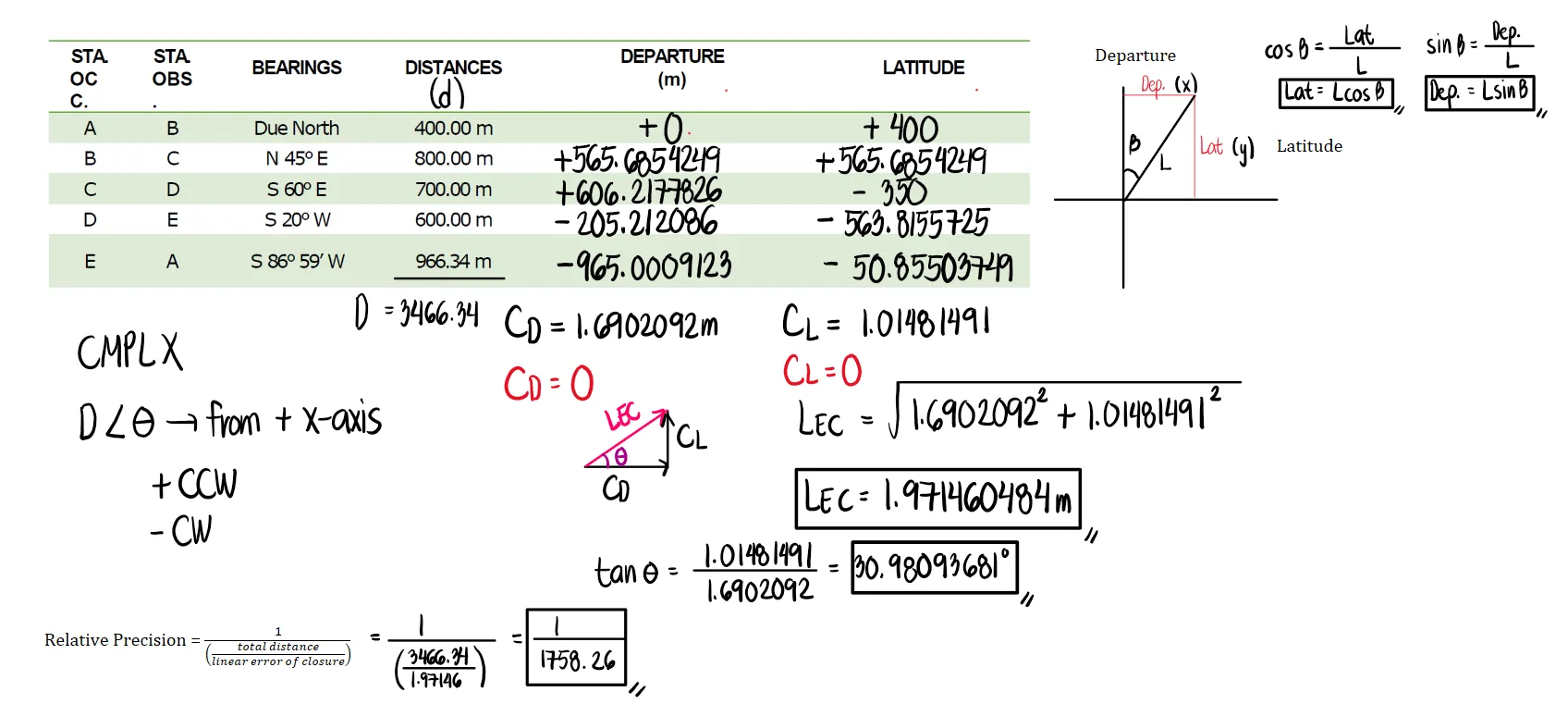
The linear error of closure will simply be the hypotenuse of the triangle formed by the sum of the departures and latitudes. We also solve the angle using the relationship between the two sides. Note that CD and CL are both positive. Hence, we subtract the corrections to the departures and latitudes so that the new summation will result to zero.
Departures and Latitudes | Fundamentals of Surveying – Problem 1: Compass Rule | Correction of Distances and Bearings – Diagram
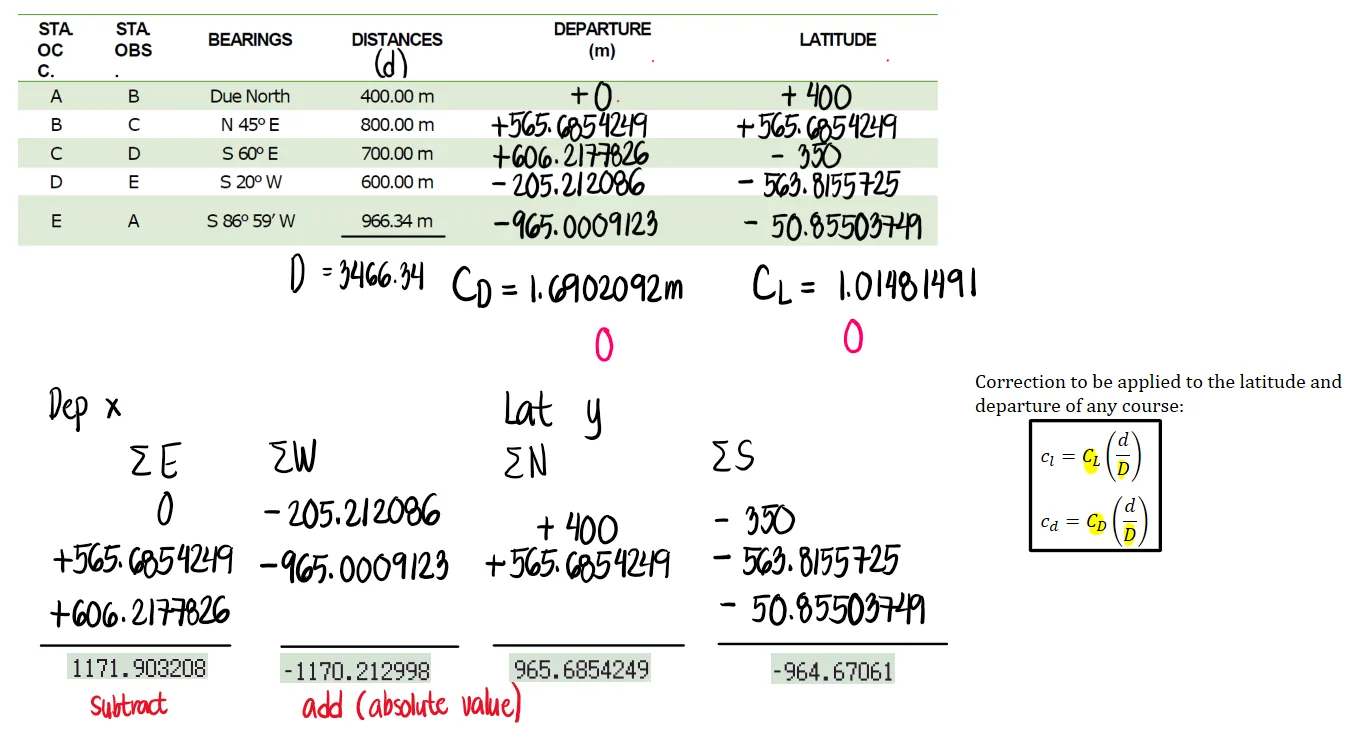
Let us focus on the sum of east departures. The result is 1171.903208m. Then, for the sum of west departures, the result is -1170.212998m. Notice that if we add both of them, the result will not be zero. To "close" the traverse, the sum should be equal to zero. To do this, we take away some value from 1171.903208m and add to the magnitude of -1170.212998m. Only when both east and west departures become equal in magnitude and opposite in signs will the correction become zero. To simplify the process, if CD or CL is positive, we subtract the corrections to each departure or latitude. If CD or CL is negative, we add the corrections to each departure or latitude.

Departures and Latitudes | Fundamentals of Surveying – Problem 1: Compass Rule | Correction of Distances and Bearings – Diagram
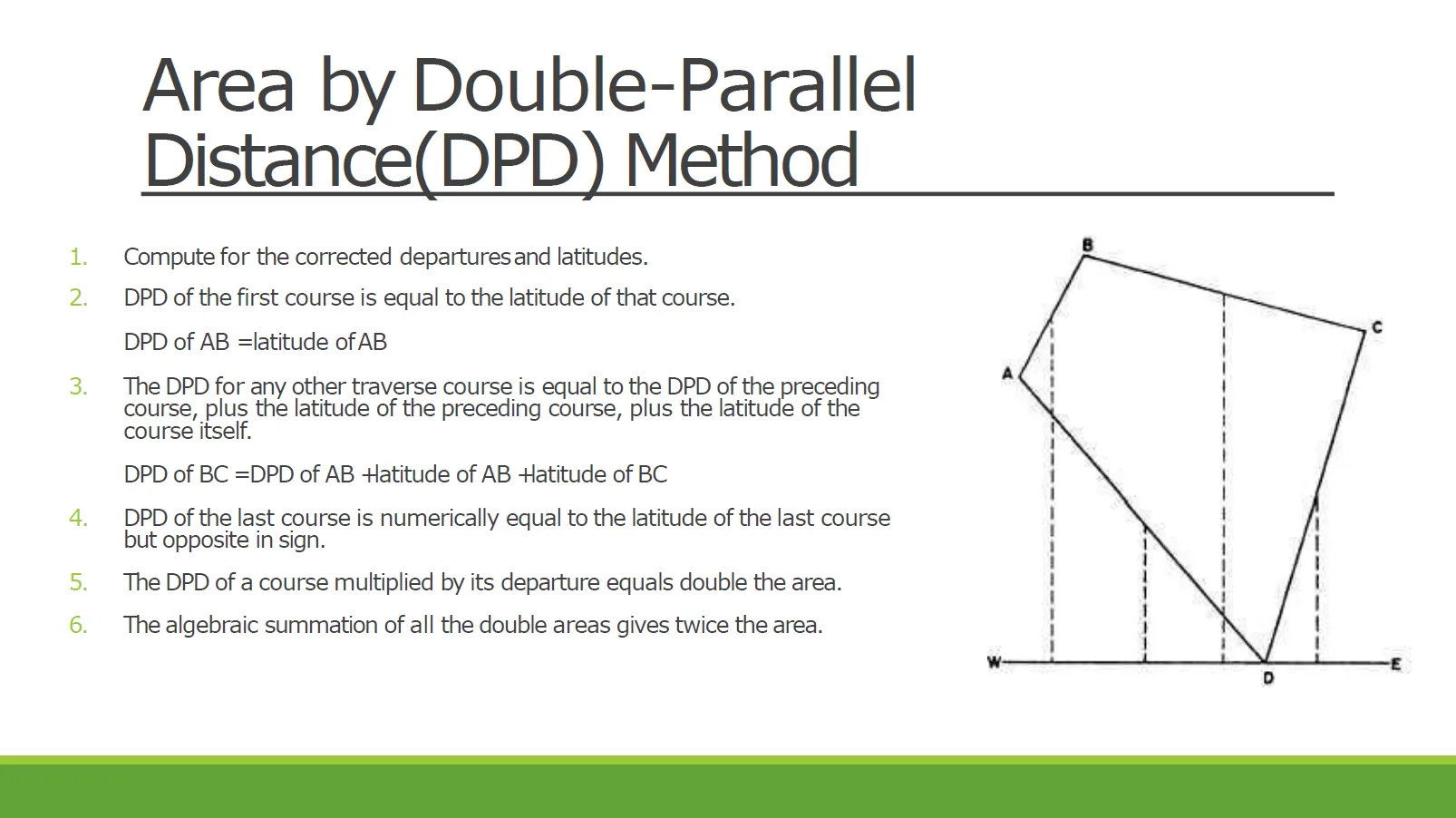
The corrected departures and latitudes are shown below. Note that to check whether all calculations are correct, we can sum up the new departures and latitudes. If the result is zero, then the new linear of closure will also be zero.
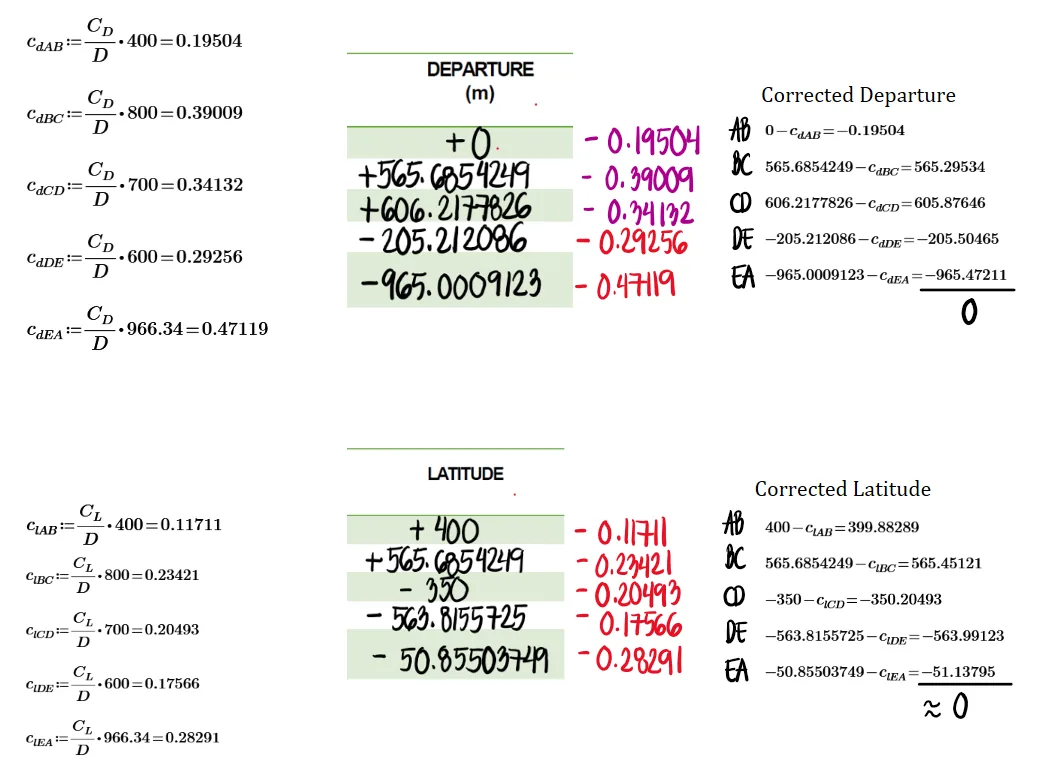
Departures and Latitudes | Fundamentals of Surveying – Problem 1: Compass Rule | Correction of Distances and Bearings – Diagram

Below are the corrected distances and bearings. If one models the following data using AutoCad, line EA will connect back to point A with a linear error of closure virtually equal to zero.
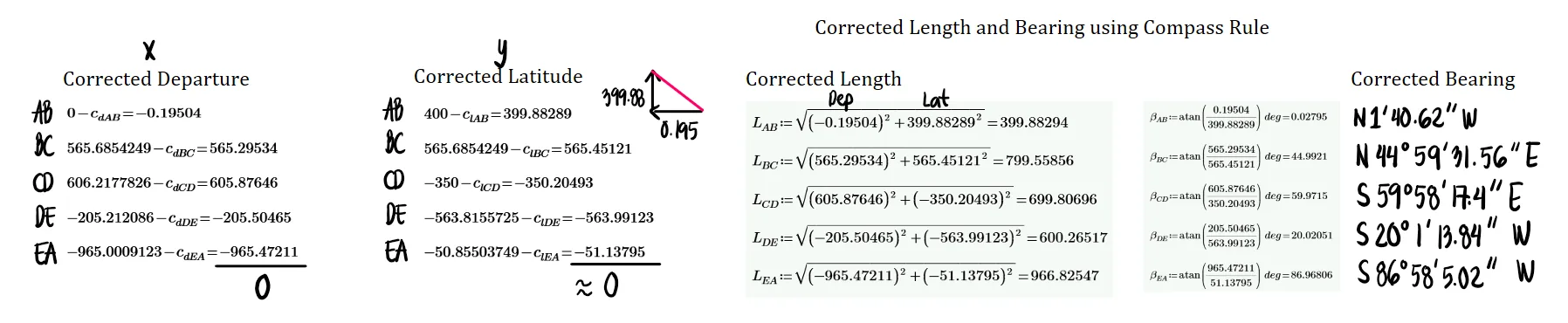
Departures and Latitudes | Fundamentals of Surveying – Problem 1: Compass Rule | Correction of Distances and Bearings – Diagram

Problem: Transit Rule | Problem Continuation

Compute the adjusted distances and bearings of the lines using the transit rule

Departures and Latitudes | Fundamentals of Surveying – Problem 2: Transit Rule | Problem 1 Continuation – Diagram Departures and Latitudes | Fundamentals of Surveying – Problem 2: Transit Rule | Problem 1 Continuation – Diagram Departures and Latitudes | Fundamentals of Surveying – Problem 2: Transit Rule | Problem 1 Continuation – Diagram

Here we use the arithmetic sum (neglecting the signs and using only the absolute values) when we sum up the north and south latitudes as well as the east and west departures.
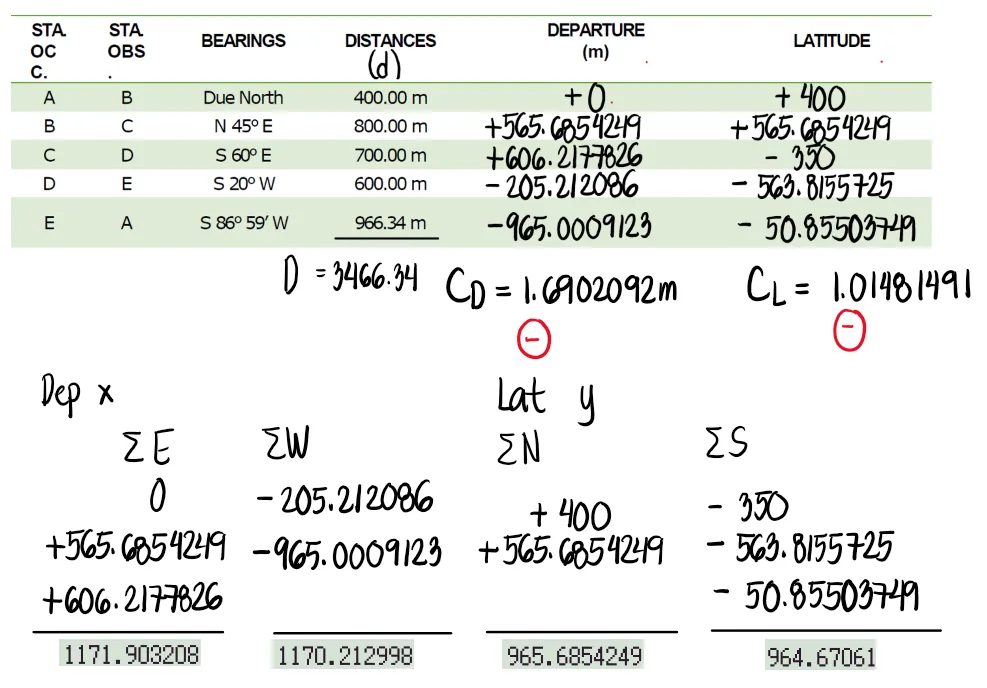
Departures and Latitudes | Fundamentals of Surveying – Problem 2: Transit Rule | Problem 1 Continuation – Diagram

Next, we use the correction formula for transit rule for each departure and latitude.
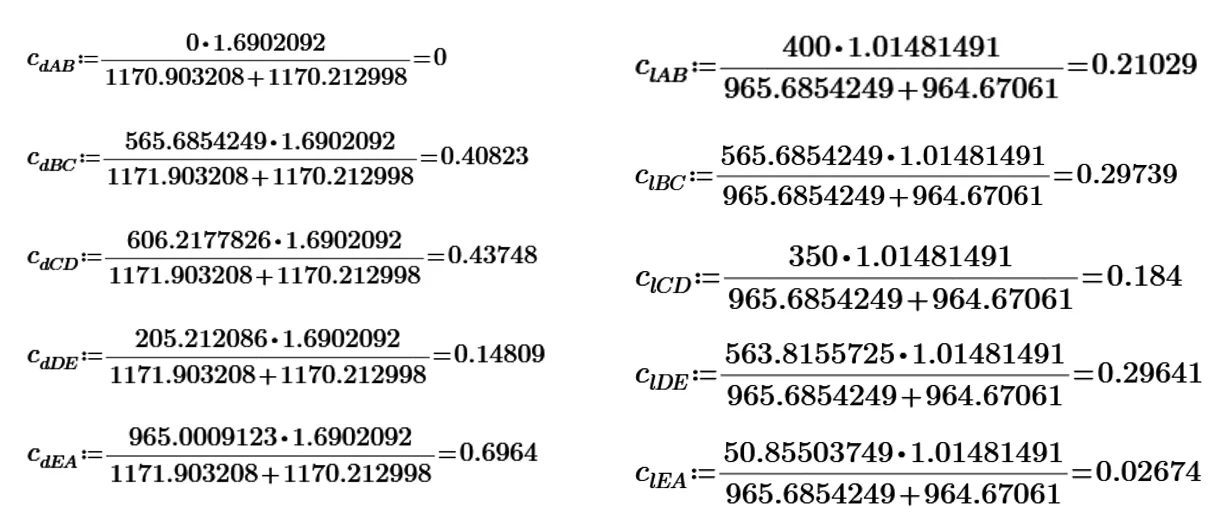
Departures and Latitudes | Fundamentals of Surveying – Problem 2: Transit Rule | Problem 1 Continuation – Diagram

When we sum up the corrected departures and latitudes, the result must be zero. This signifies that the linear error of closure will also be zero, which ensures that the traverse is closed.
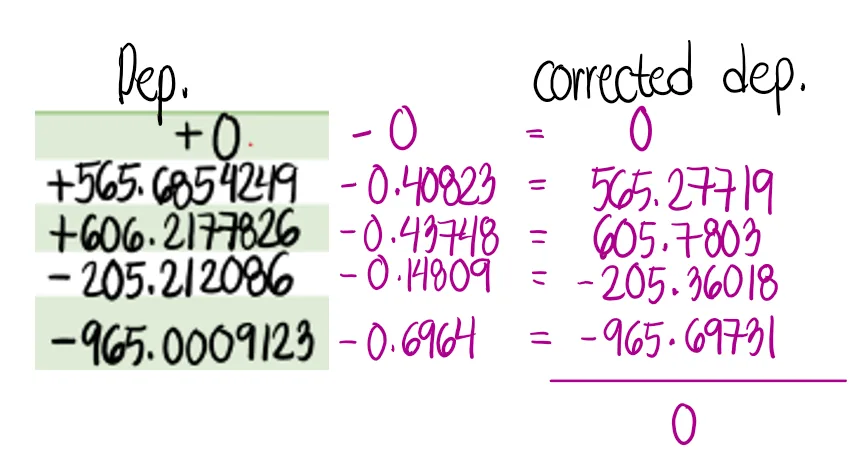
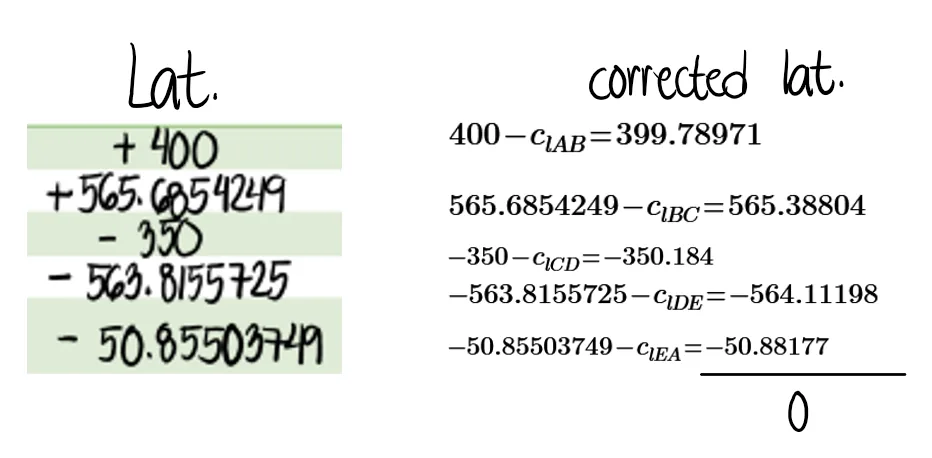
Departures and Latitudes | Fundamentals of Surveying – Problem 2: Transit Rule | Problem 1 Continuation – Diagram Departures and Latitudes | Fundamentals of Surveying – Problem 2: Transit Rule | Problem 1 Continuation – Diagram

The corrected lengths and bearings using the transit rule are shown below. Note that the results here differ from the compass rule, but only by a small amount.
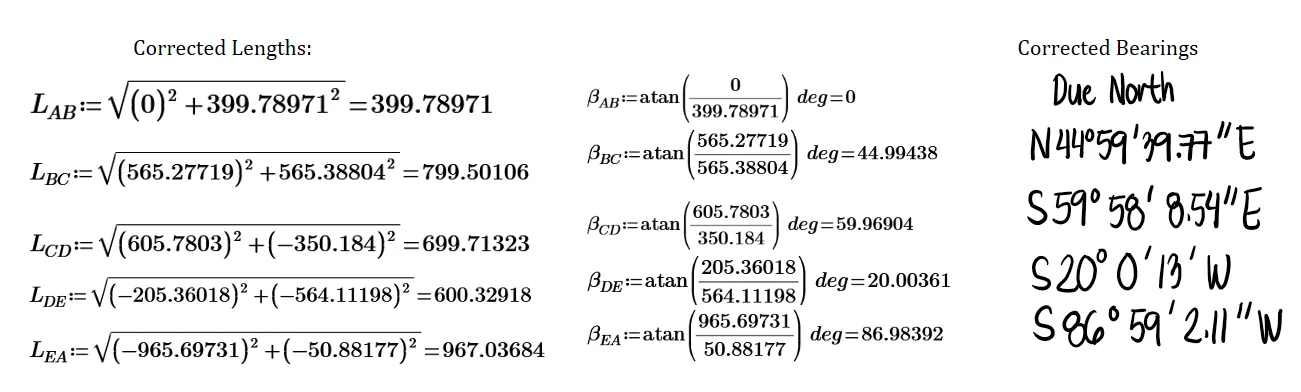
Departures and Latitudes | Fundamentals of Surveying – Problem 2: Transit Rule | Problem 1 Continuation – Diagram

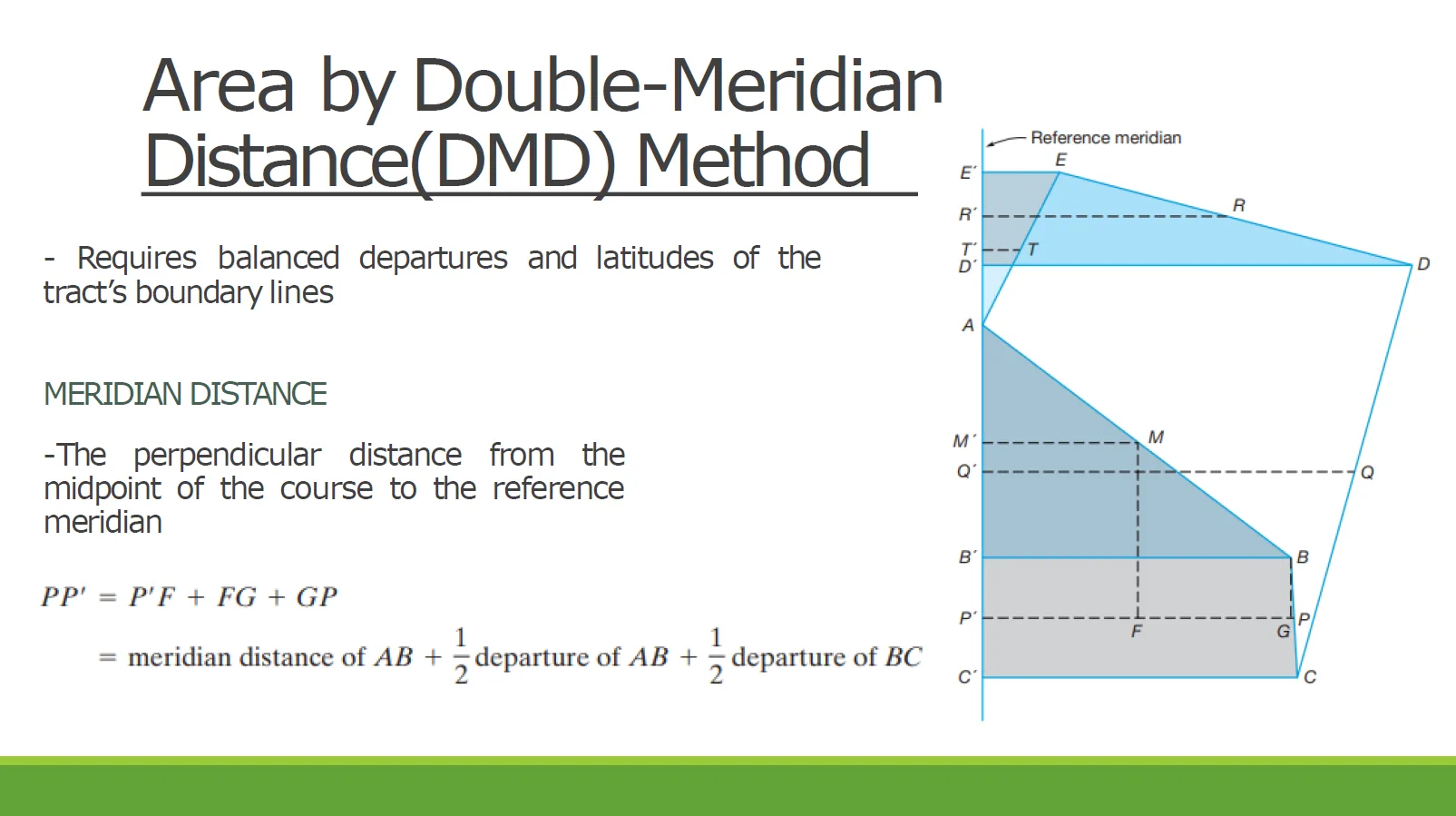
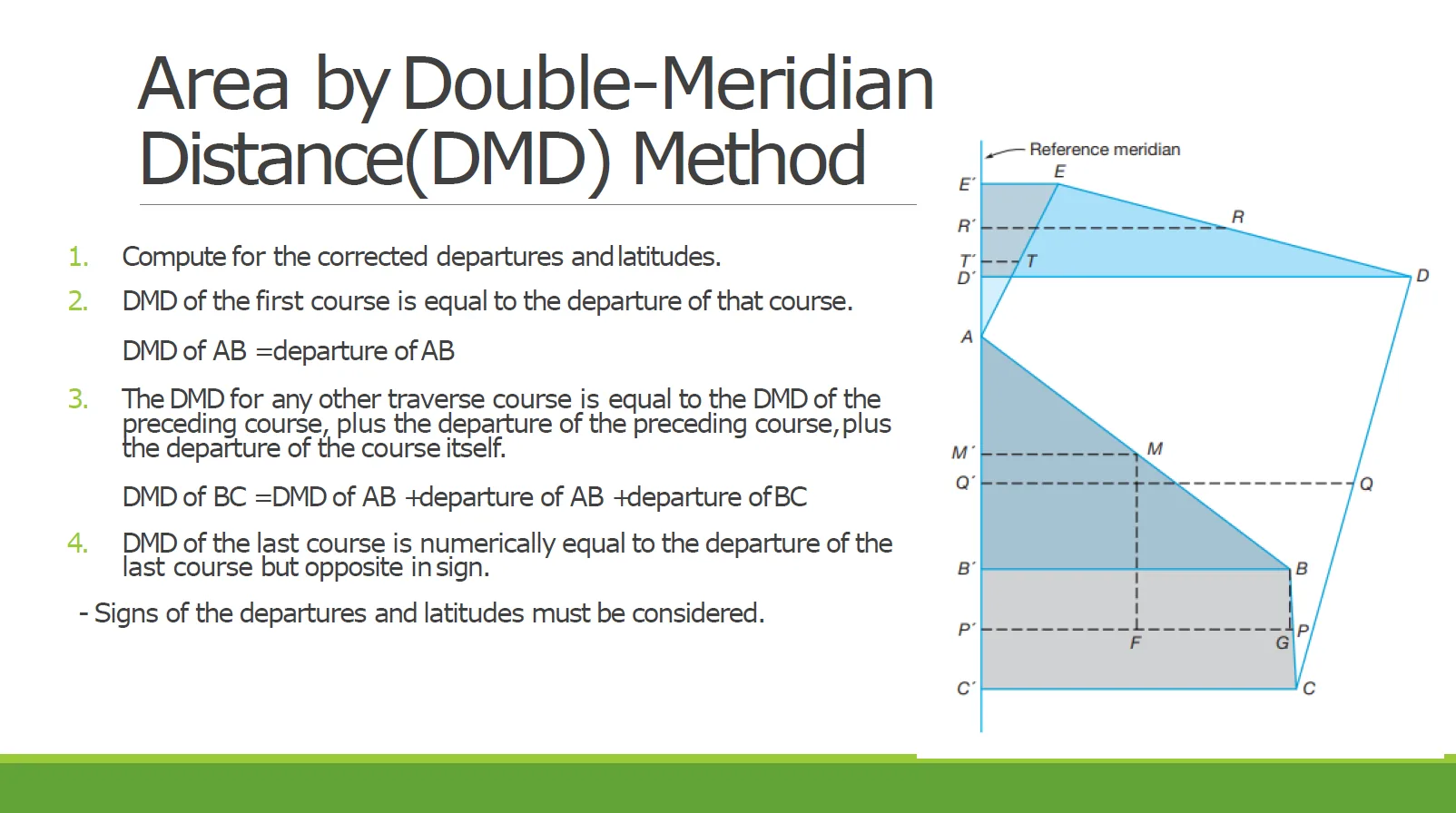
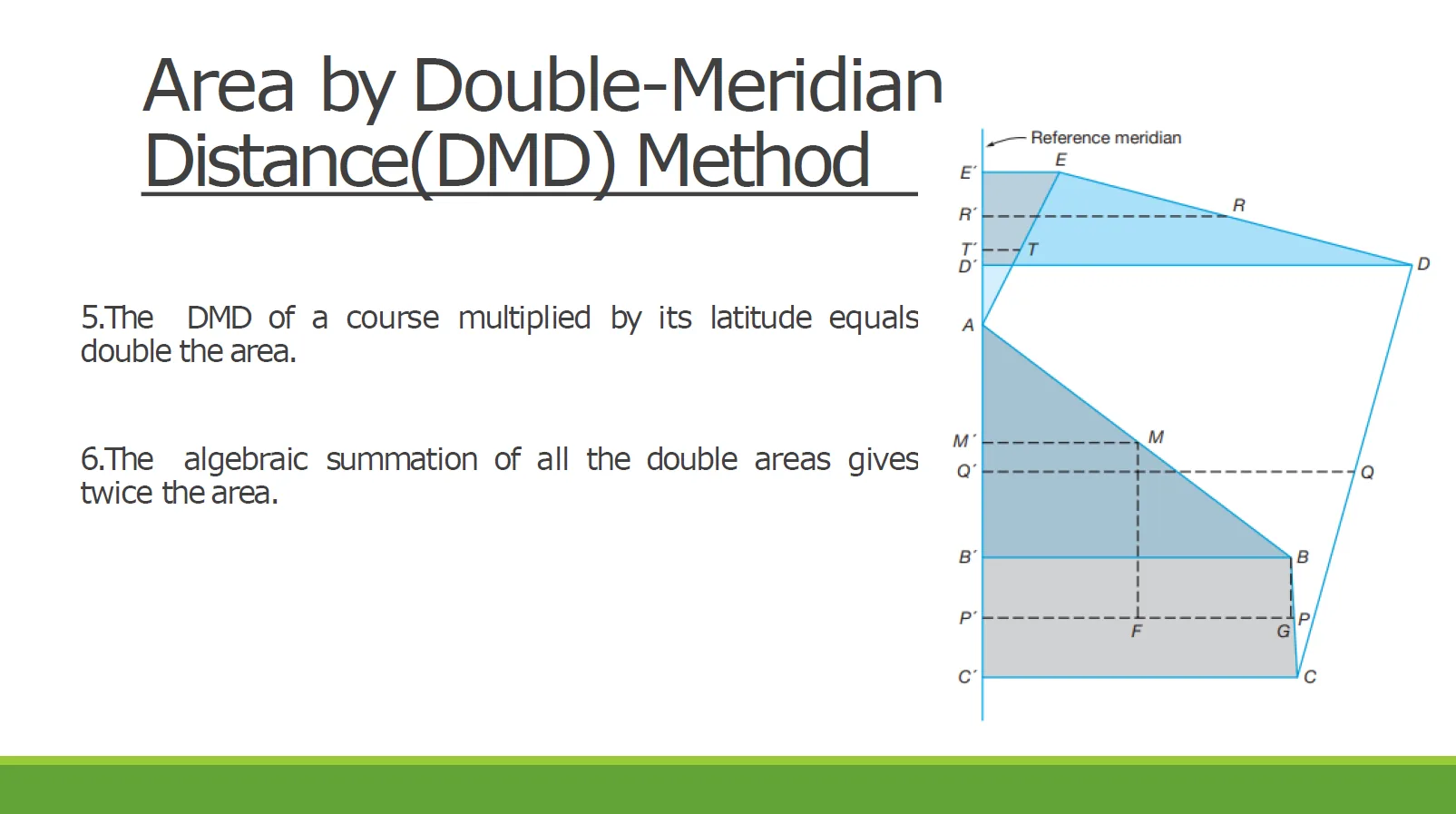
Problem: Area Computation by DMD Method

Given below is the technical description of lot 2081, Cebu Cadastre. Compute the area of the lot (in hectares) by DMD method.
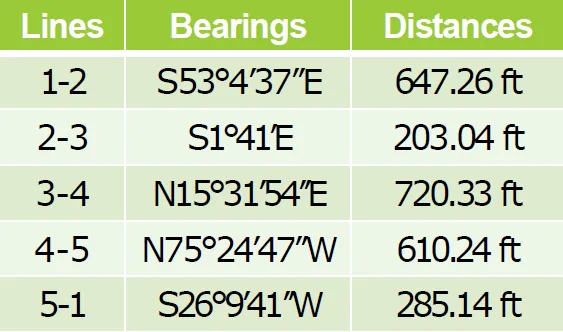
Departures and Latitudes | Fundamentals of Surveying – Problem 3: Area Computation by DMD Method – Diagram Departures and Latitudes | Fundamentals of Surveying – Problem 3: Area Computation by DMD Method – Diagram Departures and Latitudes | Fundamentals of Surveying – Problem 3: Area Computation by DMD Method – Diagram

Note here that the DMD of the last line must be numerically equal to the departure of that line, but with opposite sign. However, there is some discrepancy due to the linear error of closure not being exactly zero.
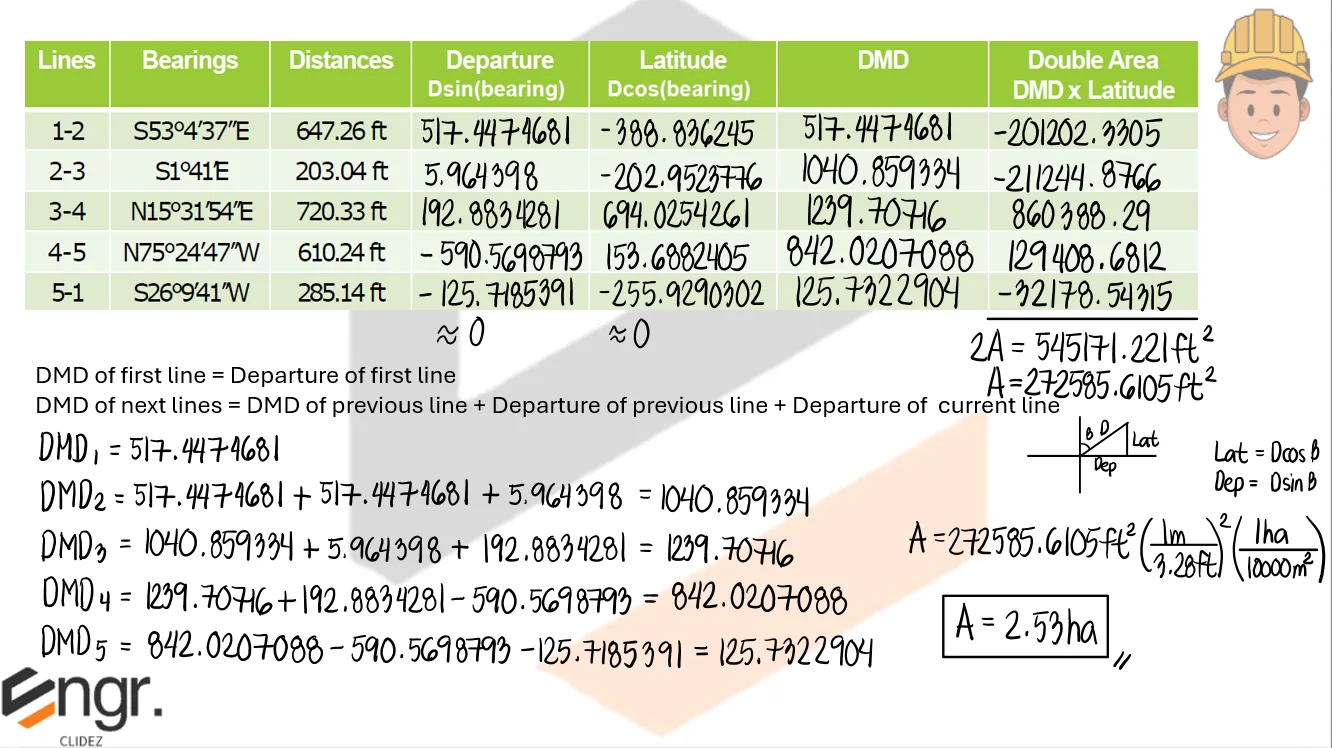
Departures and Latitudes | Fundamentals of Surveying – Problem 3: Area Computation by DMD Method – Diagram Departures and Latitudes | Fundamentals of Surveying – Problem 3: Area Computation by DMD Method – Diagram Departures and Latitudes | Fundamentals of Surveying – Problem 3: Area Computation by DMD Method – Diagram Departures and Latitudes | Fundamentals of Surveying – Problem 3: Area Computation by DMD Method – Diagram

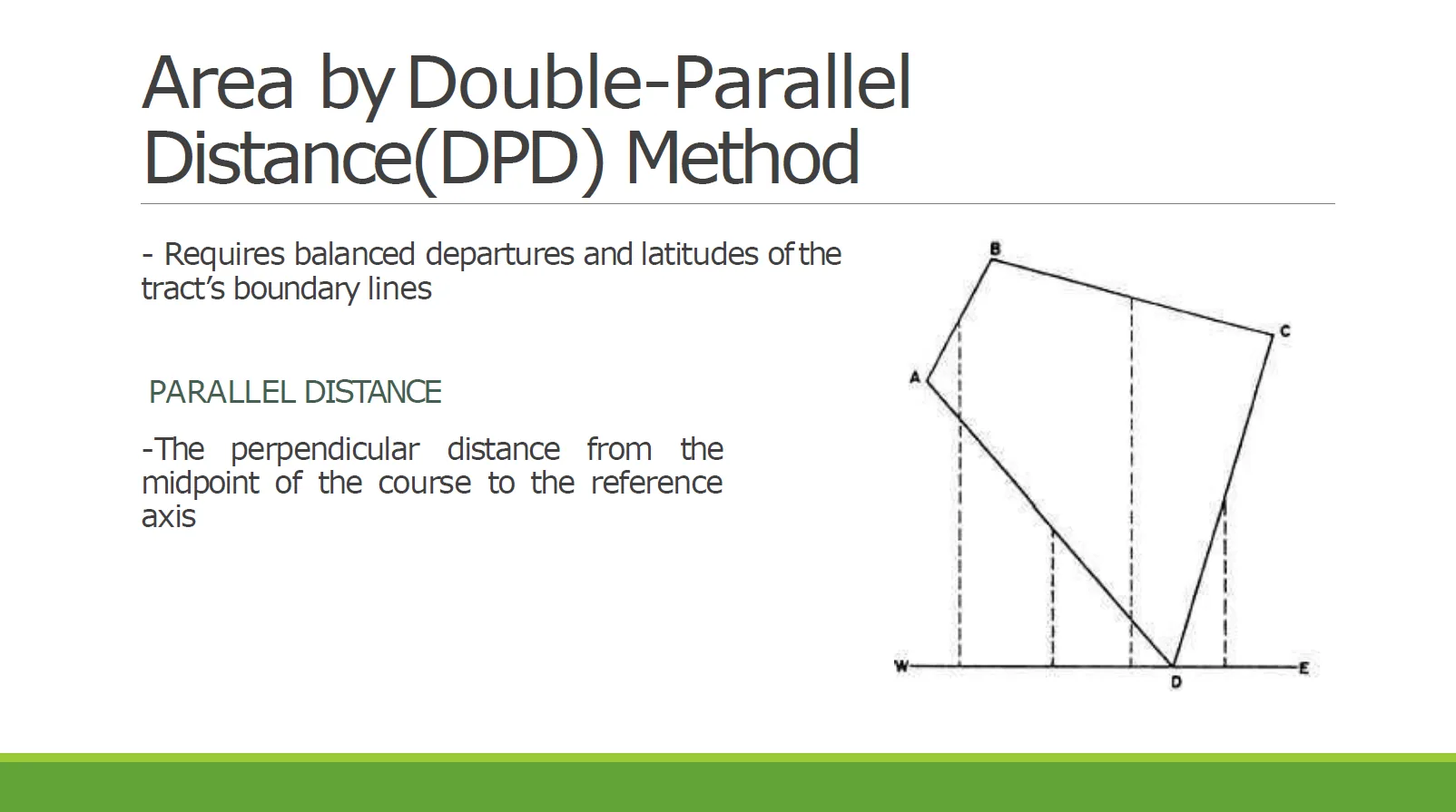
Problem: Area Computation by DPD Method

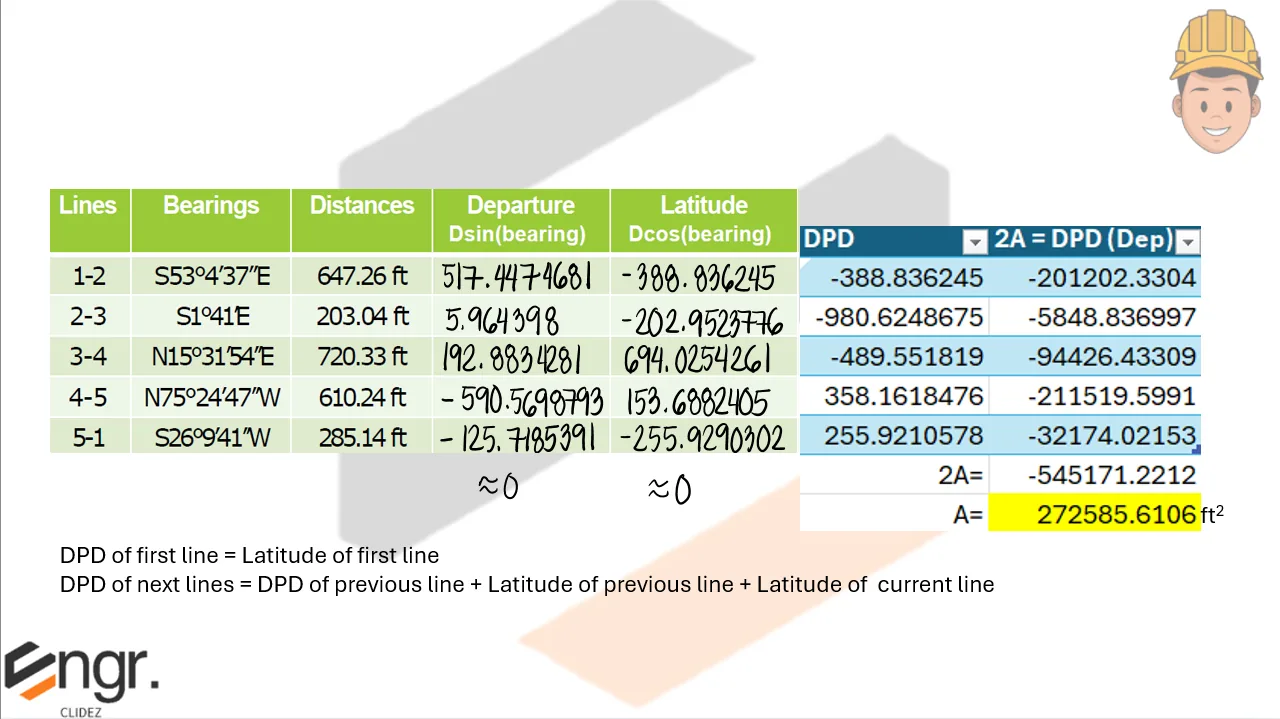
Resolve the area in Problem 3 using DPD method.

Departures and Latitudes | Fundamentals of Surveying – Problem 4: Area Computation by DPD Method – Diagram Departures and Latitudes | Fundamentals of Surveying – Problem 4: Area Computation by DPD Method – Diagram Departures and Latitudes | Fundamentals of Surveying – Problem 4: Area Computation by DPD Method – Diagram

Note here that the DPD of the last line must be numerically equal to the latitude of that line, but with opposite sign. However, there is some discrepancy due to the linear error of closure not being exactly zero.

Departures and Latitudes | Fundamentals of Surveying – Problem 4: Area Computation by DPD Method – Diagram Departures and Latitudes | Fundamentals of Surveying – Problem 4: Area Computation by DPD Method – Diagram Departures and Latitudes | Fundamentals of Surveying – Problem 4: Area Computation by DPD Method – Diagram Departures and Latitudes | Fundamentals of Surveying – Problem 4: Area Computation by DPD Method – Diagram

Problem:

Refer to the image shown:

Departures and Latitudes | Fundamentals of Surveying – Problem 5: – Diagram Departures and Latitudes | Fundamentals of Surveying – Problem 5: – Diagram Departures and Latitudes | Fundamentals of Surveying – Problem 5: – Diagram

See images:

Departures and Latitudes | Fundamentals of Surveying – Problem 5: – Diagram Departures and Latitudes | Fundamentals of Surveying – Problem 5: – Diagram Departures and Latitudes | Fundamentals of Surveying – Problem 5: – Diagram Departures and Latitudes | Fundamentals of Surveying – Problem 5: – Diagram

Problem:

Refer to the image shown:

Departures and Latitudes | Fundamentals of Surveying – Problem 6: – Diagram Departures and Latitudes | Fundamentals of Surveying – Problem 6: – Diagram Departures and Latitudes | Fundamentals of Surveying – Problem 6: – Diagram

See images:

Departures and Latitudes | Fundamentals of Surveying – Problem 6: – Diagram Departures and Latitudes | Fundamentals of Surveying – Problem 6: – Diagram Departures and Latitudes | Fundamentals of Surveying – Problem 6: – Diagram Departures and Latitudes | Fundamentals of Surveying – Problem 6: – Diagram

Problem:

Refer to the image shown:

Departures and Latitudes | Fundamentals of Surveying – Problem 7: – Diagram Departures and Latitudes | Fundamentals of Surveying – Problem 7: – Diagram Departures and Latitudes | Fundamentals of Surveying – Problem 7: – Diagram

See images:

Departures and Latitudes | Fundamentals of Surveying – Problem 7: – Diagram Departures and Latitudes | Fundamentals of Surveying – Problem 7: – Diagram Departures and Latitudes | Fundamentals of Surveying – Problem 7: – Diagram Departures and Latitudes | Fundamentals of Surveying – Problem 7: – Diagram

Problem:

Refer to the image shown:

Departures and Latitudes | Fundamentals of Surveying – Problem 8: – Diagram Departures and Latitudes | Fundamentals of Surveying – Problem 8: – Diagram Departures and Latitudes | Fundamentals of Surveying – Problem 8: – Diagram

See images:

Departures and Latitudes | Fundamentals of Surveying – Problem 8: – Diagram Departures and Latitudes | Fundamentals of Surveying – Problem 8: – Diagram Departures and Latitudes | Fundamentals of Surveying – Problem 8: – Diagram Departures and Latitudes | Fundamentals of Surveying – Problem 8: – Diagram
Scroll to zoom

Exam Generator Problems

Additional board-style practice items for this topic.

Question Bank: t1130

MSTE - Surveying / Measurements and Areas / Gemini mapped Chapter 7 to 10

An engineer setup his transit inside a triangular lot ABC and recorded the following data for corners A, B, and C of the parcel: [Corner OA: Bearing N 78.23° E, Distance 58.63 m; OB: S 42.25° W, Distance 85.24 m; OC: N 46.32° W, Distance 68.55 m].

What is the area of the parcel in sq. m.?

  1. 7836
  2. 5421
  3. 6044
  4. 6523

What is the length of side AB in meter?

  1. 137
  2. 158
  3. 169
  4. 177

What is the bearing of side AB?

  1. S 52.3° W
  2. S 56.8° W
  3. S 68.5° W
  4. S 47.7° W

Solution pending in psadquestions/t1130.json.

Question Bank: t1137

MSTE - Surveying / Measurements and Areas / Gemini mapped Chapter 7 to 10

A surveyor sets up a transit at a point Q which is at the middle portion of a four-sided tract of land and reads the bearings and measures the distances, as given below. [Table omitted]

What is the length of side BC in meters?

  1. 650.13
  2. 532.12
  3. 754.25
  4. 365.21

Determine the bearing of side BC.

  1. S 32.1° E
  2. S 12.5° W
  3. S 13.4° E
  4. S 25.4° W

What is the area of the land in hectares?

  1. 45.21
  2. 50.36
  3. 55.25
  4. 47.57

Solution pending in psadquestions/t1137.json.

Question Bank: t1156

MSTE - Surveying / Measurements and Areas / Gemini mapped Chapter 7 to 10

A closed traverse has the following information: Summation of N & S latitudes = +1.32 m, Summation of E & W departures = -1.85 m, Total latitude = 1856.32 m, Total departure = 1532.47, Perimeter of traverse = 6235.24. Line BC on this traverse has the following data: Length = 652.32, Latitude = 523.65 m N, Departure = 388.99 m E.

What is the correction to be applied to the latitude of BC using the transit rule?

  1. 0.2542
  2. 0.3724
  3. 0.1935
  4. 0.4235

What is the correction to be applied to the departure of BC using the compass rule?

  1. 0.1935
  2. 0.2542
  3. 0.4235
  4. 0.3724

What is the corrected latitude of BC using the compass rule?

  1. 523.124
  2. 524.321
  3. 523.788
  4. 523.512

Solution pending in psadquestions/t1156.json.

Question Bank: t1169

MSTE - Surveying / Measurements and Areas / Gemini mapped Chapter 7 to 10

A closed traverse has the following data: [Line 1-2: Latitude 75.54, Departure 44.35; 2-3: -4.40, ----; 3-4: -50.85, 23.93; 4-5: -101.25, -18.89; 5-6: -24.28, -48.49; 6-1: ----, -33.00].

What is the length of line 2-3?

  1. 176.83
  2. 181.87
  3. 114.49
  4. 120.8

What is the bearing of line 2-3?

  1. S 64.4° E
  2. S 76.5° E
  3. S 82.2° E
  4. S 25.2° E

What is the DMD of line 5-6?

  1. 114.49
  2. 181.87
  3. 120.80
  4. 176.83

Solution pending in psadquestions/t1169.json.

Question Bank: t1182

MSTE - Surveying / Measurements and Areas / Gemini mapped Chapter 7 to 10

A series of perpendicular offsets were taken from a transit line to a curved boundary line. These offsets were taken 10 meters apart in the following order: 0, 1.6, 3.4, 3.8, 5.9, 6.5, 5.7, 4.2, 2.4, 1.1, 0.

Determine the area included between the transit line and the curved line using Trapezoidal Rule.

  1. 346 m^2
  2. 342 m^2
  3. 354 m^2
  4. 335 m^2

Determine the area included between the transit line and the curved line using Simpson's One Third Rule.

  1. 287.3 m^2
  2. 285.6 m^2
  3. 345.3 m^2
  4. 275.7 m^2

Solution pending in psadquestions/t1182.json.

Question Bank: t1270

MSTE - Highway Engineering / Curves, Earthworks, and Traffic Engineering / Gemini mapped Chapter 7 to 10

Find the area (in m^2) of the given cross-section if the width of roadway is 12 m. [Left: 9.8 / 3, Center: 0 / 2.8, Right: 11.2 / 4.89]

  1. 58.74
  2. 53.07
  3. 47.36
  4. 63.87

Solution pending in psadquestions/t1270.json.

Question Bank: t1279

MSTE - Highway Engineering / Curves, Earthworks, and Traffic Engineering / Gemini mapped Chapter 7 to 10

Given the cross section of a proposed road to be constructed, find the cross-sectional area in sq. m. The base of road is 6m and the side slopes are 1.25:1. [7.80 / +3.84, 2.00 / +2.42, 0 / +4.25, 4.00 / +2.50, 5.65 / +2.12]

  1. 25.45
  2. 30.11
  3. 36.24
  4. 24.11

Solution pending in psadquestions/t1279.json.

Question Bank: t1285

MSTE - Highway Engineering / Curves, Earthworks, and Traffic Engineering / Gemini mapped Chapter 7 to 10

The areas in cut of two irregular sections 80 m. apart are 128 m^2 and 245 m^2, respectively. Both sections are three-level sections with base width of 8 m and side slope of 3H:2V. Assume the ground slope uniformly between the two sections and use the prismoidal correction formula.

What is the depth of cut at section 2?

  1. 7.87 m
  2. 10.39 m
  3. 8.52 m
  4. 6.95 m

What is the volume of cut by end-area method in m^3?

  1. 14,920
  2. 15,520
  3. 14,210
  4. 13,630

What is the volume of cut in m^3 using the prismoidal correction formula?

  1. 16,254
  2. 14,112
  3. 15,214
  4. 14,683

Solution pending in psadquestions/t1285.json.

Question Bank: t1291

MSTE - Highway Engineering / Curves, Earthworks, and Traffic Engineering / Gemini mapped Chapter 7 to 10

The cross-section notes of a ground to be excavated for a proposed roadway is given next. The roadway is 10 meters wide with side slope of 3:2. [Station 3+000: 8L / ?, 0 / 3.2, 12.8R / ?; Station 3+060: 8.9L / ?, 0 / 2.6, 10.4R / ?].

What is the cross-sectional area at Station 3+000?

  1. 53.43
  2. 45.88
  3. 51.28
  4. 47.65

What is the volume by end-area method in m^3?

  1. 2756.1
  2. 2768.5
  3. 2751.6
  4. 2743.2

What is the volume by prismoidal formula in m^3?

  1. 2768.5
  2. 2756.1
  3. 2743.2
  4. 2751.6

Solution pending in psadquestions/t1291.json.

Question Bank: t1336

MSTE - Highway Engineering / Curves, Earthworks, and Traffic Engineering / Gemini mapped Chapter 7 to 10

An offshore barrier that protects a harbor or other coastal area from the full force of the sea.

  1. dike
  2. wave breaker
  3. breakwater
  4. dam

Solution pending in psadquestions/t1336.json.

Question Bank: w48

MSTE - Surveying / Area Computation / MSTE May 2019

A surveyor sets up a transit at point $P$, which is at the inner portion of a four-sided tract of land $ABCD$, and reads the bearings and measures the distances as follows:

LineBearingDistance
PAN 40°30' W420.35
PBN 38°00' E530.15
PCS 70°00' E480.75
PDS 60°15' W695.10
What is the area of the tract in hectares?

  1. 52.32
  2. 48.43
  3. 50.14
  4. 43.23
Sum the four triangles about $P$ using $A = \tfrac{1}{2}d_1 d_2\sin\theta$ for the included angles (78.5°, 72°, 130.25°, 79.25°):
$A = \tfrac12[420.35(530.15)\sin 78.5^\circ] + \tfrac12[530.15(480.75)\sin 72^\circ]$
$+\ \tfrac12[480.75(695.10)\sin 130.25^\circ] + \tfrac12[695.10(420.35)\sin 79.25^\circ]$
$A = 501{,}347\text{ m}^2 = \boxed{50.13\text{ hectares}}$

Question Bank: w49

MSTE - Surveying / Measurements and Areas / MSTE May 2019

Determine the corrected values for the latitude of line $BC$ and departure of line $CD$ using the compass rule.

CourseBearingLength
ABN 26°10' E285.10
BCS 75°25' E610.45
CDS 15°30' W720.45
DEN 1°42' W203.00
EAN 53°06' W647.02

  1. $BC_{lat} = 153.537$ m; $CD_{dep} = 192.374$ m
  2. $BC_{lat} = 153.870$ m; $CD_{dep} = 192.690$ m
  3. $BC_{lat} = 153.536$ m; $CD_{dep} = 192.690$ m
  4. $BC_{lat} = 153.870$ m; $CD_{dep} = 192.374$ m
Perimeter $\sum L = 2466.02$ m. Closures: $\sum_{lat} = -0.674$ (southward), $\sum_{dep} = +0.541$ (eastward).
$C_{lat,BC} = 0.674 \times \frac{610.45}{2466.02} = 0.167$; corrected $BC_{lat} = 153.703 - 0.167 = 153.536\text{ m}$.
$C_{dep,CD} = 0.541 \times \frac{720.45}{2466.02} = 0.158$; corrected $CD_{dep} = 192.532 + 0.158 = 192.690\text{ m}$.
$\boxed{BC_{lat} = 153.536\text{ m},\ CD_{dep} = 192.690\text{ m}}$