Compass Surveying
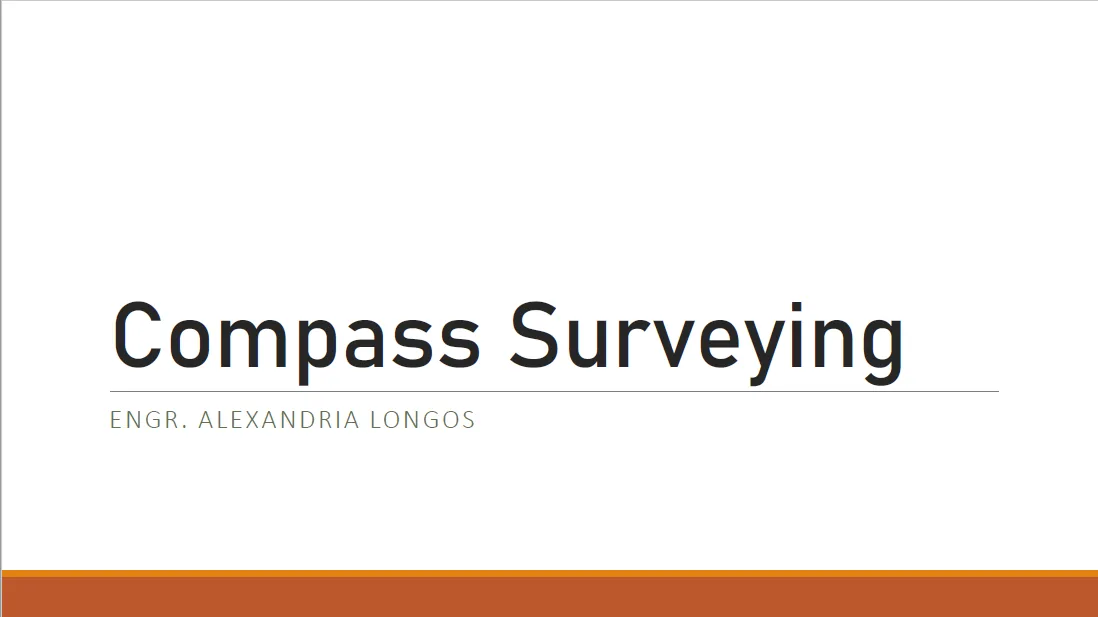
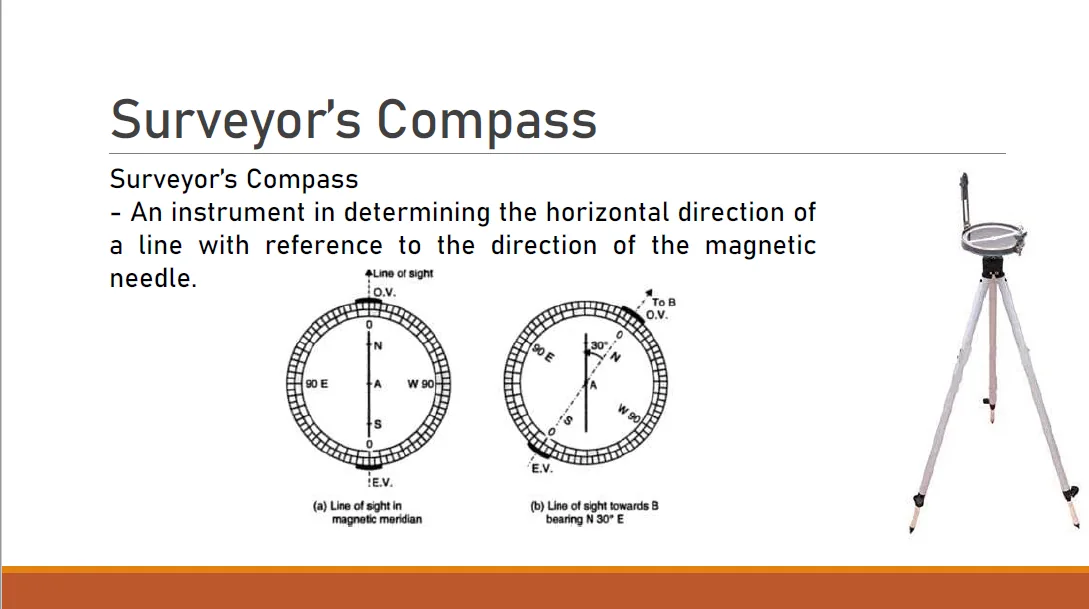
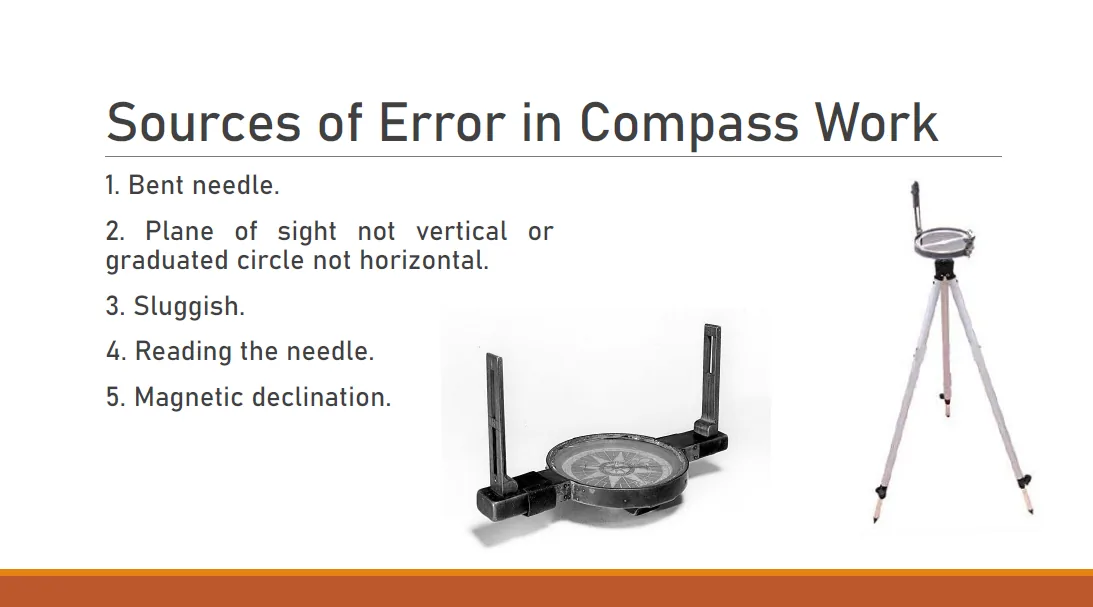
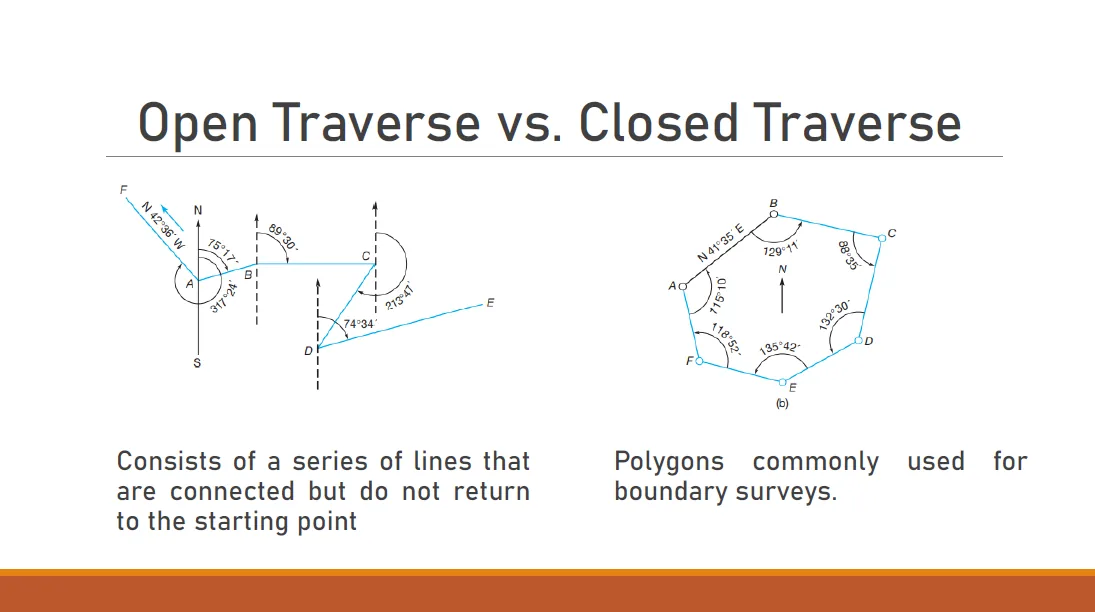
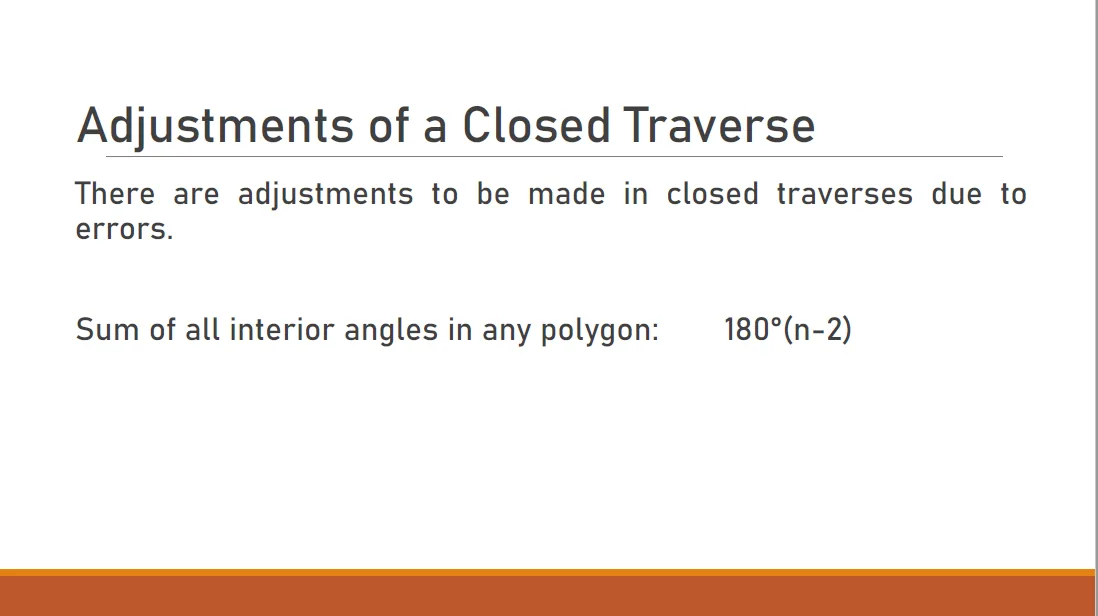


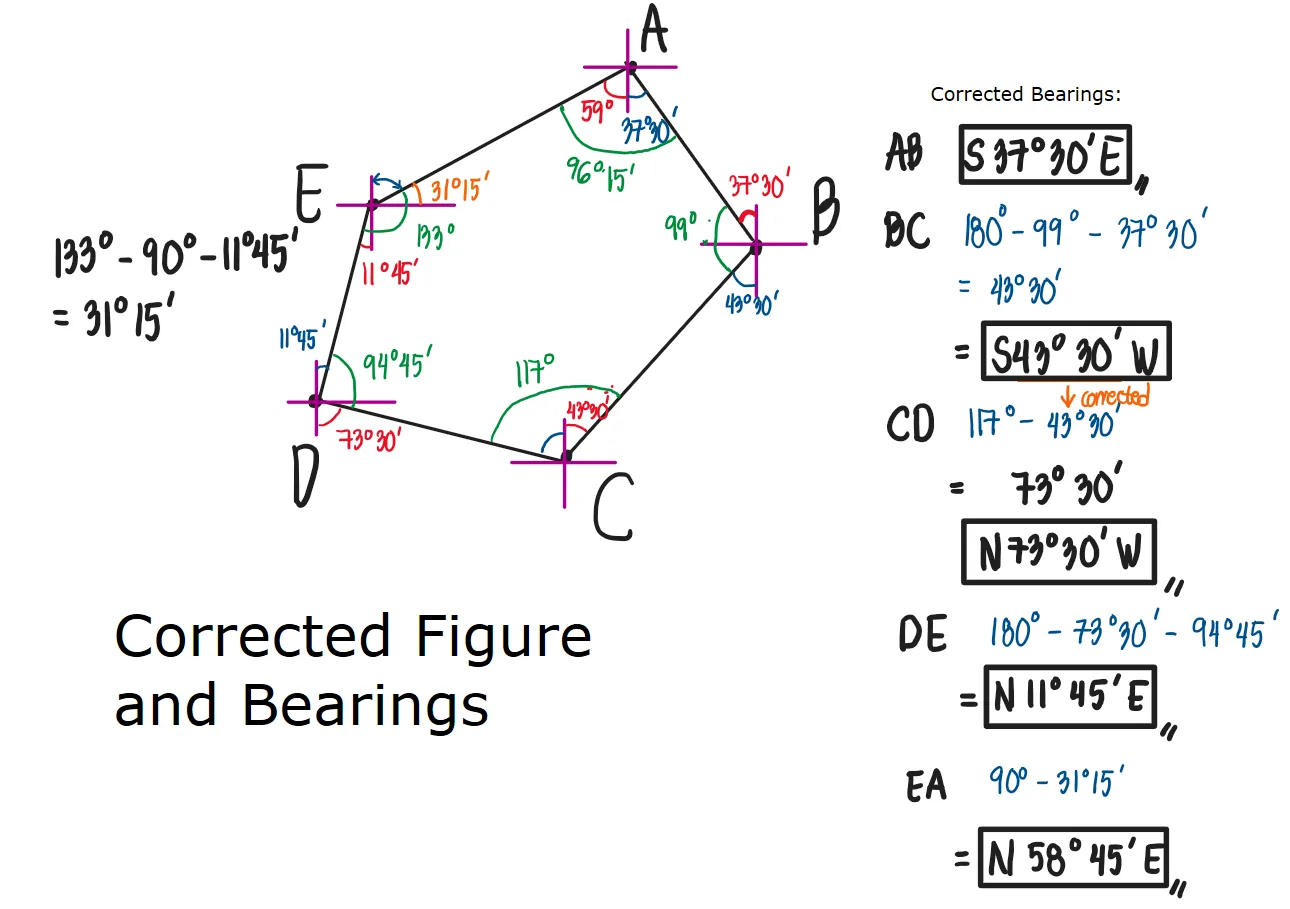
The following bearings are taken on a closed compass traverse. Assume the observed bearing of line AB to be correct.
a. Compute the error in closure.
b. Compute the corrected bearing of the lines.
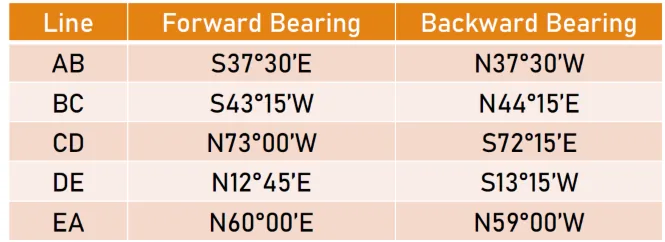


See images:
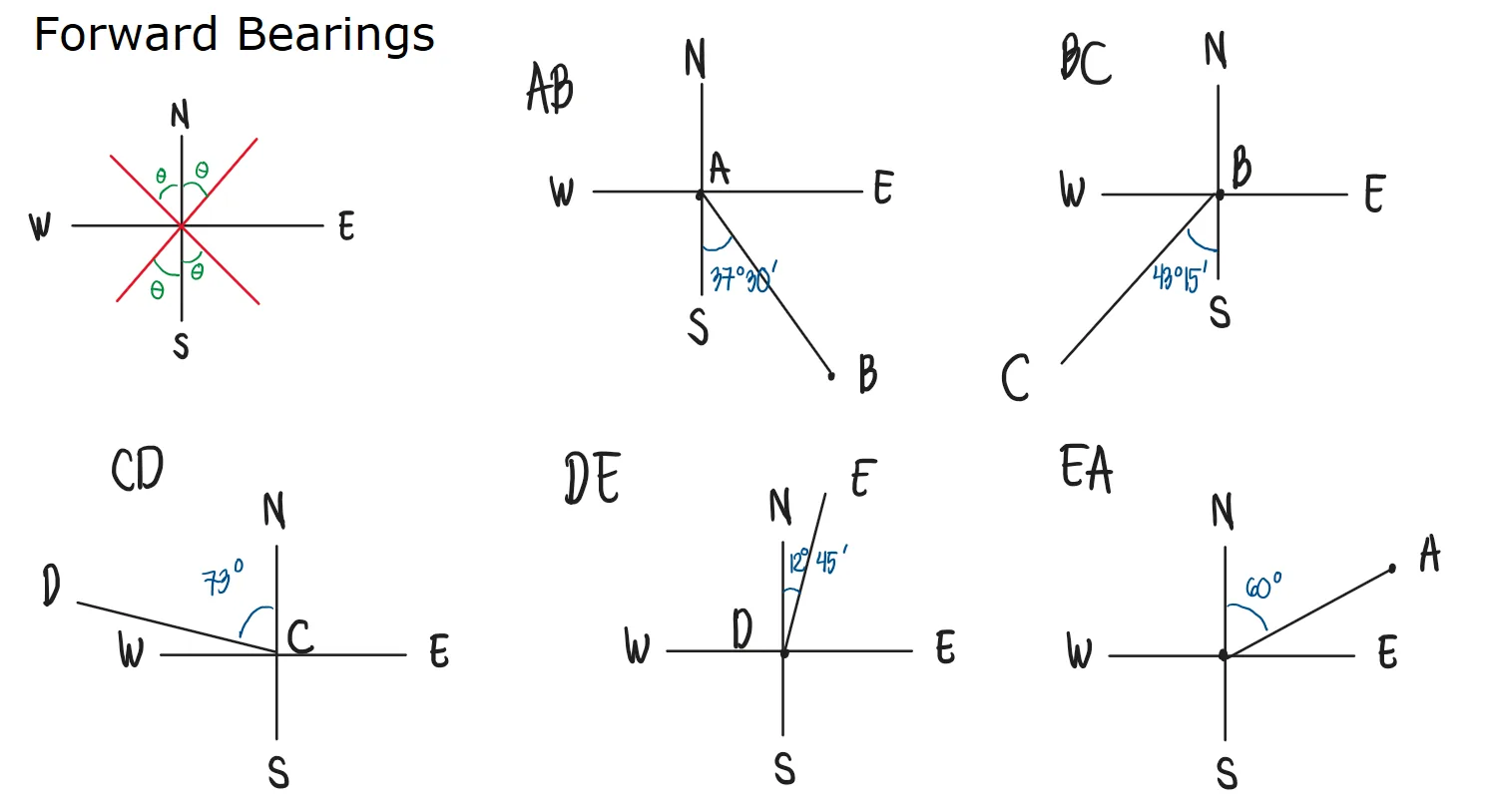
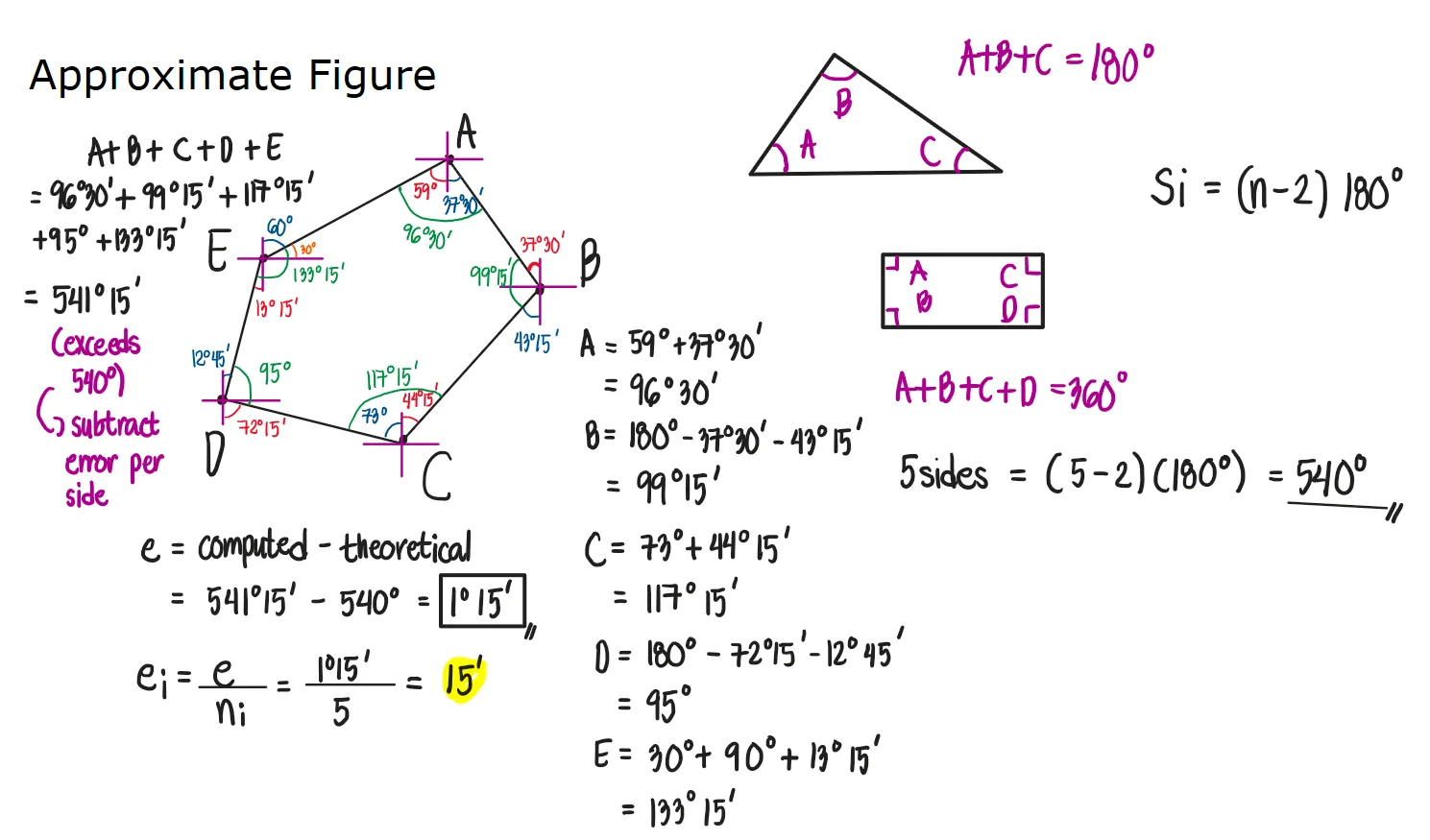
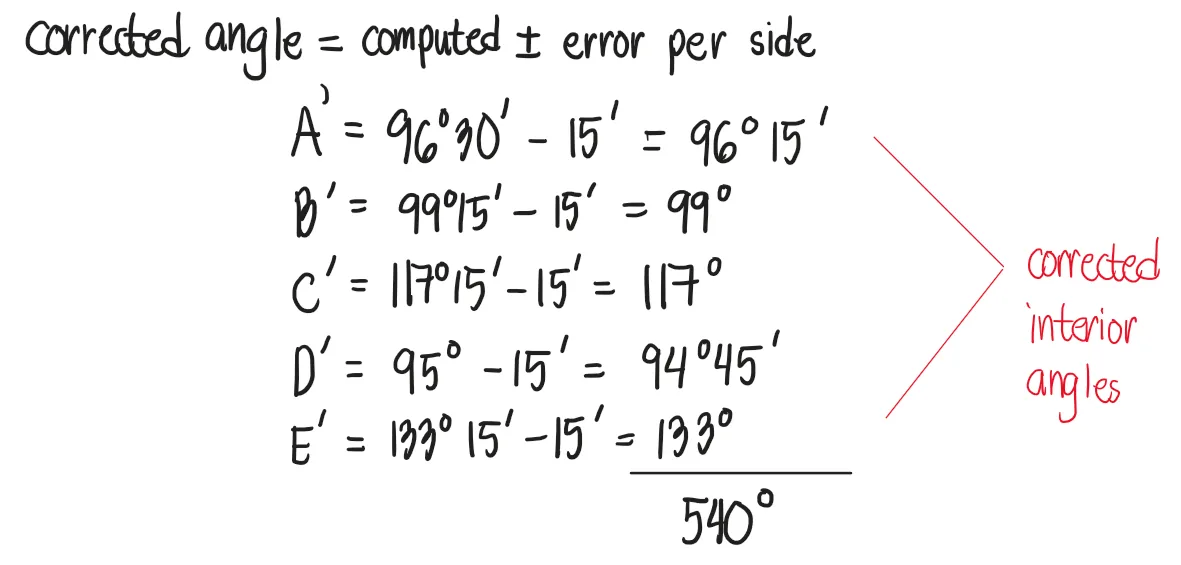
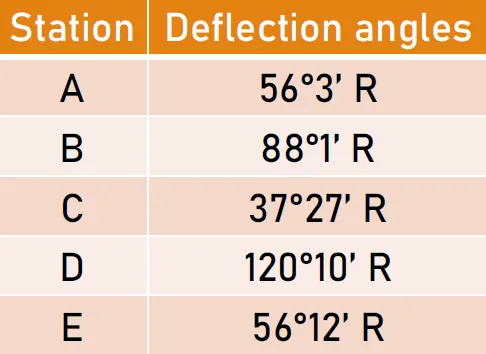
In the deflection angle traverse with a transit survey data below, find the corrected bearing of the lines. Bearing of line AB is N51°37'W.


See images:


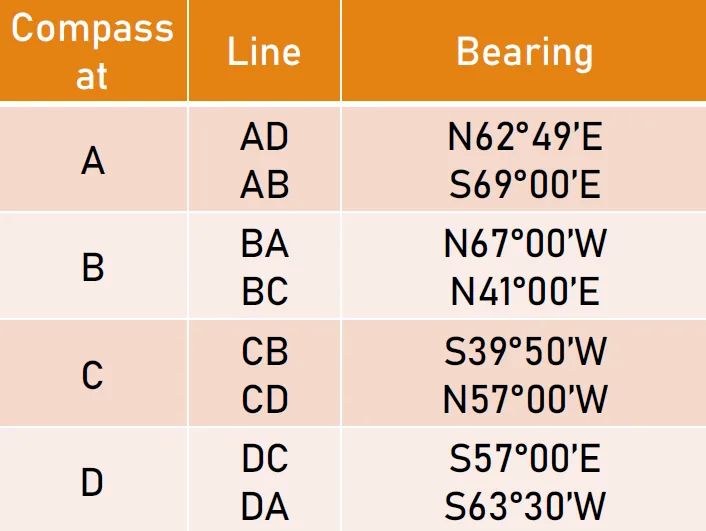
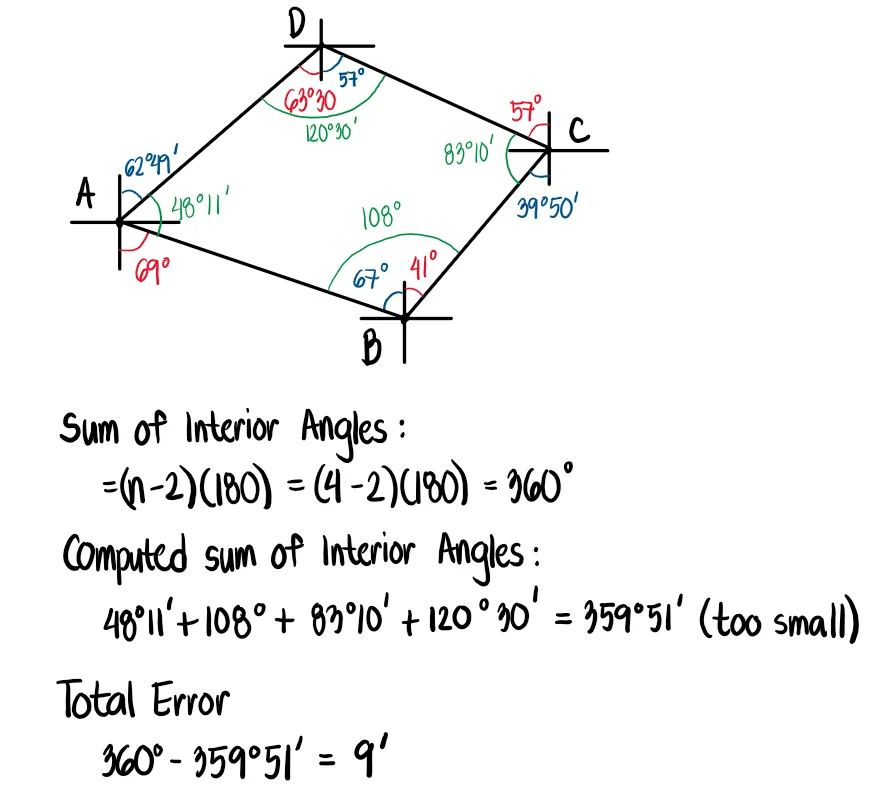
An engineer's notebook gives the observed magnetic bearings of the following traverse. Compute the corrected bearings of the lines.


See images:
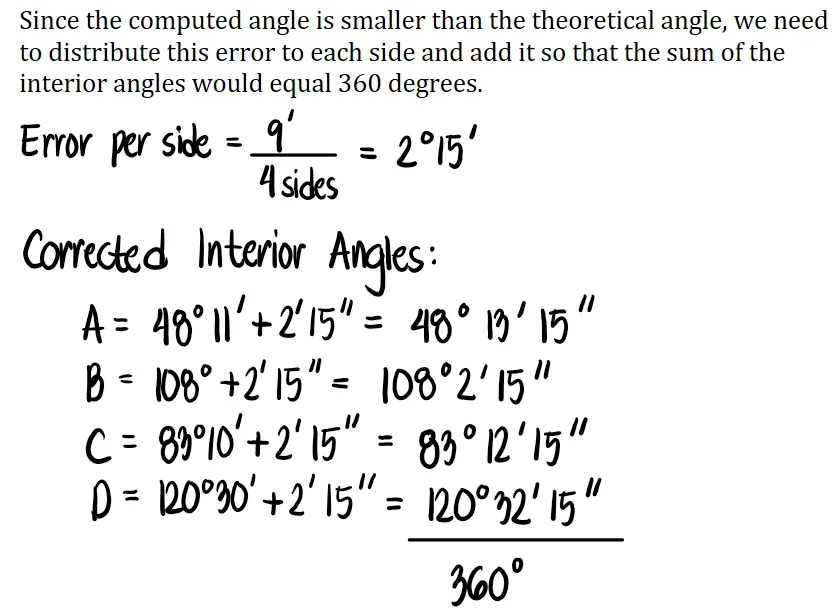
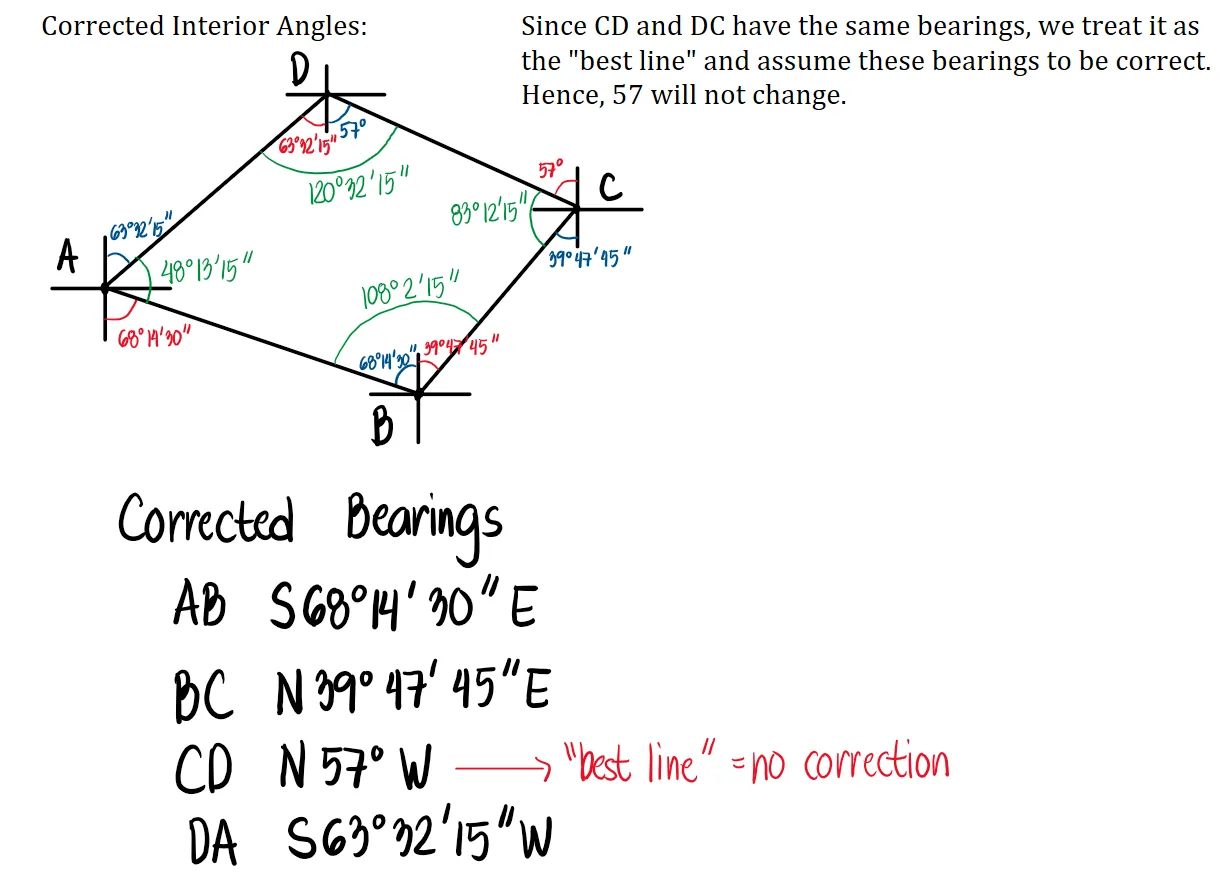

| Line | Forward Bearing | Backward Bearing |
|---|---|---|
| AB | N 30°30′ W | S 32°15′ E |
| BC | S 80°45′ W | N 82°45′ E |
| CD | S 53°00′ W | N 50°15′ E |
| DE | S 13°00′ W | N 11°30′ E |
| EA | N 66°30′ E | S 69°30′ W |


Solution:
Compute the Interior Angles
A = 180° − 30°30′ − 69°30′ = 80°00′
B = 32°15′ + 80°45′ = 113°00′
C = 180° − 82°45′ + 53°00′ = 150°15′
D = 180° − 50°15′ + 13°00′ = 142°45′
E = 66°30′ − 11°30′ = 55°00′
Sum of Interior Angles = (5 − 2)180° = 540°
Σ angles = 80° + 113° + 150°15′ + 142°45′ + 55° = 541°
Error = 541° − 540° = 1° (excess; distribute equally among the five interior angles)
Correction per interior angle = −1° / 5 = −12′
| Line | Forward Azimuth | Backward Azimuth | D = Back − Forward (mod 360°) |
|---|---|---|---|
| AB | 149°30′ | 327°45′ | 178°15′ |
| BC | 80°45′ | 262°45′ | 182°00′ |
| CD | 53°00′ | 230°15′ | 177°15′ |
| DE | 13°00′ | 191°30′ | 178°30′ |
| EA | 246°30′ | 69°30′ | 183°00′ |
Convention: azimuths here are measured clockwise from south. Forward and backward azimuths should differ by 180°, not be equal.
Compute D = backward azimuth − forward azimuth; add 360° if negative. Select the line with the smallest |D − 180°|. DE is the best line: its discrepancy is 1°30′.
Reduce final azimuths to 0°–360°. Use the directed difference, not the unsigned difference, to choose the sign. For EA: D = 69°30′ − 246°30′ + 360° = 183°00′.
This method assumes equal weight for the two reference observations. Reciprocal agreement provides a relative reference; it does not prove that both stations are free from local attraction.
Bearing check: reverse N 11°30′ E to S 11°30′ W, then average it with S 13°00′ W. The midpoint is S 12°15′ W. Adding 45′ to the forward value would move it away from this midpoint.
| Line | Bearing | Azimuth from South |
|---|---|---|
| DE | S 12°15′ W | 12°15′ |
| EA | 12°15′ + 54°48′ = N 67°03′ E | 247°03′ |
| AB | 180° − 67°03′ − 79°48′ = N 33°09′ W | 146°51′ |
| BC | 112°48′ − 33°09′ = S 79°39′ W | 79°39′ |
| CD | 150°03′ + 79°39′ − 180° = S 49°42′ W | 49°42′ |
Closure check at D: 49°42′ + 142°33′ − 180° = 12°15′, returning to the reference azimuth of DE.


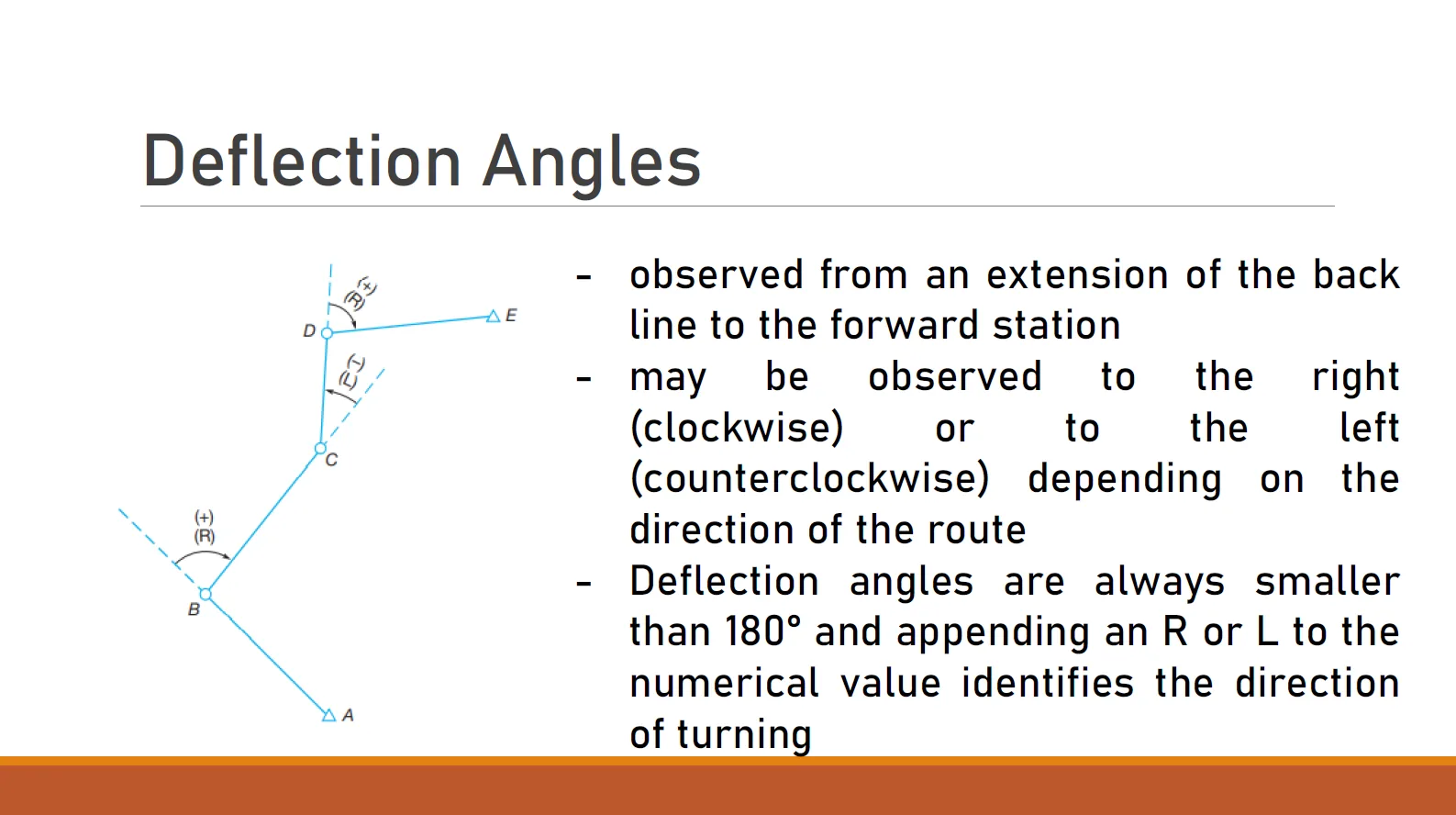
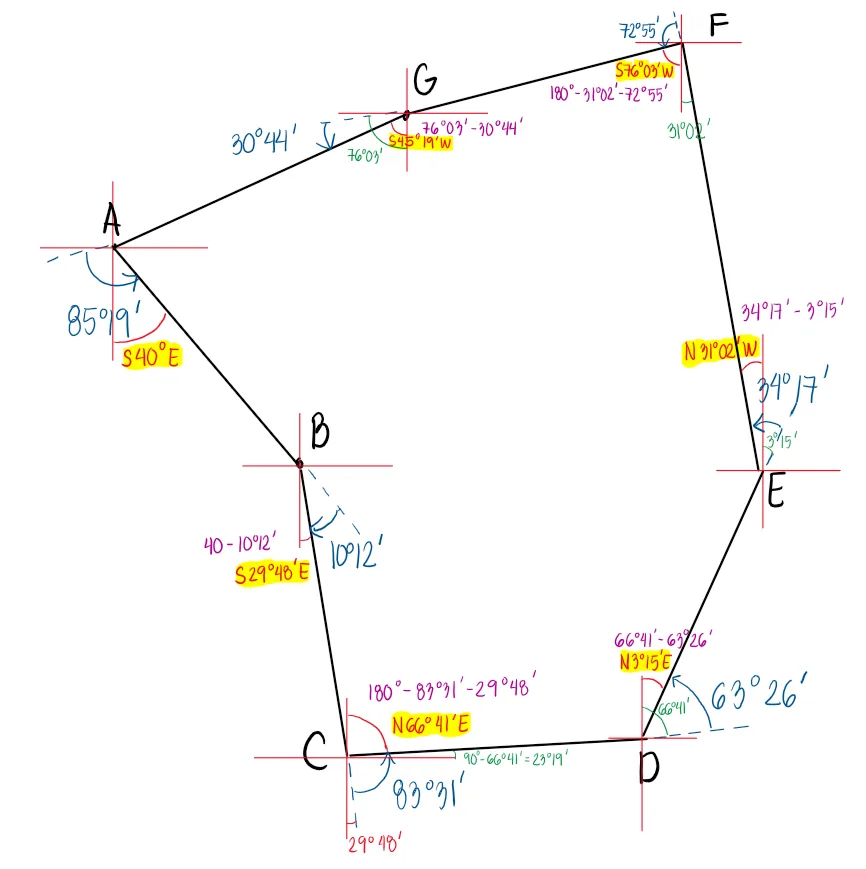
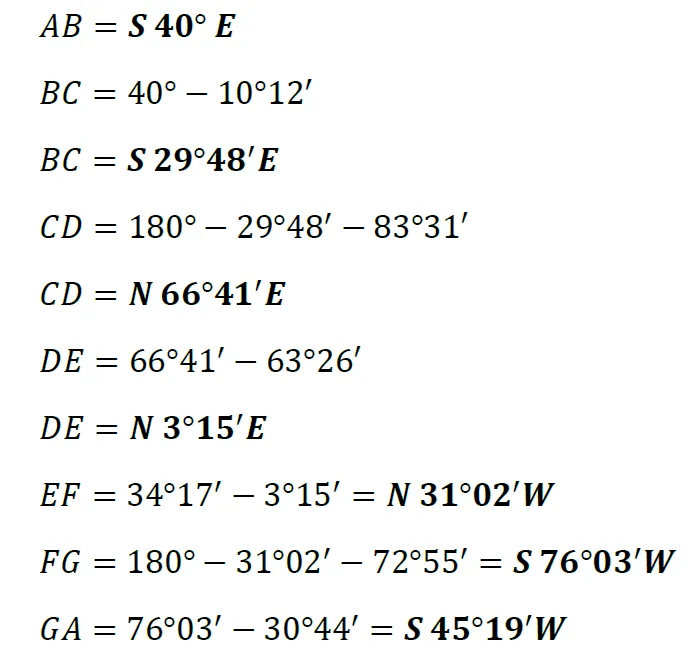
Given the following deflection angles of a closed traverse, compute the bearing of all the lines if the bearing of AB is S40°E.
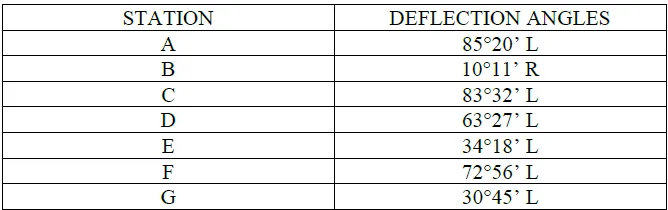


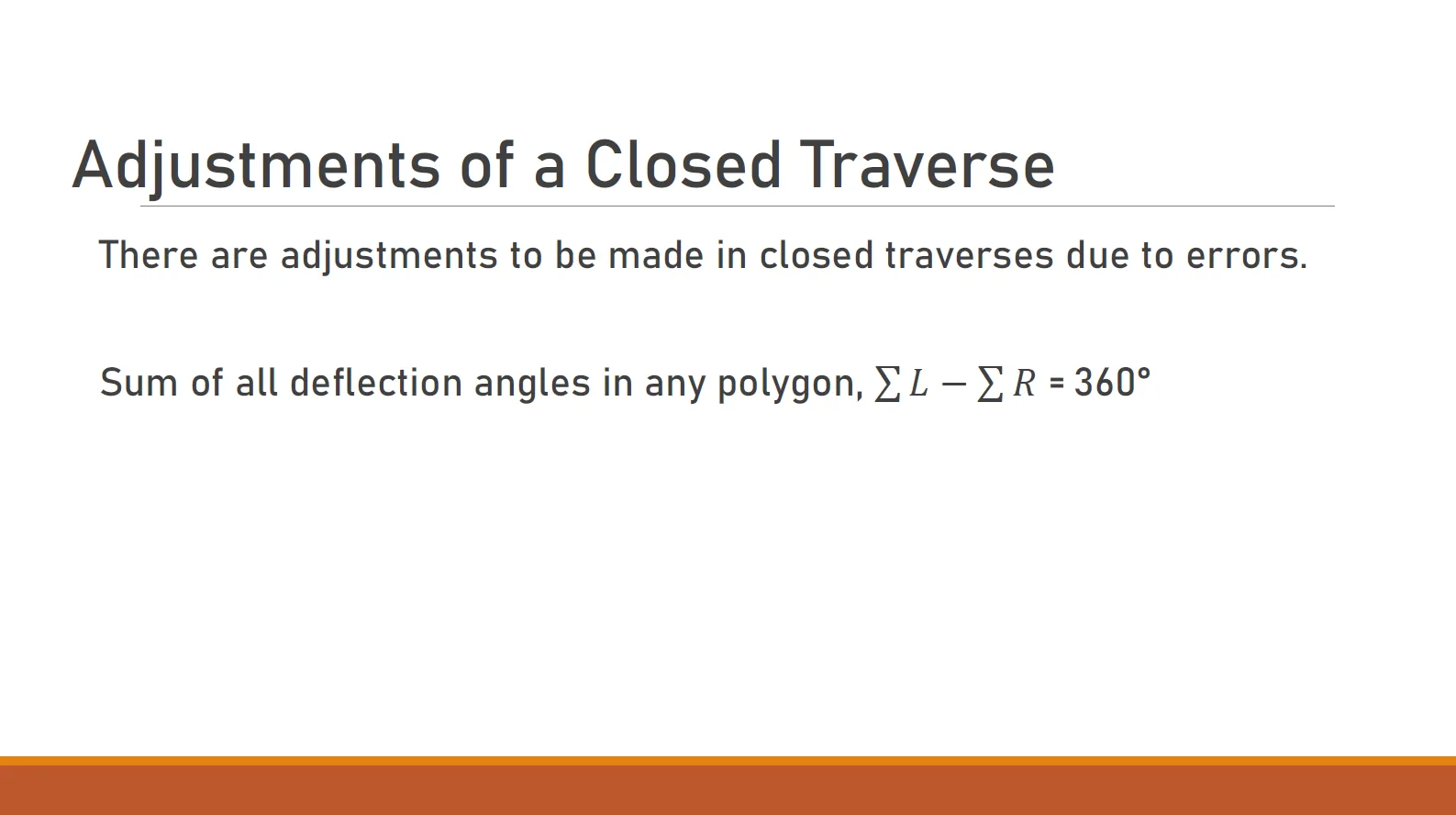
The corrected deflection angles are shown below. By analyzing the observed values, it will be identified that the sum of the left deflection angles must be reduced and the sum of the right deflection angles must be increased.
In other words, the summation of the left deflection angles is larger than the summation of the right deflection angles, and since the total angle exceeds 360°, we need to subtract the correction for the larger summation (left) and add the correction to the lesser summation (right).
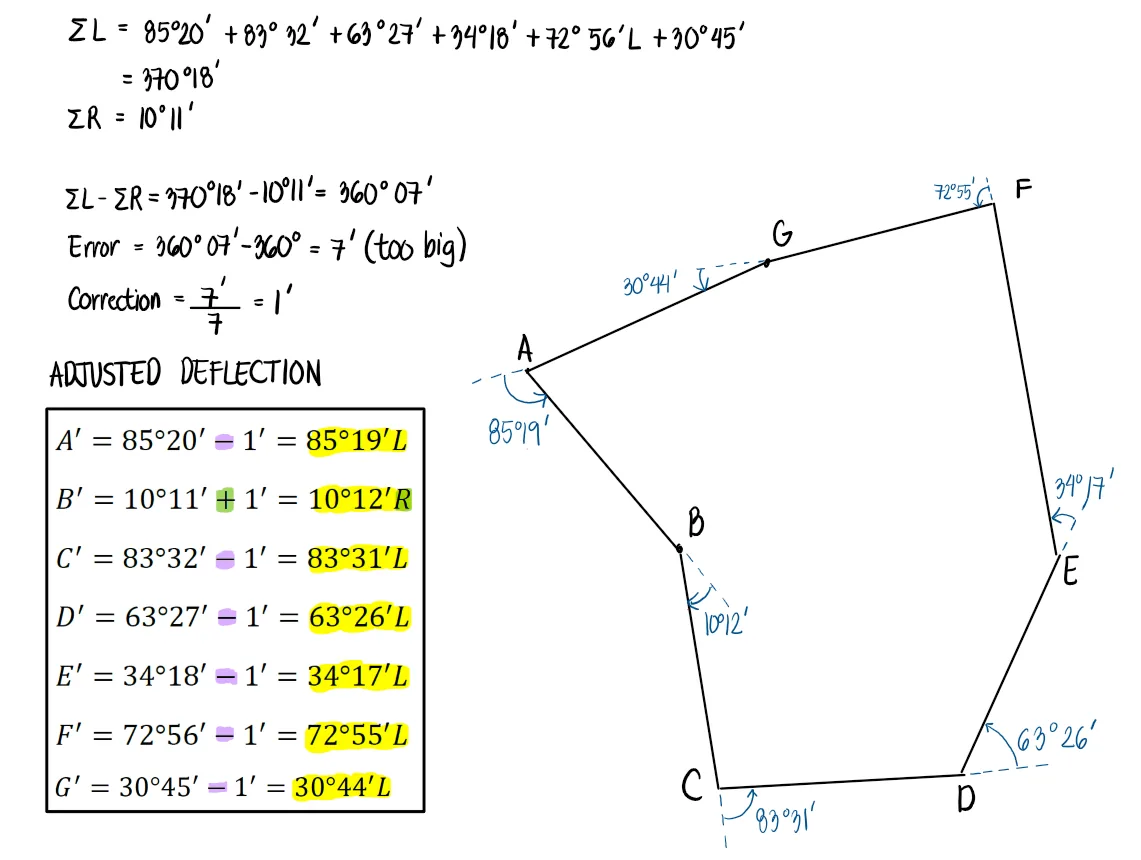

Following are the observed deflection angles of a closed traverse. Find the corrected bearing of the lines if the bearing of line AB is S31°E.
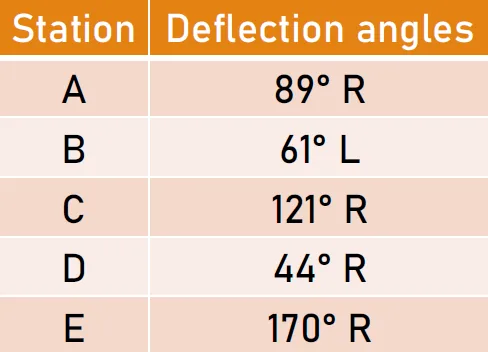


See images:


Additional board-style practice items for this topic.
The interior angles of a five sides traverse are as follows: A = 117° 30'; B = 96° 32'; C = 142° 32'; D = 132° 18'. The angle at E is not measured.
Calculate the angle at E.
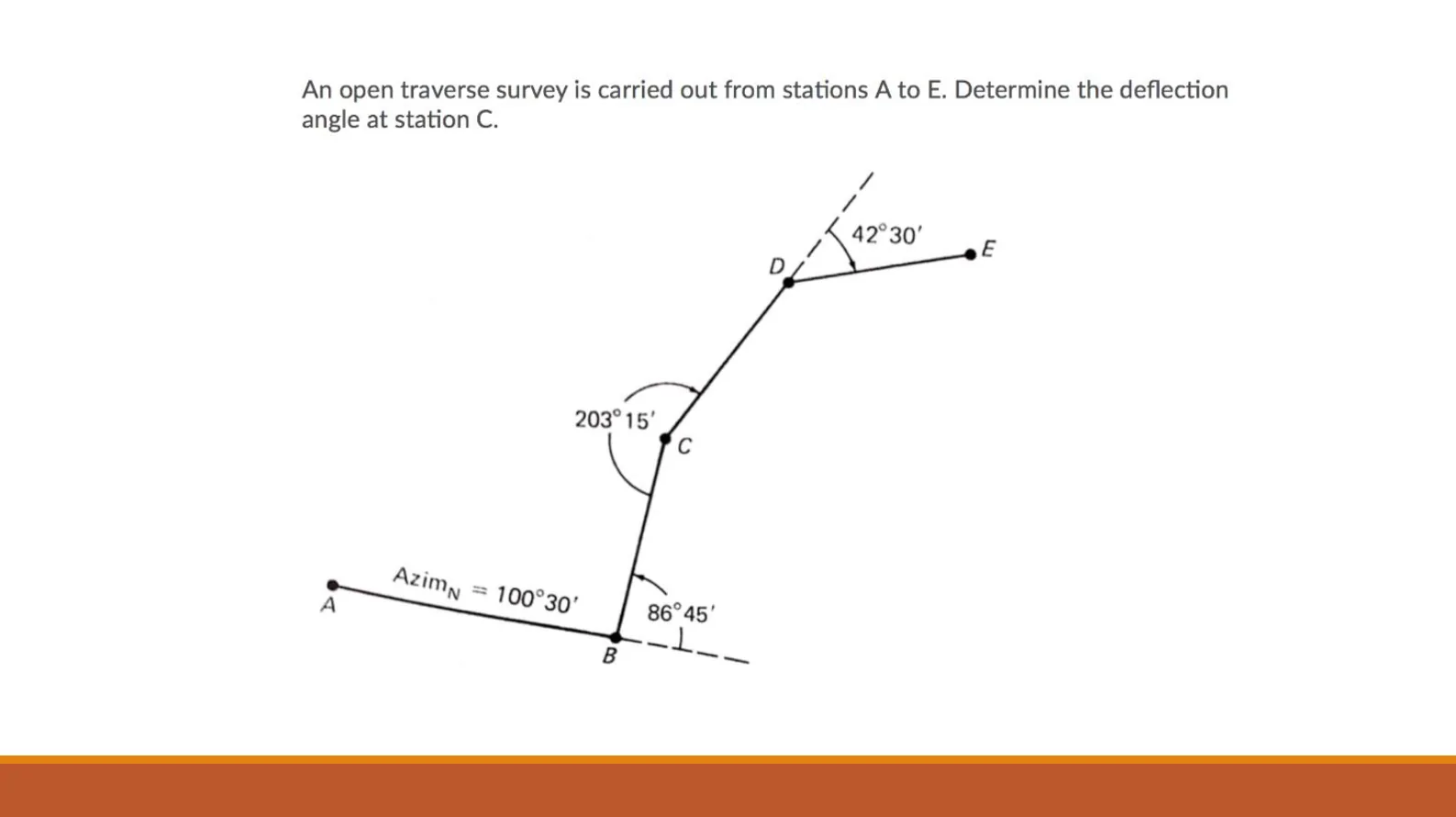
What is the deflection angle at C?
Compute the bearing of line DE if AB is due north.
Solution pending in psadquestions/t1127.json.
Given the following data for a closed traverse. [Line AB: Length 23.06, Bearing N 31° E, Lat 19.77, Dep 11.88; BC: 23.70, N 43° W, Lat 17.33, Dep -16.16; CD: 54.30, Bearing x, Lat -45.02, Dep y; DE: 32.10, S 67° E, Lat -12.54, Dep 29.55; EA: z, N 14° E, Lat w, Dep 5.10].
What is the value of x?
What is the value of y?
What is the value of z?
What is the area of the traverse?
Solution pending in psadquestions/t1146.json.
A closed traverse ABCD has the following data: [LINE AB: LENGTH 122.00, BEARING N 30° E; BC: 149.00, N 60° E; CD: 241.00, S 10° W; DA: 159.00, N 70° W].
Determine the corrected bearing of side BC using the compass rule.
Determine the corrected bearing of side CD using the compass rule.
Determine the corrected length of side BC using the compass rule.
Solution pending in psadquestions/t1150.json.
A closed traverse has the following data: [Line AB: Length 126.00 m, Bearing N 35° E; BC: 233.00 m, S 10° E; CA: 170.00 m, N 41° W].
What is the relative error of measurement?
What is the corrected length of line BC using the compass rule?
What is the corrected length of line BC using the transit rule?
Solution pending in psadquestions/t1153.json.
Closed Traverse has the following data: [LINE AB: Bearing N 30° 30' E, Distance 56.5 m; BC: N 75° 30' W, 65.7 m; CD: S 45° 30' W, 85.7 m; DA: ?, ?].
What is the bearing of line DA?
What is the length of line DA?
What is the area of the lot?
Solution pending in psadquestions/t1159.json.
A closed traverse has the following data: [LINE AB: Bearing ?, Distance 44.47; BC: ?, 137.84; CD: N 1° 45' E, 12.83; DE: N 72° 10' E, 64.86; EA: S 48° 13' E, 107.72]. Find the bearing of line AB.
Solution pending in psadquestions/t1165.json.
A lot in the form of a convex polygon has the following technical description. The bearing of adjacent sides CD and DE are missing. [Line AB: Length 525.36, Bearing N 32° 14' E; BC: 652.21, S 54° 17' E; CD: 418.24, ?; DE: 387.45, ?; EA: 569.52, N 37° 36' W].
What is the bearing of side DE?
What is the bearing of side CD?
What is the area of the lot in square meters?
Solution pending in psadquestions/t1166.json.
Determine the corrected values for the latitude of line $BC$ and departure of line $CD$ using the compass rule.
| Course | Bearing | Length |
|---|---|---|
| AB | N 26°10' E | 285.10 |
| BC | S 75°25' E | 610.45 |
| CD | S 15°30' W | 720.45 |
| DE | N 1°42' W | 203.00 |
| EA | N 53°06' W | 647.02 |
A traverse was run on a small jobsite using a 20-second theodolite and a chain. Assume the angles were measured with equal precision. The direction of AB is 54°10′. Determine the azimuth or bearing at line CA. The adjusted angles are: A = 52°25′, B = 53°04′, and C = 74°31′.