CE Board Exam Randomizer

⬅ Back to Subject Topics

Measurement Methods of Distances

Correction Formulas

Important Considerations

Difference Between Measuring and Laying Out
Measuring Distances
This is when you use a tape to determine the length of something that already exists (e.g., the width of a road, distance between two survey points, length of a beam).
→ You record what the tape shows.

Laying Out Distances
This is when you use the tape to set a required length on the ground or structure (e.g., staking 50 m for a building foundation, marking 20 m for a pipeline).
→ You establish the distance based on the tape.
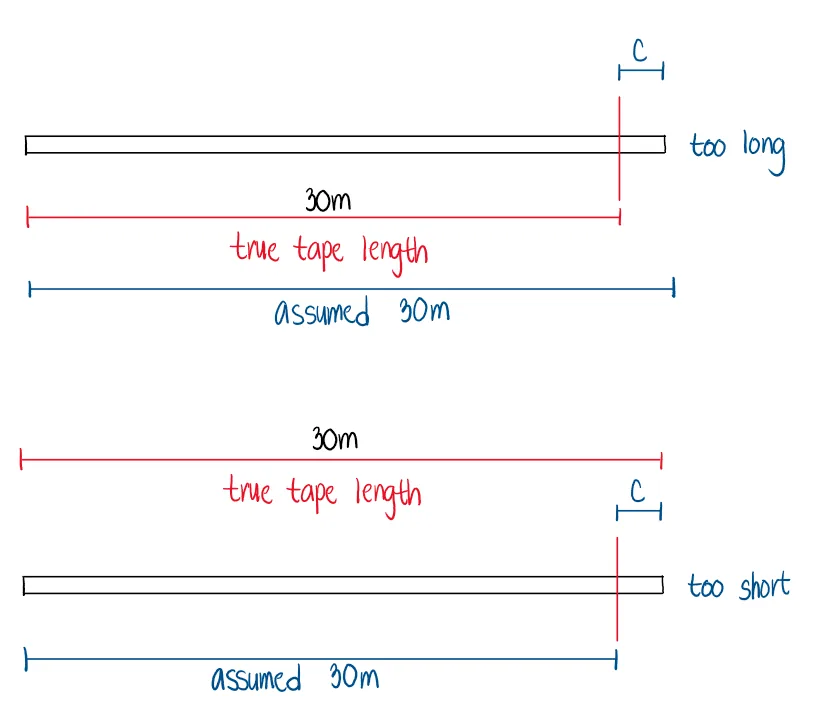
Measurement of Distances | Fundamentals of Surveying – Important Considerations – Diagram

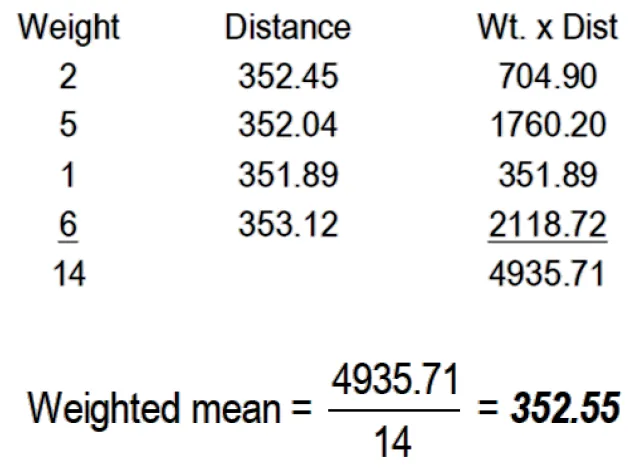
Problem (Weighted Mean):

Four measurements of a distance were recorded as 352.45, 352.04, 351.89, and 353.12m., and given weights are 2, 5, 1, and 6, respectively. Determine the weighted mean.

Measurement of Distances | Fundamentals of Surveying – Problem 1 (Weighted Mean): – Diagram Measurement of Distances | Fundamentals of Surveying – Problem 1 (Weighted Mean): – Diagram Measurement of Distances | Fundamentals of Surveying – Problem 1 (Weighted Mean): – Diagram

See images:

Measurement of Distances | Fundamentals of Surveying – Problem 1 (Weighted Mean): – Diagram Measurement of Distances | Fundamentals of Surveying – Problem 1 (Weighted Mean): – Diagram Measurement of Distances | Fundamentals of Surveying – Problem 1 (Weighted Mean): – Diagram Measurement of Distances | Fundamentals of Surveying – Problem 1 (Weighted Mean): – Diagram

Problem (Distance by Pacing):

A student recorded the following repeated paces of a given line: 456, 448, 462, 447, 452, and 455. If his pace factor is 0.628m/pace, what is the approximate length of the line in meters?

Measurement of Distances | Fundamentals of Surveying – Problem 2 (Distance by Pacing): – Diagram Measurement of Distances | Fundamentals of Surveying – Problem 2 (Distance by Pacing): – Diagram Measurement of Distances | Fundamentals of Surveying – Problem 2 (Distance by Pacing): – Diagram

$$Ave. Pace = \frac{456+448+462+447+452+455}{6}=453.33 \ paces$$
$$Length\ of\ line = 453.333(0.628)=284.69m$$

Measurement of Distances | Fundamentals of Surveying – Problem 2 (Distance by Pacing): – Diagram Measurement of Distances | Fundamentals of Surveying – Problem 2 (Distance by Pacing): – Diagram Measurement of Distances | Fundamentals of Surveying – Problem 2 (Distance by Pacing): – Diagram Measurement of Distances | Fundamentals of Surveying – Problem 2 (Distance by Pacing): – Diagram

Problem (Correction due to temperature and pull):

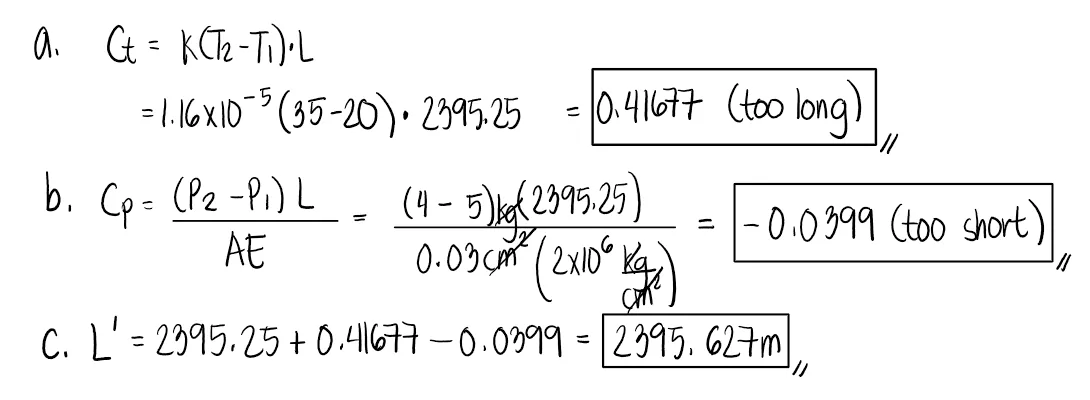
A line was determined to be 2395.25m when measured with a 30-m steel tape supported throughout its length under the pull of 4kg at a mean temperature of 35°C. The tape used is of standard length at 20°C under a pull of 5kg. The cross sectional area of the tape is 0.03 sq. cm. Coefficient of thermal expansion is 1.16x10⁻⁵/°C. Modulus of elasticity of the tape is 2x10⁶kg/cm2.
a. Determine the error due to change in temperature
b. Determine the error due to tension
c. Determine the corrected length of the line

Measurement of Distances | Fundamentals of Surveying – Problem 3 (Correction due to temperature and pull): – Diagram Measurement of Distances | Fundamentals of Surveying – Problem 3 (Correction due to temperature and pull): – Diagram Measurement of Distances | Fundamentals of Surveying – Problem 3 (Correction due to temperature and pull): – Diagram

See images:

Measurement of Distances | Fundamentals of Surveying – Problem 3 (Correction due to temperature and pull): – Diagram Measurement of Distances | Fundamentals of Surveying – Problem 3 (Correction due to temperature and pull): – Diagram Measurement of Distances | Fundamentals of Surveying – Problem 3 (Correction due to temperature and pull): – Diagram Measurement of Distances | Fundamentals of Surveying – Problem 3 (Correction due to temperature and pull): – Diagram

Problem (Laying Out a 500m Line):

CE Board May 2015
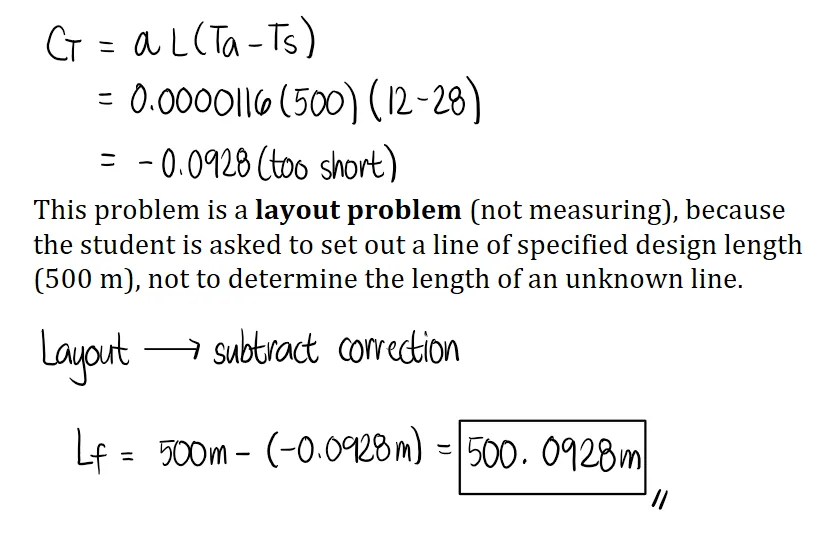
A student was asked to measure a 500m long line using a 25m tape that is of standard length at a temperature of 28°C. If the average temperature is 12°C, what is the required measurement? α=0.0000116m/m°C

Measurement of Distances | Fundamentals of Surveying – Problem 4 (Laying Out a 500m Line): – Diagram Measurement of Distances | Fundamentals of Surveying – Problem 4 (Laying Out a 500m Line): – Diagram Measurement of Distances | Fundamentals of Surveying – Problem 4 (Laying Out a 500m Line): – Diagram

See images:

Measurement of Distances | Fundamentals of Surveying – Problem 4 (Laying Out a 500m Line): – Diagram Measurement of Distances | Fundamentals of Surveying – Problem 4 (Laying Out a 500m Line): – Diagram Measurement of Distances | Fundamentals of Surveying – Problem 4 (Laying Out a 500m Line): – Diagram Measurement of Distances | Fundamentals of Surveying – Problem 4 (Laying Out a 500m Line): – Diagram

Problem (Laying Out a 345.43m long line):

CE Board May 2016
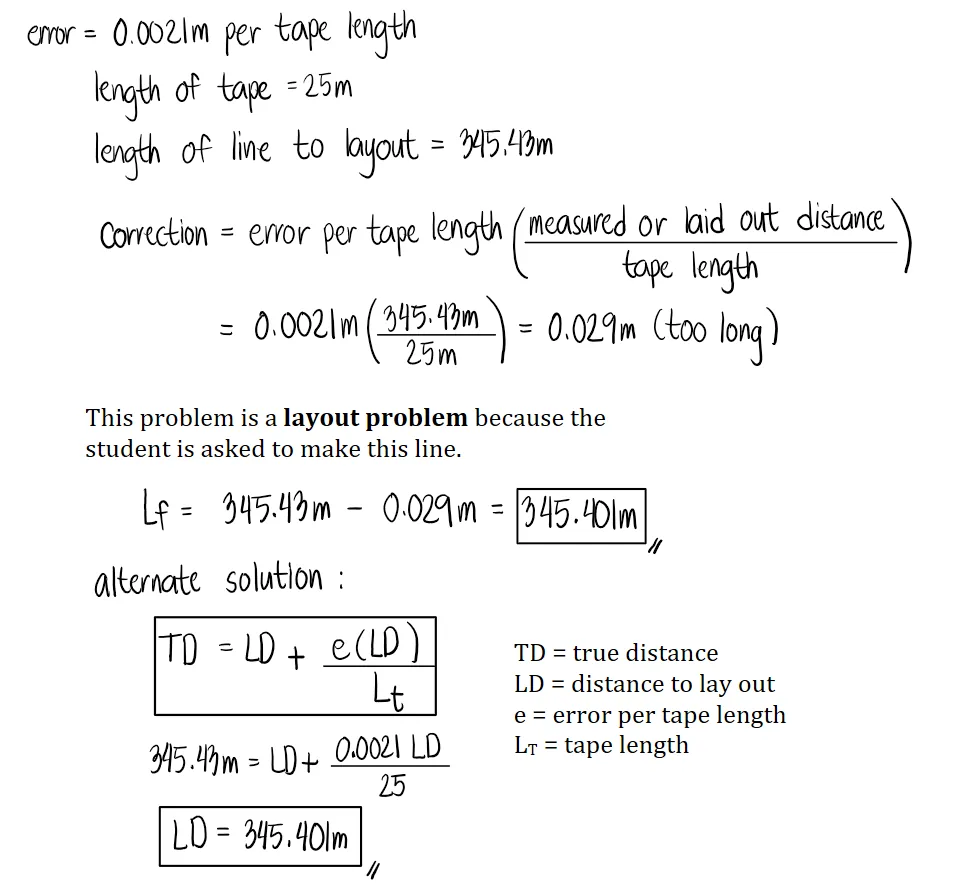
A student was asked to make a 345.43m long line using a 25m tape that is 0.0021m too long. What is the required measurement?

Measurement of Distances | Fundamentals of Surveying – Problem 5 (Laying Out a 345.43m long line): – Diagram Measurement of Distances | Fundamentals of Surveying – Problem 5 (Laying Out a 345.43m long line): – Diagram Measurement of Distances | Fundamentals of Surveying – Problem 5 (Laying Out a 345.43m long line): – Diagram

See images:

Measurement of Distances | Fundamentals of Surveying – Problem 5 (Laying Out a 345.43m long line): – Diagram Measurement of Distances | Fundamentals of Surveying – Problem 5 (Laying Out a 345.43m long line): – Diagram Measurement of Distances | Fundamentals of Surveying – Problem 5 (Laying Out a 345.43m long line): – Diagram Measurement of Distances | Fundamentals of Surveying – Problem 5 (Laying Out a 345.43m long line): – Diagram

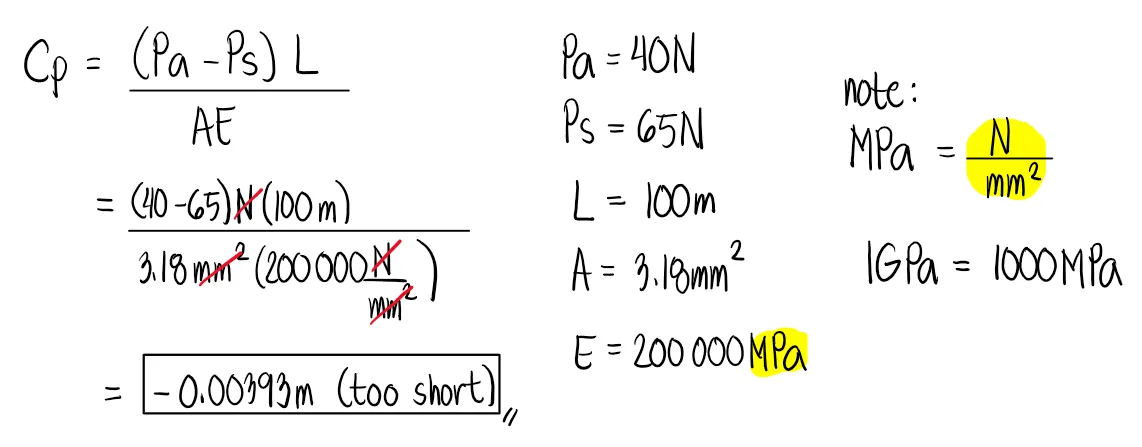
Problem (Correction due to pull):

A steel tape is 100 meters long at a standard pull of 65N. Compute the pull correction in mm if during measurement the applied pull is 40N. The tape has a cross-sectional area of 3.18mm2 and a modulus of elasticity E=200,000MPa.

Measurement of Distances | Fundamentals of Surveying – Problem 6 (Correction due to pull): – Diagram Measurement of Distances | Fundamentals of Surveying – Problem 6 (Correction due to pull): – Diagram Measurement of Distances | Fundamentals of Surveying – Problem 6 (Correction due to pull): – Diagram

See images:

Measurement of Distances | Fundamentals of Surveying – Problem 6 (Correction due to pull): – Diagram Measurement of Distances | Fundamentals of Surveying – Problem 6 (Correction due to pull): – Diagram Measurement of Distances | Fundamentals of Surveying – Problem 6 (Correction due to pull): – Diagram Measurement of Distances | Fundamentals of Surveying – Problem 6 (Correction due to pull): – Diagram

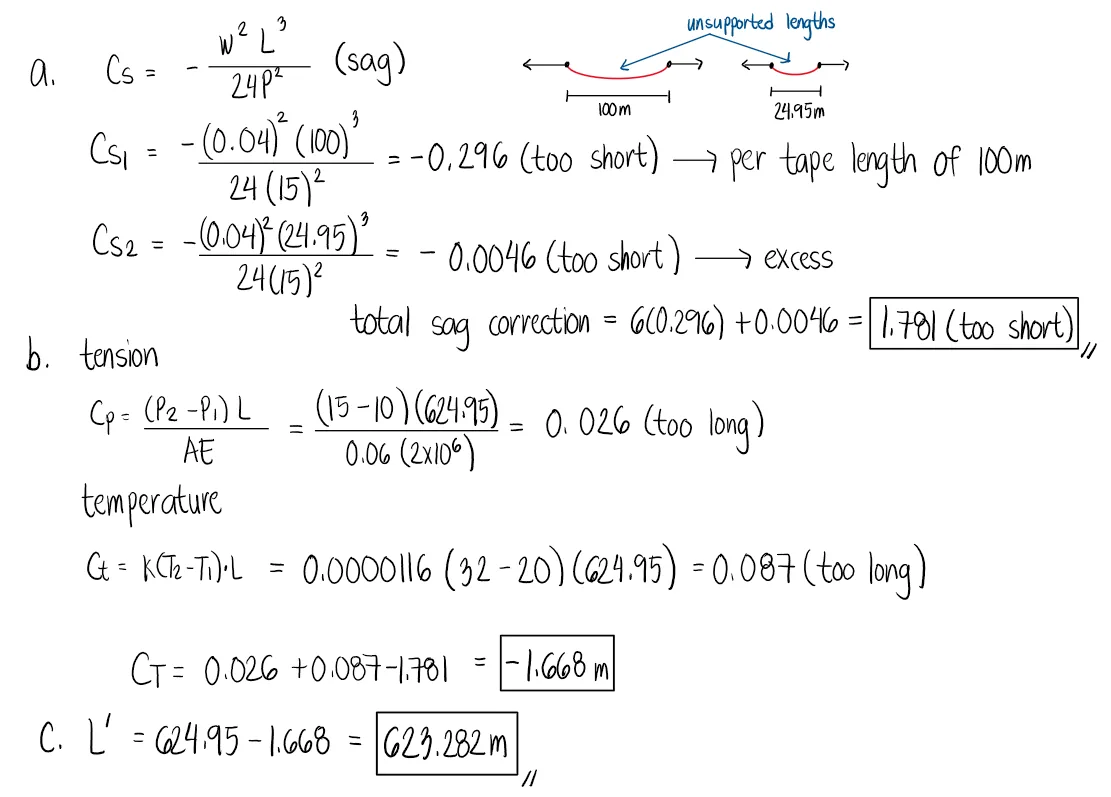
Problem (Correction due to tension, sag, and temperature):

A steel tape is 100m long at a temperature of 20°C and a pull of 10kg. It was used to measure a distance of 624.95m at a temperature of 32°C with an applied pull of 15kg during measurement with the tape supported at both ends. Coefficient of thermal expansion is 0.0000116/°C and a modulus of elasticity of 2x10⁶kg/cm2. The weight of the tape is 0.04kg/m and has a cross-sectional area of 0.06cm2
a. Compute the sag correction
b. Compute the total correction for tension, sag, and temperature.
c. Compute the corrected length of the line.

Measurement of Distances | Fundamentals of Surveying – Problem 7 (Correction due to tension, sag, and temperature): – Diagram Measurement of Distances | Fundamentals of Surveying – Problem 7 (Correction due to tension, sag, and temperature): – Diagram Measurement of Distances | Fundamentals of Surveying – Problem 7 (Correction due to tension, sag, and temperature): – Diagram

See images:

Measurement of Distances | Fundamentals of Surveying – Problem 7 (Correction due to tension, sag, and temperature): – Diagram Measurement of Distances | Fundamentals of Surveying – Problem 7 (Correction due to tension, sag, and temperature): – Diagram Measurement of Distances | Fundamentals of Surveying – Problem 7 (Correction due to tension, sag, and temperature): – Diagram Measurement of Distances | Fundamentals of Surveying – Problem 7 (Correction due to tension, sag, and temperature): – Diagram

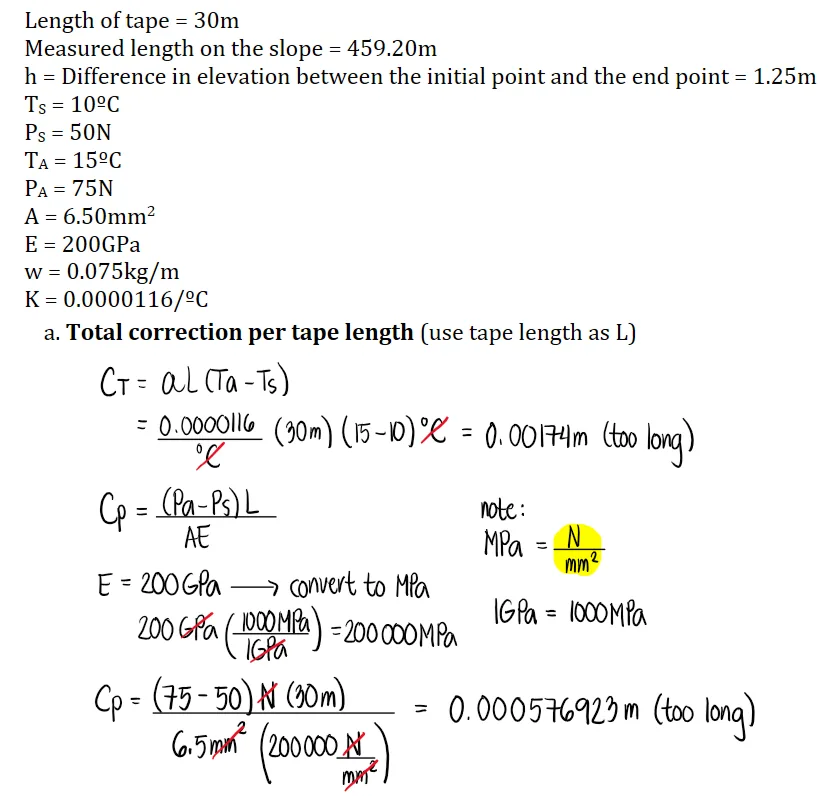
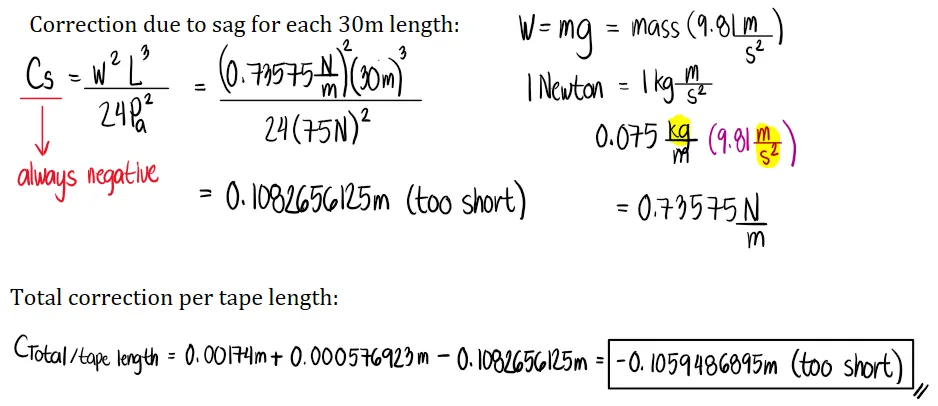
Problem (Correction due to temperature, pull, sag, and slope):

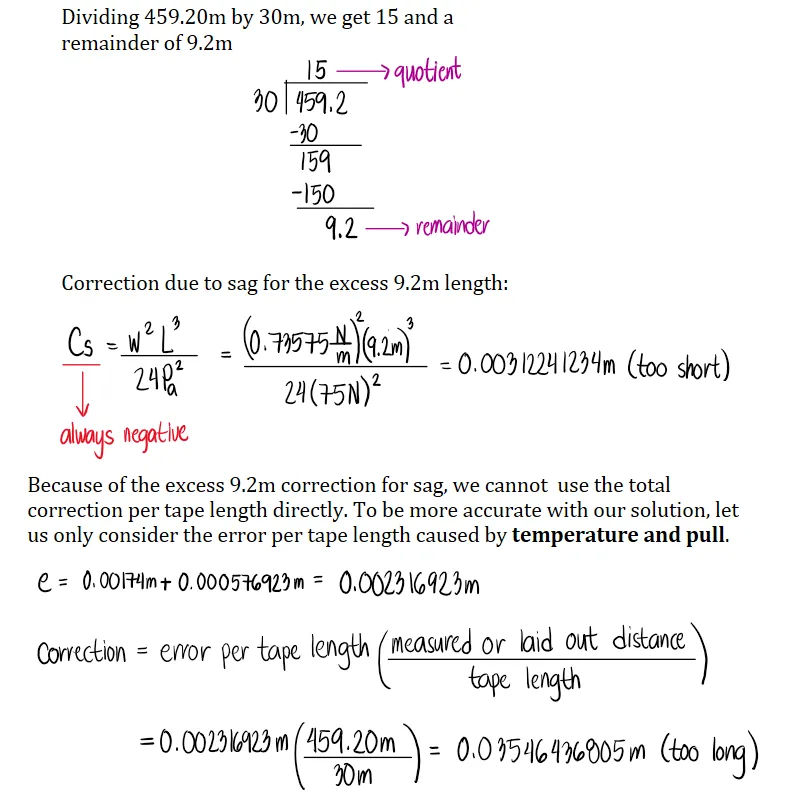
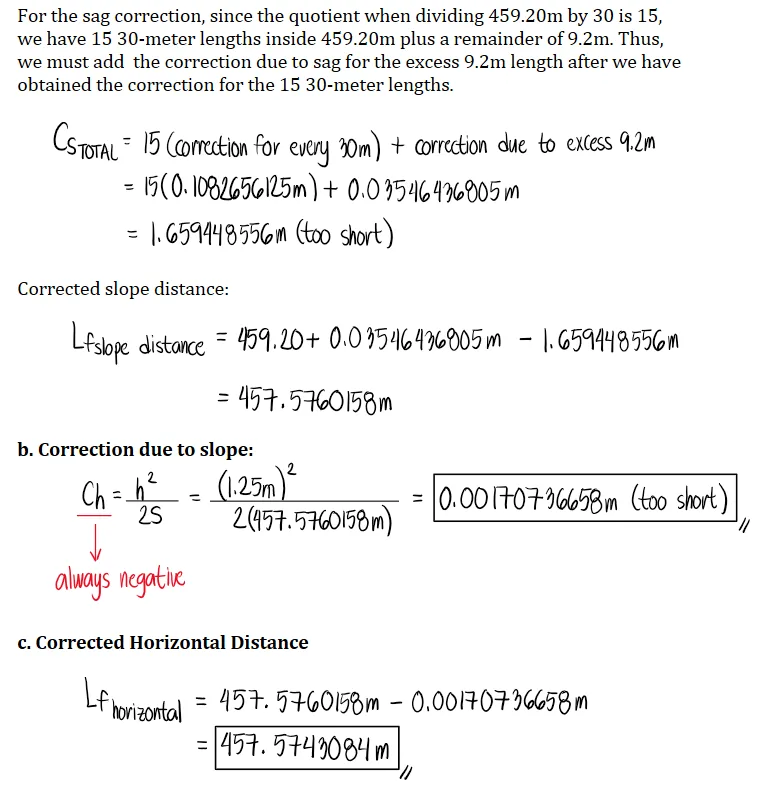
A civil engineer used a 30m tape in measuring an inclined distance. The measured length on the slope was recorded to be 459.20m long. The difference in elevation between the initial point and the end point was found to be 1.25m. The 30m tape is of standard length at a temperature of 10°C and a pull of 50N. During measurement, the temperature reading was 15°C and the tape was supported at both ends with an applied pull of 75N. The cross-sectional area of the tape is 6.50mm2 and the modulus of elasticity is 200GPa. The tape has a mass of 0.075kg/m. K=0.0000116/°C.
a. Determine the total correction per tape length.
b. Determine the correction for slope.
c. Determine the corrected horizontal distance.

Measurement of Distances | Fundamentals of Surveying – Problem 8 (Correction due to temperature, pull, sag, and slope): – Diagram Measurement of Distances | Fundamentals of Surveying – Problem 8 (Correction due to temperature, pull, sag, and slope): – Diagram Measurement of Distances | Fundamentals of Surveying – Problem 8 (Correction due to temperature, pull, sag, and slope): – Diagram

See images:

Measurement of Distances | Fundamentals of Surveying – Problem 8 (Correction due to temperature, pull, sag, and slope): – Diagram Measurement of Distances | Fundamentals of Surveying – Problem 8 (Correction due to temperature, pull, sag, and slope): – Diagram Measurement of Distances | Fundamentals of Surveying – Problem 8 (Correction due to temperature, pull, sag, and slope): – Diagram Measurement of Distances | Fundamentals of Surveying – Problem 8 (Correction due to temperature, pull, sag, and slope): – Diagram

Problem (Normal Tension):

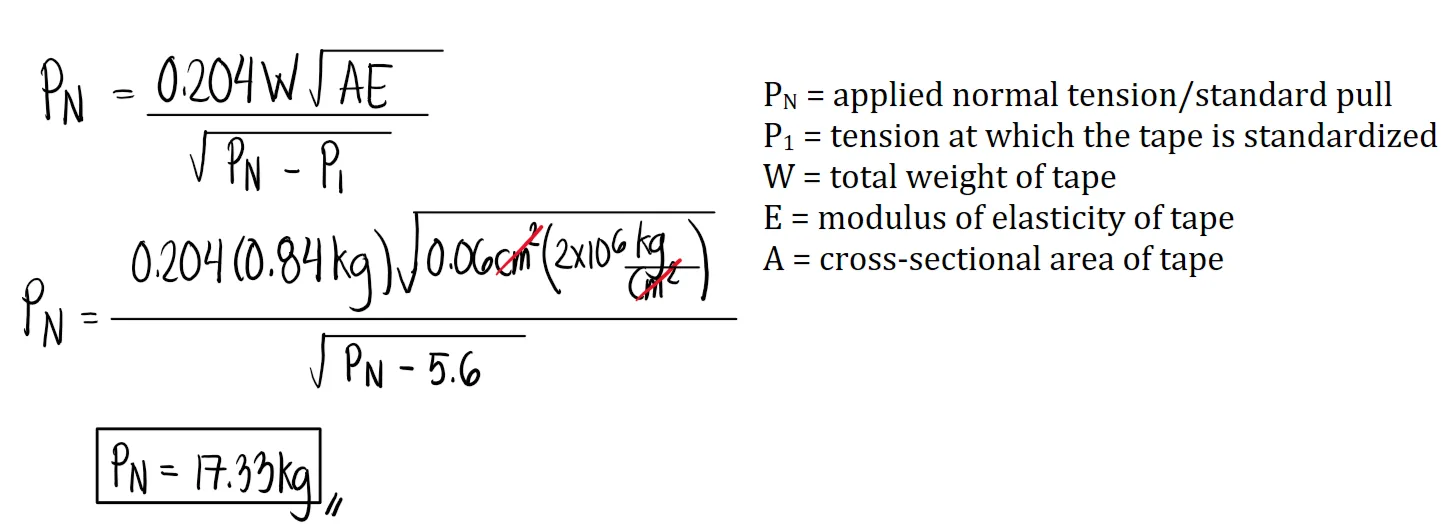
Compute the normal tension which will be applied to a tape supported over two supports in order to make the tape equal to its nominal length when supported only at end points. The steel tape is 30m long and weighs 0.84kg when supported throughout its length under a standard pull of 5.6kg, with the modulus of elasiticity of 2x10⁶kg/cm2 and an area of 0.06cm2

Measurement of Distances | Fundamentals of Surveying – Problem 9 (Normal Tension): – Diagram Measurement of Distances | Fundamentals of Surveying – Problem 9 (Normal Tension): – Diagram Measurement of Distances | Fundamentals of Surveying – Problem 9 (Normal Tension): – Diagram

See images:

Measurement of Distances | Fundamentals of Surveying – Problem 9 (Normal Tension): – Diagram Measurement of Distances | Fundamentals of Surveying – Problem 9 (Normal Tension): – Diagram Measurement of Distances | Fundamentals of Surveying – Problem 9 (Normal Tension): – Diagram Measurement of Distances | Fundamentals of Surveying – Problem 9 (Normal Tension): – Diagram

Problem (Distance by Pacing):

A line 100m long was paced by a surveyor for four times with the following data: 142, 145, 145.5, and 146. Then, another line was paced for four times again with the following results: 790, 790.5, 789.5 and 791. Determine the distance of the new line.

Measurement of Distances | Fundamentals of Surveying – Problem 10 (Distance by Pacing): – Diagram Measurement of Distances | Fundamentals of Surveying – Problem 10 (Distance by Pacing): – Diagram Measurement of Distances | Fundamentals of Surveying – Problem 10 (Distance by Pacing): – Diagram

Given: Calibration line = 100 m. Paces on 100 m: 142, 145, 145.5, 146. New line paces: 790, 790.5, 789.5, 791.

1) Average paces on the 100 m calibration line

$$ \bar{P}_{100}=\frac{142+145+145.5+146}{4}=144.625\ \text{paces per 100 m} $$

2) Average paces on the new line

$$ \bar{P}_{\text{new}}=\frac{790+790.5+789.5+791}{4}=790.25\ \text{paces} $$

3) Pace length (meters per pace)

$$ L_p=\frac{100\ \text{m}}{\bar{P}_{100}}=\frac{100}{144.625}=0.691443\ \text{m/pace} $$

4) Distance of the new line

$$ D=\bar{P}_{\text{new}}\;L_p=790.25\,(0.691443)=546.41\ \text{m} $$

Answer: The distance of the new line is ≈ 546.41 m (say, 546.4 m).

Measurement of Distances | Fundamentals of Surveying – Problem 10 (Distance by Pacing): – Diagram Measurement of Distances | Fundamentals of Surveying – Problem 10 (Distance by Pacing): – Diagram Measurement of Distances | Fundamentals of Surveying – Problem 10 (Distance by Pacing): – Diagram Measurement of Distances | Fundamentals of Surveying – Problem 10 (Distance by Pacing): – Diagram

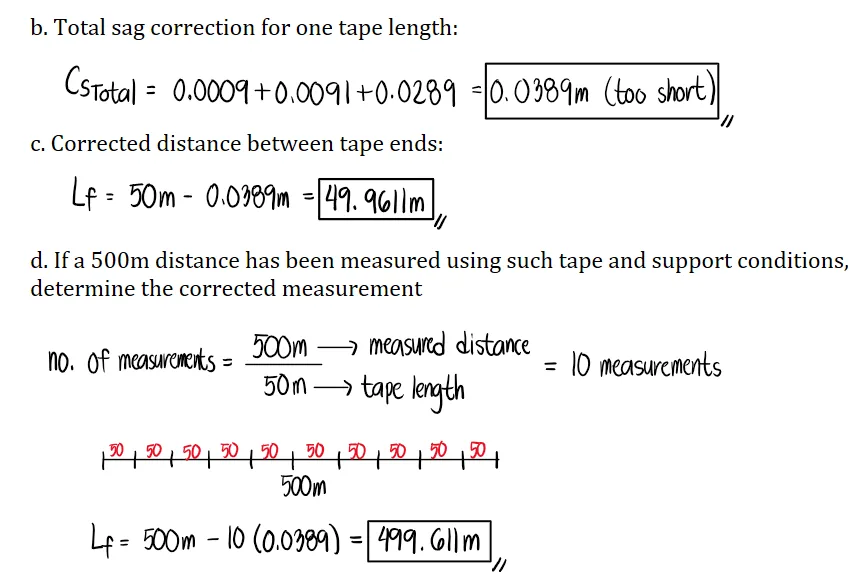
Problem (Correction due to Sag with varying support distances):

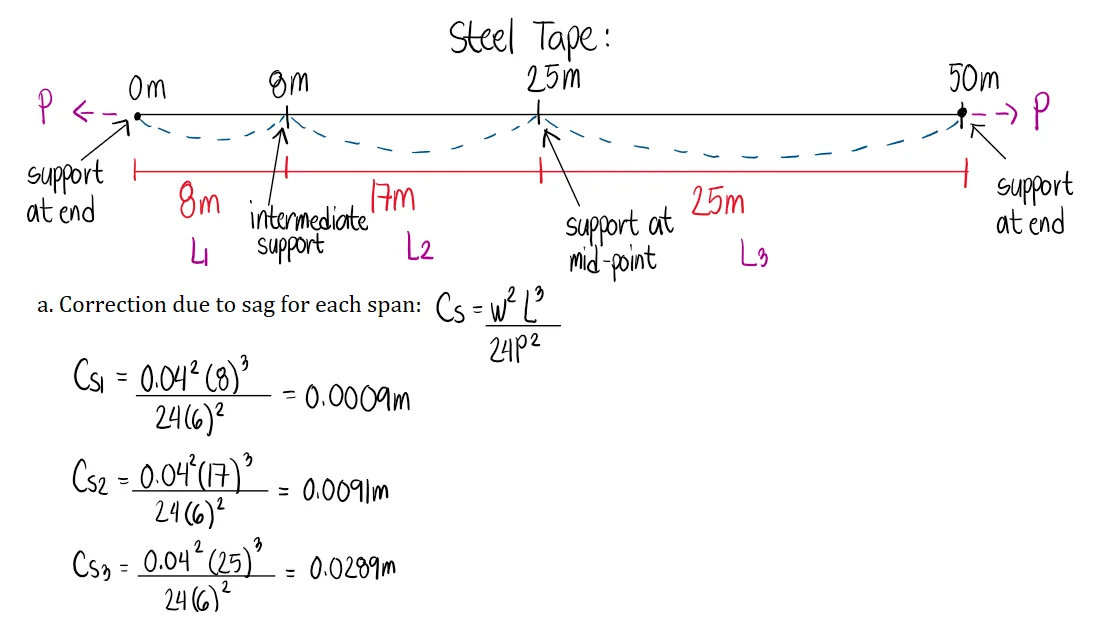
A 50-m steel tape weighs 0.04kg/m and is supported at its end points and at the 8-m and 25-m marks. If a pull of 6kg is applied, determine the following:
a. Correction due to sag between the 0m and 8-m marks, 8-m and 25-m marks, and the 25-m and 50-m marks.
b. Correction due to sag for one tape length.
c. Corrected distance between the ends of the tape.
d. If a 500m distance has been measured using such tape and support conditions, determine the corrected measurement.

Measurement of Distances | Fundamentals of Surveying – Problem 11 (Correction due to Sag with varying support distances): – Diagram Measurement of Distances | Fundamentals of Surveying – Problem 11 (Correction due to Sag with varying support distances): – Diagram Measurement of Distances | Fundamentals of Surveying – Problem 11 (Correction due to Sag with varying support distances): – Diagram

See images:

Measurement of Distances | Fundamentals of Surveying – Problem 11 (Correction due to Sag with varying support distances): – Diagram Measurement of Distances | Fundamentals of Surveying – Problem 11 (Correction due to Sag with varying support distances): – Diagram Measurement of Distances | Fundamentals of Surveying – Problem 11 (Correction due to Sag with varying support distances): – Diagram Measurement of Distances | Fundamentals of Surveying – Problem 11 (Correction due to Sag with varying support distances): – Diagram

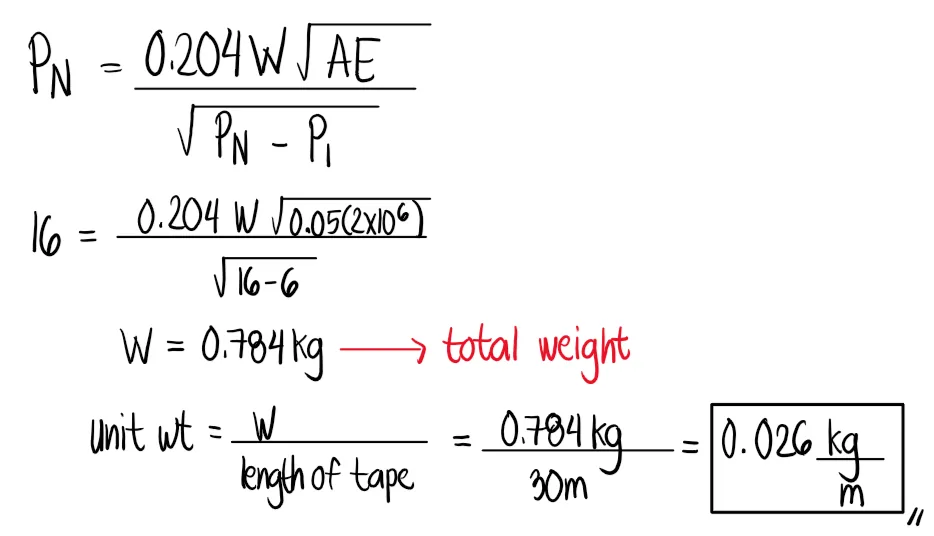
Problem (Normal Tension):

A steel tape is 30m long under a standard pull of 6kg with a constant cross-sectional area of 0.05cm2. If the normal tension applied to make the tape equal to its nominal length when supported only at the end points, that is the effect of sag will be eliminated by the elongation of the tape due to the application of this load is equal to 16kg, determine the unit weight of the tape. Modulus of elasticity of the tape is 2x10⁶kg/cm2.

See images:

Measurement of Distances | Fundamentals of Surveying – Problem 12 (Normal Tension): – Diagram

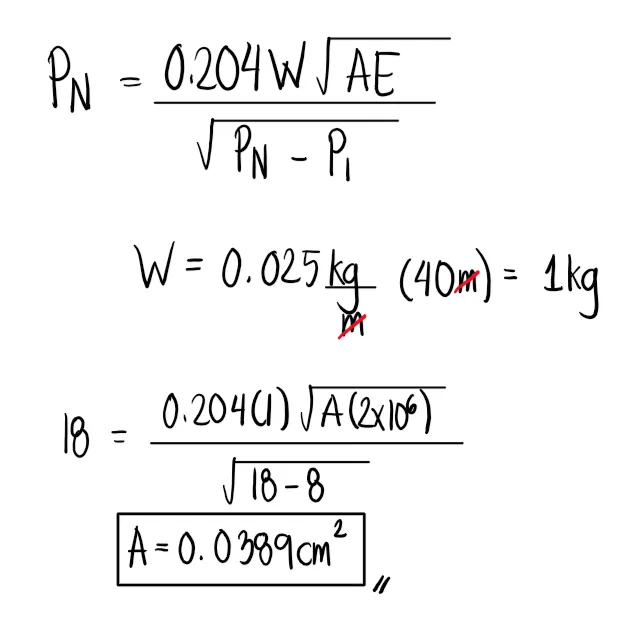
Problem (Normal Tension):

Under a standard pull of 8kg, the steel tape is 40m long. A normal tension of 16kg makes the elongation of the tape offset the effect of sag. If the tape weighs 0.025kg/m, and E=2x10⁶kg/cm2, determine its cross-sectional area in sq. cm.

See images:

Measurement of Distances | Fundamentals of Surveying – Problem 13 (Normal Tension): – Diagram

Exam Generator Problems

Additional board-style practice items for this topic.

Question Bank: t54

MSTE - Surveying / Taping Corrections / Civil Engineering Refresher

A 100 ft distance is taped with ± 0.02 ft error. Determine the anticipated error in taping 5000 ft.

  1. ± 0.14 ft
  2. ± 1.00 ft
  3. ± 0.50 ft
  4. ± 0.02 ft
$n = \frac{5000}{100} = 50$ tape lengths.
Accidental error accumulates as $\sqrt{n}$: $E = 0.02\sqrt{50} = 0.02(7.071)$
$\boxed{= \pm 0.14 \text{ ft}}$

Question Bank: t57

MSTE - Surveying / Taping Corrections / Civil Engineering Refresher

A 50 m tape (1.075 kg) has an 8 kg standard pull. Find the normal tension Pn to eliminate sag.

  1. 197.4 N
  2. 78.48 N
  3. 150.2 N
  4. 10.55 N

Solution pending in psadquestions/t57.json.

Question Bank: t58

MSTE - Surveying / Taping Corrections / Civil Engineering Refresher

A recorded distance is 696.41 m using a 50-m tape that is 0.015 m too long. What is the correct length?

  1. 696.619 m
  2. 696.201 m
  3. 696.500 m
  4. 696.425 m
Tape too long $\Rightarrow$ add correction. Correct length $= \text{recorded} \times \frac{\text{actual}}{\text{nominal}}$.
$= 696.41 \times \frac{50.015}{50} = 696.41 + 0.209$
$\boxed{= 696.619 \text{ m}}$

Question Bank: t62

MSTE - Surveying / Network Analysis / Civil Engineering Refresher

In a network with 4 nodes and 4 regions, determine the number of arcs present.

  1. 6
  2. 4
  3. 8
  4. 10
For a connected planar network, Euler's relation may be written as:
$N - A + R = 2$
where $N$ is the number of nodes, $A$ is the number of arcs, and $R$ is the number of regions.
$4 - A + 4 = 2$
$A = 4 + 4 - 2$
$\boxed{A = 6}$

Question Bank: t1105

MSTE - Surveying / Measurements and Areas / Gemini mapped Chapter 7 to 10

An aerial photograph was taken using a camera with a focal length of 12 cm. The plane was flying at an altitude of 1320 m above mean sea level and the mean ground elevation was 120 m.

What is the scale of the photograph?

  1. 1:100000
  2. 1:10000
  3. 1:1000
  4. 1:100

Using this scale, what is the actual ground distance on a map distance of 8.3 cm?

  1. 8300 m
  2. 83 m
  3. 830 m
  4. 83000 m

Using the same scale, what is the actual area (in square meter) on a map area of 10 square inches?

  1. 620,740
  2. 638,450
  3. 645,160
  4. 653,750

Solution pending in psadquestions/t1105.json.

Question Bank: t1108

MSTE - Surveying / Measurements and Areas / Gemini mapped Chapter 7 to 10

A Civil Engineering Student recorded the following paces for a 110-m line: 158, 163, 165, 159, 155. What is his pace factor?

  1. 0.825
  2. 0.689
  3. 0.75
  4. 0.625

Solution pending in psadquestions/t1108.json.

Question Bank: t1110

MSTE - Surveying / Measurements and Areas / Gemini mapped Chapter 7 to 10

A rectangular lot was measured using a 30-m metallic tape which was later found to be 8 mm too short. The recorded dimensions were 128.5 m long by 98.54 m wide. What is the error in area?

  1. 2.48 m^2
  2. -2.48 m^2
  3. +6.75 m^2
  4. -6.75 m^2

Solution pending in psadquestions/t1110.json.

Question Bank: t1112

MSTE - Surveying / Measurements and Areas / Gemini mapped Chapter 7 to 10

A 30-m steel tape is suspended in the air between a theodolite a vertical rod, which is placed exactly at the 30 meter mark. The slope of the measured line is 1°50'. The tension on the tape is 8 kg, and the weight of the tape per unit length is 0.03 kg/m.

Determine the correction for sag of the tape in meter?

  1. -0.0158
  2. 0.0158
  3. -0.0187
  4. 0.0187

Determine the horizontal distance between the theodolite and the rod in meters.

  1. 29.9863
  2. 29.8546
  3. 29.9752
  4. 29.9688

What pull (normal tension) is required in order that the effect of sag will be eliminated when the tape is supported at end points only? The tape has a standard pull of 8 kg. The tape's cross-sectional area and modulus of elasticity are 0.05 cm^2 and 200 GPa, respectively.

  1. 15.2 kg
  2. 18.3 kg
  3. 12.7 kg
  4. 25.4 kg

Solution pending in psadquestions/t1112.json.

Question Bank: t1118

MSTE - Surveying / Measurements and Areas / Gemini mapped Chapter 7 to 10

Four measurements of a distance were recorded as 352.45, 352.04, 351.89, and 353.12 meters and given weights of 2, 5, 3, and 8, respectively. Determine the weighted mean.

  1. 352.54
  2. 352.12
  3. 352.83
  4. 353.02

Solution pending in psadquestions/t1118.json.

Question Bank: t1121

MSTE - Surveying / Measurements and Areas / Gemini mapped Chapter 7 to 10

A line of levels was run from point 5 to point 6, 8 km apart. The average backsight and also foresight distance was 100 m. At every turning point, the rod settles by 2 cm. Find the correct elevation of point 6 based on its recorded elevation of 254 m.

  1. 253.2
  2. 253.24
  3. 253.18
  4. 253.22

Solution pending in psadquestions/t1121.json.

Question Bank: t1162

MSTE - Surveying / Measurements and Areas / Gemini mapped Chapter 7 to 10

Given the following field data: Coordinate of point A (600 m, 1500m), Coordinate of point B (430 m, 1680m), Bearing of AP = S 82° 30' W, Distance of AP = 85.32 m.

Determine the distance AB in meters.

  1. 231.24
  2. 247.59
  3. 220.47
  4. 210.42

Determine the distance PB in meters.

  1. 232.14
  2. 238.42
  3. 209.35
  4. 225.65

Determine the bearing of line PB.

  1. N 21° 15' 24" W
  2. N 20° 32' 02" W
  3. N 25° 14' 25" W
  4. N 24° 04' 38" W

Solution pending in psadquestions/t1162.json.

Question Bank: t1172

MSTE - Surveying / Measurements and Areas / Gemini mapped Chapter 7 to 10

Lot ABCD has the following technical description: [Side AB: Length 295.62 m, Bearing Due North; BC: 287.91 m, Due East; CD: 216.57 m, Due South; DA: ----, ----]. Its owner wishes to divide the parcel into two equal parts. The dividing line must begin at the midpoint of the northern boundary, but it may take any direction that divides the areas into halves.

What is the area of the parcel in hectares?

  1. 57.89
  2. 63.58
  3. 73.73
  4. 36.87

What is the length of side DA in meters?

  1. 298.57
  2. 268.75
  3. 272.45
  4. 321.52

At what distance (in meters) along the southern boundary from the southeastern corner of the parcel will the dividing line intersect?

  1. 154 m
  2. 172 m
  3. 198 m
  4. 299 m

Solution pending in psadquestions/t1172.json.

Question Bank: t1272

MSTE - Highway Engineering / Curves, Earthworks, and Traffic Engineering / Gemini mapped Chapter 7 to 10

Given a side slope of 2:1, a road width of 10 m and a cross-sectional area of 53.81 sq. m., find the value of y in the following cross-section notes: [Left: 9.8 / y1, Center: 0 / y, Right: x2 / +1.2]

  1. +4.56 m
  2. +5.21 m
  3. +5.87 m
  4. +6.41 m

Solution pending in psadquestions/t1272.json.

Question Bank: t1276

MSTE - Highway Engineering / Curves, Earthworks, and Traffic Engineering / Gemini mapped Chapter 7 to 10

The side slope of a road fill is 2H to 1V. The width of the roadbed (including shoulder and ditches) is 7 m and the height of fill at the road center is 3 m. The ground slope 8% upward to the right.

What is the distance of the right slope stake from the road center?

  1. 11.31 m
  2. 8.19 m
  3. 9.32 m
  4. 12.45 m

What is the distance of the left slope stake from the road center?

  1. 12.45 m
  2. 9.32 m
  3. 8.19 m
  4. 11.31 m

What is the area of fill in square meters?

  1. 40.2
  2. 45.6
  3. 35.3
  4. 54.3

Solution pending in psadquestions/t1276.json.

Question Bank: t1313

MSTE - Highway Engineering / Curves, Earthworks, and Traffic Engineering / Gemini mapped Chapter 7 to 10

The travel times of six vehicles traveling a one-kilometer segment of North Luzon Expressway is as follows: [Table omitted]

Determine the time mean speed in kph.

  1. 53.62
  2. 52.17
  3. 52.99
  4. 53.74

Determine the space mean speed in kph.

  1. 52.17
  2. 53.62
  3. 53.74
  4. 52.99

If 1500 vehicles passes the said segment in one hour, what is the traffic density in vehicles per kilometer?

  1. 24
  2. 29
  3. 32
  4. 45

Solution pending in psadquestions/t1313.json.

Question Bank: t1322

MSTE - Highway Engineering / Curves, Earthworks, and Traffic Engineering / Gemini mapped Chapter 7 to 10

An imaginary line joining points on Earth's surface that are all of equal distance north or south of the equator.

  1. nadir
  2. latitude
  3. longitude
  4. pole

Solution pending in psadquestions/t1322.json.

Question Bank: t1354

MSTE - Highway Engineering / Curves, Earthworks, and Traffic Engineering / Gemini mapped Chapter 7 to 10

Soil prepared and compacted to support aggregate, paved surface, a concrete slab, or other construction.

  1. subsoil
  2. subgrade
  3. subbase
  4. base grade

Solution pending in psadquestions/t1354.json.

Question Bank: t2159

MSTE - Surveying / Measurements and Areas / Besavilla CE Pre-Board Math & Surveying

A line was measured with a 50 m. tape. There were 2 tallies, 8 pins, and the distance from the last pin to the end of the line was 2.25 m. Find the length of the line in meters?

  1. 1563.38 m.
  2. 1178.43 m.
  3. 1215.58 m.
  4. 1402.25 m.
  5. 1312.78 m.
For a 50 m tape, one tally represents 10 full tape lengths, or 500 m.
Two tallies: $2(500)=1000$ m
Eight pins: $8(50)=400$ m
Remaining distance from the last pin: 2.25 m
$L=1000+400+2.25$
$\boxed{L=1402.25\text{ m}}$

Question Bank: w46

MSTE - Surveying / Taping Corrections / MSTE May 2019

A rectangular field was measured using a 100-m tape which was actually 10 cm too short. The recorded area was 4500 sq. m. What is the true area of the field?

  1. 4491 m2
  2. 4509 m2
  3. 4504 m2
  4. 4495 m2
True tape length $L_t = 100 - 0.1 = 99.9\text{ m}$.
$\frac{A_t}{A_m} = \left(\frac{L_t}{L_m}\right)^2$
$A_t = 4500\left(\frac{99.9}{100}\right)^2 = \boxed{4491\text{ m}^2}$
Scroll to zoom