Introduction to Surveying and Discussion of Errors
Surveying is the science of determining the earth's dimensions and surface form by measuring
distances, directions, and elevations. It also covers staking out lines/grades for construction and the
computation of areas, volumes, and related quantities for preparing maps and diagrams.
Why it matters: surveys guide construction of buildings, roads, dams, and other structures by fixing positions and
elevations needed during layout and construction.
As-Built Surveys → Document the final positions and dimensions of features after construction.
Quick Reference
Plane vs. Geodetic: use plane for small sites — subdivisions, site grading, short roads.
Use geodetic for regional control networks, long routes, and high-accuracy mapping.
Measurements, Accuracy & Precision
Measurement is central to surveying, but no measurement is exact; the true value is never fully known.
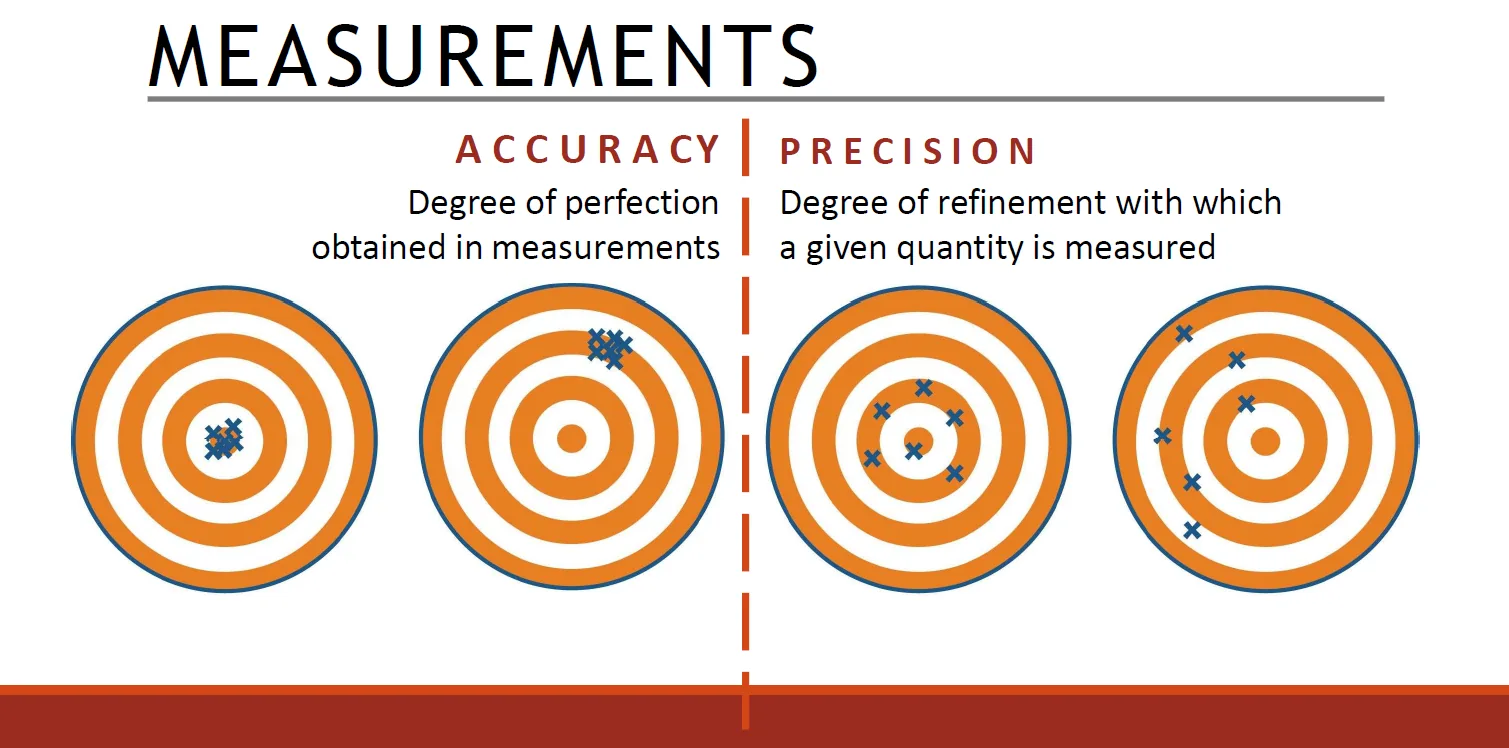
Accuracy = closeness to the true value (degree of perfection), while
Precision = repeatability or refinement of readings.
Aim: Use skill, judgment, and proper methods to make measurements as accurate and precise as practical.
Mistakes vs. Errors
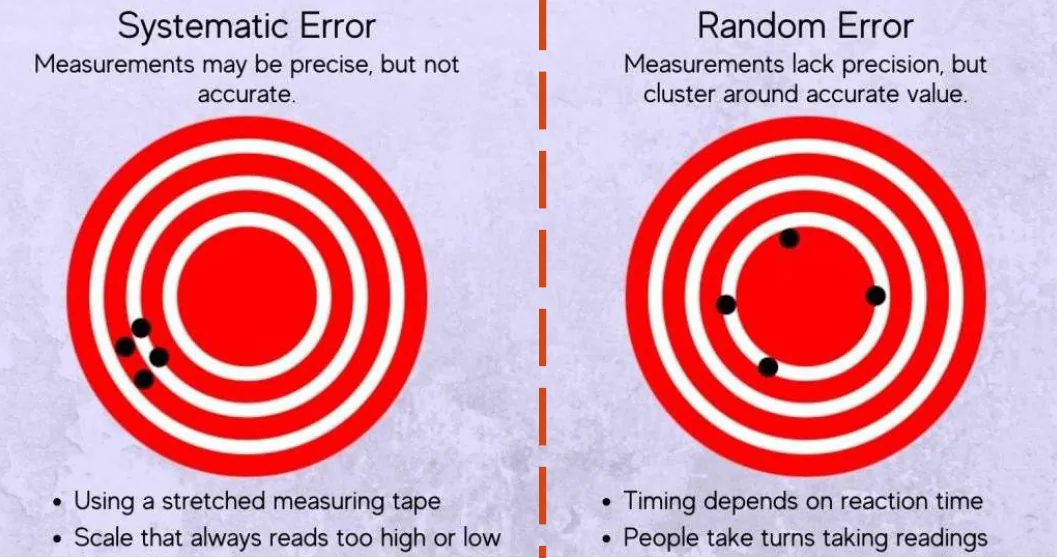
Mistake (Blunder): due to inattention or misunderstanding; eliminable by careful checking.
Error (Unavoidable): due to limits of senses, instrument imperfections, or environment; cannot be eliminated
but can be minimized.
Relative / Probable Error
835.82 ± 0.06
The quality of a measurement can be expressed by stating a relative error.
Maximum Probable Value: 835.88ft
Minimum Probable Value: 835.76ft
Most Probable Value: 835.82ft
Probable error statements:
50% error: “There is a 50% chance that the error is ±0.12 ft or less and a
50% chance that it contains a larger error”
90% error: “There is a 90% chance that the error is ±0.12 ft or less and a 10%
chance that it contains a larger error”
Treating a Set of Repeated Measurements
Arithmetic Mean (assumed best/most-probable value): $\,\mu=\dfrac{\sum x_i}{n}\,$
Residuals (deviations): $\,v_i=x_i-\mu\,$
Standard Deviation (sample): $\,\sigma=\sqrt{\dfrac{\sum v_i^{2}}{n-1}}$
Why $n-1$? Imagine you're measuring how much students deviate from the class average — but you don't know the true class average, so you use your group's average. Since your group average is “tuned” to your group's own values, your spread will look smaller. Dividing by $n-1$ counteracts that, making the estimate closer to the true population spread.
Probability (Normal) Curve insights:
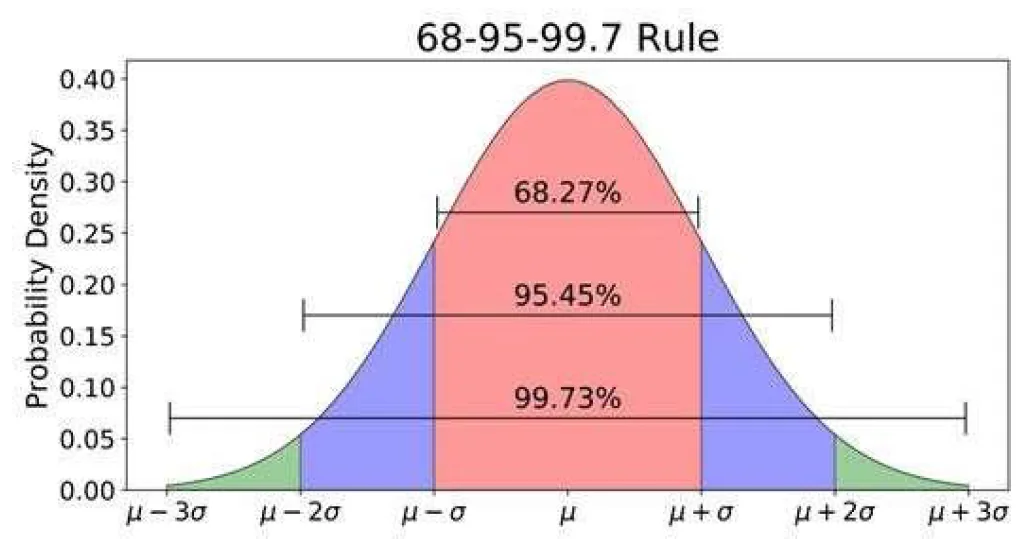
There is 68.27% chance that the error is $\pm\sigma$ or less and 31.73% chance that the error is larger.
There is 95.45% chance that the error is $\pm2\sigma$ or less and 4.55% chance that the error is larger.
There is 99.73% chance that the error is $\pm3\sigma$ or less and 0.27% chance that the error is larger.
Tip: Compute $\mu$, tabulate $v_i$, then $\sum v_i^2$ to obtain $\sigma$ and make probability statements on your result.
Propagation of Accidental (Random) Errors
Series of Similar (Repeated) Measurements
Error of a Series of Similar Measurements When a series of quantities are measured, random errors tend to accumulate in proportion to the square root of the number of measurements. Error grows with the square root of the count:
$E_{\text{series}}=\pm E\sqrt{n}$, where $E$ is the error of each observation.
If a distance is measured a number of times with a probable random
error in each measurement, the probable error in the distance will
equal the total probable error in the number of observations divided by
the number of observations. Error of the mean (standard error): $E_{\bar{x}}=\dfrac{E_{\text{series}}}{n}=\pm\dfrac{E\sqrt{n}}{{n}}$
Examples: Combining errors for a tract's sides; angle series with a per-angle error to get a total
series error.
Measurements of a Single Quantity
$$E_p = C_p \sqrt{\dfrac{\sum v^2}{\,n-1\,}}$$
where $E_p$ = error for probability $p$;
$C_p$ = constant for probability $p$;
$v$ = residuals $\,\big(v_i = x_i-\bar{x}\big)$;
$n$ = number of observations.
To compute: find $\bar{x}$, list $v_i$, compute $\sum v_i^2$, then pick $C_p$ for your desired confidence (e.g., 90%) and evaluate $E_p$.
Probabilities for Certain Error Range (Normal Distribution)
Error (=)
Probability (%)
Probability that error is larger than value
$0.50\sigma$
38.3
$\approx$ 2 in 3
$0.6745\sigma$
50.0
1 in 2
$1.00\sigma$
68.3
1 in 3
$1.6449\sigma$
90.0
1 in 10
$1.9599\sigma$
95.0
1 in 20
$2.00\sigma$
95.4
1 in 23
$3.00\sigma$
99.7
1 in 333
$3.29\sigma$
99.9
1 in 1000
Reminder: use the sample SD with $n-1$ when the true mean is unknown. Intuition: if you estimate the mean from the same data, the spread looks smaller; dividing by $n-1$ counteracts that bias.
Interpretation: The most probable value is $152.91 \pm 0.136\ \text{ft}$ at 90% confidence, meaning the true value is likely between $152.774\ \text{ft}$ and $153.046\ \text{ft}$.
Problem:
A series of 12 angles was measured, each
angles with an
estimated error of ±20 seconds of arc. What is the total estimated error in the 12 angles?
Given:
Number of measurements: $n = 12$
Error in each measurement: $E = \pm 20''$
Interpretation: The total estimated error for the 12 angles is $\pm 69.28''$ (about $\pm 1'$ 9.28"), meaning that the accumulated random error across all measurements is larger than the error in a single measurement due to the square root accumulation rule.
Problem:
The four approximately equal sides of a tract of land were measured.
These measurements included the following probable errors: ±0.09 ft,
±0.013 ft, ±0.18 ft, and ±0.40 ft, respectively. Determine the probable
error for the total length or perimeter of the tract.
Interpretation: The probable error for the total length (perimeter) of the tract is approximately $\pm 0.45\ \text{ft}$.
Problem:
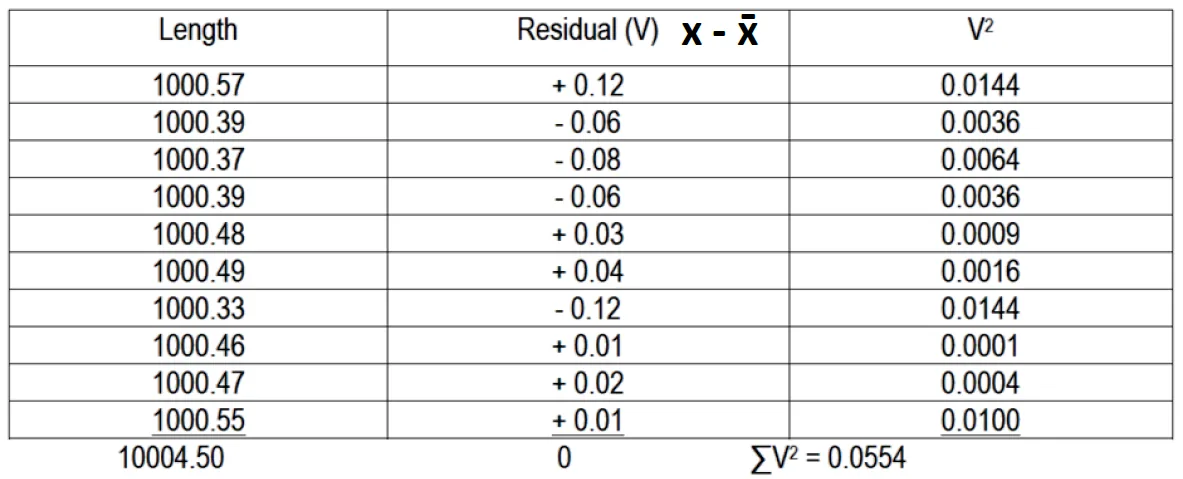
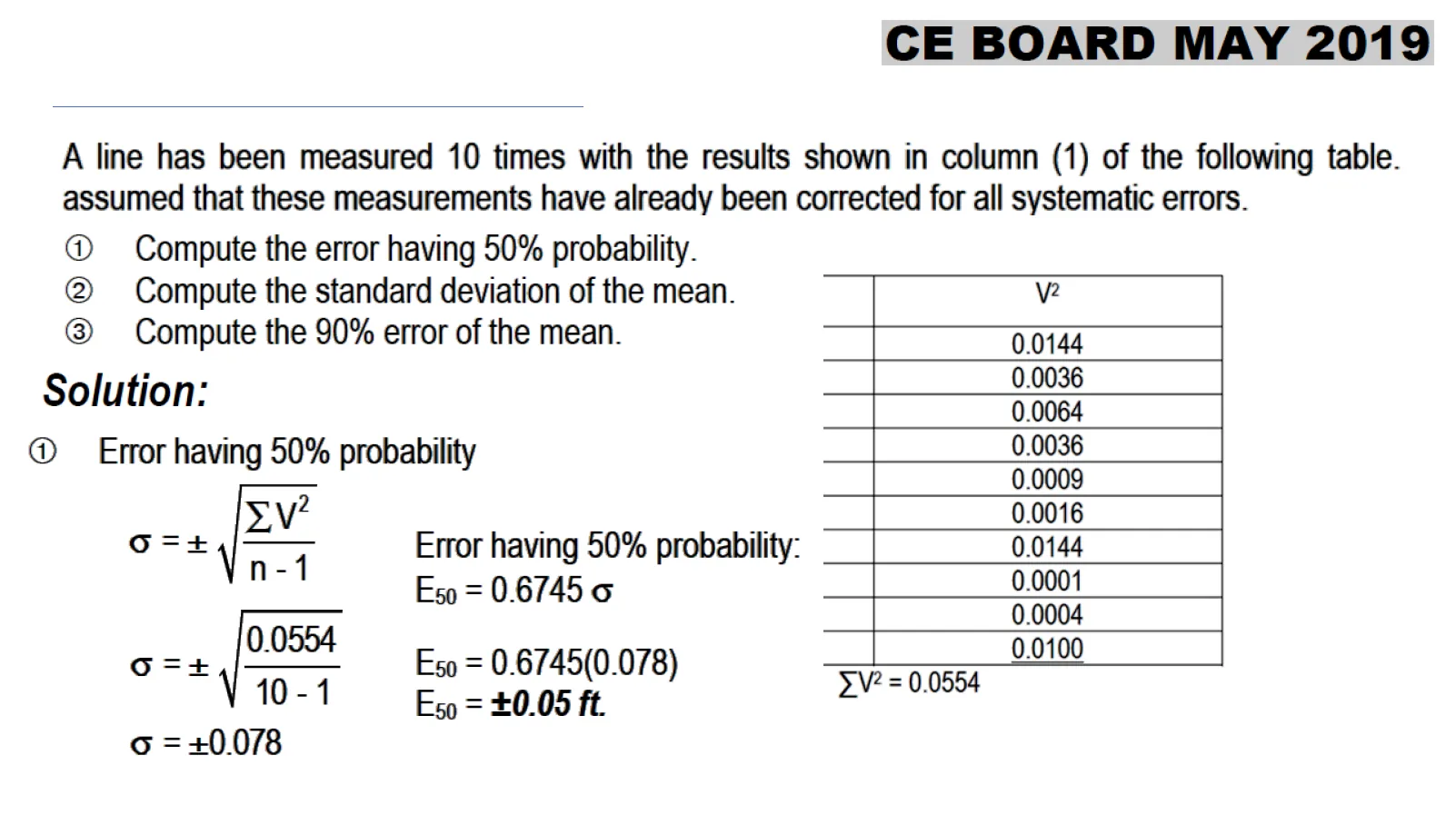
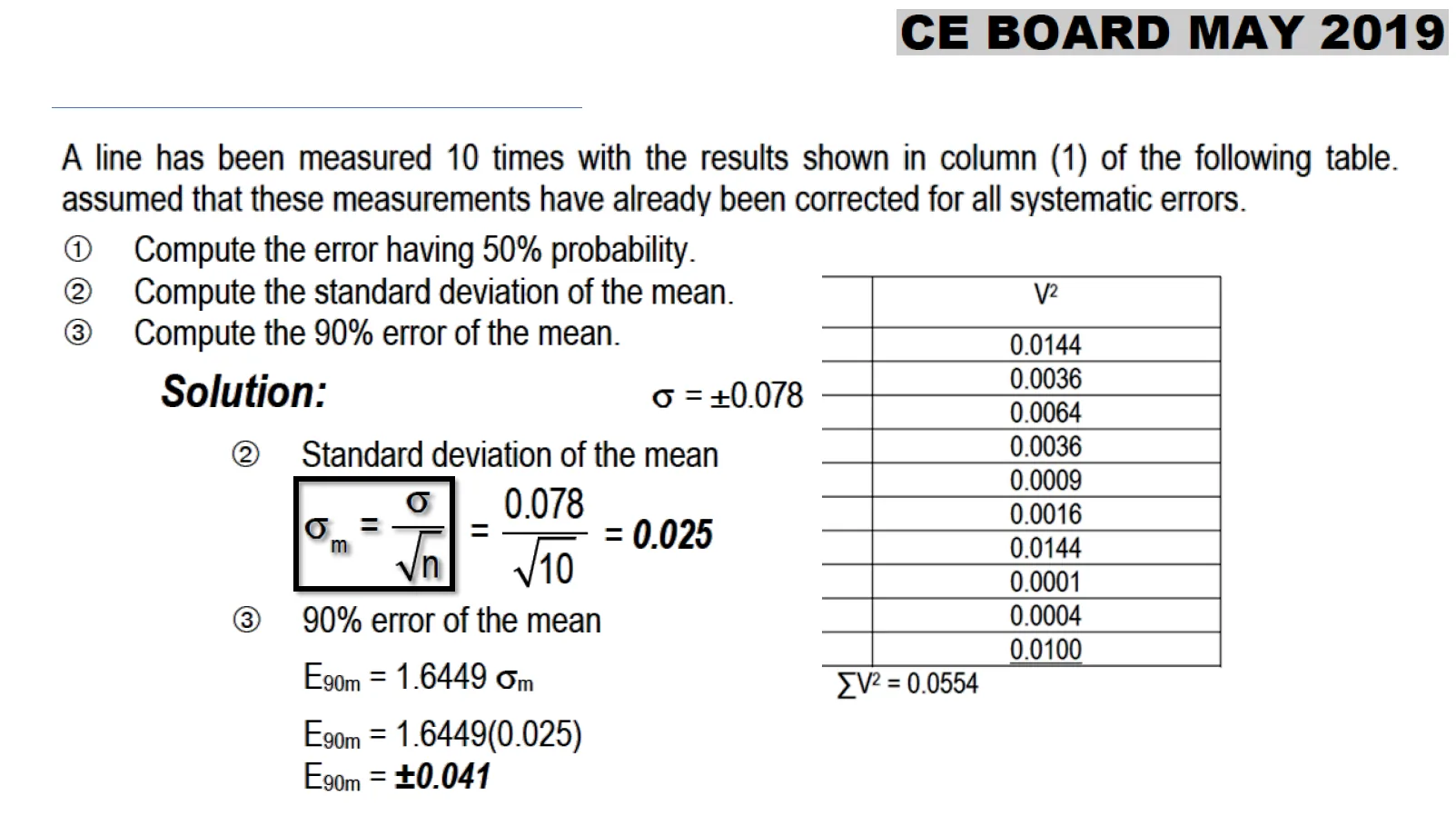
CE Board Exam May 2019 A line has been measured 10 times with the results shown in column 1, assuming that the measurements have already been corrected for all systematic errors. 1. Compute the error having 50% probability 2. Compute the standard deviation of the mean. 3. Compute the 90% error of the mean.
See images:
-->
Exam Generator Problems
Additional board-style practice items for this topic.
MSTE - Surveying / Measurements and Areas / Gemini mapped Chapter 7 to 10
The foundation of the building is to be 10.50 m × 15.75 m. If an old 15-m metallic tape known to be 15.025 m long is used in setting its corners, what measurements must we make?
10.518 m × 15.776 m
10.482 m × 15.724 m
10.482 m × 15.776 m
10.518 m × 15.724 m
Solution pending in psadquestions/t1109.json.
Question Bank: t1111
MSTE - Surveying / Measurements and Areas / Gemini mapped Chapter 7 to 10
An existing rectangular parcel of land was measured many years ago with a Gunter's chain and was found to contain 40 hectares. The original surveyor noted later that the chain used to make the measurements was one link to short. Assuming that the error was evenly distributed throughout the measuring, what was the area of the parcel in hectares?
39.204
40.812
39.254
40.523
Solution pending in psadquestions/t1111.json.
Question Bank: t1115
MSTE - Surveying / Measurements and Areas / Gemini mapped Chapter 7 to 10
The observed interior angles of a piece of land ABCD are as follows: A (85°, 4 measurements), B (102°, 3 measurements), C (72°, 2 measurements), D (98°, 3 measurements). What is the most probable value of angle B?
101.687°
102.214°
102.705°
101.295°
Solution pending in psadquestions/t1115.json.
Question Bank: t1116
MSTE - Surveying / Measurements and Areas / Gemini mapped Chapter 7 to 10
The sides of a rectangular section were determined to be 756.23 ± 0.007 m and 526.85 ± 0.003 m, respectively. What is the probable error in the area in square meter.
6.3241
5.5245
2.5478
4.5568
Solution pending in psadquestions/t1116.json.
Question Bank: t1117
MSTE - Surveying / Measurements and Areas / Gemini mapped Chapter 7 to 10
A line was measured three times and yield the following results: 856.42, 856.89, and 856.12 m. Determine the probable error of the mean.
0.2412 m
0.3241 m
0.2618 m
0.1511 m
Solution pending in psadquestions/t1117.json.
Question Bank: t2147
MSTE - Surveying / Errors and Measurements / Besavilla CE Pre-Board Math & Surveying
The sides of a square lot having an area of 2.25 hectares were measured using a 100 m. tape that was 0.04 m. too short. Compute the error in the area in sq.m.
20 sq.m.
17 sq.m.
15 sq.m.
16 sq.m.
18 sq.m.
The recorded square lot area is 2.25 hectares $=22500\text{ m}^2$, so the recorded side is $\sqrt{22500}=150$ m. The 100 m tape is 0.04 m too short, so actual length $=99.96$ m per recorded 100 m. True side $=150\left(\frac{99.96}{100}\right)=149.94$ m True area $=(149.94)^2=22482.00\text{ m}^2$ Error $=22500-22482.00$ $\boxed{18\text{ sq.m.}}$
Question Bank: w47
MSTE - Surveying / Errors and Measurements / MSTE May 2019
A line has been measured 10 times and the measurements have already been corrected for all systematic errors. The residuals $V$ are: $+0.12$, $-0.06$, $-0.08$, $-0.06$, $+0.03$, $+0.04$, $-0.12$, $+0.01$, $+0.02$, $+0.10$. What is the standard error?
In standard practice for measuring vertical or zenith angles, which practices are important? I. Be sure the instrument is level. II. Sight with the vertical crosshair. III. Sight exactly on the target. IV. Sight direct and reverse. Which practices are true?
I only
I, III, IV only
All of the above
I & III only
All four listed surveying practices are standard precautions for vertical or zenith-angle observations.