Earthwork Volume
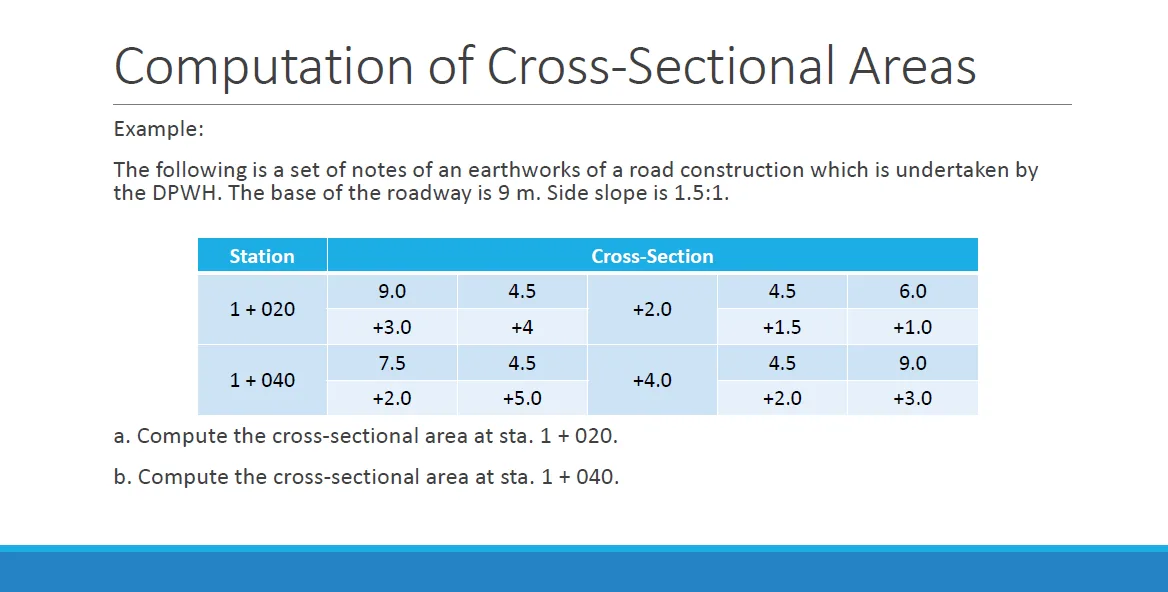

From the given cross-section of an earthworks between A (20+200) and B (20+220) assuming both have the same slope and width of base,
a. Determine the width of the base.
b. Determine the value of the cut at station B if it has an area of 16.82m2.
c. Determine the volume between A and B using the prismoidal formula.
d. Determine the volume between A and B with prismoidal correction.


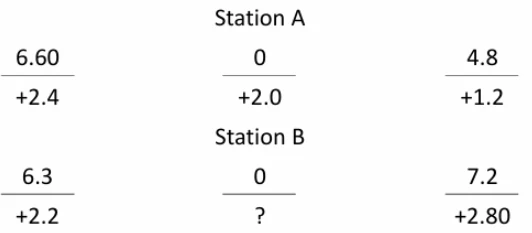
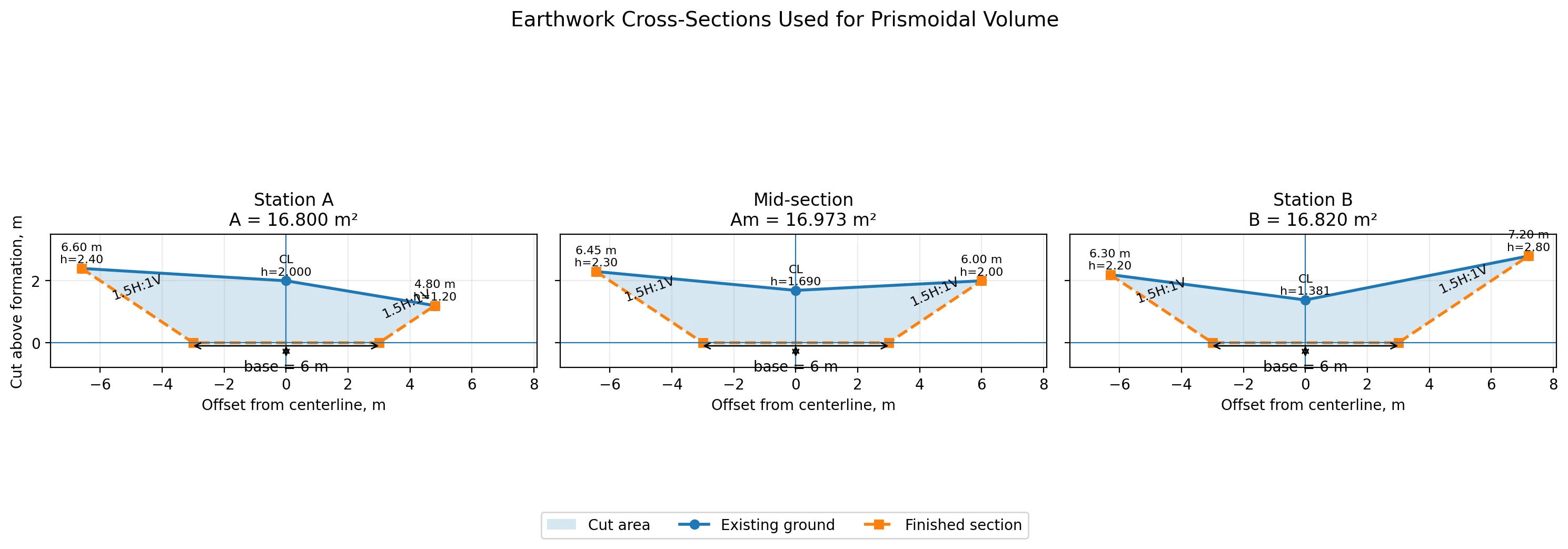
See images:


The values above the line are treated as the horizontal offsets from the centerline, while the values below the line are the cut depths.
The distance between Station $A$ and Station $B$ is:
$$ L = 20 + 220 - (20 + 200) = 20 \text{ m} $$a) Width of the Base
Let $b$ be the base width and $m$ be the side slope ratio in $H:V$.
From Station $A$:
$$ 6.60 = \frac{b}{2} + 2.4m $$ $$ 4.80 = \frac{b}{2} + 1.2m $$Subtracting the two equations:
$$ 6.60 - 4.80 = 2.4m - 1.2m $$ $$ 1.80 = 1.2m $$ $$ m = 1.5 $$Substitute $m = 1.5$ into the right-side equation:
$$ 4.80 = \frac{b}{2} + 1.2(1.5) $$ $$ 4.80 = \frac{b}{2} + 1.80 $$ $$ \frac{b}{2} = 3.00 $$ $$ \boxed{b = 6.00 \text{ m}} $$Therefore, the base width is:
$$ \boxed{6.00 \text{ m}} $$b) Cut at Station B
Let the center cut at Station $B$ be $x$.
$$ h_L = 2.2 $$ $$ h_C = x $$ $$ h_R = 2.8 $$The area at Station $B$ is given as $16.82 \text{ m}^2$.
The area is computed by taking the trapezoidal area from the left catch point to the right catch point, then subtracting the two side-slope triangular areas.
$$ 16.82 = \frac{6.3}{2}(2.2+x) + \frac{7.2}{2}(x+2.8) - \frac{1}{2}(3.3)(2.2) - \frac{1}{2}(4.2)(2.8) $$Simplifying:
$$ 16.82 = 3.15(2.2+x)+3.6(x+2.8)-3.63-5.88 $$ $$ 16.82 = 7.5 + 6.75x $$ $$ 6.75x = 9.32 $$ $$ x = 1.3807 $$ $$ \boxed{x = 1.381 \text{ m}} $$Therefore, the cut at Station $B$ is:
$$ \boxed{1.381 \text{ m}} $$c) Volume Between A and B Using Prismoidal Formula
First, determine the area at Station $A$.
$$ A_A = \frac{6.6}{2}(2.4+2.0) + \frac{4.8}{2}(2.0+1.2) - \frac{1}{2}(3.6)(2.4) - \frac{1}{2}(1.8)(1.2) $$ $$ A_A = 16.80 \text{ m}^2 $$The area at Station $B$ is:
$$ A_B = 16.82 \text{ m}^2 $$For the mid-section, average the corresponding cut depths from Station $A$ and Station $B$:
$$ h_{Lm} = \frac{2.4+2.2}{2}=2.3 $$ $$ h_{Cm} = \frac{2.0+1.3807}{2}=1.6904 $$ $$ h_{Rm} = \frac{1.2+2.8}{2}=2.0 $$The corresponding mid-section offsets are:
$$ x_L = 3 + 1.5(2.3)=6.45 $$ $$ x_R = 3 + 1.5(2.0)=6.00 $$Therefore, the mid-section area is:
$$ A_m = \frac{6.45}{2}(2.3+1.6904) + \frac{6.00}{2}(1.6904+2.0) - \frac{1}{2}(3.45)(2.3) - \frac{1}{2}(3.00)(2.0) $$ $$ A_m = 16.9726 \text{ m}^2 $$Using the prismoidal formula:
$$ V = \frac{L}{6}(A_A + 4A_m + A_B) $$ $$ V = \frac{20}{6}(16.80 + 4(16.9726) + 16.82) $$ $$ \boxed{V = 338.367 \text{ m}^3} $$d) Volume Using Prismoidal Correction
First, compute the volume using the average-end-area method:
$$ V_{\text{AEA}} = \frac{L}{2}(A_A + A_B) $$ $$ V_{\text{AEA}} = \frac{20}{2}(16.80+16.82) $$ $$ V_{\text{AEA}} = 336.20 \text{ m}^3 $$The prismoidal correction is:
$$ C_p = \frac{L}{6}\left(4A_m - 2A_A - 2A_B\right) $$ $$ C_p = \frac{20}{6}\left(4(16.9726)-2(16.80)-2(16.82)\right) $$ $$ C_p = 2.167 \text{ m}^3 $$Therefore, the corrected volume is:
$$ V = V_{\text{AEA}} + C_p $$ $$ V = 336.20 + 2.167 $$ $$ \boxed{V = 338.367 \text{ m}^3} $$Final Answers
$$ \boxed{b = 6.00 \text{ m}} $$ $$ \boxed{x = 1.381 \text{ m}} $$ $$ \boxed{V_{\text{prismoidal}} = 338.367 \text{ m}^3} $$ $$ \boxed{V_{\text{corrected}} = 338.367 \text{ m}^3} $$Additional board-style practice items for this topic.
Given the following cross-section notes for a 12-meter wide road. Side slopes (in cut) is 3H to 2V. [Left: y / 12, Center: 5 / 0, Right: 3 / x]. What is the area of the cross-section?
Solution pending in psadquestions/t1271.json.
Given the following cross-section notes for a road in cut: [Left: x / +2.5, Center: 0 / +c, Right: 7.8 / +y]. The road has a width of 10 m and its sides have slope of 2:1. The area of the cross section is 47.4 m^2.
What is the value of x?
What is the value of y?
What is the value of c?
Solution pending in psadquestions/t1273.json.
From Station A with center height of 1.4 m in fill, the ground makes a uniform slope of 5% to Station B whose center height is 2.8 m in cut. Assuming both sections to be level sections having a width of roadway of 10 m and side slope of 3:2 for both cut and fill, compute the cross-sectional area of fill 12 m from Station A. Distance from Station A to Station B is 60 m.
Solution pending in psadquestions/t1280.json.
The center height of the road at station 6 + 420 is 2 meters fill and at station 6 + 470 is 1.20 meters cut. The ground makes a uniform slope o +4.8% from station 6 + 420 to station 6 + 470.
What is the slope of the road?
How far from station 6 + 420 will the fill extend?
What is the stationing of the point up to which the fill is extended?
Solution pending in psadquestions/t1281.json.
The areas in cut of two irregular sections 80 m. apart are 128 m^2 and 245 m^2, respectively. Both sections are three-level sections with base width of 8 m and side slope of 3H:2V. Assume the ground slope uniformly between the two sections and use the prismoidal correction formula.
What is the depth of cut at section 2?
What is the volume of cut by end-area method in m^3?
What is the volume of cut in m^3 using the prismoidal correction formula?
Solution pending in psadquestions/t1285.json.
Given the following road cross-section notes in cut: [Station 1000 + 100: 2.75 / 9.45, 1.00 / 0.00, 0.50 / 4.50; Station 1000 + 220: 2.50 / 8.50, 1.25 / 0.00, 0.80 / 6.00]. Width of roadway is 8 m.
Determine the area of cut at Station 1000 + 100 in square meter.
Determine the area of cut at Station 1000 + 220 in square meter.
Determine the volume of cut using the end-area method in cubic meter.
Solution pending in psadquestions/t1288.json.
The cross-section notes of a ground to be excavated for a proposed roadway is given next. The roadway is 10 meters wide with side slope of 3:2. [Station 3+000: 8L / ?, 0 / 3.2, 12.8R / ?; Station 3+060: 8.9L / ?, 0 / 2.6, 10.4R / ?].
What is the cross-sectional area at Station 3+000?
What is the volume by end-area method in m^3?
What is the volume by prismoidal formula in m^3?
Solution pending in psadquestions/t1291.json.
The longitudinal ground profile and the gradeline shows that the length of cut is 380 m while the length of fill is 520 m. The width of the roadbed is 12 m for both cut and fill. The profile areas between the groundline and the gradeline, which are parallel, are 3400 m^2 for cut and 4550 m^2 for fill. Find the difference between the volume of fill and the volume of cut in cubic meters if the side slopes are 1.5:1 for cut and 2:1 for fill.
Solution pending in psadquestions/t1294.json.
A ground makes uniform slope of -5% from Station 5 + 350 to Station 5 + 440. At Station 5 + 350, the centerheight of the road is 2.6 m cut and in Station 5 + 440 the centerheight is 4.5 meter fill. The uniform base width of the road is 12 m and the side slope of both cut and fill is 1:1.
What is the grade of the finished roadway?
What is the volume of cut in cubic meter?
What is the volume of waste or borrow in cubic meter?
Solution pending in psadquestions/t1295.json.
The area bounded by the waterline of a lake and contours at 2 m intervals are as follows: A1 = 25300 m^2; A2 = 22100 m^2; A3 = 19600 m^2; A4 = 17400 m^2; A5 = 15200 m^2; A6 = 12300 m^2; A7 = 9600 m^2.
Estimate the volume of water in the lake (in m^3) using the prismoidal formula.
Estimate the volume of water in the lake (in m^3) using the end-area formula.
Solution pending in psadquestions/t1302.json.
The cross-sectional area of station 2 + 210 is 40 square meters in fill and at station 2 + 810 is 60 square meter in cut. The free haul distance is 100 meters. The balancing point is at Sta. 2 + 510. The ground surface is sloping uniformly upward from Sta. 2 + 210 to Sta. 2 + 510 and also uniformly upward from Sta. 2 + 510 to Sta. 2 + 810. Determine the stationing (along fill) of the limits of free haul.
Solution pending in psadquestions/t1304.json.
Given the following cross-section notes for a road grading work (format = height/distance):
$\dfrac{-3.2}{x_1}\quad \dfrac{1.2}{0}\quad \dfrac{1.2}{3.5}\quad \dfrac{2.8}{x_2}$
The roadbed is 9 m wide and the side slope for cut is 1:1 and for fill is 1.5:1. Determine the area of cut of the section.