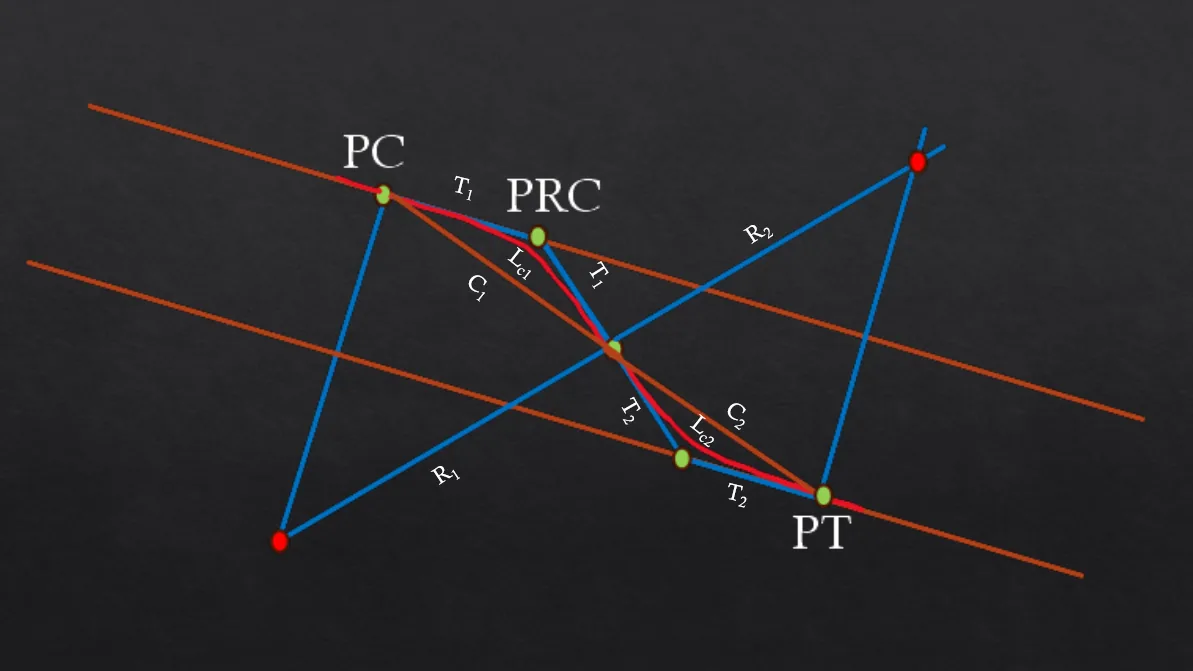
A reversed curve is a horizontal alignment consisting of two consecutive circular curves that bend in opposite directions and are joined directly without an intervening tangent; its engineering significance lies in the abrupt reversal of centrifugal force acting on vehicles, which can reduce riding comfort and compromise safety if not properly designed. Because drivers must immediately adjust steering in the opposite direction, reversed curves are generally avoided on high-speed facilities unless adequate transition curves, proper superelevation development, and sufficient sight distance are provided. When unavoidable due to terrain or right-of-way constraints, careful geometric design is essential to minimize operational hazards and ensure smooth vehicle maneuvering.
Reverse Curve with Parallel Tangents
;
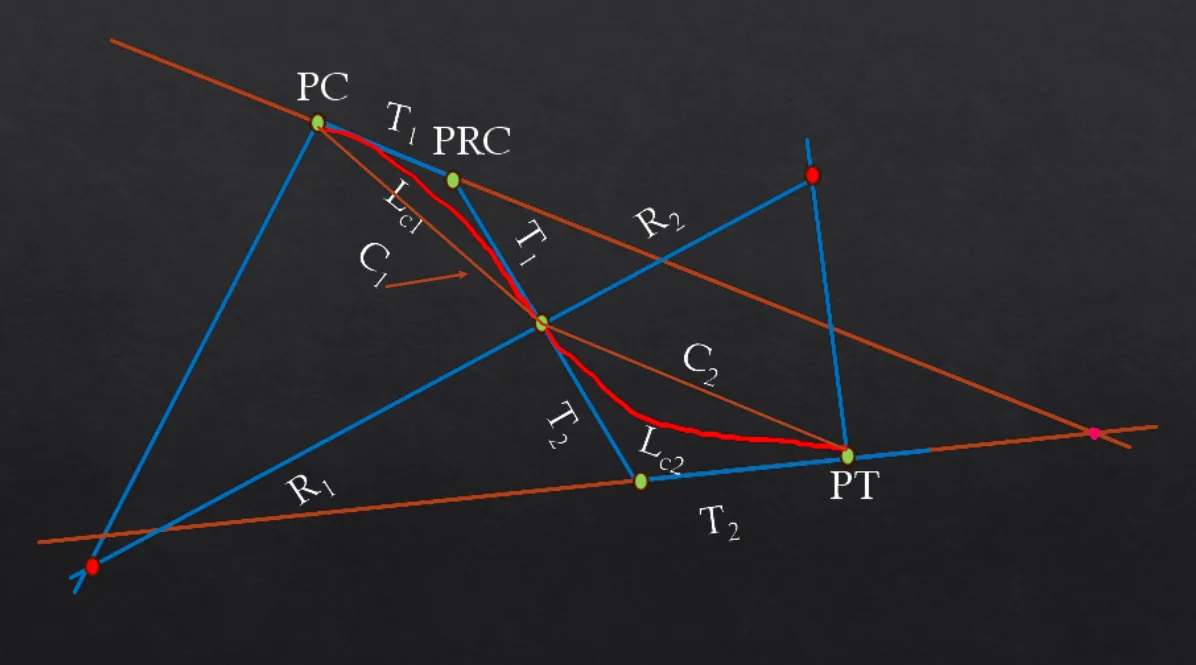
Reverse Curve with Converging Tangents
;
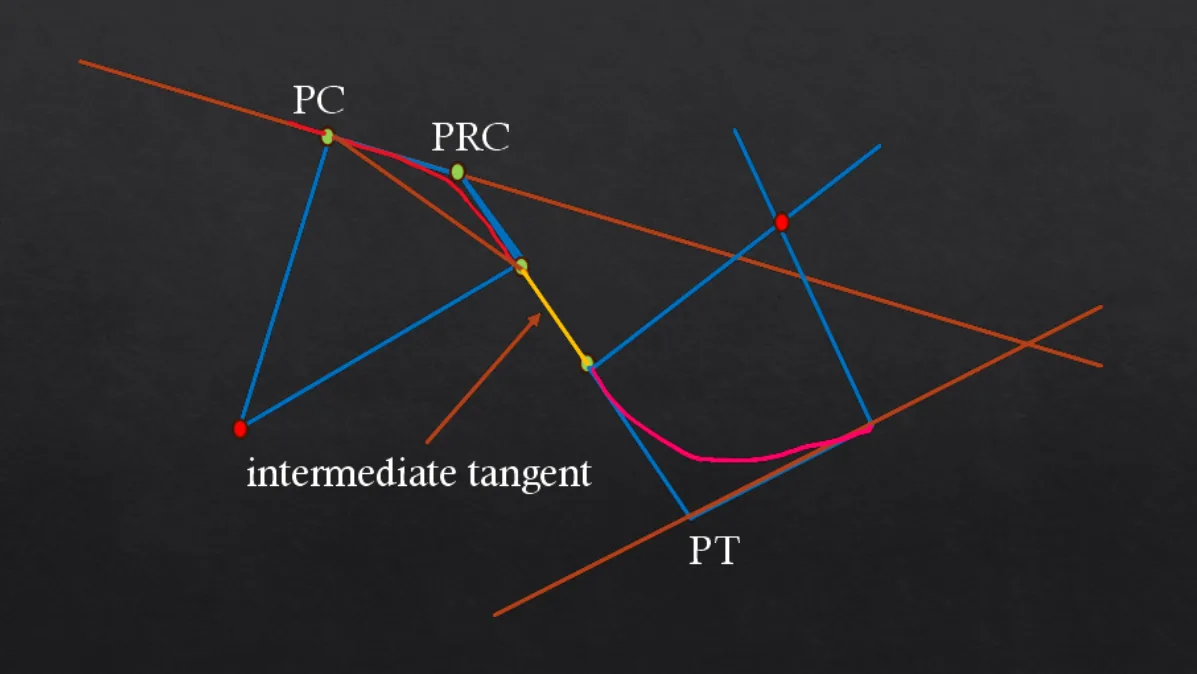
Reverse Curve with Intermediate Tangent
;
Problem: Reversed Curve with Parallel Tangents
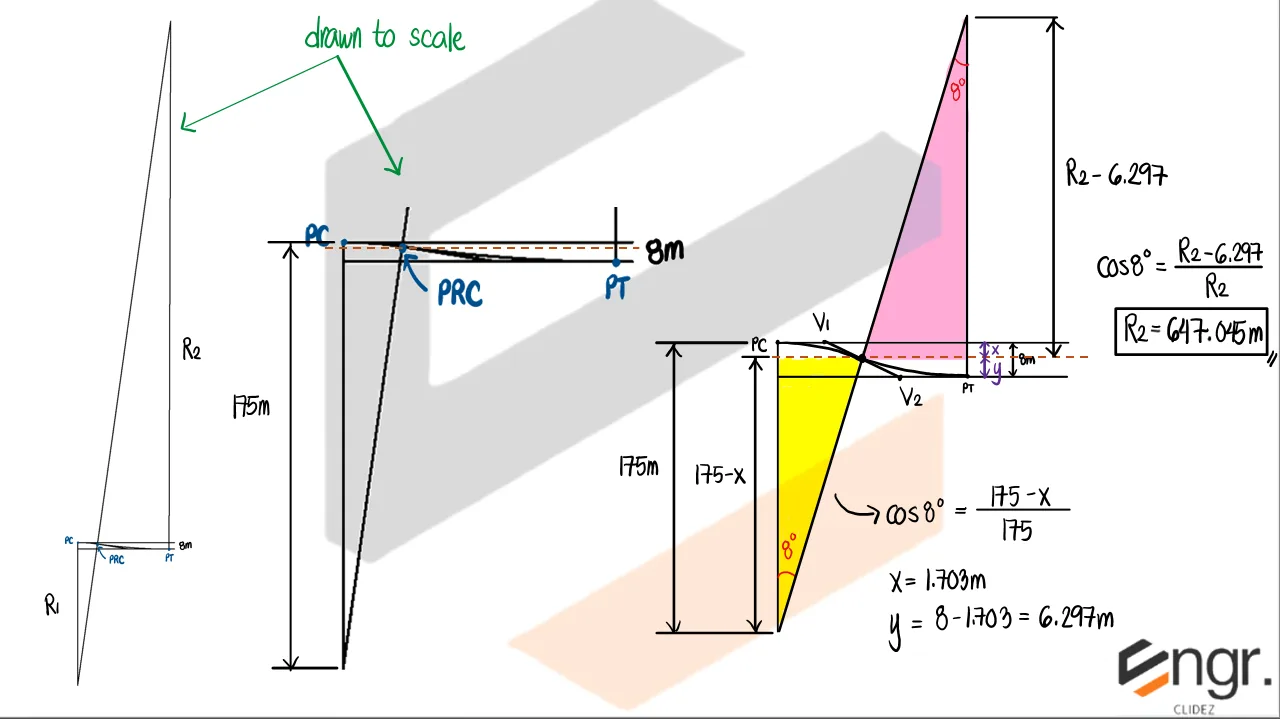
The perpendicular distance between two parallel tangents is equal to 8 meters. These tangents are connected by a reversed curvature such that the central angle is 8º and the radius of curvature of the first curve is equal to 175m. Find the radius of the second curve of the reversed curvature.
Problem: Reversed Curve with Parallel Tangents and Connected by Intermediate Tangent
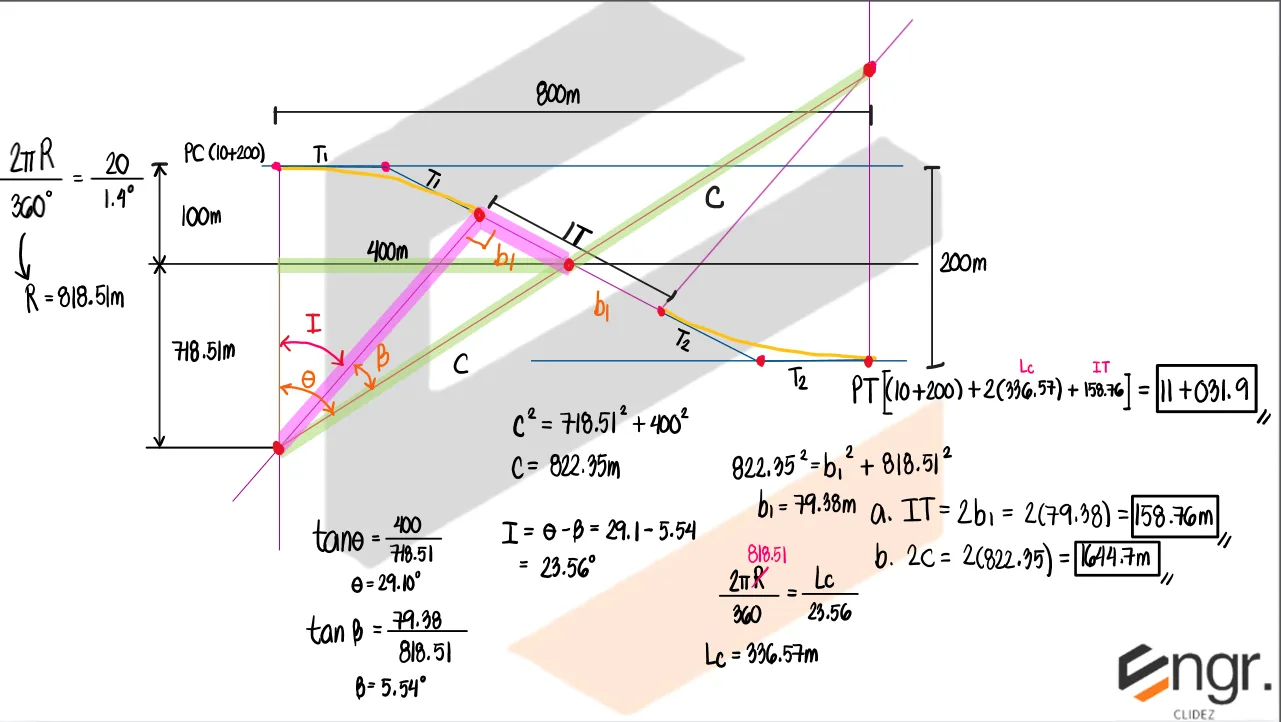
Two parallel tangents have directions of due east and are 200 meters apart. They are connected by a reversed curve having the same degree of 1.4º. PC of the curve is on the upper tangent while the PT of the curve is at the lower tangent. If the horizontal distance parallel to the tangent from the PC to the PT of the reversed curve is 800m, determine:
a. The distance of the intermediate tangent between the two curves.
b. The distance between the centers of the reversed curvature.
c. The stationing of PT if the stationing of PC is 10+200.
Problem: Reversed Curve with Converging Tangents
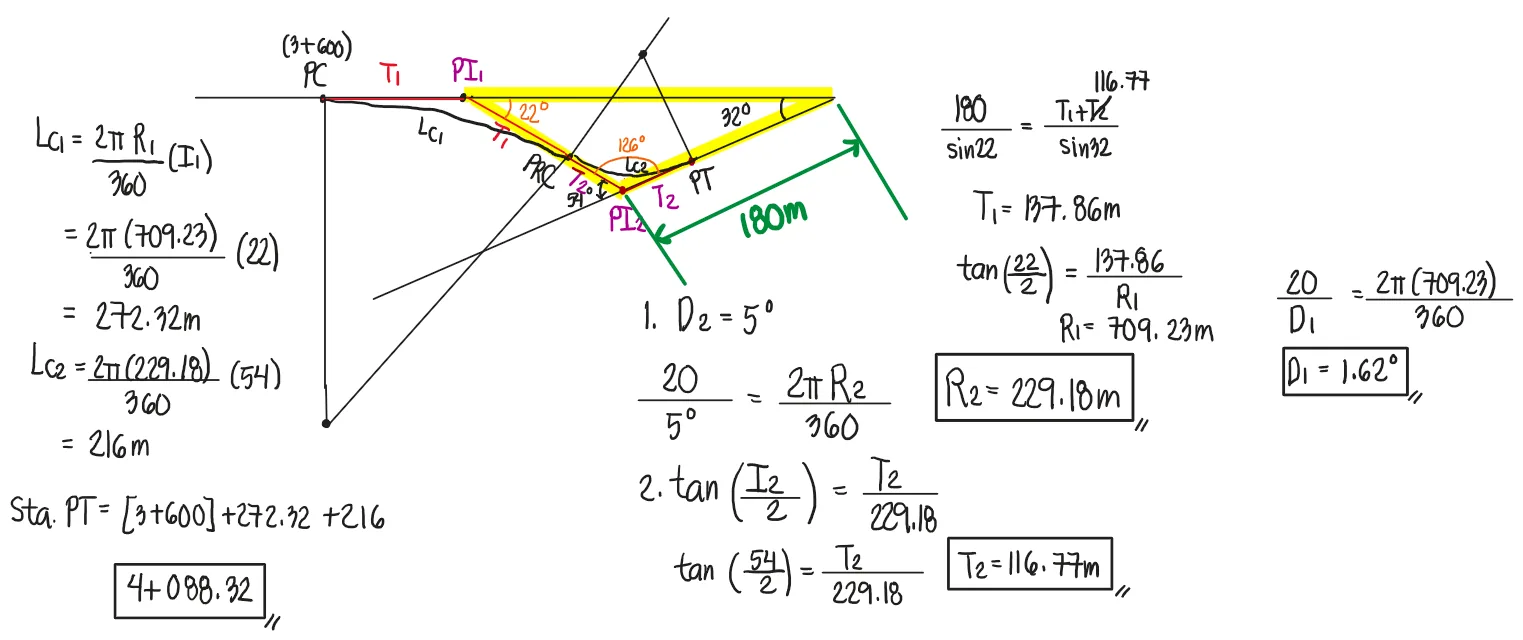
A reverse curve connects two converging tangents with an angle of intersection of 32º. The distance from PI of the second curve to this point of intersection is 180m. The deflection angle of the common tangent from the back tangent is 22º and the degree of curve of the 2nd curve is 5º.
a. Determine the radius of the 2nd curve.
b. Determine the tangent distance of the 2nd curve.
c. Determine the degree of curve of the 1st curve by arc basis.
d. If the stationing of PC is 3+600, determine the stationing of PT.
Problem: Total Length of Reverse Curves
A reverse curve consists of arcs 180 m and 260 m long. Find the total curved length.
$$L=L_1+L_2=180+260=440\text{ m}$$
Answer: The total curved length is 440 m.
Problem: Radius from Degree of Curve
Using the metric arc definition, find the radius for a 6° curve with 20 m arc basis.
The perpendicular distance between two parallel tangents is equal to 8 meters. These tangents are connected by a reversed curvature such that the central angle is 8º and the radius of curvature of the first cruve is equal to 175m. Find the radius of the second curve of the reversed curvature.
Answer:
647m
674m
658m
685m
For a reverse curve connecting parallel tangents, the perpendicular offset is: $p=(R_1+R_2)(1-\cos\Delta)$ $8=(175+R_2)(1-\cos8^\circ)$ $R_2=\frac{8}{1-\cos8^\circ}-175$ $R_2=647.04$ m $\boxed{R_2\approx647\text{m}}$
Two parallel tangents have directions of due east and are 200 meters apart. They are connected by a reversed curve having the same degree of 1.4 degrees. PC of the curve is on the upper tangent while the PT of the curve is at the lower tangent. If the horizontal distance parallel to the tangent from the PC to the PT of the reversed curve is 800m, determine:
The distance of the intermediate tangent between the curve
158.76m
152.46m
149.76m
145.68m
The distance between the centers of the reversed curvature
1637.06m
1593.2m
1621.3m
1586.6m
The stationing of PT if the stationing of PC is 10+200
11+032
11+047
11+058
11+016
For a $1.4^\circ$ metric curve using the 20-m arc definition, the radius of each reverse curve is: $$R=\frac{20(180)}{\pi(1.4)}=818.53\text{ m}$$ Therefore, the distance between the two centers is the sum of the equal radii: $$O_1O_2=2R=1637.06\text{ m}$$
Let $\Delta$ be the central angle of each arc and let $t$ be the intermediate tangent. Resolving the PC-to-PT displacement into horizontal and vertical components gives: $$2R\sin\Delta+t\cos\Delta=800$$ $$2R(1-\cos\Delta)+t\sin\Delta=200$$ Solving yields approximately: $$\Delta=23.57^\circ,\qquad t=158.76\text{ m}$$ The total alignment length consists of two equal arcs and the intermediate tangent: $$L=2\left(\frac{\pi R\Delta}{180}\right)+t\approx832\text{ m}$$ Thus: $$\text{Sta. PT}=10+200+832=11+032$$
Therefore, the intermediate tangent is 158.76 m, the center spacing is 1637.06 m, and the PT station is 11+032.
Given the following lines and directions:
AB = 57.6m due east
BC=91.5m, N68ºE
CD=102.6m, azimuth = 132º (from North)
A reverse curve is to connect these three lines thus forming the centerline of a new road. Compute the length of the common radius of the reversed curve.
111.69m
97.62m
124.83m
96.42m
Convert the bearings to azimuths: $AB=90^\circ$, $BC=68^\circ$, and $CD=132^\circ$. The changes of direction are therefore $22^\circ$ and $64^\circ$ in opposite senses for the reverse curve. Resolve the surveyed line vectors into northing/easting components and impose the reverse-curve tangent geometry with equal radii. Solving the two coordinate equations gives the common radius $$R=111.69\text{ m}$$ Therefore, the common radius is 111.69 m.
A reversed curve of equal radii connects two parallel tangents 12m apart. The length of chord from PC to PT is 140m. Determine the radius of the curve.
408.33m
472.67m
430.33m
466.67m
For a reverse curve of equal radii joining parallel tangents, the common radius is related to the long chord $c$ and the perpendicular separation $h$ by
MSTE - Highway Engineering / Curves, Earthworks, and Traffic Engineering / Gemini mapped Chapter 7 to 10
In a railroad layout, the centerlines of two parallel tracks are connected with a reversed curve of unequal radii. The central angle of the first curve is 16° and the distance between parallel tracks is 27.60 m. Stationing of PC is 15 + 420 and the radius of the second curve is 290 m. Compute the stationing of PT.
15 + 523.75
15 + 618.96
15 + 641.62
15 + 491.19
Solution pending in psadquestions/t1222.json.
Question Bank: t1223
MSTE - Highway Engineering / Curves, Earthworks, and Traffic Engineering / Gemini mapped Chapter 7 to 10
Two tangents intersecting at an angle of 46°40' (at PI) are to be connected by a reversed curve. The tangent distance from PI to PT of the reversed curve is 48.6 m and from PI to PC is 360.43. The radius of the curve through the PC is 240 m. Sta. of PI is 25 + 863.2.
What is the radius of the curve though PT in meters?
135.2
148.6
114.7
158.9
What is the stationing of PRC?
25 + 843.21
25 + 356.98
25 + 657.23
25 + 660.11
What is the stationing of PT?
25 + 814.60
26 + 167.98
26 + 061.97
25 + 934.21
Solution pending in psadquestions/t1223.json.
Question Bank: t1226
MSTE - Highway Engineering / Curves, Earthworks, and Traffic Engineering / Gemini mapped Chapter 7 to 10
Two parallel roads 400 meters apart were to be connected by equal turnouts. The intermediate tangent is 400 meters and the radius of each curve is 1100 m.
Find the distance between the centers of each curve.
2258 m
2236 m
2244 m
2200 m
Find the central angle of the simple curve.
42.5°
10.3°
37.2°
26.1°
Find the length of turnouts from PC on the 1st road to PT on the 2nd road.
395.5 m
1032.1 m
1401.8 m
896.4 m
Solution pending in psadquestions/t1226.json.
Question Bank: t1240
MSTE - Highway Engineering / Curves, Earthworks, and Traffic Engineering / Gemini mapped Chapter 7 to 10
A spiral easement curve has a length of 100 m with a central curve having a radius of 300 m. Determine the degree of spiral at the third-quarter point.

 ;
;
 ;
;
 ;
;