Use the distance formula to write equations for each object or direction, then solve based on the relationship given in the problem.
Variable Speed
In problems involving rivers or flowing water, the motion of a boat or swimmer is affected by the speed of the current. The total effective speed depends on whether the motion is going with or against the current.
Key Relationships:
With the current: The object moves faster.
Against the current: The object moves slower.
Let the variables be:
$r$ = rate of the boat or swimmer in still water
$c$ = rate of the current
Effective Speeds:
With the current:
$$
\text{Effective Rate} = r + c
$$
Against the current:
$$
\text{Effective Rate} = r - c
$$
Once you know the effective rate, use the distance formula:
This type of problem often involves comparing times or distances for round trips or upstream/downstream travel.
Problem:
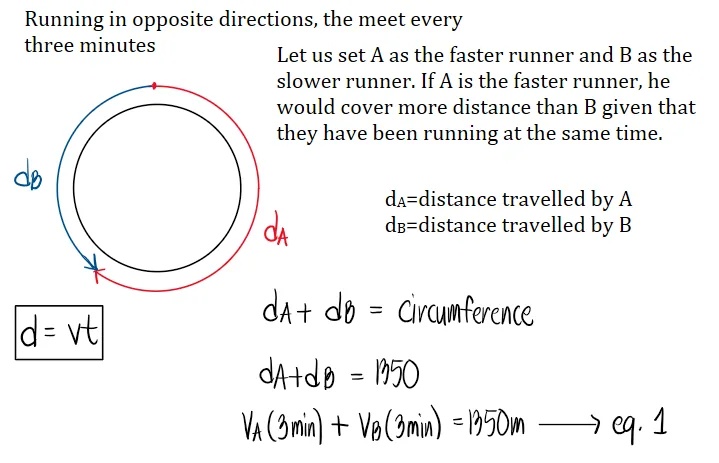
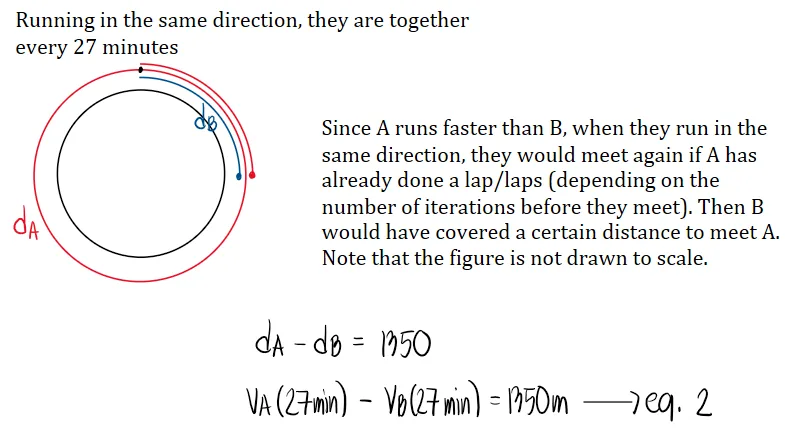
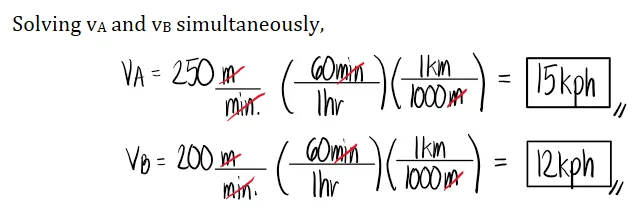
Two pals A and B run at constant speeds along a circular track 1350m in circumference. Running in opposite directions they meet every 3 minutes, while running in the same direction they are together every 27 minutes. Determine their speeds in km/hr. Ans. A=15kph B=12kph
See images:
Problem:
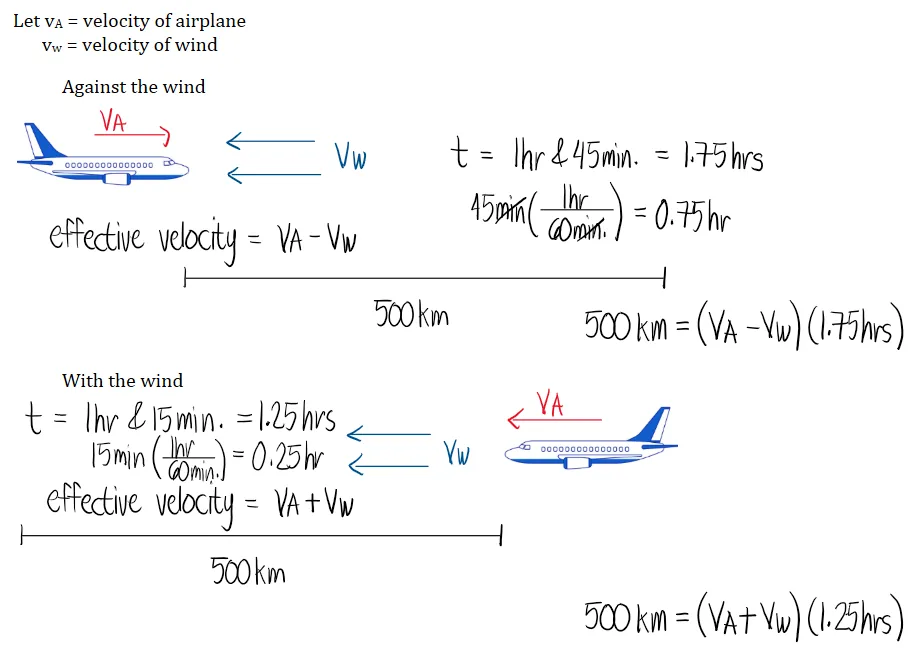
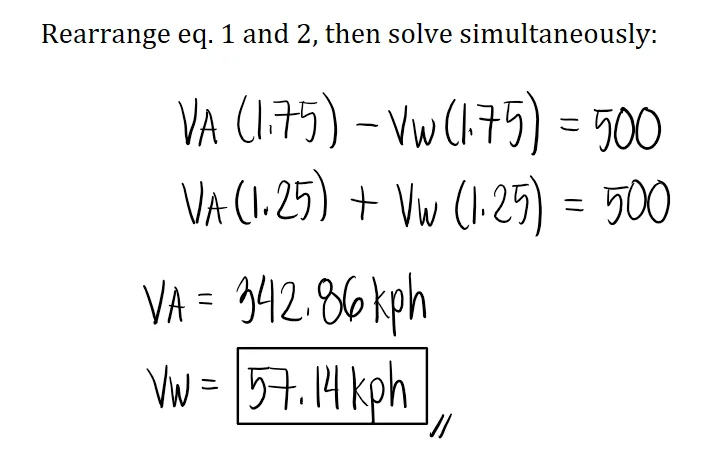
An airplane travels 500km against the wind in one hour and 45 minutes. Travelling the same distance with the wind, the airplane consumed one hour and 15 minutes. Find the velocity of the wind in kph. Ans. 57.14kph
See images:
-->
Exam Generator Problems
Additional board-style practice items for this topic.
Two pals A and B run at constant speeds along a circumference track 1350m in circumference. Running in opposite directions they meet every 3 minutes, while running in the same direction they are together every 27 minutes. Determine their speeds in km/hr.
What is the speed of A?
15
12
17
13
What is the speed of B?
12
15
13
17
Part 1.
Let speeds be $a$ and $b$ in m/min. Opposite directions: $a+b=1350/3=450$ Same direction: $a-b=1350/27=50$ Solving gives $a=250$ m/min. Convert to km/hr: $250(60)/1000=15$ $\boxed{15\text{ km/hr}}$
Part 2.
From $a+b=450$ and $a-b=50$, $b=200$ m/min. Convert: $200(60)/1000=12$ $\boxed{12\text{ km/hr}}$
The speed of a Ranger boat in still water is 32 mph. If the boat travels 72 miles upstream at the same time that it takes to travel 120 miles downstream, find the current of the stream.
Answer:
8 mph
20 mph
16 mph
24 mph
Let the current speed be $c$. Upstream speed is $32-c$ and downstream speed is $32+c$. Equal times give: $\frac{72}{32-c}=\frac{120}{32+c}$ $72(32+c)=120(32-c)$ $192c=1536$ $\boxed{c=8\text{ mph}}$
Cars A and B leave a town at the same time and travel in opposite directions.
Car A travels at 40 kph and car B at 60 kph.
How long will the two cars be 350 km apart?
3.5 hrs
5.5 hrs
2.5 hrs
4 hrs
The cars separate at their combined speed: $40+60=100$ kph Time for 350 km separation: $t=350/100$ $\boxed{3.5\text{ hrs}}$
An army of troops is marching along a road at 5 kph. A messenger on horseback was sent from the front to the rear of the column and returns immediately back.
The total time taken is 10 minutes.
Assuming the messenger rides at the rate of 10 kph, determine the length of the column.
625 m
526 m
1 km
854 m
Let the column length be $L$ km and messenger speed be 10 kph while troops move at 5 kph. Time front-to-rear: $t_1=\frac{L}{10+5}$ Time rear-to-front: $t_2=\frac{L}{10-5}$ Total time is 10 min = $1/6$ hr: $\frac{L}{15}+\frac{L}{5}=\frac{1}{6}$ $\frac{4L}{15}=\frac{1}{6}$ $L=0.625$ km $\boxed{625\text{ m}}$
A man drives from station A to station B 60 km away at an average speed of 30 kph and returns to A at an average speed of 20 kph.
What was the average speed of the man in the whole journey?
24 kph
20 kph
25 kph
22 kph
Average speed for the whole round trip is total distance over total time: $d=60+60=120$ km $t=60/30+60/20=2+3=5$ hr $v_{avg}=120/5$ $\boxed{24\text{ kph}}$
Two men are walking toward each other along a railway.
A freight train overtakes one of them in 20 seconds and exactly 10 minutes later meets the other man coming from the opposite direction.
The train passes this second man in 18 seconds.
How long after the train has passed the second man will the two men meet?
1 hr 32 min 42 sec
1 hr 42 min 32 sec
1 hr 24 min 23 sec
1 hr 23 min 24 sec
Let train speed be $v$, walking speed $u$, and train length $L$. Overtaking the first man gives $L=20(v-u)$; meeting the second gives $L=18(v+u)$. Hence $$20(v-u)=18(v+u)\Rightarrow v=19u$$ Track the men during the 10-minute interval, including the 20-s and 18-s train-passing intervals. Their remaining separation after the train passes the second man, divided by their closing speed $2u$, is $5562$ s, or 1 hr 32 min 42 sec.
A battalion 20 miles long advances 20 miles.
During this time, a messenger on a horse travels from the rear of the battalion to the front, immediately turns around, and ends up precisely at the rear of the battalion upon completion of the 20-mile journey.
How far has the messenger traveled?
48.28 miles
40 miles
50 miles
52.42 miles
Let battalion speed be $v$ and horse speed be $u$. The battalion advances 20 mi while its length is 20 mi, so time is $20/v$. Messenger travel time rear-to-front is $20/(u-v)$ and front-to-rear is $20/(u+v)$. Thus: $\frac{20}{u-v}+\frac{20}{u+v}=\frac{20}{v}$ This gives $u/v=1+\sqrt2$. Messenger distance is $u(20/v)=20(1+\sqrt2)$. $\boxed{48.28\text{ miles}}$
A plane flies 465 miles with the wind and 345 miles against the wind in the same amount of time. If the wind speed is 20 mph, find the speed of the plane in still air.
A car travelled for $p$ hours with a velocity of magnitude $q$ kph, then travels the same direction for $r$ hours with velocity of magnitude $s$ kph. What is the average velocity during the travel?
$(pq + rs)/(p + r)$
$(pr + qs)/(p + r)$
$(pr + qs)/(q + s)$
$(pq + rs)/(q + s)$
Average velocity is total displacement divided by total time. First displacement $=pq$; second displacement $=rs$. Total time $=p+r$. $v_{avg}=\frac{pq+rs}{p+r}$ $\boxed{\frac{pq+rs}{p+r}}$
At 2:25 PM, an engineer and his girlfriend walks along Osmeña Boulevard for 30 minutes at a speed of 3 kph. They waited for a taxi for 10 minutes which brought them back to where they start at 3:15 PM. What was the average speed of the taxi?
4.75 kph
6.25 kph
9.00 kph
2.25 kph
They walked for 30 minutes at 3 kph, so distance from the start is $3(0.5)=1.5$ km. After waiting 10 minutes, the taxi trip is from 3:05 PM to 3:15 PM, or $\frac{1}{6}$ hr. Taxi speed $=\frac{1.5}{1/6}=9.00$ kph. $\boxed{9.00\text{ kph}}$
A boat takes 2/3 as much time to travel downstream from C to D, as to return. If the rate of the river's current is 8 kph, what is the speed of the boat in still water?
40 kph
38 kph
41 kph
39 kph
Let $v$ be the boat speed in still water. Downstream speed is $v+8$ and upstream speed is $v-8$. For the same distance, downstream time is $\frac{2}{3}$ of upstream time: $\frac{d}{v+8}=\frac{2}{3}\left(\frac{d}{v-8}\right)$ $3(v-8)=2(v+8)$ $v=40$ kph. $\boxed{40\text{ kph}}$
It takes 12 seconds for two trains to pass each other when moving in opposite directions. The faster train which is 130 m long is moving at 13.5 m/s. What is the speed of the slower train which is 120 m long?
7.33 m/s
7.67 m/s
8.33 m/s
8.67 m/s
When trains pass in opposite directions, relative speed equals total length divided by time. Total length $=130+120=250$ m. Relative speed $=\frac{250}{12}=20.833$ m/s. Slower train speed $=20.833-13.5=7.33$ m/s. $\boxed{7.33\text{ m/s}}$
A train takes four hours and thirty minutes to travel from station A to station B. How long will the journey be if:
The train's speed is increased to 1.5 times its original speed.
2 hrs
3 hrs
4 hrs
5 hrs
The train's speed is increased to 3.75 times its original speed.
1.8 hrs
1.5 hrs
2.4 hrs
1.2 hrs
The train's speed is decreased to 0.75 times its original speed.
6 hrs
8 hrs
5 hrs
7 hrs
Part 1.
Original time is 4 hr 30 min $=4.5$ hr. For the same distance, time is inversely proportional to speed. If speed becomes $1.5$ times original, new time $=\frac{4.5}{1.5}=3$ hr. $\boxed{3\text{ hrs}}$
Part 2.
For the same distance, time varies inversely with speed. New time $=\frac{4.5}{3.75}=1.2$ hr. $\boxed{1.2\text{ hrs}}$
Part 3.
For the same distance, time varies inversely with speed. If speed becomes $0.75$ of the original, new time $=\frac{4.5}{0.75}=6$ hr. $\boxed{6\text{ hrs}}$
Question Bank: w15
MSTE - Algebra / Motion Problems / MSTE May 2019
Two trains going in opposite directions leave at the same time. One train travels 15 mph faster than the other. In 6 hours, the trains are 630 miles apart. Find the speed of the faster train.
60 mph
45 mph
75 mph
30 mph
Let the slower speed be $v$. $6v + 6(v + 15) = 630$ $12v + 90 = 630 \Rightarrow v = 45\text{ mph}$ Faster train $= 45 + 15 = \boxed{60\text{ mph}}$
Question Bank: w230
MSTE - Algebra / Motion Problems / MSTE April 2025
An airplane flies roundtrip a distance $L$ kilometers each way. The velocity with the head wind is 160 kph, while the velocity with tail wind is 240 kph. What is the average speed of the round trip?
192 kph
195.96 kph
200 kph
198.78 kph
Average speed is total distance divided by total time, not the arithmetic mean of the two speeds. Total time for the round trip: $t = \dfrac{L}{160} + \dfrac{L}{240} = \dfrac{L}{96}$ Total distance is $2L$, so $2L = v_{ave}\cdot\dfrac{L}{96}$ $\boxed{v_{ave} = 192\ \text{kph}}$
Exam trap: averaging 160 and 240 gives 200 kph, which is choice C and is wrong.
Question Bank: w246
MSTE - Algebra / Motion Problems / MSTE April 2025
An army of troops is marching along a road at 5 kph. A messenger on horseback was sent from the front to the rear of the column and returns immediately back. The total time taken being 10 minutes. Assuming that the messenger rides at the rate of 10 kph, determine the length of the column.
526 m
1 km
854 m
625 m
Riding from front to rear, the messenger and the column close on each other, so the relative speed is the sum. Riding back from rear to front, the messenger overtakes the column, so the relative speed is the difference.
MSTE - Algebra / Motion Problems / MSTE April 2025
A man arrives at the railroad station nearest his country home an hour and 5 minutes before the time at which he had ordered his driver to meet him with his car. He starts to walk at the rate of 4 mph and meets his car when it has traveled 8 miles. It turns back and takes him the remainder of the way home, where he arrives just 10 minutes ahead of the time he had originally planned to get there. Find the distance from the station to his home. Assume no waiting time on the part of his driver.
10 miles
14 miles
12 miles
16 miles
Let $d$ be the distance from the station to the home. The car travels 8 miles from the house before meeting the man, so the man walked $d - 8$ miles.
Arriving home 10 minutes early means the car saved 10 minutes of round-trip driving, i.e. 5 minutes of one-way driving over the distance $d - 8$. Combined with the 65-minute head start, the man's walking time before the meeting is $65 - 5 = 60\ \text{minutes} = 1\ \text{hour}$
MSTE - Algebra / Motion Problems / MSTE April 2025
A bus travels a distance of 350 km in exactly the same time that a car travels a distance of 600 km. If the car is 50 kph faster than the bus, how fast was the bus?
70 kph
80 kph
90 kph
60 kph
Equal travel times give one equation: $t_B = t_C$ $\dfrac{350}{v_B} = \dfrac{600}{v_C}$