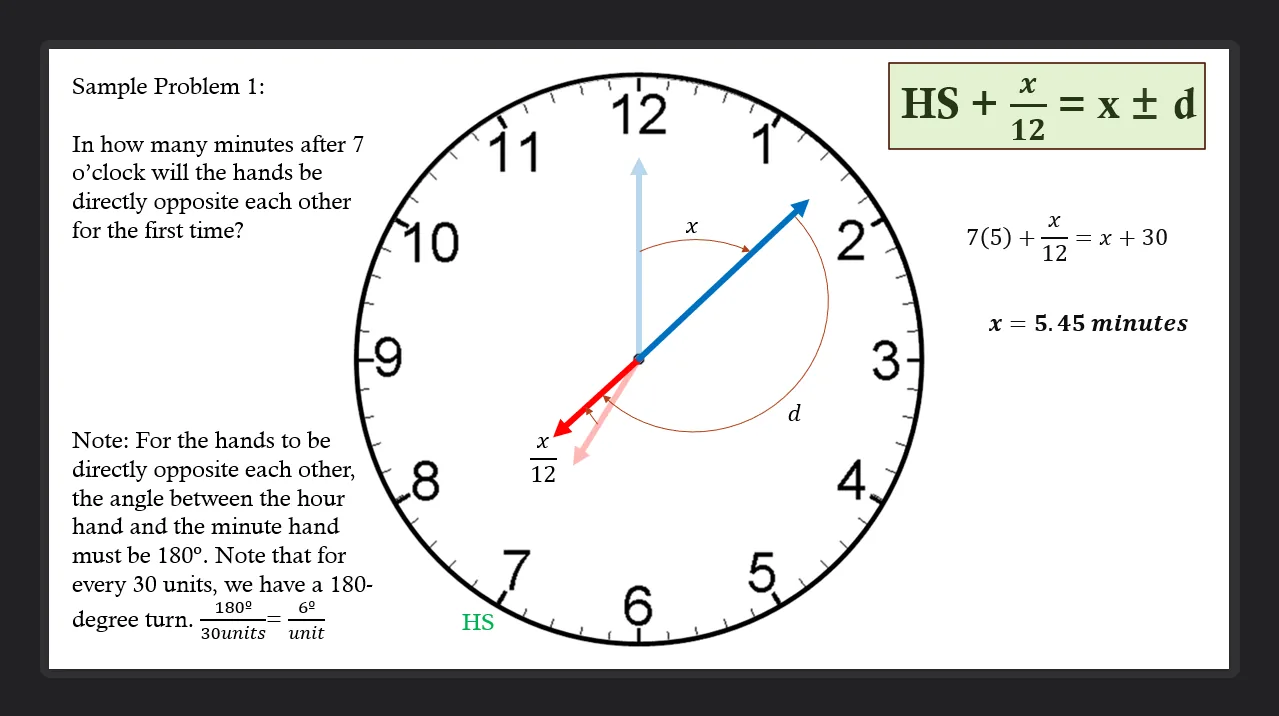
In how many minutes after 7 o'clock will the hands be directly opposite each other for the first time?
See images:
Problem:
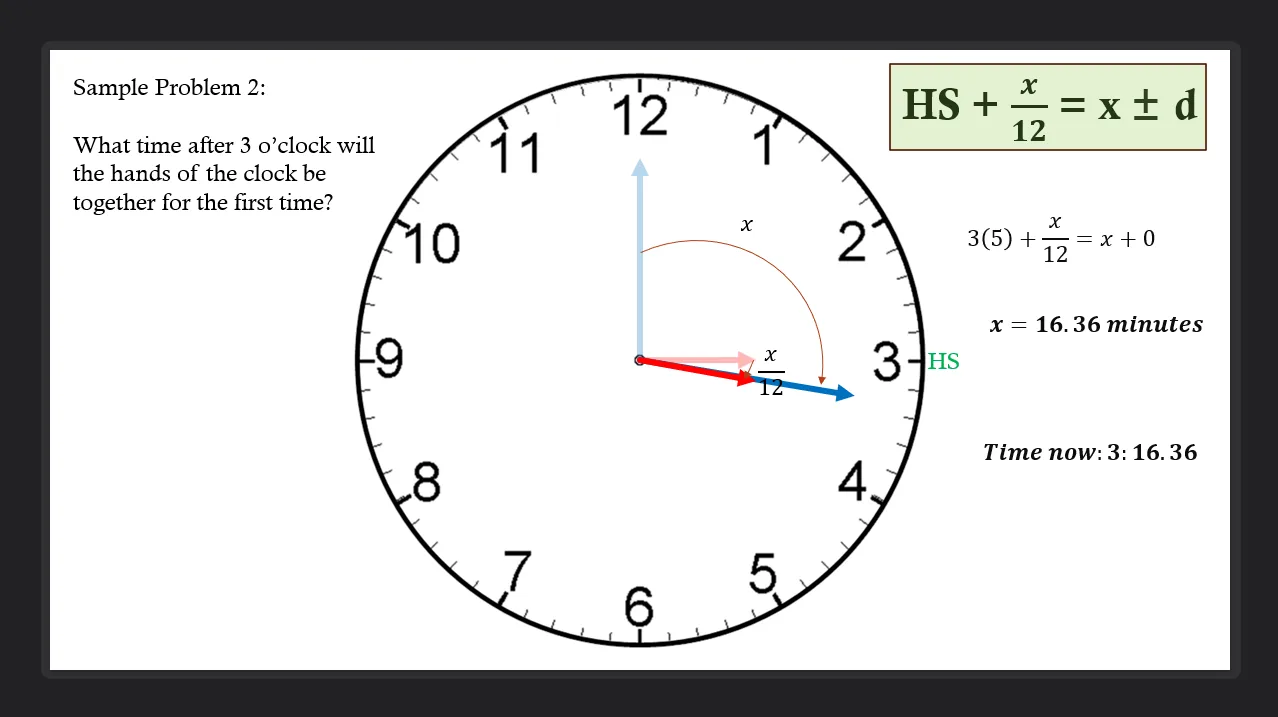
What time after 3 o'clock will the hands of the clock be together for the first time?
See images:
Problem:
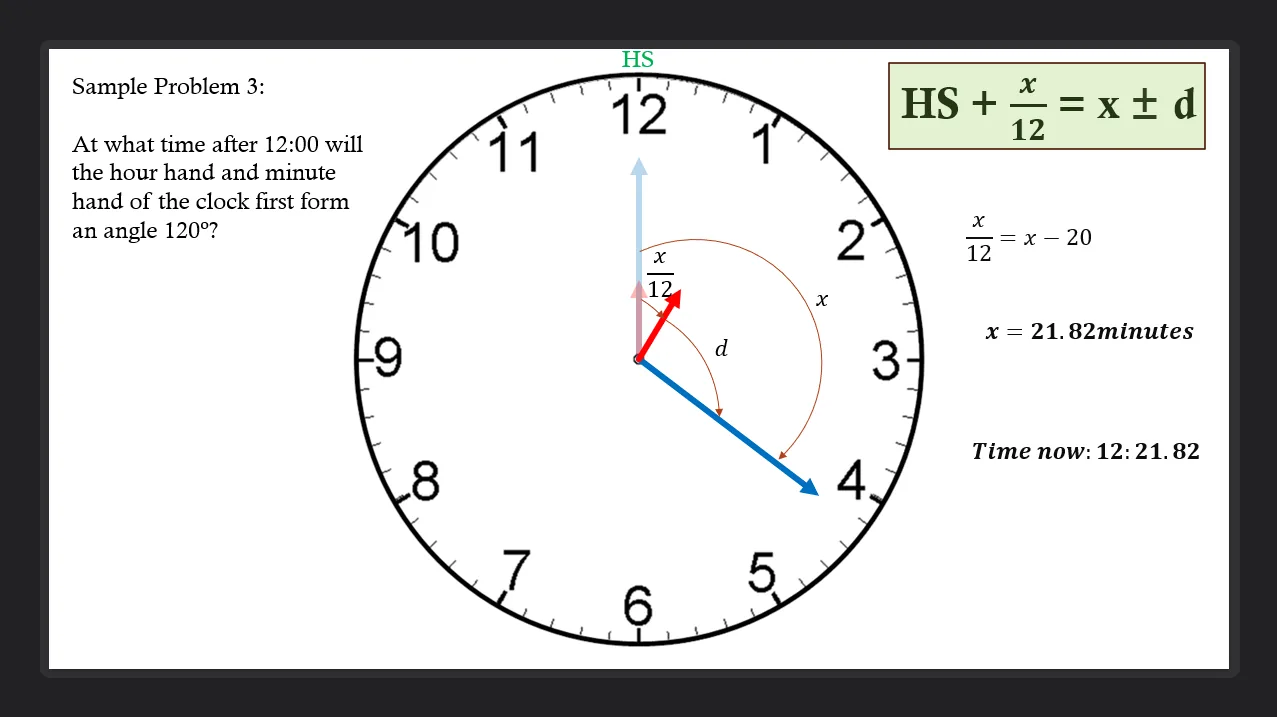
At what time after 12:00 will the hour hand and minute hand of the clock first form an angle of 120°?
See images:
Problem:
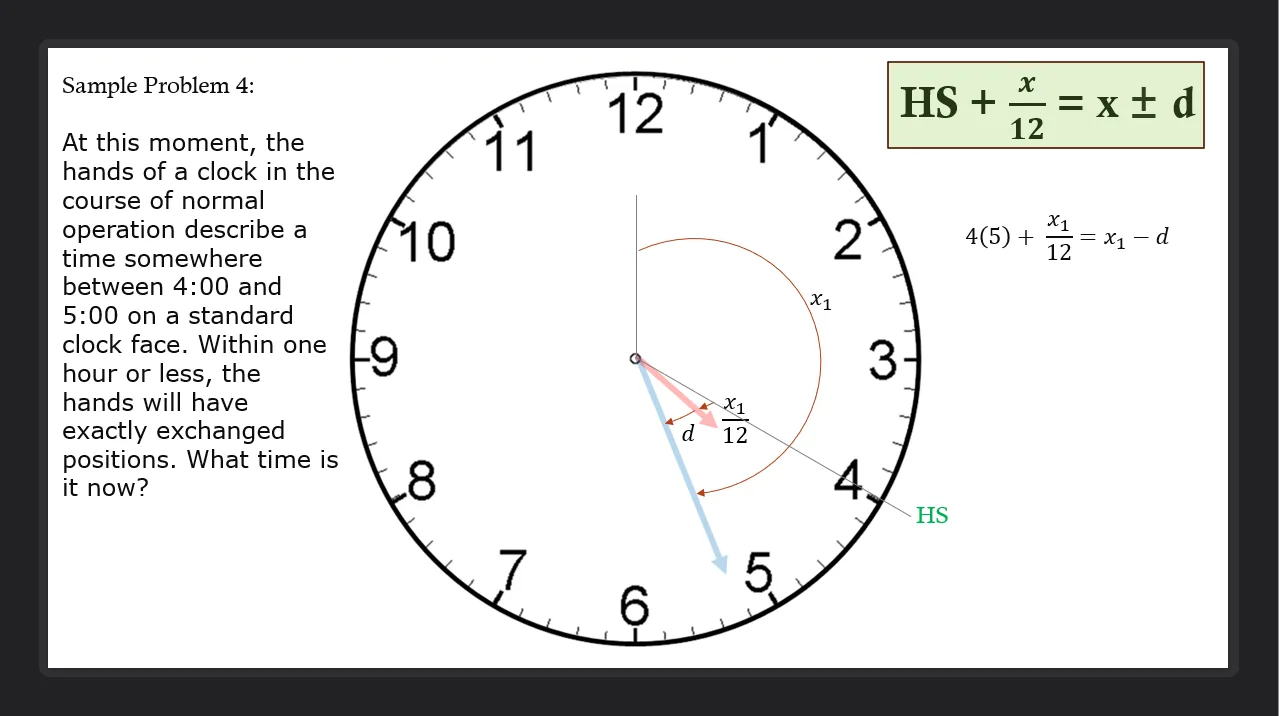
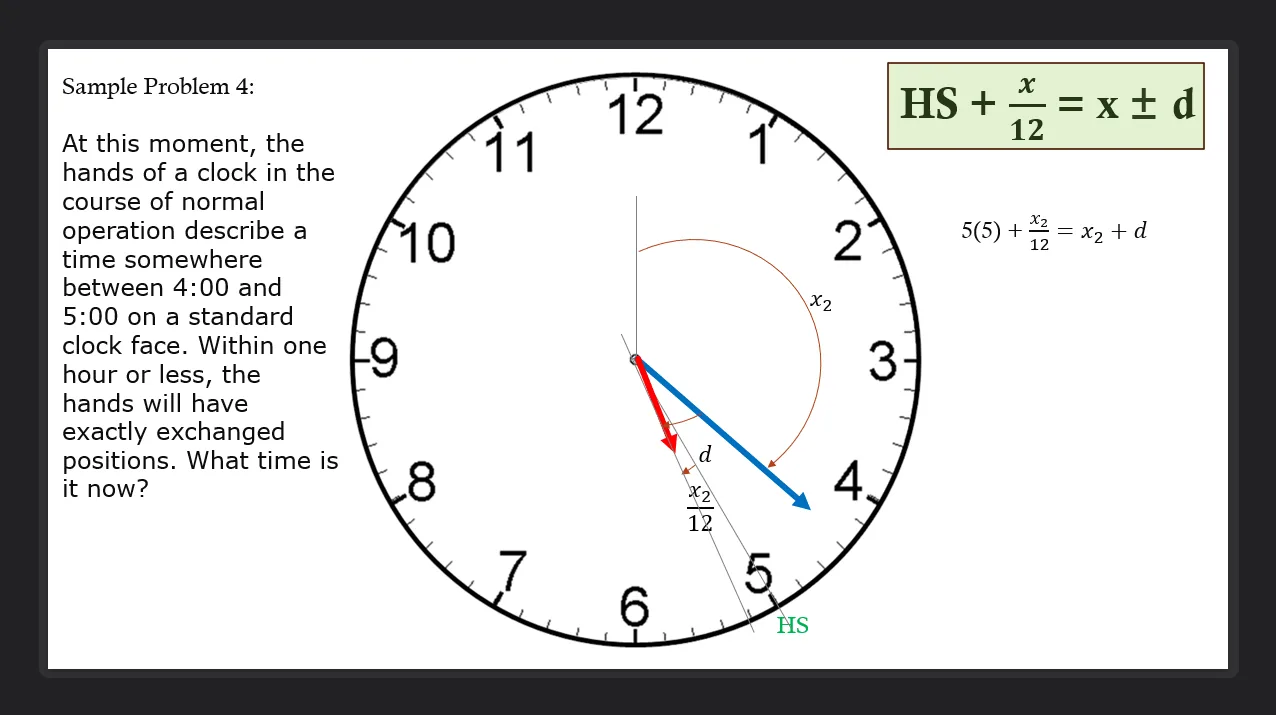
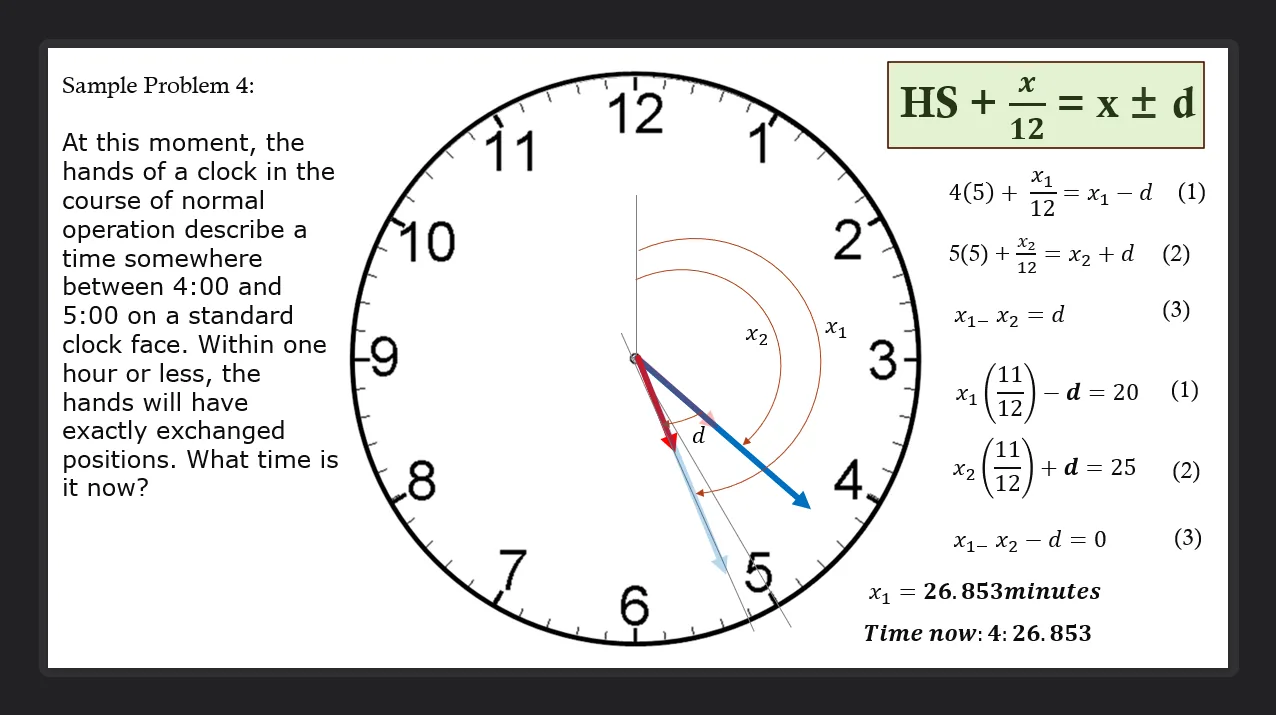
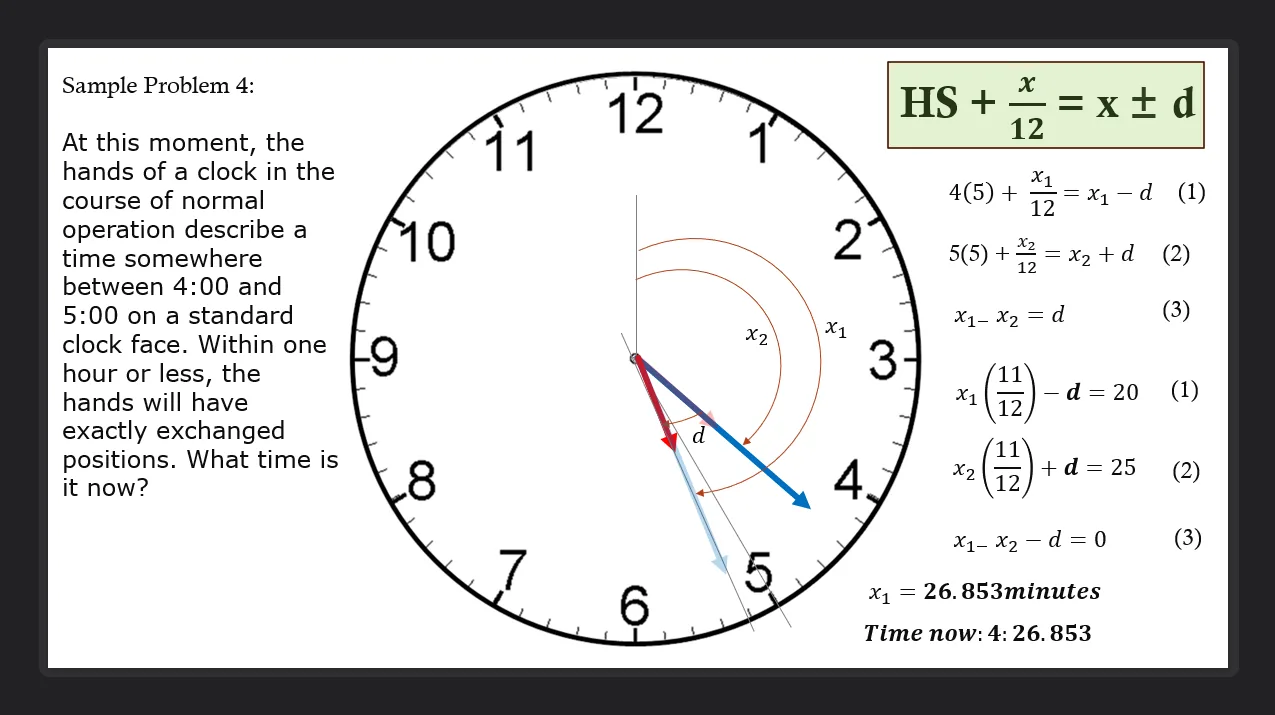
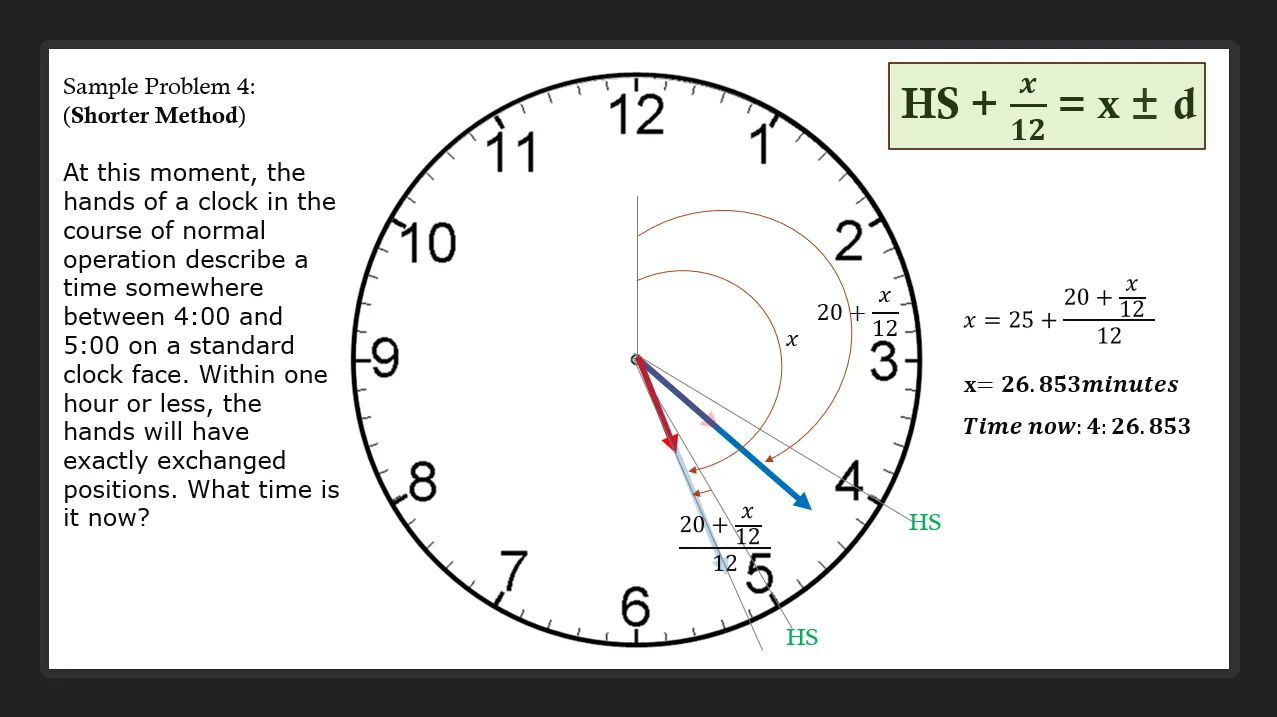
At this moment, the hands of a clock in the course of a normal operation describe a time somewhere between 4:00 and 5:00 on a standard clock face. Within one hour or less, the hands will have exactly changed positions. What time is it now?
See images:
Problem:
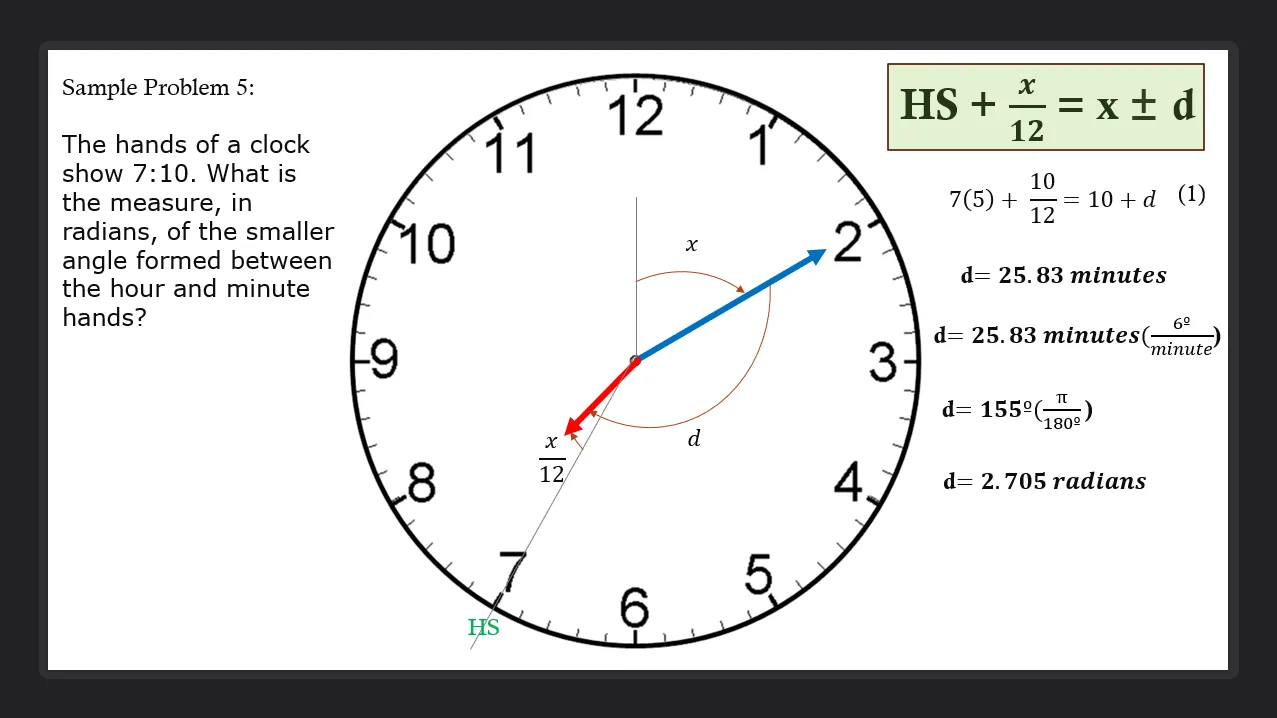
The hands of a clock show 7:10. What is the measure, in radians, of the smaller angle formed between the hour and minute hands?
See images:
Problem:
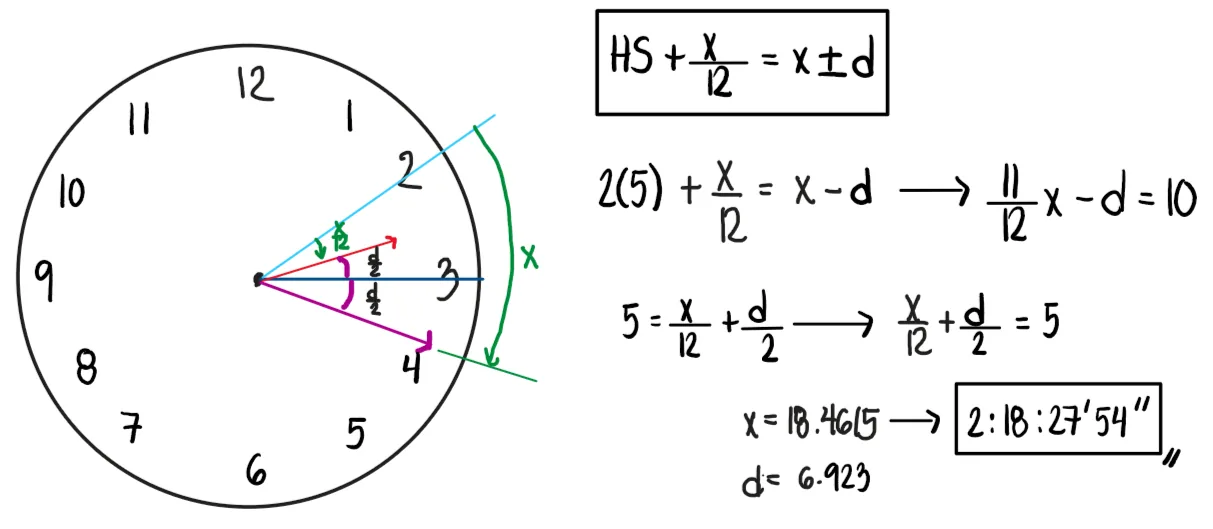
What time between 2 and 3 o'clock will the angle between the hands of the clock be bisected by the line connecting the center of the clock and the 3 o'clock mark? Ans. 2:18:27.6
See images:
-->
🧭 Jump to:
Scroll to zoom
Exam Generator Problems
Additional board-style practice items for this topic.
At this moment, the hands of a clock in the course of normal operation describe a time somewhere between 4:00 and 5:00 on a standard clock face. Within one hour or less, the hands will have exactly exchanged positions. What time is it now?
Answer:
4:26.853
4:27.362
4:26.723
4:25.683
Let the time be $4:m$ and let $t$ be the minutes until the hands exchange positions. The initial hand angles are $120+0.5m$ for the hour hand and $6m$ for the minute hand. At the exchange: $6(m+t)=120+0.5m$ $120+0.5(m+t)=6m+360$ Solving the simultaneous equations gives $m=26.853$. $\boxed{4:26.853}$
In one day, how many times will the hour hand and minute hand of a continuously driven clock be together?
Answer:
22
21
23
24
The minute hand makes 24 revolutions per day; hour hand makes 2. The minute hand gains $24 - 2 = 22$ laps on the hour hand, so they coincide 22 times in 24 hours. (11 times every 12 hours × 2 = 22 per day.) $\boxed{22 \text{ times}}$
How many minutes after 3:00 will the minute hand of the clock overtake the hour hand?
Answer:
16 and 4/11 minutes
16 and 11/12 minutes
14/12 minutes
14/11 minutes
At 3:00, hour hand is 15 minute-marks ahead. Relative speed of minute hand = $\frac{11}{12}$ marks/min. $ t = \frac{15}{11/12} = \frac{15 \times 12}{11} = \frac{180}{11} $ $\boxed{= 16\frac{4}{11} \text{ min after 3:00}}$
How many minutes after 10:00 o'clock will the hands of the clock be opposite of the other for the first time?
Answer:
21.81
22.31
21.41
22.61
At 10:00, hour hand is at 50-mark (minute scale), minute hand at 0. For opposite hands, they must be 30 marks apart. Let $t$ = min after 10:00: $ t - (50 + t/12) = -30 $ $ \frac{11t}{12} = 20 \Rightarrow t = \frac{240}{11} $ $\boxed{\approx 21.81 \text{ min after 10:00}}$
It is now between 3 and 4 o'clock. In twenty minutes, the minute hand will be as much ahead of the hour-hand as it is now behind it. What is the time now?
Answer:
3:06.06
3:07.36
3:09.36
3:08.36
Let $t$ = minutes after 3:00 (current time). Minute-hand lead over hour hand at time $t+20$: $\frac{11(t+20)}{12} - 15$ For symmetric position: gap at $t$ = gap at $t+20$ (but on opposite side) $ 15 - \frac{11t}{12} = \frac{11(t+20)}{12} - 15 $ $ \frac{22t}{12} = 30 - \frac{220}{12} = \frac{140}{12} $ $ t = \frac{70}{11} \approx 6.36 $ min after 3:00 $\boxed{\approx 3:06}$
A man left his home at past 3:00 o'clock PM as indicated in his wall clock. Between two to three hours after, he returned home and noticed that the hands of the clock interchanged. At what time did he leave his home?
Answer:
3:31.47
3:22.22
3:44.44
3:27.27
Let $t$ = minutes after 3:00 (departure). Let $r$ = minutes after 3:00 (return). At $t$: minute hand at $m = t$, hour hand at $h = 15 + t/12$. At $r$: minute hand = $r$, hour hand = $15 + r/12$. Interchange: $r = h = 15 + t/12$ and $15 + r/12 = t$ From these: $r = 15 + t/12$ and $15 + (15+t/12)/12 = t$ $ 15 + 15/12 + t/144 = t \Rightarrow 143t/144 = 16.25 \Rightarrow t = \frac{16.25 \times 144}{143} = 16.36 + \ldots $ After careful algebra, $ t \approx 16.36 $ and $ r \approx 46.36 $ min after 3:00. Time away $\approx 30$ min. [Man left at about 3:16, returned around 3:46.] $\boxed{\approx 3:16 \text{ PM departure}}$
At what time after 12:00 noon will the hour hand and the minute hand of the clock first form an angle of 120°?
Answer:
12:21.818
21.181
21.818
12:21.181
At 12:00, both hands start together. The minute hand gains on the hour hand at: $6-0.5=5.5^\circ/\text{min}$ For the first 120° angle: $5.5t=120$ $t=21.818\text{ min}$ $\boxed{12:21.818}$
It is between 3 and 4 o’clock, and in 20 minutes, the minute hand will be as much after the hour hand as it is now behind it. What is the time?
Answer:
3:06:21.82
3:07:21.82
3:08:21.82
3:09:21.82
Let the time be 3:$m$. The hour hand angle is $90+0.5m$ and the minute hand angle is $6m$. Current lag of the minute hand is: $90+0.5m-6m=90-5.5m$ After 20 minutes, the minute hand is ahead by: $6(m+20)-[90+0.5(m+20)]=5.5m+20$ Set them equal: $90-5.5m=5.5m+20$ $m=6.3636$ min = 6 min 21.82 sec $\boxed{3:06:21.82}$
Question Bank: q716
MSTE - Algebra / Fundamental Principles of Counting / Engr. Janclyde Espinosa (Clidez)
10 business executives and 7 chairmen meet at a conference.
Each business executive shakes hands with every other business executive and every chairman once, and each chairman shakes hands with each business executive but not the other chairmen.
How many handshakes would take place?
115
144
131
90
Executive-executive handshakes: $\binom{10}{2}=45$ Executive-chairman handshakes: $10(7)=70$ Chairmen do not shake hands with other chairmen, so total: $45+70=115$ $\boxed{115}$
It is now 10:00 o'clock. How many minutes from now will the hands of the clock be perpendicular for the first time?
5.256
5.325
5.454
5.121
At 10:00, the hour hand is at $300^\circ$ and the minute hand is at $0^\circ$. After $t$ minutes, the minute hand moves $6t$ degrees and the hour hand moves $0.5t$ degrees. For the first perpendicular position after 10:00, the larger separation becomes $270^\circ$: $300-5.5t=270$ $t=\frac{30}{5.5}=5.454$ minutes. $\boxed{5.454\text{ minutes}}$
A salesman started walking from office A at 9:30 am at the rate of 2.5 kph. He arrived office B 12 seconds late. Had he started at A at 9:00 am and walked at 1.5 kph, he would have arrived at B one minute before the required time. At what time was he supposed to be at B?
10:13 am
10:16 am
10:22 am
10:18 am
Let $T$ be the required arrival time in hours after 9:00 am, and let $D$ be the distance. Starting at 9:30 and arriving 12 seconds late: $D=2.5\left(T-0.5+\frac{12}{3600}\right)$. Starting at 9:00 and arriving 1 minute early: $D=1.5\left(T-\frac{1}{60}\right)$. Equate distances: $2.5\left(T-0.5+\frac{12}{3600}\right)=1.5\left(T-\frac{1}{60}\right)$ $T=1.2167$ hr after 9:00, or about 10:13 am. $\boxed{10:13\text{ am}}$
Question Bank: w263
MSTE - Algebra / Clock Problems / MSTE April 2025
What time between 2 and 3 o'clock will the angle between the hands of the clock be bisected by the line connecting the center of the clock and the 3 o'clock mark?
2:18:27.6
2:16:00.0
2:17:56.3
2:19:03.1
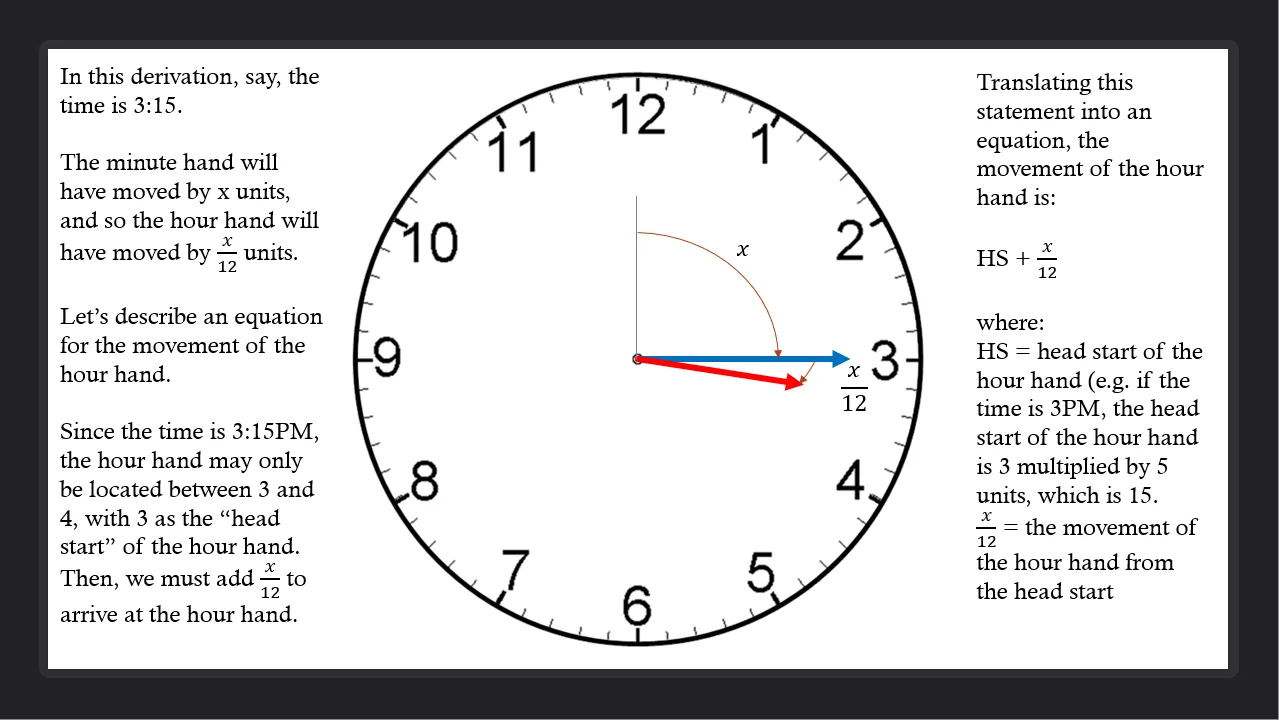
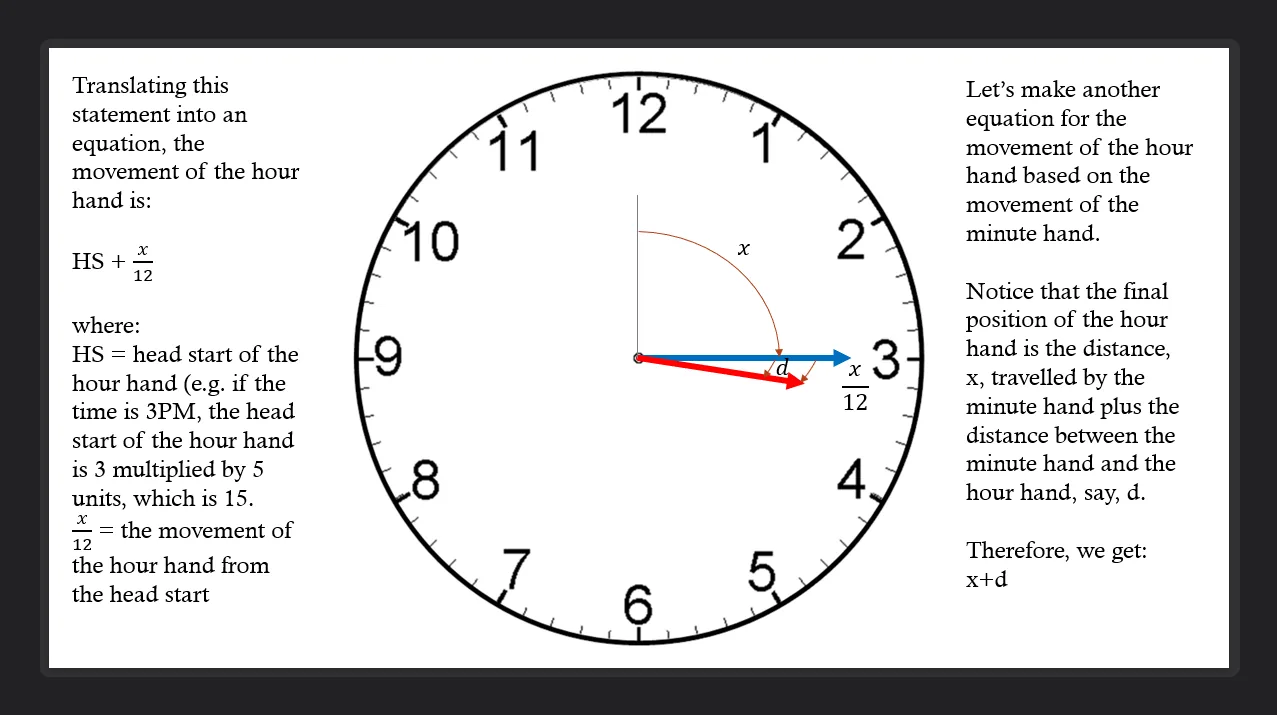
Work in minute-space units. Let $x$ be the minute-hand reading past 12.
The 3 o'clock mark is at 15 minute-spaces. The minute hand is past it by $y_1 = x - 15$. The hour hand at 2 o'clock plus $x$ minutes sits at $10 + x/12$, so it is short of the 15-mark by $y_2 = 15 - (10 + x/12) = 5 - x/12$.
For the 3 o'clock line to bisect the angle, the two offsets must be equal: $y_1 = y_2$ $x - 15 = 5 - \dfrac{x}{12}$ $x = 18.46\ \text{minutes} = 18\ \text{minutes and }27.69\ \text{seconds}$ $\boxed{\text{time} = 2\text{:}18\text{:}27.6}$