Number problems often involve finding unknown values that satisfy several conditions simultaneously.
These conditions may include:
Sum or difference relationships between the numbers
Quotient and remainder information from division
Other mathematical constraints
The key steps are:
Assign variables to represent each unknown number.
Translate the conditions into equations.
For example:
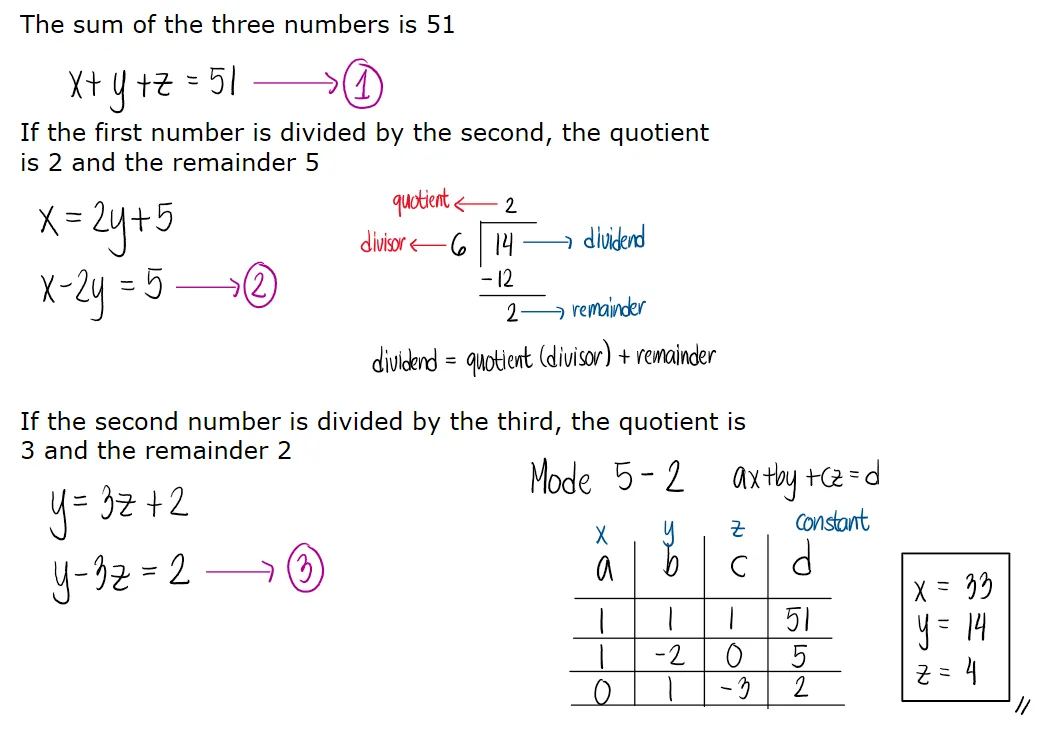
“The sum of the three numbers is 51” becomes:
$x + y + z = 51$
“The first number divided by the second gives a quotient of 2 and remainder 5” becomes:
$x = 2y + 5$
“The second divided by the third gives a quotient of 3 and remainder 2” becomes:
$y = 3z + 2$
Solve the system of equations step-by-step, often starting from the simpler equations and substituting into the more complex ones.
Check the solution by substituting back into all original conditions.
These problems are a practical application of algebra and logical reasoning,
where understanding how to model real statements into equations is just as important as solving them.
Problem:
The sum of the three numbers is 51. If the first number is divided by the second, the quotient is 2 and the remainder 5; but if the second number is divided by the third, the quotient is 3 and the remainder 2. Determine the numbers.
See images:
Problem:
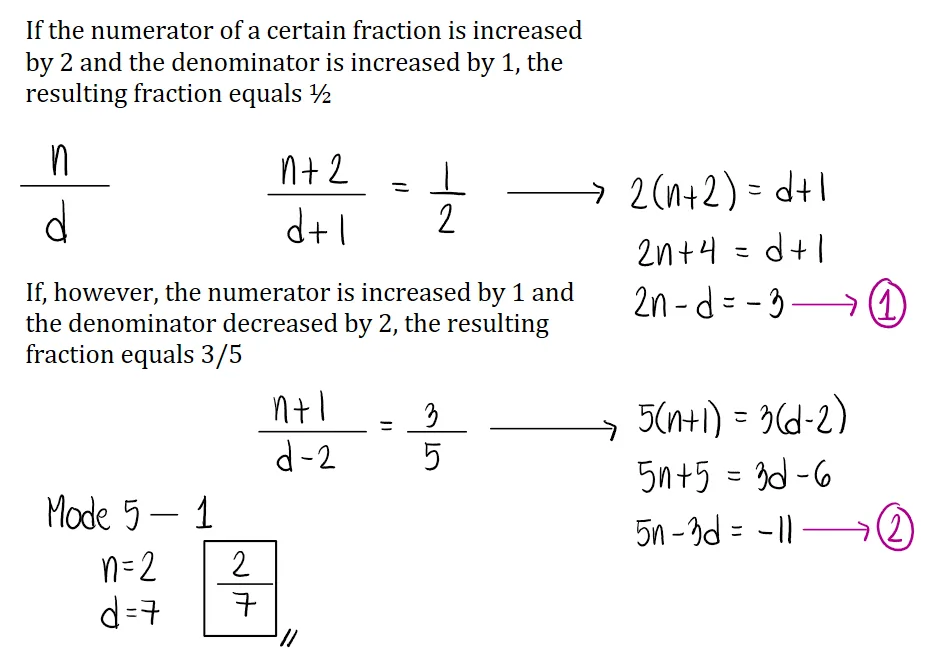
If the numerator of a certain fraction is increased by 2 and the denominator is increased by 1, the resulting fraction equals 1/2. If, however, the numerator is increased by 1 and the denominator decreased by 2, the resulting fraction equals 3/5 . Find the fraction.
Problem:
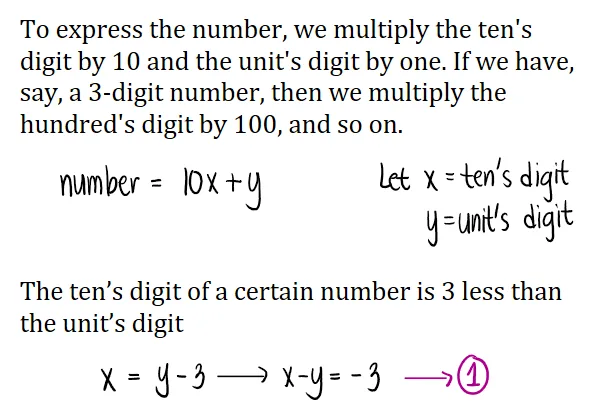
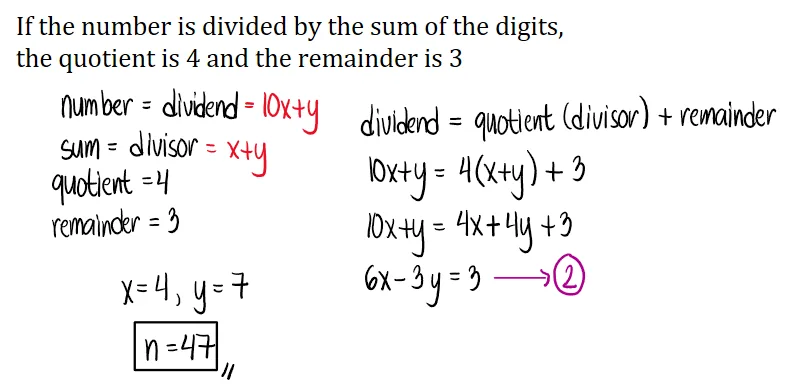
The ten's digit of a certain number is 3 less than the unit's digit. If the number is divided by the sum of the digits, the quotient is 4 and the remainder is 3. What is the original number?
See images:
Problem:
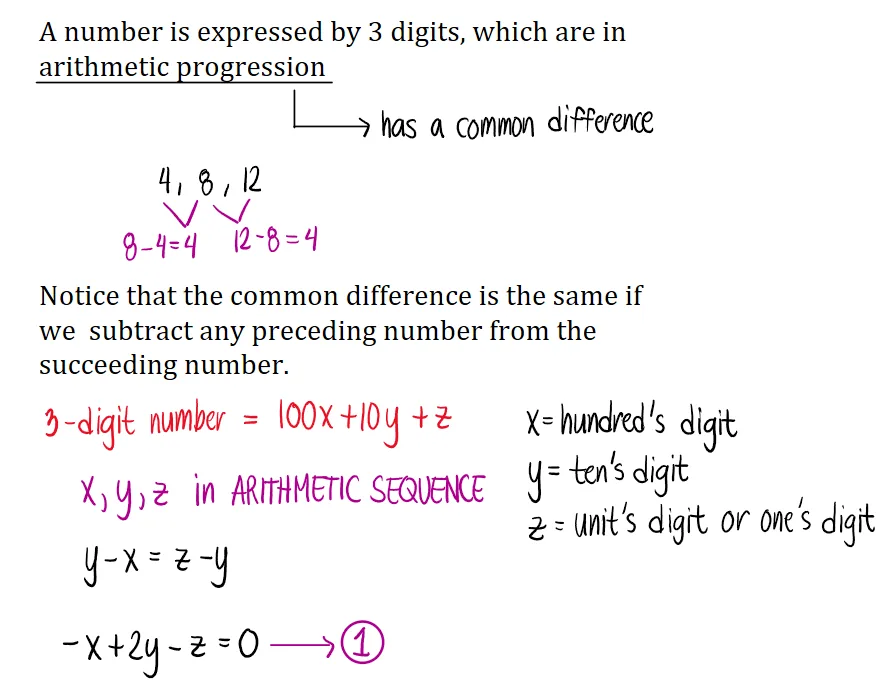
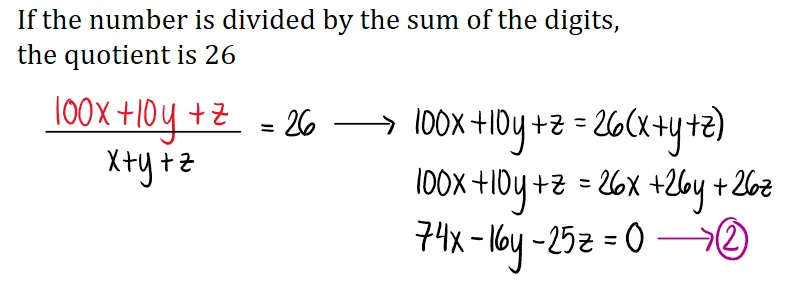
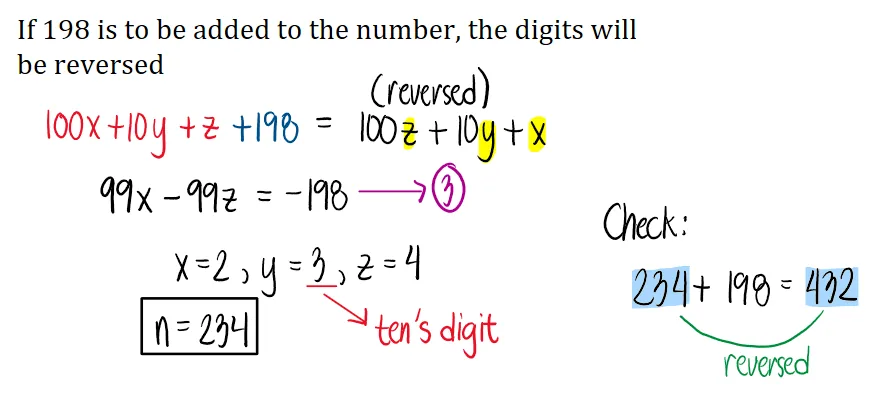
A number is expressed by 3 digits, which are in arithmetic progression. If the number is divided by the sum of the digits, the quotient is 26 and if 198 is to be added to the number, the digits will be reversed. Find the ten's digit.
See images:
Problem:
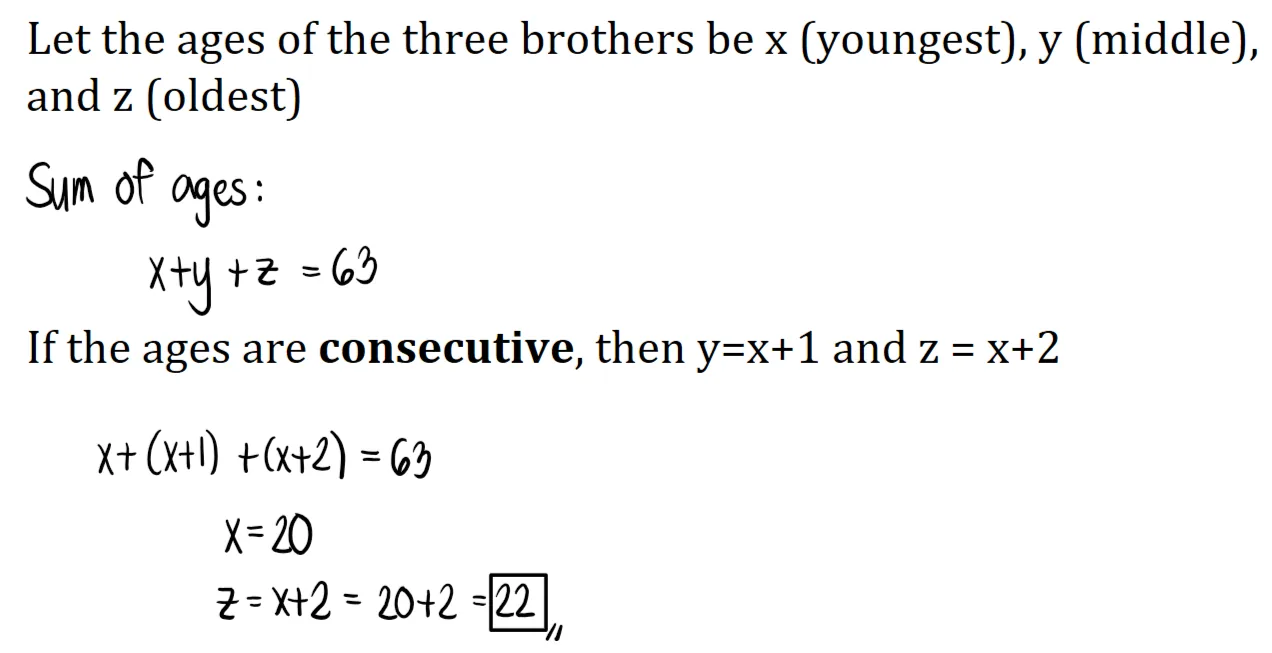
The sum of the ages of the three brothers is 63. If their ages are consecutive integers, what is the age of the eldest brother?
See images:
-->
🧭 Jump to:
Scroll to zoom
Exam Generator Problems
Additional board-style practice items for this topic.
The sum of the three numbers is 51. If the first number is divided by the second, the quotient is 2 and the remainder 5; but if the second number is divided by the third, the quotient is 3 and the remainder 2. Determine the numbers.
What is the value of x?
33
4
14
16
What is the value of y?
14
33
4
16
What is the value of z?
4
14
33
16
Part 1.
Let the three numbers be $x$, $y$, and $z$. From the division statements: $x=2y+5$ $y=3z+2$ $x+y+z=51$ Substitute into the sum: $(2(3z+2)+5)+(3z+2)+z=51$ $10z+11=51$, so $z=4$, $y=14$, and $x=33$. $\boxed{x=33}$
Part 2.
From $y=3z+2$ and $z=4$: $y=3(4)+2=14$ $\boxed{y=14}$
Part 3.
After substitution, $10z+11=51$, so: $z=4$ $\boxed{z=4}$
Twice the middle digit of a three-digit number is the sum of the other two. If the number is divided by the sum of its digits, the answer is 56 and the remainder is 12. If the digits are reversed, the number becomes smaller by 594. Find the number.
The denominator of a certain fraction is three more than twice the numerator. If 7 is added to both terms of the fraction, the resulting fraction is 3/5. Find the original fraction.
The ten’s digit of a certain number is 3 less than the unit’s digit. If the number is divided by the sum of the digits, the quotient is 4 and the remainder is 3. What is the original number?
Answer:
47
58
14
36
Let the units digit be $u$ and the tens digit be $u-3$. The number is: $10(u-3)+u=11u-30$ Sum of digits is $2u-3$. Given quotient 4 remainder 3: $11u-30=4(2u-3)+3$ $11u-30=8u-9$ $u=7$ The number is $47$. $\boxed{47}$
What is the value of k if the sum of odd consecutive positive integers from 1 to k equals 441?
41
21
30
29
The sum of the first $n$ odd positive integers is $n^2$. If the sum from 1 to $k$ is 441: $n^2=441$, so $n=21$. The 21st odd integer is: $k=2n-1=41$ $\boxed{41}$
Which of the following must be true for the product of $(x + 1)(x)(x - 1)$ when $x$ is a positive integer.
it is either odd or even
it is always divisible by 3
it can be negative
it always is divisible by 4
The factors $(x-1)$, $x$, and $(x+1)$ are three consecutive integers. In any three consecutive integers, one factor must be divisible by 3. Therefore their product is always divisible by 3. $\boxed{\text{it is always divisible by 3}}$
The seven-digit telephone number of a certain town starts with $350$. If the last four digits cannot begin or end with zero, how many telephone numbers can be assigned?
7290
10000
6561
8100
The number starts with 350, so only the last four digits vary. The first of the last four digits cannot be zero: 9 choices. The two middle digits can be any digit: 10 choices each. The last digit cannot be zero: 9 choices. Total $=9\times10\times10\times9=8100$. $\boxed{8100}$
Question Bank: w4
MSTE - Algebra / Number Problems / MSTE May 2019
During the 2006 Winter Olympic Games in Torino, Italy, the total number of gold medals won by Germany, Canada, and the United States were three consecutive odd integers. Of these three countries, Germany won the most gold medals and Canada won the fewest. If the sum of the first integer, twice the second integer, and four times the third integer is 69, find the number of gold medals won by each country.
Germany: 11; U.S: 9, and Canada: 7
Germany: 12; U.S: 10, and Canada: 8
Germany: 13; U.S: 11, and Canada: 9
Germany: 14; U.S: 12, and Canada: 10
Let Canada $= x$, U.S. $= x+2$, Germany $= x+4$ (consecutive odd integers, common difference 2). $x + 2(x+2) + 4(x+4) = 69$ $7x + 20 = 69 \Rightarrow x = 7$ Canada $= 7$, U.S. $= 9$, $\boxed{\text{Germany} = 11}$
Question Bank: w65
MSTE - Algebra / Number Problems / MSTE November 2019
Some Civil Engineering students decide to have a parade during Engineering Week. When the students form ranks of 3 abreast, two are left over. In ranks of 5, four students are left over. In ranks of 7, six are left over. In ranks of 11, ten are left over. What is the least possible number of students in the parade?
1362
1154
986
1028
Each remainder is exactly one less than its divisor, so $N+1$ is divisible by 3, 5, 7, and 11: $N + 1 = 3 \times 5 \times 7 \times 11 = 1155$ $N = 1154$ Check: $1154 = 3(384)+2 = 5(230)+4 = 7(164)+6 = 11(104)+10$. $\boxed{N = 1154}$
Question Bank: w270
MSTE - Algebra / Number Problems / MSTE April 2025
My house is on a road where the numbers run 1, 2, 3, 4... consecutively. My number is a three digit one and, by a curious coincidence, the sum of all house numbers less than mine is the same as the sum of all house numbers greater than mine. What is my number?
384
288
148
204
Let $m$ = my house number and $n$ = the highest house number. Using $S = \dfrac{k}{2}(a_1 + a_k)$ for each arithmetic series:
Solving the quadratic in $n$: $n = \dfrac{-1 + \sqrt{1 + 8m^{2}}}{2}$
Test the three-digit choices; $n$ must come out a whole number. For $m = 204$: $\sqrt{1 + 8(204)^{2}} = \sqrt{332{,}929} = 577$, so $n = 288$ — a whole number. $\boxed{m = 204}$
Question Bank: w297
MSTE - Algebra / Number Problems / MSTE April 2025
A construction company wants to number new houses using digit plates only. If the company puts an order for 1212 plates how many houses are to be given numbers? (The numbers of houses are consecutive, and the number of the first house is 1).
260
440
556
792
Count plates group by group according to how many digits each house number uses.
Houses 1 to 9 (9 houses, 1 digit each): Number of plates $= 9$
Houses 10 to 99 (90 houses, 2 digits each): Number of plates $= 90(2) = 180$
Remaining plates: $1212 - 9 - 180 = 1023$
Houses with 3-digit numbers: $x = \dfrac{1023}{3} = 341$
Total number of houses: $9 + 90 + 341$ $\boxed{440\ \text{houses}}$
Question Bank: w306
MSTE - Algebra / Number Problems / MSTE April 2025
The zip codes of three Nevada locations, Fallon, Fernly, and Gardnerville Ranchos are three consecutive even integers. If twice the first integer added to the third integer is 268222, find the zip code for Fallon.
89406
84906
86490
89460
Let $x$ = zip code of Fallon (1st integer) $x + 2$ = zip code of Fernly (2nd integer) $x + 4$ = zip code of Gardnerville (3rd integer)
MSTE - Algebra / Number Problems / MSTE April 2025
Three farmers, Adams, Brown and Clark all have farms containing the same number of acres. Adams' farm is most nearly square, the length being only 8 miles longer than the width. Clark has the most oblong farm, the length being 34 miles longer than the width. Brown's farm is intermediate between these two, the length being 28 miles longer than the width. If all the dimensions are in exact miles, what is the size of each farm?
1902 mi2
1200 mi2
1920 mi2
1600 mi2
Write each farm's area in terms of its own width:
Adams: Area $= A(A + 8)$ Brown: Area $= B(B + 28)$ Clark: Area $= C(C + 34)$
All three areas are equal, and every dimension must be a whole number of miles. Test each choice in all three equations.
Only 1920 mi² yields whole-number widths in all three cases: Adams: $40 \times 48$; Brown: $32 \times 60$; Clark: $30 \times 64$