This section summarizes the essential concepts and formulas for Sets, Subsets, Set Operations, and the Principle of Inclusion and Exclusion, foundational for understanding Algebra at the engineering level.
A set is a collection of distinct elements, usually denoted by capital letters. The number of elements in a set is called its cardinality and is written as $|S|$ or $n(S)$.
Common Sets
$\{\}$ or $\emptyset$ → Null set (no elements)
$\{x\}$ → Unit set (one element)
$P$ → Set of all prime numbers
$N$ → Natural numbers
$Z$ → Integers
$Q$ → Rational numbers
$R$ → Real numbers
$C$ → Complex numbers
$H$ → Quaternions
Subsets
If every element of set $A$ is also in $B$, we write:
$$
A \subseteq B
$$
A proper subset is one where $A \subseteq B$ but $A \ne B$.
Complement and Relative Complement
Absolute Complement: All elements not in $A$
$$
A' \quad \text{or} \quad A^c
$$
Relative Complement: All elements in $A$ but not in $B$
$$
A \setminus B
$$
Set Operations
Union: All elements in $A$ or $B$
$$
A \cup B
$$
Intersection: All elements common to $A$ and $B$
$$
A \cap B
$$
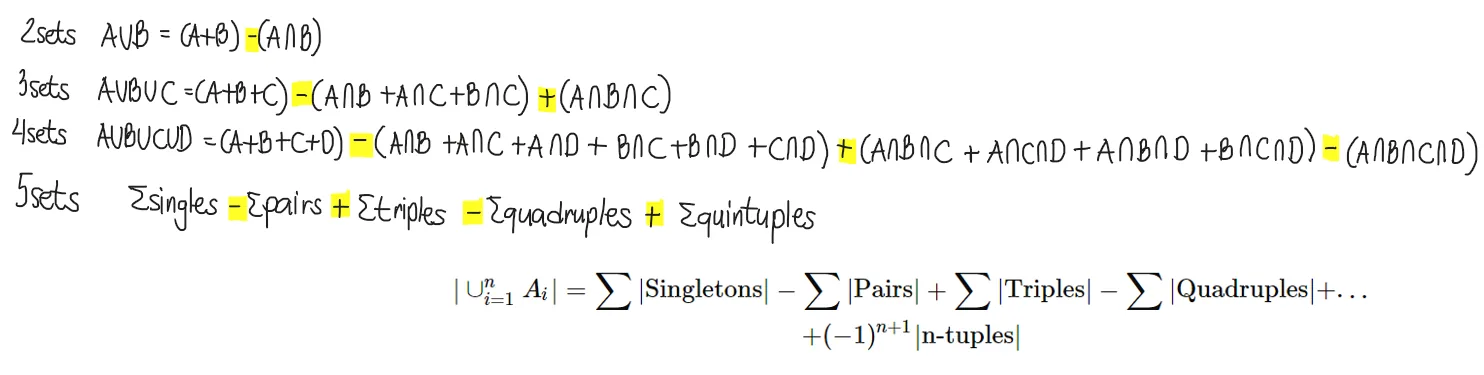
Principle of Inclusion and Exclusion
This principle helps count elements in the union of overlapping sets while avoiding overcounting.
This formula is especially useful in solving problems involving 2 or more overlapping sets, common in surveys, probability, and classification tasks in engineering.
Problem:
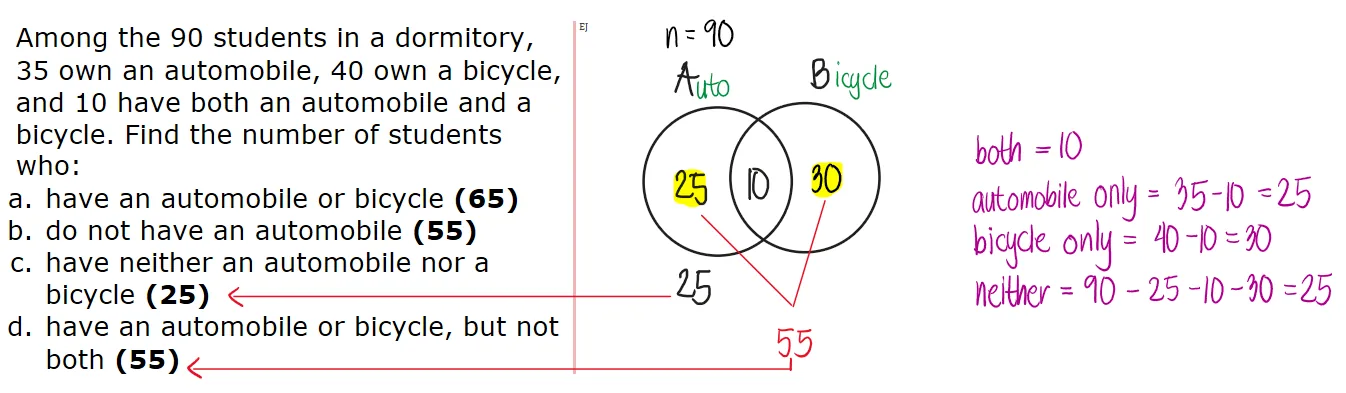
Among the 90 students in a dormitory, 35 own an automobile, 40 own a bicycle, and 10 have both an automobile and a bicycle. Find the number of students who:
a. have an automobile or bicycle
b. do not have an automobile
c. have neither an automobile nor a bicycle
d. have an automobile or bicycle, but not both
See images:
Problem:
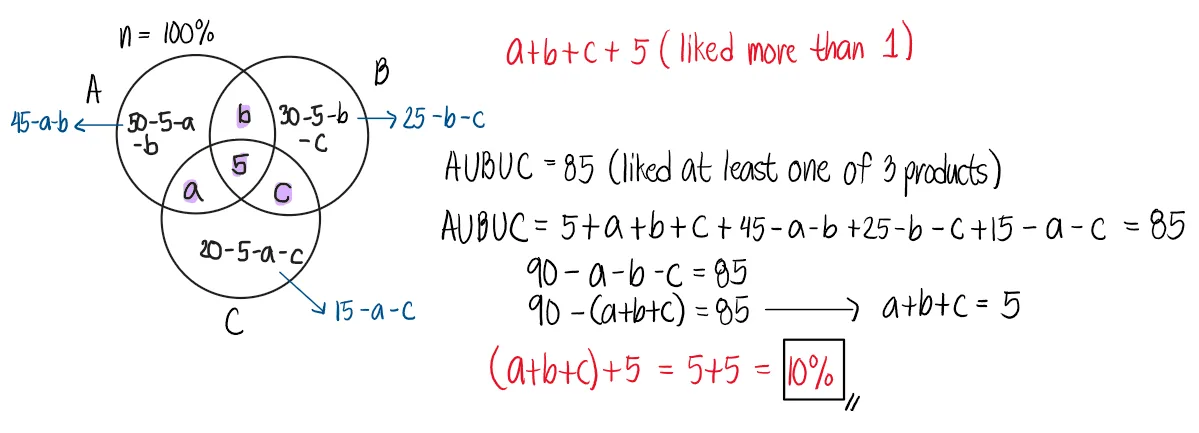
In a consumer market, 85% of those surveyed liked at least one of three products: 1, 2, or 3. 50% of those asked liked product 1, 30% liked product 2, and 20% liked product 3. If 5% of the people in the survey liked all three of the products, what percentage of the survey participants liked more than one of the three products?
A. 10%
B. 15%
C. 25%
D. 30%
See images:
Problem:
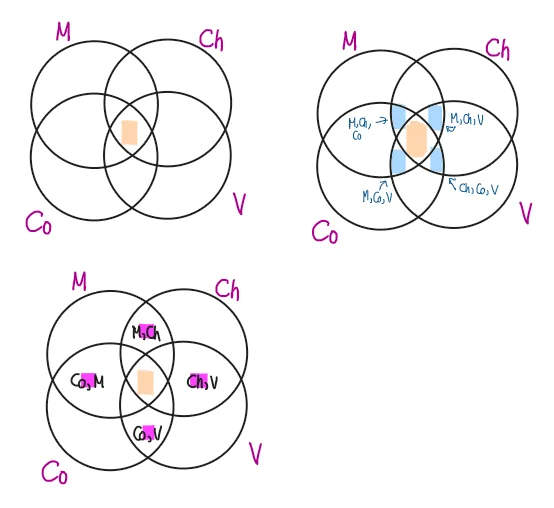
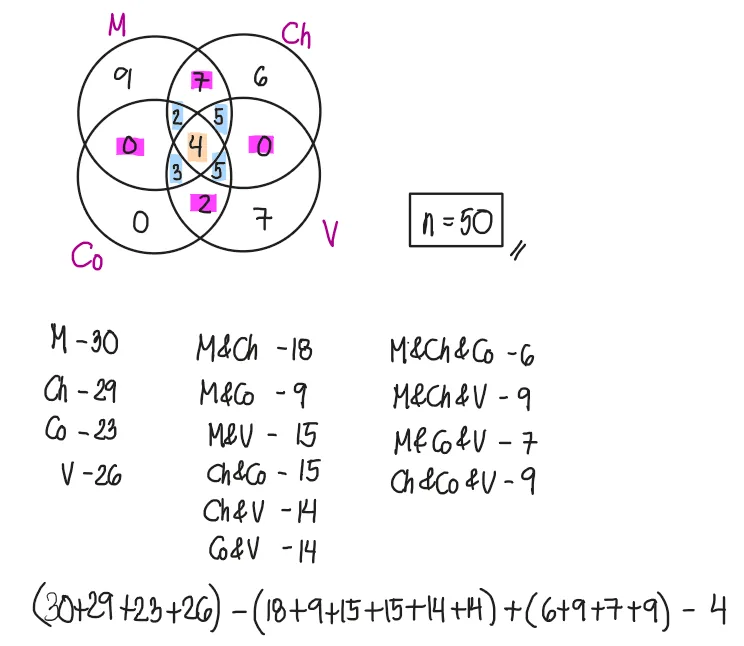
In a coffee shop that offers four kinds of drinks: Mocha, Choco, Coffee, and Vanilla. Thirty ordered Mocha. 29 ordered Choco. 23 ordered Coffee. 26 ordered Vanilla. Eighteen ordered Mocha and Choco, 9 ordered Mocha and Coffee, 15 ordered Mocha and Vanilla, 15 ordered Choco and Coffee, 14 ordered Choco and Vanilla, and 14 ordered Coffee and Vanilla. Six ordered Mocha, Choco, and Coffee; 9 ordered Mocha, Choco, and Vanilla; 7 ordered Mocha, Coffee, and Vanilla; and 9 ordered Choco, Coffee, and Vanilla. Four ordered Mocha, Choco, Coffee, and Vanilla. Assuming that each person ordered one of a kind for each purchase, determine the total number of people who ordered.
A. 50
B. 40
C. 75
D. 100
Answer: 19
Problem:
Consider the following data for 120 mathematics students: 65 study French, 20 study French and German, 45 study German, 25 study French and Russian, 42 study Russian, 15 study German and Russian, and 8 study all three languages.
a. Find the number of students studying at least one of the three languages Ans. 100
b. Find the number of students studying at least two languages Ans. 44
c. Find the number of students studying exactly one language Ans. 56
See images:
-->
🧭 Jump to:
Scroll to zoom
Exam Generator Problems
Additional board-style practice items for this topic.
Among the 90 students in a dormitory, 35 own an automobile, 40 own a bicycle, and 10 have both an automobile and a bicycle. Find the number of students who:
Have an automobile or bicycle:
65
45
50
25
Do not have an automobile:
55
50
30
45
Have neither an automobile nor a bicycle:
25
55
35
50
Have an automobile or bicycle but not both:
55
90
75
30
Part 1.
Use inclusion-exclusion for automobile $A$ and bicycle $B$: $n(A\cup B)=n(A)+n(B)-n(A\cap B)$ $n(A\cup B)=35+40-10$ $\boxed{65}$
Part 2.
Students who do not have an automobile are the complement of the automobile owners: $90-35=55$ $\boxed{55}$
Part 3.
Students with neither are outside $A\cup B$: $90-65=25$ $\boxed{25}$
Part 4.
Students who have automobile or bicycle but not both are counted in exactly one set: $n(A\cup B)-n(A\cap B)=65-10$ $\boxed{55}$
Consider the following data for 120 mathematics students. 65 study French, 20 study French and German, 45 study German, 25 study French and Russian, 42 study Russian, 15 study German and Russian, and 8 study all three languages.
Find the number of students studying at least one of the three languages.
100
65
75
45
Find the number of students studying at least 2 languages.
44
67
23
50
Find the number of students studying exactly one language.
56
57
35
38
Part 1.
Use inclusion-exclusion for French $F$, German $G$, and Russian $R$: $n(F\cup G\cup R)=65+45+42-20-25-15+8$ $\boxed{100}$
Part 2.
Students studying at least two languages are the pair intersections, with the triple intersection counted once overall: $(20+25+15)-2(8)=44$ $\boxed{44}$
Part 3.
Students studying exactly one language equals at least one minus at least two: $100-44=56$ $\boxed{56}$
Ninety people at a Superbowl party were surveyed to see what they ate while watching the game. The following data were collected: 48 had nachos, 39 had wings, 35 had potato skins, 20 had both wings and potato skins, 19 had both potato skins and nachos, 22 had both wings and nachos, 10 had nachos, wings, and potato skins. How many had nothing?
Answer:
19
22
16
24
Use inclusion-exclusion: $n(N\cup W\cup P)=48+39+35-22-19-20+10=71$ Thus the number who had nothing is: $90-71=19$ $\boxed{19}$
At XYZ University, 40% of all students are members of both a chess club and a swim team.
If 20% of members of the swim team are not members of the chess club, what percentage of all XYZ students are members of the swim team?
If function f(x) satisfies:
f(x2)=f(x)2 for all x, which of the following must be true?
50%
20%
30%
40%
Let $S$ be swim team members and $C$ chess club members. Since 20% of swim team members are not in chess, 80% of swim team members are in both: $0.80S=40\%$ of all students $S=40\%/0.80=50\%$ $\boxed{50\%}$
A number of light bulbs were purchased to illuminate a gym. However, only 2/3 of them were needed. After 160 light bulbs were returned, and 60% percent of their cost ($96) was reimbursed, how much money was spent on illuminating the gym, in dollars?
384
360
320
364
The 160 returned bulbs are the unused $1/3$ of the bulbs, so total purchased was: $160/(1/3)=480$ bulbs The refund was 60% of the returned bulbs' cost and equaled $96, so the returned bulbs originally cost: $96/0.60=160$ dollars Cost per bulb is $160/160=1$ dollar. Bulbs used were $2/3(480)=320$, so money spent for illumination is: $\boxed{384}$
Set $M$ and $N$ have 20 pairs where each element in $M$ is paired with one in $N$ such that the element of $M$ is always greater than its pair from $N$. Which of the following is always true?
range of $M$ > range of $N$
mode of $M$ > mode of $N$
mean of $M$ > mean of $N$
median of $M$ > median of $N$
Each paired element in $M$ is greater than its corresponding element in $N$. Adding all 20 pair inequalities gives: $\sum M_i>\sum N_i$ Dividing both sides by 20 gives $\bar{M}>\bar{N}$. $\boxed{\text{mean of }M>\text{mean of }N}$
Given the following set of numbers arranged from smallest to largest: ${1, x, 4, 6, x^2}$. If the range of the set is 8, what is the average of the set?
$4.3$
$4.2$
$4.6$
$5.2$
The set is arranged from smallest to largest, so the range is $x^2-1$. $x^2-1=8 \Rightarrow x^2=9$. Since $x$ is between 1 and 4 in the ordered set, $x=3$. Average $=\frac{1+3+4+6+9}{5}=4.6$. $\boxed{4.6}$
Question Bank: w16
MSTE - Algebra / Sets / MSTE May 2019
The passengers on an excursion bus consisted of 14 married couples, 8 of whom brought no children and 6 of whom brought 3 children apiece. Counting the driver, the bus has 31 occupants. How is this possible?
included among the 18 children were 8 married couples.
included among the 18 children were 6 married couples.
included among the 18 children were 10 married couples.
included among the 18 children were 4 married couples.
14 couples $= 28$ adults; children $= 6 \times 3 = 18$; driver $= 1$. Counting everyone separately gives $28 + 18 + 1 = 47$. To reach 31 occupants, some persons counted as “children” are also among the married couples (double counted): overlap $= 47 - 31 = 16$ persons $= 8$ couples. $\boxed{\text{8 married couples are among the 18 children}}$
Question Bank: w251
MSTE - Algebra / Sets / MSTE April 2025
In a certain town there are 1000 married couples. Two-thirds of the husbands who are taller than their wives are also heavier and three-quarters of the husbands who are heavier than their wives are also taller. If there are 120 wives who are taller and heavier than their husbands, how many husbands are taller and heavier than their wives?
880
320
380
480
Let $x$ = husbands who are taller and heavier than their wives, $T$ = husbands taller, $H$ = husbands heavier.
$\left(\tfrac{2}{3}\right)T = x\ \Rightarrow\ T = \tfrac{3}{2}x$ $\left(\tfrac{3}{4}\right)H = x\ \Rightarrow\ H = \tfrac{4}{3}x$
The union of the two sets covers all couples except the 120 where the wife is both taller and heavier: $(T - x) + x + (H - x) = 1000 - 120$ $T + H - x = 880$ $\tfrac{3}{2}x + \tfrac{4}{3}x - x = 880$ $\boxed{x = 480}$