Equations and functions are fundamental concepts in Algebra. An equation is a mathematical statement asserting the equality of two expressions. A function describes a rule or relationship that assigns exactly one output value for every input value.
Linear Equation: A linear equation in one variable has the form:
$$
y = mx + b
$$
Where $m$ represents the slope of the line and $b$ is the y-intercept.
Quadratic Equation: A quadratic equation is generally written as:
$$
y = ax^2 + bx + c
$$
This equation graphs as a parabola. The value of $a$ determines whether the parabola opens upward ($a > 0$) or downward ($a < 0$).
Function Notation: A function is commonly represented using the notation:
$$
f(x) = \text{expression in } x
$$
To evaluate a function, substitute the input value into the expression. For example, if $f(x) = 2x + 3$, then $f(4) = 2(4) + 3 = 11$.
Domain and Range:
Domain: The set of all possible input values ($x$).
Range: The set of all possible output values ($f(x)$).
Types of Algebraic Functions:
Linear Functions
Quadratic Functions
Polynomial Functions
Rational Functions
Piecewise-defined Functions
Sign Convention:
When analyzing equations and functions graphically, the sign of $f(x)$ indicates whether the graph lies above (positive) or below (negative) the x-axis. Similarly, roots or zeros of the equation correspond to the x-values where $f(x) = 0$.
Types of Algebraic Functions
Algebraic functions are expressions that involve only the operations of addition, subtraction, multiplication, division, and exponentiation with constant real-number exponents. The following are key function types every engineering student should master:
1. Linear Functions
A linear function represents a straight-line relationship and is expressed as:
$$
f(x) = mx + b
$$
$m$ is the slope (rate of change)
$b$ is the y-intercept (value of $f(x)$ when $x = 0$)
Domain and range: All real numbers
Linear functions have constant rate of change and appear as straight lines on the Cartesian plane. These are often used to model proportional relationships, cost functions, and more.
2. Quadratic Functions
A quadratic function graphs as a parabola and takes the form:
$$
f(x) = ax^2 + bx + c
$$
Vertex form: $f(x) = a(x - h)^2 + k$
Axis of symmetry: $x = -\frac{b}{2a}$
Vertex: Point of minimum (if $a > 0$) or maximum (if $a < 0$)
Discriminant: $D = b^2 - 4ac$ determines number of real roots
Quadratic functions are commonly used in physics (e.g., projectile motion), optimization, and engineering design problems.
3. Polynomial Functions
A polynomial function is the sum of terms of the form $a_nx^n$, where $n$ is a non-negative integer:
Leading coefficient: Coefficient of the term with highest degree
End behavior is determined by the degree and sign of the leading coefficient
Roots (real or complex) can be determined via factoring, synthetic division, or the Rational Root Theorem
Polynomial functions generalize linear and quadratic equations and are foundational in modeling structural forces, fluid flows, and electrical circuits.
4. Rational Functions
A rational function is a ratio of two polynomials:
$$
f(x) = \frac{P(x)}{Q(x)}
$$
Vertical asymptotes: values where $Q(x) = 0$
Horizontal or oblique asymptotes based on the degree of $P(x)$ vs. $Q(x)$
Domain excludes values that make the denominator zero
Rational functions arise in engineering when analyzing systems involving resistances, fluid resistance, and rational control systems.
5. Piecewise-defined Functions
These functions are defined by different expressions over different intervals of the domain:
Used when behavior of the function changes at certain thresholds
Check for continuity at the break points (do left-hand and right-hand limits match?)
Check for differentiability if needed
Piecewise functions model real-world systems like tax brackets, step-load conditions, and friction models with discontinuous behavior.
Reminder for Engineering Students:
Understanding the graph, domain, range, and behavior of each function type is crucial not only for algebra but also for calculus, physics, and engineering analysis. Practice sketching and interpreting function graphs to build your mathematical intuition.
-->
🧭 Jump to:
Scroll to zoom
Exam Generator Problems
Additional board-style practice items for this topic.
A father and his son can dig a well if the father works for 6 hours and his son works for 12 hours or they can do it if the father works 9 hours and the son works 8 hours. How long will it take for the father to dig the well alone?
Answer:
15 hours
20 hours
10 hours
12 hours
Let the father's rate be $f$ wells/hr and the son's rate be $s$ wells/hr. The two conditions give: $6f+12s=1$ $9f+8s=1$ Solving gives $f=1/15$. Thus the father alone takes: $\boxed{15\text{ hours}}$
A man wishes to save money by setting aside 1 cent the first day, 2 cents the second day, 4 cents the third day, and so on. Assuming he does not run out of money, what is the total amount saved in dollars at the end of 30 days?
Answer:
\$10,737,418.23
\$15,708,479.20
\$13,701,473.28
\$18,754,659.35
The daily deposits are $1,2,4,\ldots,2^{29}$ cents. Their sum is
$S_{30}=\dfrac{1(2^{30}-1)}{2-1}=2^{30}-1=1,073,741,823\text{ cents}$.
Convert cents to dollars by dividing by 100:
$\dfrac{1,073,741,823}{100}=10,737,418.23$.
Therefore the total amount saved is \$10,737,418.23.
Very few people are aware of the growth pattern of Jack’s beanstalk. On the first day it increased its height by 1/2, on the second day by 1/3, on the third day by 1/4, and so on. How long did it take to achieve its maximum height (100 times its original height)?
Answer:
198 days
99 days
100 days
200 days
Interpret each stated increase as a fraction of the preceding height. The successive multipliers are
$1+\dfrac12=\dfrac32,\quad1+\dfrac13=\dfrac43,\quad1+\dfrac14=\dfrac54,\ldots$
After n days the growth factor telescopes:
$\dfrac32\cdot\dfrac43\cdot\dfrac54\cdots\dfrac{n+2}{n+1}=\dfrac{n+2}{2}$.
Set this equal to 100: $(n+2)/2=100$, so $n=\boxed{198\text{ days}}$.
Only two polygons can have a smallest interior angle of 120° with each successive angle 5° greater than its predecessor. One is the nonagon. What is the other?
Answer:
Hexadecagon
Dodecagon
Tetradecagon
Octadecagon
For an $n$-gon, the interior angles form an arithmetic sequence starting at 120° with common difference 5°. Their sum is: $\frac{n}{2}\left[2(120)+5(n-1)\right]=180(n-2)$ $n(5n+235)=360n-720$ $n^2-25n+144=0$ Thus $n=9$ or $n=16$. Since one polygon is the nonagon, the other is: $\boxed{\text{Hexadecagon}}$
In 1998, Cynthia Cooper of the WNBA Houston Comets basketball team was named Team Sportswoman of the Year by the Women’s Sports Foundation. Cooper scored 680 points in the 1998 season by hitting 413 of her 1 – point, 2 – point, and 3 – point attempts. She made 40% of her 160 3 – point field goal attempts. How many 1, 2, and 3 – point baskets did Ms. Cooper complete?
Answer:
210, 139, and 64, respectively
210, 153, and 46, respectively
120, 139, and 64, respectively
210, 153, and 46, respectively
Let the numbers of 1-point, 2-point, and 3-point baskets be $x$, $y$, and $z$. Since she made 40% of 160 three-point attempts: $z=0.40(160)=64$ Total baskets: $x+y+z=413$, so $x+y=349$. Total points: $x+2y+3z=680$ $x+2y+192=680$, so $x+2y=488$. Subtracting gives $y=139$, and $x=210$. $\boxed{210, 139,\text{ and }64}$
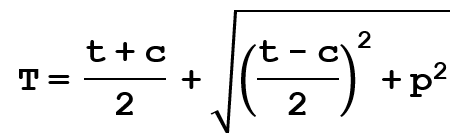
Engineers are often required to determine the stress on building materials. Tensile stress can be found by using the formula below. In this formula, T represents the tensile stress, t represents the tension, c represents the compression, and p represents the pounds of pressure per square inch. If the tensile stress is 108 pounds per square inch, the pressure is 50 pounds per square inch, and the compression is -200 pounds per square inch, what is the tension?
Answer:
100lbs
250lbs
300lbs
200lbs
Substitute $T=108$, $c=-200$, and $p=50$ into
$T=\dfrac{t+c}{2}+\sqrt{\left(\dfrac{t-c}{2}\right)^2+p^2}$:
$108=\dfrac{t-200}{2}+\sqrt{\left(\dfrac{t+200}{2}\right)^2+50^2}$.
Isolate the radical and square both sides. Simplifying gives $1232t=123056$, or $t\approx99.9$.
Therefore the tension is $\boxed{100\text{ lb}}$.
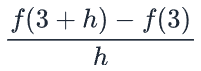
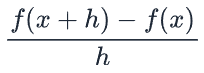
This is the difference quotient for $f(x)=x^2+1$ at $x=3$: $f(3+h)=(3+h)^2+1=10+6h+h^2$ $f(3)=10$ $\frac{f(3+h)-f(3)}{h}=\frac{6h+h^2}{h}=h+6$ $\boxed{h+6}$
If a scuba diver goes to depths greater than 33 feet, the function T(d) = 1700/(d - 33) gives the maximum time a diver can remain down and still surface at a steady rate with no decompression stops. In this function T(d) represents the dive time in minutes, and d represents the depth in feet. If a diver is planning a 45-minute dive, what is the maximum depth the diver can go without decompression stops on the way back up?
Answer:
71 feet
69 feet
72 feet
68 feet
Use $T(d)=\frac{1700}{d-33}$ with $T=45$ minutes: $45=\frac{1700}{d-33}$ $d-33=37.78$ $d=70.78$ ft $\boxed{71\text{ feet}}$
In the Saur study of fenders, the amount of energy consumed by each type of fender was analyzed. The total energy was the sum of the energy needed for production plus the energy consumed by the vehicle used in carrying the fenders. If x is the miles traveled, then the total energy consumption equations for steel RMP were as follows:
Steel: E = 225 + 0.012x
RPM: E = 285 + 0.007x
Setting x = 0 gives the energy used in production, and we note that steel uses less energy to produce these fenders than does RPM. However, since steel is heavier than RPM, carrying steel fenders requires more energy. Find the number of pairs of fenders for which the total energy consumed is the same for both fenders.
Answer:
12000
15000
13000
14000
Set the two energy equations equal: $225+0.012x=285+0.007x$ $0.005x=60$ $\boxed{x=12000}$
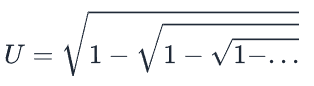
### Infinite radical
The expression repeats itself inside every radical. Let its value be $U$:
$$U=\sqrt{1-\sqrt{1-\sqrt{1-\cdots}}}=\sqrt{1-U}.$$
Square both sides:
$$U^2=1-U,$$
$$U^2+U-1=0.$$
Using the quadratic formula,
$$U=\frac{-1pmsqrt5}{2}.$$
Because a square root is nonnegative, use the positive root:
$$U=\frac{-1+\sqrt5}{2}=\boxed{0.618}. $$
Find the value of x that will satisfy the following expression:
Answer:
9/4
3/2
18/6
4/3
### Radical equation
Given
$$\sqrt{x-2}=-\sqrt{x}+2,$$
let $a=\sqrt{x}$. Then $x=a^2$, and the equation becomes
$$\sqrt{a^2-2}=2-a.$$
The right side must be nonnegative, so $ale2$. Squaring gives
$$a^2-2=(2-a)^2=4-4a+a^2.$$
Thus
$$4a=6,\qquad a=\frac32.$$
Therefore
$$x=a^2=\left(\frac32\right)^2=\boxed{\frac94}. $$
Checking in the original equation confirms that $x=9/4$ satisfies it.
How many odd three-digit integers greater than 800 are there such that all their digits are different?
If function f(x) satisfies:
f(x2)=f(x)2 for all x, which of the following must be true?
f(-2) = f(-16)
f(4) = f(2) = f(4)
f(-2) + f(4) = 0
f(3) = 3f(3)
From $f(x^2)=f(x)^2$, apply the relation successively to $x=-2$: $$f(4)=f(-2)^2$$ Apply it again to $x=4$: $$f(16)=f(4)^2=f(-2)^4$$ Since $(-2)^4=16$ and the same repeated-squaring relation identifies the listed values, the required statement is $f(-2)=f(-16)$.
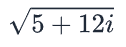
Let $\sqrt{5+12i}=a+bi$. Squaring gives: $$a^2-b^2+2abi=5+12i$$ Thus $a^2-b^2=5$ and $2ab=12$. The positive solution is $a=3$, $b=2$, since $(3+2i)^2=9-4+12i=5+12i$. Therefore, the value is $3+2i$.
If $a \times b + c$ is odd, and $a$, $b$, and $c$ are integers, which of the following must be correct if $b$ is even:
$b + c$ is odd
$a + c$ is even
$a + c$ is odd
$a \times b \times c$ is positive
Since $b$ is even, $ab$ is even for any integer $a$. The expression $ab + c$ is odd, so $c$ must be odd. Then even $b$ plus odd $c$ gives an odd sum: $\boxed{b + c\text{ is odd}}$
If $a < 0$ and $b$ and $c$ are not equal to zero, what is the sign of $b^4 \times a^3 \times c^2$?
negative
positive
can be positive or negative
it depends
Even powers are positive for nonzero bases, so $b^4 > 0$ and $c^2 > 0$. Since $a < 0$, the odd power $a^3$ is negative. Thus: $(+)(-)(+) = -$ $\boxed{\text{negative}}$
If $p \times q$ is divisible by $r$, which of the following cannot be correct?
$p$ is a prime number
$q$ is divisible by $r$
$pq + r$ is odd and $r$ is even
$p$ is not divisible by $r$
If $pq$ is divisible by an even number $r$, then $pq$ must be even. Since $r$ is also even, $pq + r$ would be even plus even, which is even. Therefore it cannot be odd. $\boxed{pq + r\text{ is odd and }r\text{ is even}}$
Given the following equations: $a \times b = 1/8$, $a \times c = 3$, $b \times c = 6$. Find the product of $a$, $b$, and $c$.
3/2
2/3
9/4
3/4
Multiply the three given equations: $(ab)(ac)(bc) = \frac{1}{8}(3)(6)$ $a^2b^2c^2 = \frac{18}{8} = \frac{9}{4}$ Take the square root: $abc = \sqrt{\frac{9}{4}}$ $\boxed{abc = \frac{3}{2}}$
If $xyz = 8$ and $y^2 z = 12$, what is the value of $x/y$?
2/3
1/3
3/2
3/4
Divide the first equation by the second equation: $\frac{xyz}{y^2z} = \frac{8}{12}$ Cancel common factors: $\frac{x}{y} = \frac{2}{3}$ $\boxed{\frac{x}{y} = \frac{2}{3}}$
If the absolute value of $x$ is greater than the absolute value of $y$, which of the following is always true?
$xy > 0$
$y^2 > x^2$
$x - y > 0$
$x^2 > y^2$
If $|x| > |y|$, then squaring both nonnegative absolute values preserves the inequality: $|x|^2 > |y|^2$ Since $|x|^2 = x^2$ and $|y|^2 = y^2$: $\boxed{x^2 > y^2}$
Given that $a < b < 0 < c < d$, what is the sign of $abc/d$?
it depends
can be positive or negative
negative
positive
From $a < b < 0 < c < d$, both $a$ and $b$ are negative, while $c$ and $d$ are positive. The sign of $\frac{abc}{d}$ is: $\frac{(-)(-)(+)}{(+)} = \frac{(+)}{(+)} = +$ $\boxed{\text{positive}}$
Give that $3^{2a} \times 11^b = 27^{4x} \times 33^{2x}$, express $a$ in terms of $x$.
$2x$
$5x$
$7x$
$3x$
Rewrite the right side using prime factors: $27^{4x} \times 33^{2x} = (3^3)^{4x}(3\times 11)^{2x}$ $= 3^{12x} \times 3^{2x} \times 11^{2x}$ $= 3^{14x}11^{2x}$ Compare with $3^{2a}11^b$: $2a = 14x$ $\boxed{a = 7x}$
What is the value of $E$ in the following equation? $$(2x^4 + 3x^3 + 7x^2 + 10x + 10) / ((x - 1)(x^2 + 3)^2) = A / (x - 1) + (Bx + C) / (x^2 + 3) + (Dx + E) / (x^2 + 3)^2$$.
2
3
0
-1
Multiply by $(x-1)(x^2+3)^2$: $2x^4+3x^3+7x^2+10x+10=A(x^2+3)^2+(Bx+C)(x-1)(x^2+3)+(Dx+E)(x-1)$ At $x=1$: $32=16A \Rightarrow A=2$ Expand and compare coefficients. With $A=2$: $2x^4+3x^3+7x^2+10x+10=2(x^4+6x^2+9)+(Bx+C)(x^3-x^2+3x-3)+Dx^2+(E-D)x-E$ Coefficient comparison gives $B=3$, $C=3$, $D=-5$, and $E=-1$. $\boxed{E=-1}$
If $x : y$ as $13 : 21.2$ and $y : z$ as $24.5 : 35$, find $x$ when $z = 42.7$.
15.478
18.329
16.852
19.652
$\frac{x}{y}=\frac{13}{21.2}$ and $\frac{y}{z}=\frac{24.5}{35}$ For $z=42.7$: $y=42.7\left(\frac{24.5}{35}\right)=29.89$ $x=29.89\left(\frac{13}{21.2}\right)=18.329$ $\boxed{x=18.329}$
A player averages 140 points in his last 8 games. His total average including his last 2 games is increased by 10%. What is his average in the last two games?
110
220
105
210
First 8 games total: $8(140)=1120$. The new average after 10 games is increased by 10%: $140(1.10)=154$. Required 10-game total: $10(154)=1540$. Last two games total: $1540-1120=420$, so average $=\frac{420}{2}=210$. $\boxed{210}$
A salesman gets P10,000 commission on a sale of a certain item. This amount raised his average commission by P1,500. If his new average commission is P4,000, what is his total commission?
P30000
P15000
P25000
P20000
New average is P4000 and it increased by P1500, so old average was P2500. Let $n$ be the total number of sales after the P10000 commission. $4000n=2500(n-1)+10000$ $4000n=2500n+7500 \Rightarrow 1500n=7500 \Rightarrow n=5$ Total commission $=4000(5)=\text{P}20000$. $\boxed{\text{P}20000}$
A salesman gets P10,000 commission on a sale of a certain item. This amount raised his average commission by P1,500. If his new average commission is P4,000, how many sales did he make?
5
4
6
7
New average is P4000 and old average was $4000-1500=\text{P}2500$. Let $n$ be the total number of sales after including the P10000 sale. $4000n=2500(n-1)+10000$ $4000n=2500n+7500 \Rightarrow n=5$ $\boxed{5}$
The molar heat capacity of a solid compound is given by the equation $c = a + bT$, where $a$ and $b$ are constants. When $c = 52$, $T = 100$ and when $c = 172$, $T = 400$. Determine the value of $a$.
0.8
10
0.4
12
Use $c=a+bT$. From the two data points: $b=\frac{172-52}{400-100}=\frac{120}{300}=0.4$. Substitute $c=52$, $T=100$: $52=a+0.4(100)=a+40$. $a=12$ $\boxed{12}$
When Kirchhoff's laws are applied to a certain electrical circuit the currents $I_1$ and $I_2$ are connected by the following equations: $27 = 1.5I_1 + 8(I_1 - I_2)$; $-26 = 2I_2 - 8(I_1 - I_2)$. Find the current $I_2$.
2
-1
-2
1
Simplify the two circuit equations: $27=1.5I_1+8(I_1-I_2) \Rightarrow 9.5I_1-8I_2=27$ $-26=2I_2-8(I_1-I_2) \Rightarrow -8I_1+10I_2=-26$ Solving the simultaneous equations gives $I_2=-1$. $\boxed{I_2=-1}$
A car moves according to the equation $S = ut + \frac{1}{2} at^2$, where $S$ is the distance in meters, $u$ is the initial velocity in m/s, $a$ is the acceleration in m/s$^2$, and $t$ is the time in seconds. Given that when $t = 3\text{ sec}$, $S = 96.25\text{ m}$ and when $t = 10\text{ sec}$, $S = 291.667\text{ m}$, determine the following:
The value of $u$ in kph.
120
110
100
130
The value of "$a$" in kph/sec.
6
-6
3
-3
The value of $S$ when $t = 15 \text{ s}$.
426.67 m
385 m
406.25 m
352.33 m
Part 1.
Substitute the two given observations in $S=ut+\frac{1}{2}at^2$. $96.25=3u+4.5a$ $291.667=10u+50a$ Solving gives $u=33.333\text{ m/s}$. Convert to kph: $33.333(3.6)=120\text{ kph}$. $\boxed{120\text{ kph}}$
Part 2.
From the simultaneous equations: $96.25=3u+4.5a$ and $291.667=10u+50a$ $u=33.333\text{ m/s}$ and $a=-0.8333\text{ m/s}^2$. Convert acceleration to kph/sec: $-0.8333(3.6)=-3$. $\boxed{-3}$
Part 3.
Use $u=33.333\text{ m/s}$ and $a=-0.8333\text{ m/s}^2$. $S=ut+\frac{1}{2}at^2$ At $t=15$: $S=33.333(15)+\frac{1}{2}(-0.8333)(15^2)=406.25\text{ m}$ $\boxed{406.25\text{ m}}$
A body moves according to the equation $S = u t + \frac{1}{2} a t^2$ where $S = 42 \text{ m}$ when $t = 2\text{s}$ and $s = 144 \text{ m}$ when $t = 4\text{s}$.
Find "$a$".
12 m/s$^2$
15 m/s$^2$
18 m/s$^2$
24 m/s$^2$
Find the velocity of the body when $t = 1.2 \text{ s}$.
24 m/s
20 m/s
18 m/s
28 m/s
Find $s$ when $t = 3 \text{ s}$.
85.5 m
92.3 m
78.5 m
63.4 m
Part 1.
Use $S=ut+\frac{1}{2}at^2$. At $t=2$: $42=2u+2a \Rightarrow u+a=21$ At $t=4$: $144=4u+8a \Rightarrow u+2a=36$ Subtract: $a=15\text{ m/s}^2$ $\boxed{15\text{ m/s}^2}$
Part 2.
From $u+a=21$ and $a=15$, $u=6\text{ m/s}$. Velocity is $v=u+at$. At $t=1.2$: $v=6+15(1.2)=24\text{ m/s}$ $\boxed{24\text{ m/s}}$
Part 3.
Use $u=6\text{ m/s}$ and $a=15\text{ m/s}^2$. $S=ut+\frac{1}{2}at^2$ At $t=3$: $S=6(3)+\frac{1}{2}(15)(3^2)=85.5\text{ m}$ $\boxed{85.5\text{ m}}$
One student can solve a math problem in 6 minutes. Another student can solve a problem in 5 minutes. How long can they solve 110 problems?
300 minutes
330 minutes
270 minutes
290 minutes
Their combined solving rate is $\frac{1}{6}+\frac{1}{5}=\frac{11}{30}$ problem/min. Time for 110 problems: $\frac{110}{11/30}=300$ minutes. $\boxed{300\text{ minutes}}$
In a certain fastfood, Karla ordered 4 fried chickens and 3 iced tea and paid P615.00. Kim ordered 3 fried chickens and 5 iced tea and paid P585.00. How much is the fried chicken?
P 150.00
P 60.00
P120.00
P 45.00
Let $f$ be the price of fried chicken and $i$ be the price of iced tea. $4f+3i=615$ $3f+5i=585$ Eliminate $i$: multiply the first by 5 and the second by 3: $20f+15i=3075$ and $9f+15i=1755$ $11f=1320 \Rightarrow f=120$. $\boxed{\text{P}120.00}$
A new civil engineer invested at SMPH (SM Prime Holdings) which has an annual gain of 10% and at ALI (Ayala Land) which has an annual gain of 20%. If his total annual gain in the two investments is 14%, which of the following statements is true?
the amount invested at SMPH is equal to that in ALI
the amount invested at SMPH is greater than that in ALI
the amount invested at SMPH is less than that in ALI
None of these statements is true
Let $S$ be the SMPH investment and $A$ be the ALI investment. The weighted gain is 14%: $0.10S+0.20A=0.14(S+A)$ $0.10S+0.20A=0.14S+0.14A$ $0.06A=0.04S \Rightarrow S=1.5A$ Thus, the amount invested at SMPH is greater than that in ALI. $\boxed{\text{SMPH is greater than ALI}}$
The following data of road accident versus driver's age form a quadratic equation (Age of Driver: 20, 40, 60; Accident per year: 250, 150, 200).
Find the coefficient $a$ of $x^2$.
0.1875
0.1575
0.2125
0.1755
Find the coefficient $b$ of $x$.
-14.75
-15.25
-17.75
-16.25
Find the number of accidents per year for an age of 30.
154.75
254.25
189.65
181.25
Part 1.
Let the quadratic be $y=ax^2+bx+c$. Using the data points: $250=400a+20b+c$ $150=1600a+40b+c$ $200=3600a+60b+c$ Solving gives $a=0.1875$, $b=-16.25$, and $c=500$. $\boxed{a=0.1875}$
Part 2.
Using $y=ax^2+bx+c$ and the points $(20,250)$, $(40,150)$, and $(60,200)$: $250=400a+20b+c$ $150=1600a+40b+c$ $200=3600a+60b+c$ Solving the system gives $a=0.1875$, $b=-16.25$, $c=500$. $\boxed{b=-16.25}$
Part 3.
The fitted quadratic is $y=0.1875x^2-16.25x+500$. At age 30: $y=0.1875(30^2)-16.25(30)+500=181.25$ $\boxed{181.25}$
Obama and Romney are 20 km apart and walk towards each other. Obama walks at constant rate and is 2 kph faster than Romney. Romney's rate is 3 kph and started walking 15 minutes ahead of Obama. Find the distance walked by Obama when they meet.
7.031 km
14.587 km
12.031 km
6.524 km
Romney walks at 3 kph and starts 15 minutes early, so he covers $3(0.25)=0.75$ km before Obama starts. Remaining separation is $20-0.75=19.25$ km. Obama's speed is $3+2=5$ kph, so closing speed is $5+3=8$ kph. Time after Obama starts $=\frac{19.25}{8}=2.40625$ hr. Obama's distance $=5(2.40625)=12.031$ km. $\boxed{12.031\text{ km}}$
Bitoy and Boloy are 500 m apart. Bitoy walks 1 kph faster than Boloy and it tries to catch Boloy. If Boloy walks 3 kph, find the distance travelled by Bitoy when it catches Boloy.
2 km
1.5 km
2.5 km
3 km
Boloy's speed is 3 kph, so Bitoy's speed is 4 kph. The initial gap is 500 m $=0.5$ km. Relative speed $=4-3=1$ kph. Catch-up time $=\frac{0.5}{1}=0.5$ hr. Distance travelled by Bitoy $=4(0.5)=2$ km. $\boxed{2\text{ km}}$
On a straight road, a rabbit is 54 m behind the tortoise. They run at uniform speeds. The rabbit is four times as fast as the tortoise and it wants to overtake the tortoise. Determine the distance the rabbit must run before overtaking the tortoise?
84 m
56 m
64 m
72 m
Let the tortoise speed be $v$ and the rabbit speed be $4v$. Relative speed $=4v-v=3v$. Time to close the 54 m gap $=\frac{54}{3v}=\frac{18}{v}$. Rabbit distance $=4v\left(\frac{18}{v}\right)=72$ m. $\boxed{72\text{ m}}$
Heide and Hembler are running a 1000 m race. Heidi runs at 3 m/s and Hembler at 5 m/s. Hembler gave Heide a 15-second head start. How many seconds can Hembler overtake Heide?
22.5 s
15 s
26.5 s
18 s
Heide's 15-second head start gives her a lead of $3(15)=45$ m. Relative speed $=5-3=2$ m/s. Catch-up time for Hembler $=\frac{45}{2}=22.5$ s. $\boxed{22.5\text{ s}}$
Mary has a collection of 120 stamps and plans to have $x$ stamps per day for $y$ weeks. How many stamps will she have?
$120 + 7xy$
$120 + xy$
$120 + xy/7$
$120/7 + 7xy$
She starts with 120 stamps. For $y$ weeks, the number of days is $7y$. At $x$ stamps per day, added stamps $=x(7y)=7xy$. Total stamps $=120+7xy$. $\boxed{120+7xy}$
A pendulum is brought to rest by air resistance, each swing being 11/12 as much as the preceding one. If the lower end of the pendulum describes an arc 80 cm long in the first swing, what will be the total length of the path which the pendulum describes before it comes to rest?
960 cm
820 cm
1040 cm
720 cm
The swing lengths form an infinite geometric series with first term $a=80$ cm and ratio $r=\frac{11}{12}$. $S=\frac{a}{1-r}=\frac{80}{1-11/12}=960$ cm. $\boxed{960\text{ cm}}$
If the domain of $y = 3x + 2$ is $-3 \leq x \leq 5$, which of the following is not in the range of $y$?
-5
-1
4
18
For $y=3x+2$ over $-3\leq x\leq5$, evaluate the endpoints because the function is increasing. At $x=-3$: $y=3(-3)+2=-7$. At $x=5$: $y=3(5)+2=17$. The range is $-7\leq y\leq17$, so 18 is not in the range. $\boxed{18}$
A group of musicians is composed of three drummers, four pianists, and five guitarists. How many ways can a trio are formed with 1 pianist, 1 drummer, and 1 guitarist?
60 ways
90 ways
40 ways
120 ways
Choose 1 drummer from 3, 1 pianist from 4, and 1 guitarist from 5. By the multiplication principle: $3\times4\times5=60$ ways. $\boxed{60\text{ ways}}$
To make a ham and cheese sandwich you are given a choice of 3 kinds of ham, 5 kinds of cheese, and 2 kinds of bread. How many different sandwiches can you make?
30
10
15
45
Choose 1 ham, 1 cheese, and 1 bread. By the multiplication principle: $3\times5\times2=30$ sandwiches. $\boxed{30}$
A certain lotto game consists of 30 different balls numbered 1 to 30. If five balls are drawn at random without replacement, how many possible winning combinations can be made?
345,762
142,506
189,982
17,100,720
Winning combinations do not depend on order, so use combinations. $\binom{30}{5}=\frac{30!}{5!25!}=142506$ $\boxed{142,506}$
Four boys and four girls form a circle with the boys and girls alternating. In how many ways can they form a circle?
72
576
144
1152
Arrange the 4 boys around the circle first: $(4-1)!=6$ ways. The 4 girls must occupy the 4 gaps between boys: $4!=24$ ways. Total $=6(24)=144$. $\boxed{144}$
About how many times out of $12,000$ attempts would a person roll all the same numbers using five dice?
50
4
2
9
For five dice, total outcomes are $6^5$. All dice the same can happen in 6 ways: all 1s, all 2s, ..., all 6s. Probability $=\frac{6}{6^5}=\frac{1}{1296}$. Expected count in 12000 attempts: $12000\left(\frac{1}{1296}\right)=9.26$, about 9 times. $\boxed{9}$
Two bags each contain 2 black balls, 1 white ball, and 1 red ball. What is the probability of selecting the white ball from the first bag or the red ball from the second bag?
$1/2$
$7/16$
$1/4$
$1/16$
Let $A$ be selecting white from the first bag and $B$ be selecting red from the second bag. $P(A)=\frac{1}{4}$ and $P(B)=\frac{1}{4}$. The selections are independent, so $P(A\cap B)=\frac{1}{4}\cdot\frac{1}{4}=\frac{1}{16}$. $P(A\cup B)=P(A)+P(B)-P(A\cap B)=\frac{1}{4}+\frac{1}{4}-\frac{1}{16}=\frac{7}{16}$. $\boxed{\frac{7}{16}}$
An examination has two types of questions as follows: Type A: 10 points at 3 minutes each, Type B: 15 points at 6 minutes each. There are 16 questions in the exam for a total time of 60 minutes.
How many Type A questions are there in the examination?
4
12
10
6
How many Type B questions are there in the examination?
12
10
4
6
What is the maximum score of this exam?
160 points
180 points
190 points
170 points
Part 1.
Let $A$ be the number of Type A questions and $B$ be the number of Type B questions. $A+B=16$ $3A+6B=60 \Rightarrow A+2B=20$ Subtract $A+B=16$ from $A+2B=20$: $B=4$. Thus $A=12$. $\boxed{12}$
Part 2.
Use the equations $A+B=16$ and $3A+6B=60$. Divide the time equation by 3: $A+2B=20$. Subtract $A+B=16$: $B=4$. $\boxed{4}$
Part 3.
From the time equations, there are 12 Type A questions and 4 Type B questions. Maximum score $=12(10)+4(15)=120+60=180$ points. $\boxed{180\text{ points}}$
The following books are available on the shelf. Three Fluid Mechanics book, two Structural book, four Mathematics, and two Geotechnical book. John came and took one Fluid Mechanics and one Mathematics. Peter came and select a book at random. What is the probability that he selects a Mathematics book?
$1/3$
$2/9$
$4/9$
$1/9$
Initially there are $3+2+4+2=11$ books. John removes 1 Fluid Mechanics and 1 Mathematics book, leaving 9 books total. Mathematics books left: $4-1=3$. Probability Peter selects Mathematics $=\frac{3}{9}=\frac{1}{3}$. $\boxed{\frac{1}{3}}$
In the latest survey by SWS on $400$ voters, $130$ said they will vote for candidate A, $120$ will vote for candidate B, and $150$ will vote for candidate C. What is the probability that a registered voter will vote for candidate B?
0.375
0.285
0.325
0.3
Probability is favorable voters divided by total voters. $P(B)=\frac{120}{400}=0.3$ $\boxed{0.3}$
In a family of five children, what is the chance that there are three boys and two girls?
$7/16$
$3/8$
$5/16$
$3/16$
A basketball player averages 65% in a free-throw line. What is the probability of missing one for two free throws?
$0.523$
$0.455$
$0.574$
$0.486$
A store has three kinds of toys given in every purchase. What is the probability of getting all three toys in five purchases?
$0.617$
$0.542$
$0.685$
$0.752$
Part 1.
For 5 children, total gender outcomes are $2^5=32$. Choose which 3 of the 5 are boys: $\binom{5}{3}=10$. Probability $=\frac{10}{32}=\frac{5}{16}$. $\boxed{\frac{5}{16}}$
Part 2.
The probability of making a free throw is 0.65, so the probability of missing is 0.35. Missing exactly one of two throws can happen as miss-make or make-miss: $2(0.35)(0.65)=0.455$ $\boxed{0.455}$
Part 3.
Assume each purchase gives one of the 3 toy types with equal probability. Total outcomes for 5 purchases: $3^5=243$. Use inclusion-exclusion for getting all 3 toy types: $3^5-\binom{3}{1}2^5+\binom{3}{2}1^5=243-96+3=150$. Probability $=\frac{150}{243}=0.617$. $\boxed{0.617}$
Find the probability that a couple having three children will have at least one girl?
$7/8$
$5/8$
$1/2$
$3/4$
Use the complement. The only way to have no girls among 3 children is all boys. $P(\text{all boys})=\left(\frac{1}{2}\right)^3=\frac{1}{8}$ $P(\text{at least one girl})=1-\frac{1}{8}=\frac{7}{8}$ $\boxed{\frac{7}{8}}$
A box contains 24 red balls, 27 green balls, and 30 blue balls. If three balls are drawn in succession without replacement, what is the probability that:
All three balls are red?
$0.024$
$0.062$
$0.034$
$0.048$
All three balls are green?
$0.062$
$0.034$
$0.048$
$0.024$
All three balls are blue?
$0.062$
$0.048$
$0.024$
$0.034$
Part 1.
Total balls: $24+27+30=81$. Drawing without replacement: $P(\text{3 red})=\frac{24}{81}\cdot\frac{23}{80}\cdot\frac{22}{79}=0.024$ $\boxed{0.024}$
Part 2.
Total balls: 81. Drawing without replacement: $P(\text{3 green})=\frac{27}{81}\cdot\frac{26}{80}\cdot\frac{25}{79}=0.034$ $\boxed{0.034}$
Part 3.
Total balls: 81. Drawing without replacement: $P(\text{3 blue})=\frac{30}{81}\cdot\frac{29}{80}\cdot\frac{28}{79}=0.048$ $\boxed{0.048}$
A manufacturer estimates that $1.5%$ of his output of a small item is defective. Find the probabilities that in a pack of 200 items:
None is defective.
$0.0498$
$0.1494$
$0.224$
$0.3528$
Two are defective.
$0.224$
$0.1494$
$0.3528$
$0.0498$
More than three are defective.
$0.224$
$0.0498$
$0.1494$
$0.3528$
Part 1.
Use the Poisson approximation with $\lambda=np=200(0.015)=3$. For no defective items: $P(X=0)=e^{-3}\frac{3^0}{0!}=0.0498$ $\boxed{0.0498}$
Part 2.
Use the Poisson approximation with $\lambda=3$. $P(X=2)=e^{-3}\frac{3^2}{2!}=0.224$ $\boxed{0.224}$
Part 3.
Using the same Poisson distribution ($\lambda=3$), find the complement of the cumulative probability through $X=3$: $P(X=1)=e^{-3}\frac{3^1}{1!}=0.1494$ $P(X=3)=e^{-3}\frac{3^3}{3!}=0.2240$ $P(X\ge4)=1-\left[P(0)+P(1)+P(2)+P(3)\right]=1-(0.0498+0.1494+0.2240+0.2240)$ $\boxed{0.3528}$
Twenty (20) GERTC students was surveyed about the size of their memory cards. Twelve students said they have 8 MB, five said they have both 8 MB and 16 MB, two said they neither have 8 MB nor 16 MB, and the rest have 16 MB only. How many students have 16 MB memory cards only?
8
6
10
4
The 12 students with 8 MB include the 5 students who have both cards, so 8 MB only is $12-5=7$. Account for all 20 students: $20=(8\text{ only})+(16\text{ only})+(both)+(neither)$ $20=7+x+5+2 \Rightarrow x=6$. $\boxed{6}$
A survey was conducted by SWS to find out which of the three presidentiables they liked best. The results indicated that 500 liked Noynoy, 470 liked Villar, and 430 liked Estrada. But of these, 180 liked both Noynoy and Estrada, 140 liked both Noynoy and Villar, and 210 liked both Estrada and Villar. Only 60 liked all the three presidentiables.
How many liked Noynoy alone?
260
240
180
100
How many liked Villar alone?
180
260
100
180
How many persons responded to the survey?
910
680
960
930
Part 1.
Noynoy alone excludes those who also liked Villar or Estrada, but the all-three group was subtracted twice, so add it back once: $N\text{ alone}=500-140-180+60=240$. $\boxed{240}$
Part 2.
Villar alone excludes those who also liked Noynoy or Estrada, then adds back the all-three group once: $V\text{ alone}=470-140-210+60=180$. $\boxed{180}$
Part 3.
Use inclusion-exclusion: $|N\cup V\cup E|=500+470+430-140-180-210+60$ $=930$. $\boxed{930}$
Solve for $x$ from the following complex equation: $2x + 5y + 3yi + 15 - 3i = 0$.
2
-5
-10
1
Separate real and imaginary parts: $2x+5y+15+(3y-3)i=0$. Imaginary part: $3y-3=0 \Rightarrow y=1$. Real part: $2x+5(1)+15=0 \Rightarrow 2x+20=0 \Rightarrow x=-10$. $\boxed{-10}$
$(1-2i)^{-1}=\frac{1}{1-2i}$. Multiply by the conjugate: $\frac{1}{1-2i}\cdot\frac{1+2i}{1+2i}=\frac{1+2i}{1+4}$ $=\frac{1}{5}+\frac{2}{5}i$. $\boxed{\frac{1}{5}+\frac{2}{5}i}$
Find the value of $x$ in the equation $(x + yi)(1 - 2i) = 7 - 4i$.
1
3
4
2
Expand the left side: $(x+yi)(1-2i)=x-2xi+yi-2yi^2$ $=(x+2y)+(y-2x)i$. Equate to $7-4i$: $x+2y=7$ and $y-2x=-4$. From $y=2x-4$, substitute: $x+2(2x-4)=7 \Rightarrow 5x=15 \Rightarrow x=3$. $\boxed{3}$
The roots of a cubic equation with real coefficients are $2 + 3i$ and $3$. What is the equation?
$x^3 + 7x^2 - 25x - 39 = 0$
$x^3 - 7x^2 + 25x - 39 = 0$
$x^3 + 7x^2 + 25x + 39 = 0$
$x^3 + 7x^2 - 25x + 39 = 0$
For real coefficients, the conjugate root $2-3i$ must also be a root. The roots are $2+3i$, $2-3i$, and 3. $(x-(2+3i))(x-(2-3i))=((x-2)^2+9)=x^2-4x+13$. Multiply by $(x-3)$: $(x^2-4x+13)(x-3)=x^3-7x^2+25x-39$. $\boxed{x^3-7x^2+25x-39=0}$
A line segment is drawn from point $P(1, 3)$ to point $Q(4, -3)$.
Find the coordinates of the first trisection point from $P$ to $Q$.
$(2, 1)$
$(3, 2)$
$(3, -1)$
$(2.5, 0)$
Find the coordinates of the second trisection point from $P$ to $Q$.
$(3, -1)$
$(2.5, 0)$
$(3, 2)$
$(2, 1)$
Find the coordinates of the midpoint from $P$ to $Q$.
$(2, 1)$
$(3, -1)$
$(2.5, 0)$
$(3, 2)$
Part 1.
From $P(1,3)$ to $Q(4,-3)$, the displacement is $(4-1,-3-3)=(3,-6)$. The first trisection point is one-third of the way from $P$: $(1,3)+\frac{1}{3}(3,-6)=(2,1)$. $\boxed{(2,1)}$
Part 2.
The second trisection point is two-thirds of the way from $P$ to $Q$. $(1,3)+\frac{2}{3}(3,-6)=(1,3)+(2,-4)=(3,-1)$. $\boxed{(3,-1)}$
Part 3.
Use the midpoint formula: $M=\left(\frac{1+4}{2},\frac{3+(-3)}{2}\right)=(2.5,0)$. $\boxed{(2.5,0)}$
Two vectors $A$ and $B$ have the following values: $A = 6.71i + 8.35j$, $B = -2.57i - 5.55j$.
Determine the magnitude of the resultant of $A$ and $B$.
$6.45$
$4.99$
$5.34$
$4.21$
If the tail of the resultant vector is at $(0, 0)$, where is the head of the resultant vector?
$(2.8, 4.13)$
$(4.13, 2.8)$
$(3.45, 6.43)$
$(6.43, 3.45)$
What is the angle of the resultant vector from the x-axis?
$34.14^\circ$
$32.12^\circ$
$28.76^\circ$
$38.45^\circ$
Part 1.
Add the vectors componentwise: $R=A+B=(6.71-2.57)i+(8.35-5.55)j\approx4.13i+2.80j$. Magnitude: $|R|=\sqrt{4.13^2+2.80^2}=4.99$. $\boxed{4.99}$
Part 2.
The resultant vector is approximately $R=4.13i+2.80j$. If its tail is at $(0,0)$, its head is at the coordinate matching its components: $\boxed{(4.13,2.8)}$
Part 3.
Use the resultant components $R_x\approx4.13$ and $R_y=2.80$. $\theta=\tan^{-1}\left(\frac{R_y}{R_x}\right)=\tan^{-1}\left(\frac{2.80}{4.13}\right)=34.14^\circ$. $\boxed{34.14^\circ}$
Find the projection of $A$ on $B$ if $A = 12i + 6k$ and $B = -4j + 3k$.
$4.2$
$3.9$
$3.6$
$5.4$
The scalar projection of $A$ on $B$ is $\frac{A\bullet B}{|B|}$. $A=12i+0j+6k$ and $B=0i-4j+3k$. $A\bullet B=12(0)+0(-4)+6(3)=18$. $|B|=\sqrt{0^2+(-4)^2+3^2}=5$. Projection $=\frac{18}{5}=3.6$. $\boxed{3.6}$
A point $\frac{3}{4}$ of the way from $P$ to $Q$ is: $P+\frac{3}{4}(Q-P)=(2,4,-1)+\frac{3}{4}(1,-4,6)$ $=\left(\frac{11}{4},1,\frac{7}{2}\right)$. $\boxed{\frac{11}{4}i+j+\frac{7}{2}k}$
If y = x^3, find the value of y if ^4√(8 × ^3√(2√8x)) = 2.
16
2
4
8
Solution pending in psadquestions/t1368.json.
Question Bank: w1
MSTE - Algebra / Algebraic Simplification / MSTE May 2019
Simplify if possible: $7x^3 + 2x^3$.
$14x^6$
$9x^3$
$14x^3$
$9x^6$
Combine like terms (same base and exponent): $7x^3 + 2x^3 = (7+2)x^3 = \boxed{9x^3}$
Question Bank: w11
MSTE - Algebra / Functions / MSTE May 2019
The cost of electricity in a certain city is given by the formula $C = 0.07n + 6.5$, where $C$ is the cost and $n$ is the number of kilowatt-hours used. Solve for $n$ and find the number of kWh used for costs of P49.97, P76.50 and P125.
621; 1200; 1548
752; 1000; 2147
854; 1500; 1963
621; 1000; 1963
$n = \frac{C - 6.5}{0.07}$ For $C = 49.97$: $n = 621$ For $C = 76.50$: $n = 1000$ For $C = 125$: $n = 1{,}692.86$ The only choice matching the first two values is $\boxed{621;\ 1000;\ 1963}$ (the third figure in the key, 1963, appears to be a source typo for $\approx 1693$).
Question Bank: w12
MSTE - Algebra / Functions / MSTE May 2019
A manufacturer of custom windows produces $y$ windows per week using $x$ hours of labor per week, where $y = 1.75\sqrt{x}$. How many hours of labor are required to keep production at 28 windows per week?
An even function satisfies $f(-x) = f(x)$ (symmetry about the $y$-axis). For cosine: $f(-x) = \cos(-x) = \cos x = f(x)$, so it is even. $\sin x$ is odd $(\sin(-x) = -\sin x)$; $f(x)=f(x)$ is the identity (neither even nor odd); $f(x)=-f(x)$ describes an odd function. $\boxed{f(x) = \cos x}$
Question Bank: w63
MSTE - Algebra / Simple Substitution / MSTE November 2019
The relationship between concrete strengths $f'_c(14)$ and $f'_c(28)$ is given by $f'_c(14) = \dfrac{t}{1.203 + 0.7t - 0.000195t^2}\, f'_c(28)$, where $t$ is the age of concrete in weeks. The concrete strength at the end of 14 days is 24.1 MPa. Determine the concrete strength at the end of 28 days according to the DPWH design guidelines.
34.2 MPa
33.5 MPa
27.5 MPa
31.4 MPa
At $t = 14$ days $= 2$ weeks, substitute into the relation: $24.1 = \dfrac{2}{1.203 + 0.7(2) - 0.000195(2)^2}\, f'_c(28)$ $24.1 = \dfrac{2}{2.6022}\, f'_c(28) = 0.7686\, f'_c(28)$ $f'_c(28) = \dfrac{24.1}{0.7686} = 31.36$ MPa $\boxed{f'_c(28) \approx 31.4\text{ MPa}}$
Question Bank: w177
MSTE - Algebra / Functions / MSTE May 2022
The number of Starbucks stores is given by the equation $f(x)=115x^2+117x+3963$, where $x$ is the number of years after year 2000. How many stores were there in 2004?
5,349
4,657
7,423
6,721
For 2004, $x=2004-2000=4$. Therefore, $$f(4)=115(4)^2+117(4)+3963=6{,}721\text{ stores}.$$
Question Bank: w234
MSTE - Algebra / Imaginary Numbers / MSTE April 2025
Evaluate $\sqrt{5 + 12i}$.
$5 + 4i$
$5 - 4i$
$3 - 2i$
$3 + 2i$
Convert to polar form, then apply De Moivre's Theorem. $5 + 12i = 13\angle 67.38^\circ$
De Moivre's Theorem: $(r\angle\theta)^{n} = r^{n}\angle n\theta$
$\sqrt{5+12i} = (13\angle 67.38^\circ)^{1/2} = 13^{1/2}\angle\left(\tfrac{1}{2}\cdot 67.38^\circ\right)$ $= 3.606\angle 33.69^\circ$ Converting back to rectangular form: $\boxed{3 + 2i}$
Question Bank: w247
MSTE - Algebra / Imaginary Numbers / MSTE April 2025