A polynomial is an algebraic expression involving variables raised to non-negative integer exponents, combined using addition, subtraction, or multiplication.
Each row corresponds to the coefficients of $(a + b)^n$ for $n = 0, 1, 2, \dots$ Note that the number of terms in the expansion (u+v)n is n+1. The exponent of u decreases from n to zero while that of v increases from 0 to n. Additionally, the coefficient of the terms equidistant from the extremes are equal.
Additional Binomial Expansion Formulas
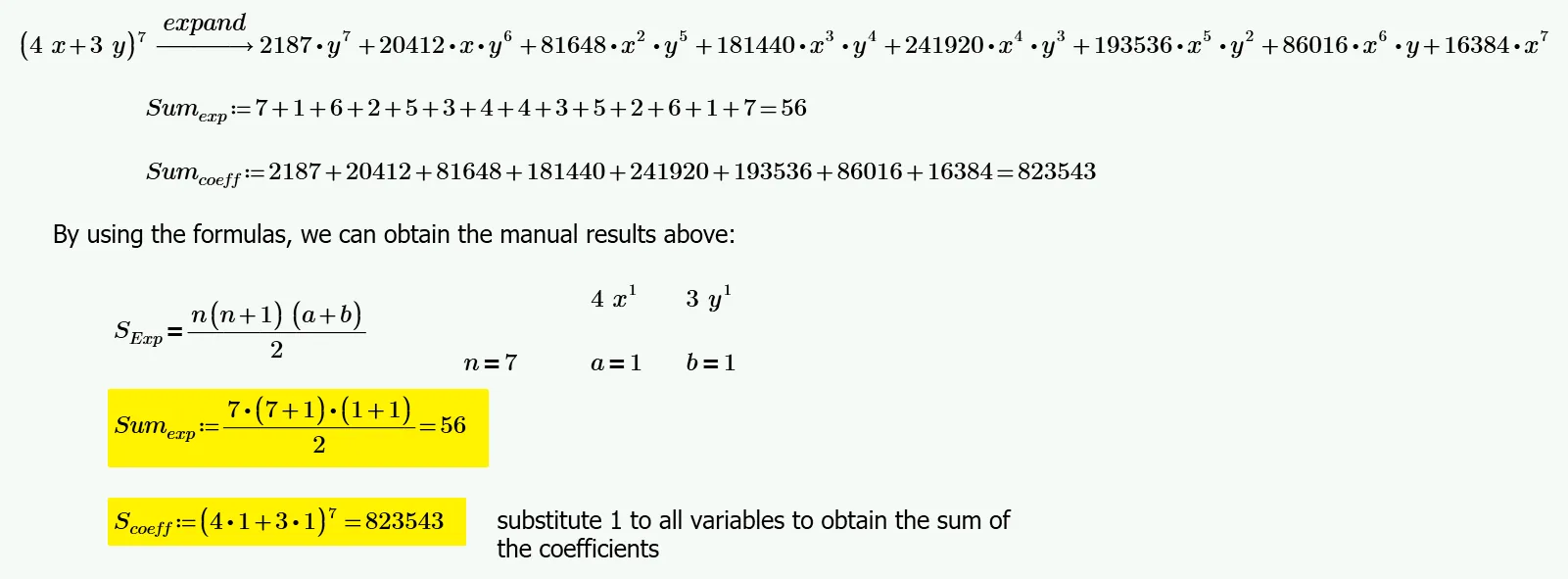
Sum of the coefficients (substitute 1 for all variables):
For $(px+qy)^n$:
$$S=(p\cdot1+q\cdot1)^n=(p+q)^n$$
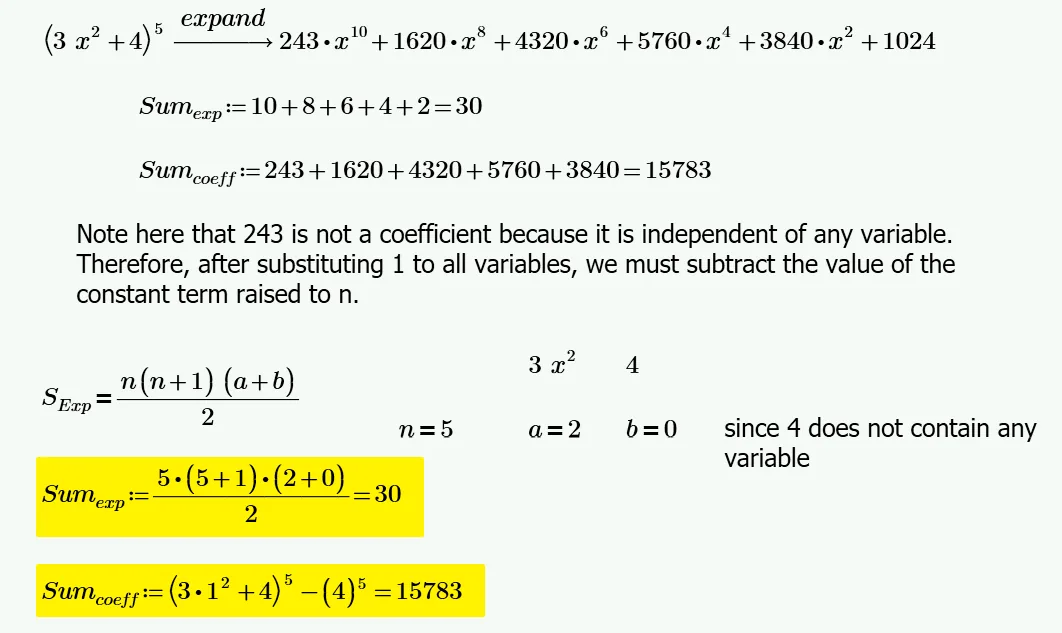
For $(px+k)^n$ where $k$ is constant:
$$S=(p\cdot1+k)^n-k^n=(p+k)^n-k^n$$
Sum of the exponents in $(u^a+v^b)^n$:
$$S=\dfrac{n(n+1)(a+b)}{2}$$
rth term:
$$rth\ term = nCm \,(a^{\,n-m})(b^m) \quad | \quad m=r-1$$
Useful in Engineering Applications:
Stress-strain modeling using polynomial fits
Control systems using polynomial transfer functions
Signal and systems analysis (filter design)
Binomial expansion in series approximations (e.g., Taylor series)
Understanding polynomials is essential not only in pure math but also in approximating curves, solving real-world system equations, and modeling engineering phenomena.
Special Products
Special products are algebraic expressions that follow predictable patterns when expanded. Recognizing these patterns makes factoring and simplification faster and easier.
These help expand cubic binomials without multiplying step by step.
4. Sum and Difference of Cubes
$$
a^3 + b^3 = (a + b)(a^2 - ab + b^2)
$$
$$
a^3 - b^3 = (a - b)(a^2 + ab + b^2)
$$
These identities are used when factoring expressions with cubic terms.
5. Perfect Square Trinomials
Recognize expressions of the form:
$$
a^2 \pm 2ab + b^2 = (a \pm b)^2
$$
Useful in completing the square or solving quadratic equations.
Mastering these special products allows you to reverse the process during factoring and apply them in higher math, engineering equations, and simplifications in calculus.
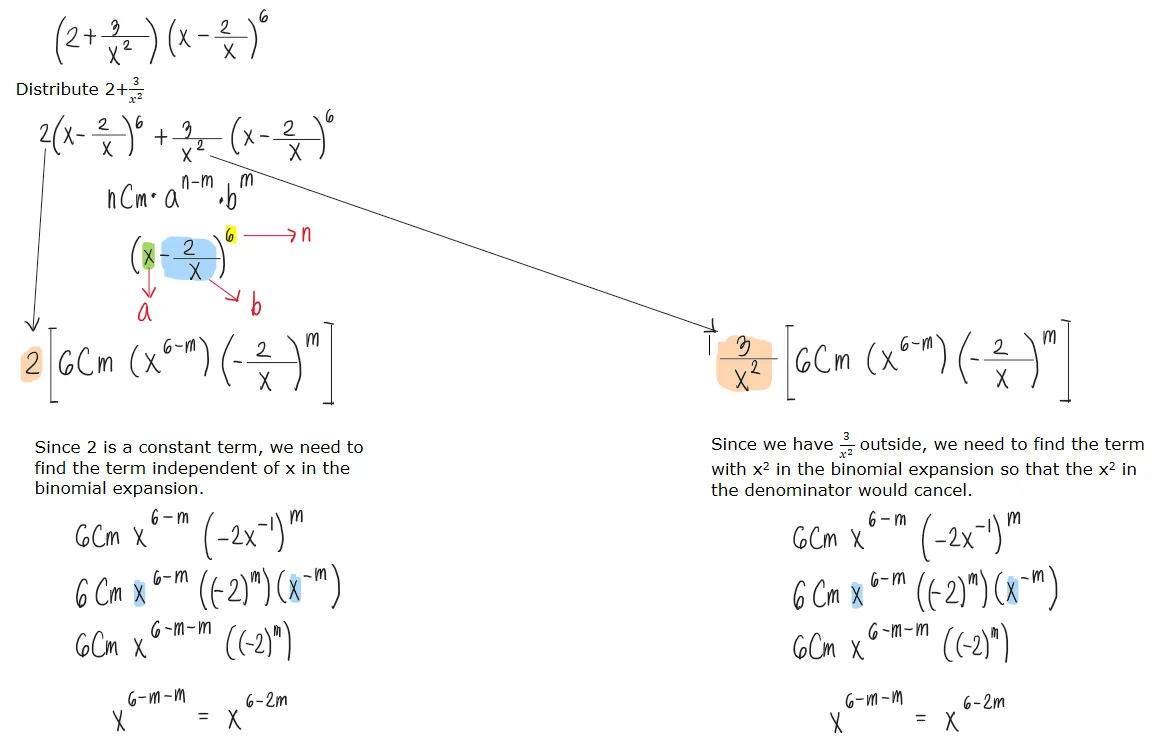
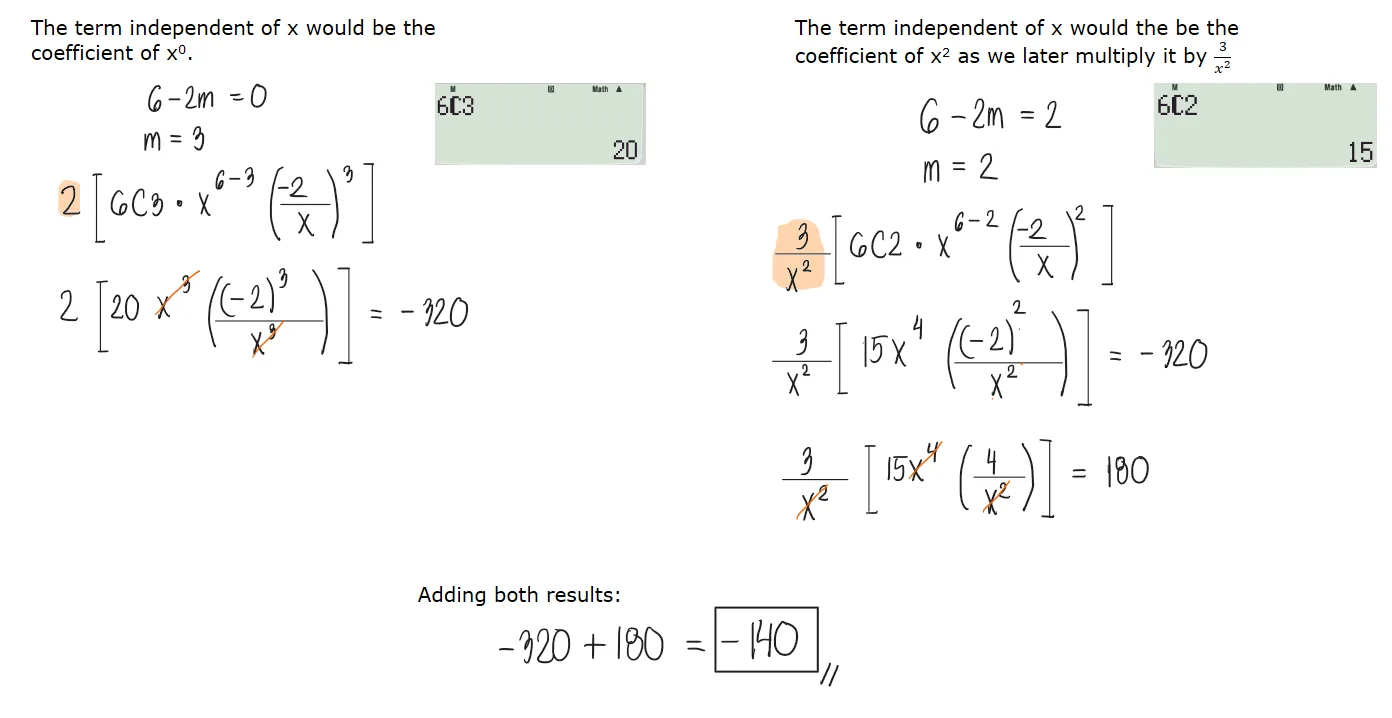
Find the term that is independent of x in the expansion of $\left( 2 + \frac{3}{x^2} \right)\left( x - \frac{2}{x} \right)^6$
By expansion, we observe that the term independent of x is -140. However, this process is tedious if we have to apply the FOIL method. Another way we can tackle this problem is by using the binomial expansion formulas.
Problem:
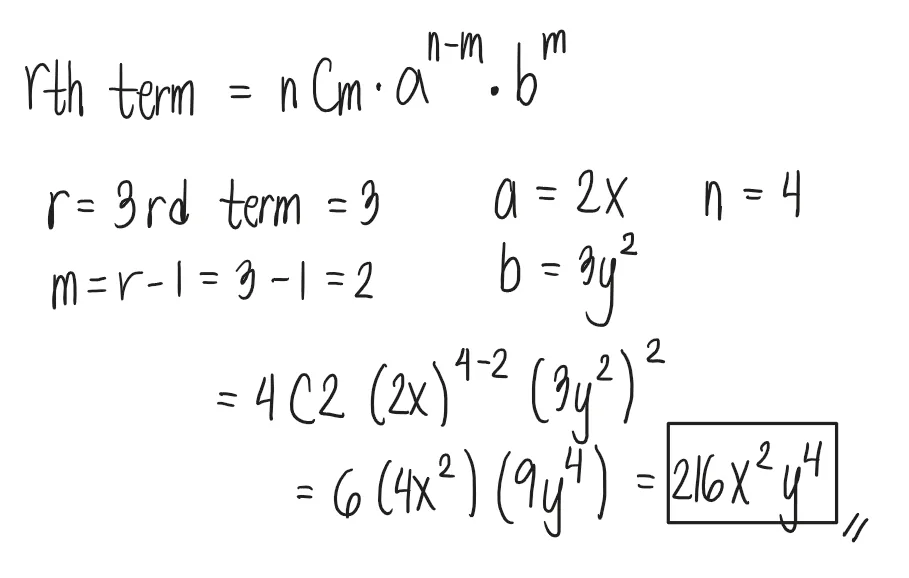
Find the 3rd term in the expansion of (2x+3y2)4
See images:
Problem:
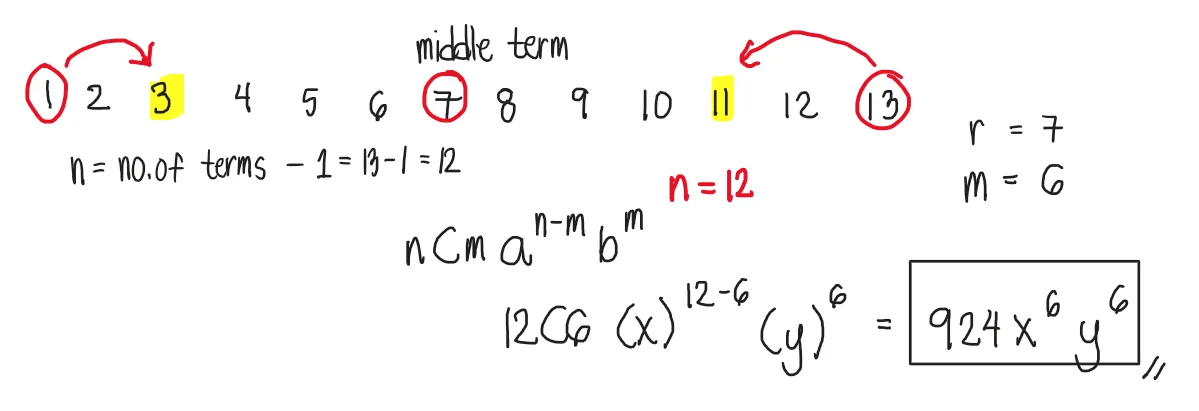
In the binomial expansion of (x+y)n, find the middle term if the coefficients of the 3rd and 11th term are equal to each other.
See images:
Problem:
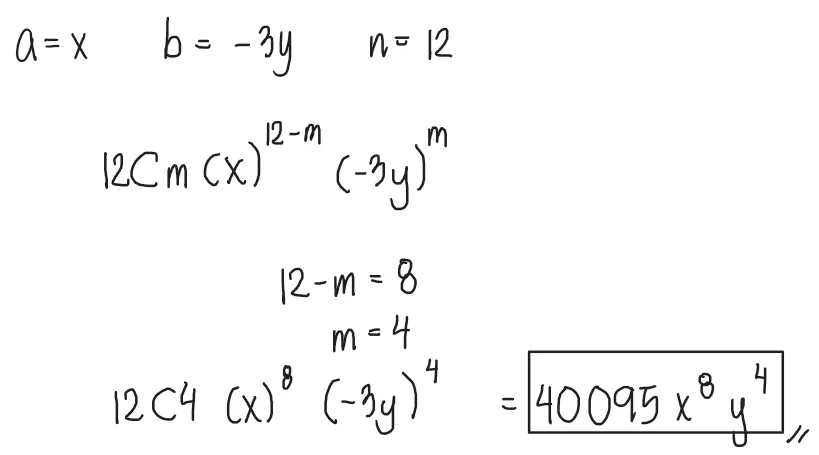
Find the term involving x8 in the expansion of (x-3y)12
See images:
Problem:
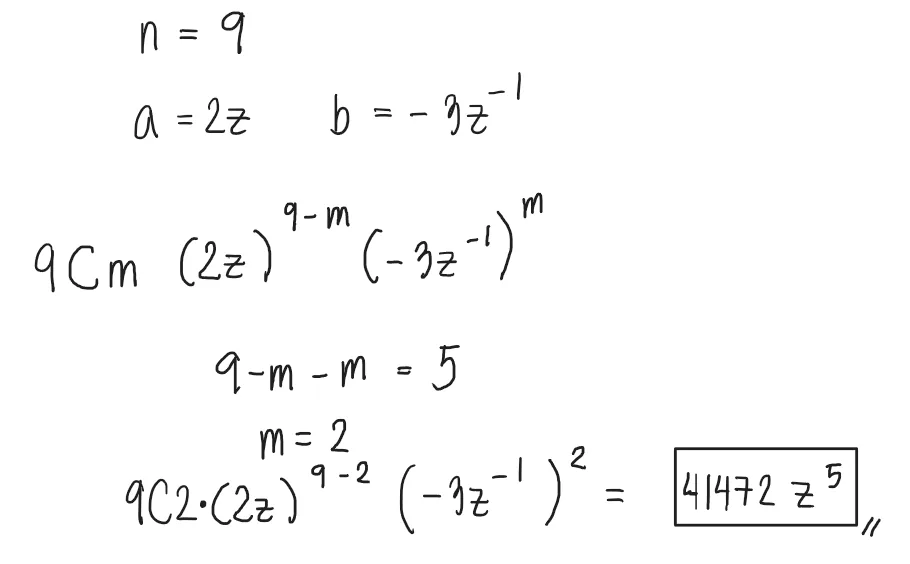
Find the term containing z5 in the expansion of (2z-3z-1)9
See images:
Problem:
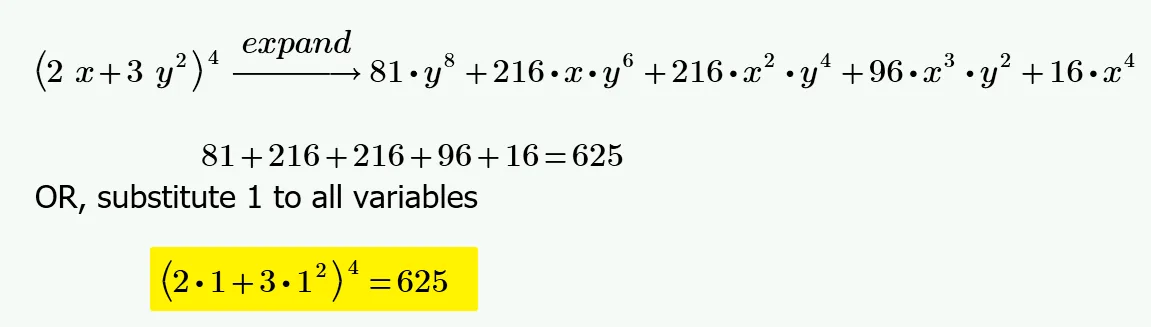
Find the sum of the coefficients of all terms in the expansion of (2x+3y2)4
See images:
Problem:
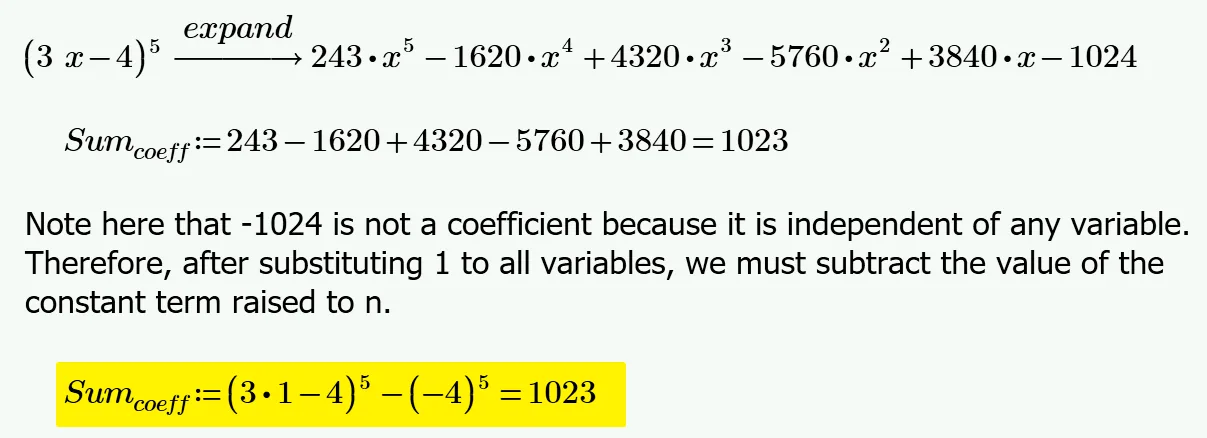
Find the sum of the coefficients of the expression (3x-4)5
See images:
Problem:
Find the sum of the coefficients and exponents of the expansion (4x+3y)7
See images:
Problem:
Find the sum of the coefficients and exponents of the expansion (3x2+4)5
See images:
🧭 Jump to:
Scroll to zoom
Exam Generator Problems
Additional board-style practice items for this topic.
Question Bank: longquiz8
MSTE - Algebra / Binomial Expansion / Engr. Anne
In the expansion of $\left(2x-\dfrac{1}{x}\right)^{10}$, find the coefficient of the 8th term.
−960
960
−3360
120
The $r$th term of $(a+b)^n$ is $\;{}_nC_{r-1}\,a^{\,n-r+1}b^{\,r-1}$. For the 8th term, $n=10$, $r=8$: $T_8=\dfrac{10!}{3!\,7!}(2x)^3\left(-\dfrac{1}{x}\right)^{7}=120(8x^3)\left(-\dfrac{1}{x^{7}}\right)=-\dfrac{960}{x^{4}}$ $\boxed{\text{coefficient}=-960}$ Note: the source sheet reports 960; the term is negative because $(-1/x)^7$ carries an odd power, so the coefficient is −960 (magnitude 960).
Question Bank: longquiz9
MSTE - Algebra / Binomial Expansion / Engr. Anne
Find the sum of the exponents of the expansion of $(4x-3)^{9}$.
45
90
36
55
The sum of the exponents in the expansion of $(a x^{m}+b y^{n})^{p}$ is $S=\dfrac{p(p+1)(m+n)}{2}$ Here the exponent of $x$ is $m=1$ and the exponent of the constant term is $n=0$, with $p=9$: $S=9(9+1)\left(\dfrac{1+0}{2}\right)$ $\boxed{S=45}$
Question Bank: longquiz10
MSTE - Algebra / Binomial Expansion / Engr. Anne
Find the sum of the numerical coefficients of the expansion of $(3x-1)^{12}$.
4095
4096
4097
531441
Substitute $x=1$ to collapse the expansion, then remove the constant term: Sum of all terms at $x=1$: $(3-1)^{12}=2^{12}=4096$ Constant term of the expansion: $(-1)^{12}=1$ Sum of numerical coefficients $=4096-1$ $\boxed{4095}$ Note: if the constant term is included, the total is $4096$. Board-exam convention subtracts it.
Two engineering students are solving a problem leading to a quadratic equation. One student made a mistake in the coefficient of the first-degree term, obtained roots of 2 and -3. The other student made a mistake in the coefficient of the constant term, obtaining roots of -1 and 4. What is the correct equation?
Answer:
x2-3x-6=0
x2+3x-6=0
x2-3x+6=0
x2+3x+6=0
If the first-degree coefficient was wrong, the product of the roots still gives the correct constant term: $(2)(-3)=-6$ If the constant term was wrong, the sum of the roots still gives the correct first-degree coefficient: $(-1)+4=3$ Thus the equation is: $x^2-3x-6=0$ $\boxed{x^2-3x-6=0}$
Two times the father's age is 8 more than six times his son's age. Ten years ago, the sum of their ages was 44. The age of the son is:
Answer:
15
49
20
18
Let the father's age be $F$ and the son's age be $S$. The statements give: $2F=6S+8$ Ten years ago, $(F-10)+(S-10)=44$, so $F+S=64$. From the first equation, $F=3S+4$. Then: $3S+4+S=64$ $4S=60$ $\boxed{S=15}$
In the expansion of (6x+5/x)(4x+2)10, find the term independent of x.
Answer:
102400
5120
927744
5038080
The independent term must come from $\frac{5}{x}$ multiplied by the $x^1$ term of $(4x+2)^{10}$. The $x^1$ term is: $\binom{10}{1}(4x)(2^9)=20480x$ Thus the constant term is: $\frac{5}{x}(20480x)=102400$ $\boxed{102400}$
In the expansion (5x2-3)7, determine the sum of the coefficients.
Answer:
2315
128
-2059
2187
### Sum of binomial coefficients
The sum of the coefficients of a polynomial is found by setting its variable equal to 1. Hence
$$\sum \text{coefficients}=(5(1)^2-3)^7=2^7=\boxed{128}.$$
### Sum of exponents
The general term of
$$(2/x+y^2)^6$$
contains $x^{-r}y^{2r}$ for $r=0,1,\ldots,6$. The sum of the variable exponents in the successive terms is
$$0+1+2+3+4+5+6=\boxed{21}.$$
### Middle term of the binomial expansion
There are $11$ terms in $(2P-2/Q)^{10}$, so the middle term is the sixth term, for which $r=5$:
$$T_6={10\choose5}(2P)^5\left(-\frac2Q\right)^5.$$
Thus
$$T_6=252(32P^5)\left(-\frac{32}{Q^5}\right)=\boxed{-258048\frac{P^5}{Q^5}}.$$
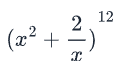
What is the sum of the numerical coefficients of the expansion of
404,721
531,441
326,721
658,161
The sum of the numerical coefficients of a polynomial is found by setting its variable equal to 1. For $(x^2+2/x)^{12}$: $$\left(1^2+\frac2{1}\right)^{12}=3^{12}=531441$$ Therefore, the sum of the numerical coefficients is 531,441.
Find the sum of the roots of the equation: x4-4x3+4x+5=0
6
4
3+2i
3 − 2i
For $a_nx^n+a_{n-1}x^{n-1}+\cdots=0$, the sum of roots is $-a_{n-1}/a_n$. Here $a_4=1$ and $a_3=-4$: $$\sum r=-\frac{-4}{1}=4$$ Therefore, the sum of the roots is 4.
If the coefficients of xk and xk+1 in the expansion of (2+3x)19 are equal, find k.
11
9
13
15
Coefficient of $x^k$ in $(2+3x)^{19}$ is $\binom{19}{k}2^{19-k}3^k$. Set adjacent coefficients equal: $\binom{19}{k}2^{19-k}3^k=\binom{19}{k+1}2^{18-k}3^{k+1}$ $2\binom{19}{k}=3\binom{19}{k+1}$ $2=3\frac{19-k}{k+1}$ $5k=55$ $\boxed{k=11}$
There are n points on a circle. A straight line-segment is drawn between each pair of points.
How many intersections are there inside the circle if n = 13?
(nP4)/24
(nP4)/4
nC3
nP3
Each interior intersection is determined by choosing 4 points on the circle; the two chords joining opposite pairs intersect once. Therefore: $N=\binom{n}{4}=\frac{nP4}{24}$ $\boxed{(nP4)/24}$
The polynomial:
f(x)=ax3-10x2-3x+b has a factor of x+5. When f(x) is divided by x-2, the remainder is -77. Find the values of a and b.
a = −2, b = −15
a = 2, b = 15
a = −2, b = 1
a = 2, b = −15
Since $x+5$ is a factor, $f(-5)=0$: $-125a-250+15+b=0\Rightarrow b=125a+235$ The remainder on division by $x-2$ is $f(2)=-77$: $8a-40-6+b=-77\Rightarrow b=-31-8a$ Equate: $125a+235=-31-8a$ $a=-2$, $b=-15$ $\boxed{a=-2,\ b=-15}$
In the algebraic expansion of (2x - 1/x)10, determine the numerical coefficient of the 8th term.
-960
960
-120
840
The $(k{+}1)$th term is $\binom{10}{k}(2x)^{10-k}\left(-\frac{1}{x}\right)^k$. For the 8th term, $k = 7$: $\binom{10}{7}(2)^3(-1)^7 = 120 \cdot 8 \cdot (-1)$ $\boxed{= -960}$
Determine the sum of the coefficients of the expansion (3x - 1)12, excluding the final constant adjustment as per standard refresher practice.
4095
4096
2048
8191
Set $x = 1$: $(3(1)-1)^{12} = 2^{12} = 4096$ This sum includes the constant term. The sum of all binomial coefficients (with $x=1$) gives 4096. If the problem asks for the sum excluding the last term (constant), subtract $(-1)^{12} = 1$: $4096 - 1$ $\boxed{= 4095}$
What is the middle term in the expansion of $(x + 2/x)^6$?
$60x^2$
160
$192x^4$
$12x^4$
The expansion of $(x + 2/x)^6$ has 7 terms, so the middle term is the 4th term. Use: $T_{r+1} = {6 \choose r}x^{6-r}\left(\frac{2}{x}\right)^r$ For the 4th term, $r = 3$: $T_4 = {6 \choose 3}x^3\left(\frac{2}{x}\right)^3$ $= 20(8)$ $\boxed{160}$
The resistance $R$ ohms of copper wire at $t^\circ\text{C}$ is given by $R = R_0(1 + \alpha t)$, where $R_0$ is the resistance at $0^\circ\text{C}$ and $\alpha$ is the temperature coefficient of resistance. If $R = 25.44\Omega$ at $30^\circ\text{C}$ and $R = 32.17\Omega$ at $100^\circ\text{C}$, find $\alpha$.
0.00426
0.00264
0.00624
0.00462
Use $R=R_0(1+\alpha t)$. $25.44=R_0(1+30\alpha)$ and $32.17=R_0(1+100\alpha)$ Divide to eliminate $R_0$: $\frac{25.44}{32.17}=\frac{1+30\alpha}{1+100\alpha}$ $25.44(1+100\alpha)=32.17(1+30\alpha)$ $\alpha=0.00426$ $\boxed{0.00426}$
An object is dropped from the top of a 256-m tower. The height of the object above the ground after t seconds is modelled by the polynomial 256 - 16t^2. Factor this expression completely.
16(4 + t)(4 - t)
4(4 + t)(4 - t)
(4 + t)(4 - t)
16(4 - t)(4 - t)
Solution pending in psadquestions/t1364.json.
Question Bank: w61
MSTE - Algebra / Polynomials / MSTE November 2019
The volume of a rectangular building with a square base and height $x$ is $x^3 - 60x^2 + 900x$. Find the base dimensions in terms of $x$.
$(x-20) \times (x+20)$
$(x-20) \times (x-20)$
$(x-30) \times (x-30)$
$(x+30) \times (x-30)$
Let the square base have side $a$, so $V = a^2 x$. $a^2 x = x^3 - 60x^2 + 900x$ $a^2 = x^2 - 60x + 900 = (x-30)^2$ So $a = x - 30$ and the base is $(x-30)\times(x-30)$. $\boxed{(x-30)\times(x-30)}$
Question Bank: w287
MSTE - Algebra / Binomial Expansion / MSTE April 2025
In the expansion of $(2x^{2} - 5)^{8}$, what is the sum of the coefficient of all the terms?
364024
6561
-384064
124562
Setting $x = 1$ collapses every term to its coefficient, giving the sum of all terms including the constant term. Subtract the constant term to leave the sum of the coefficients of the variable terms.