A geometric progression (GP) is a sequence where each term is obtained by multiplying the previous term by a fixed constant called the common ratio, denoted by $r$.
General Term of a GP:
$$
a_n = a_1 \cdot r^{n-1}
$$
Where:
$a_1$ = the first term
$r$ = common ratio
$n$ = number of terms
Sum of First n Terms of a GP:
$$
S_n = \frac{a_1(1 - r^n)}{1 - r}
$$
This formula is valid as long as $r \ne 1$.
Sum of an Infinite GP (when $|r| < 1$):
$$
S_\infty = \frac{a_1}{1 - r}
$$
This applies to converging geometric series, where the terms get smaller and smaller as $n$ increases.
Real-Life Examples:
Exponential growth and decay
Bank interest compounded regularly
Halving distances or population models
Problem:
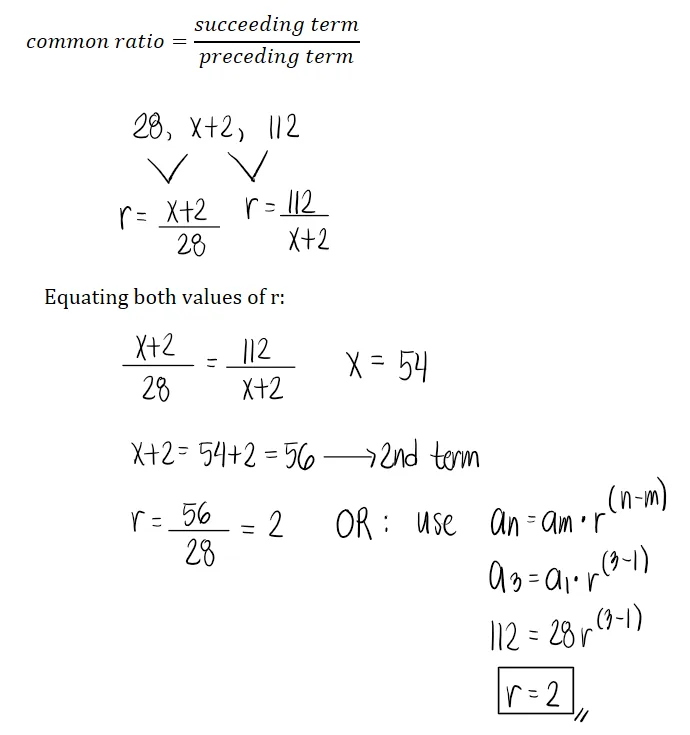
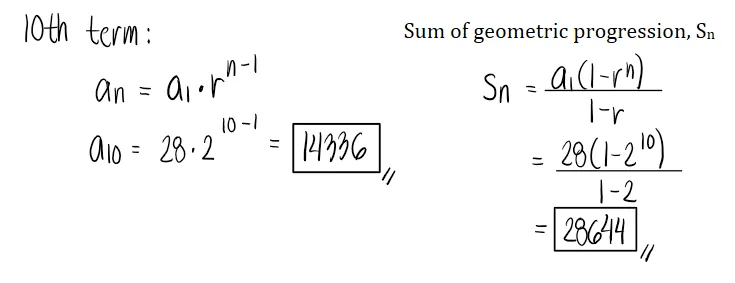
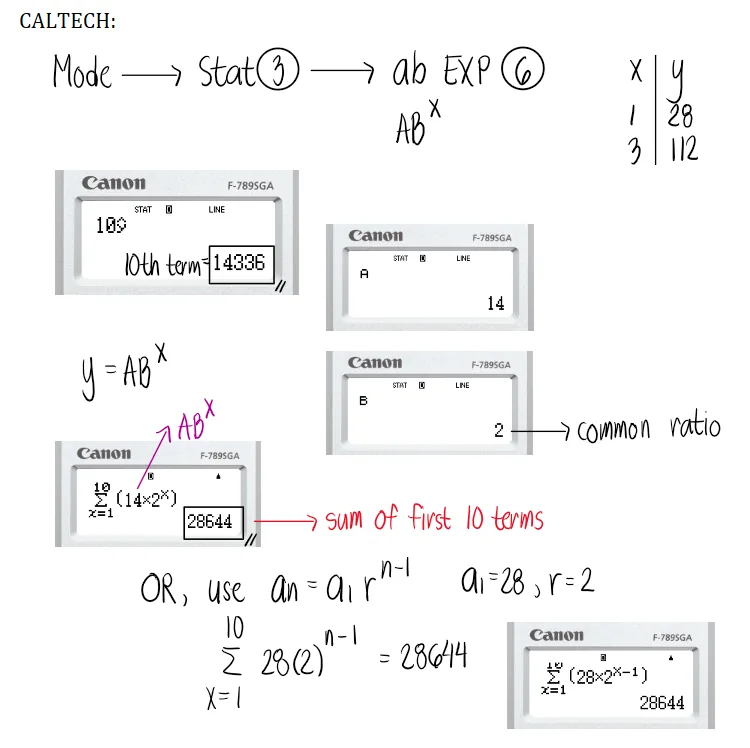
The number 28, x + 2, 112 form a geometric progression. What is the 10th term? What is the sum of the geometric progression?
See images:
Problem:
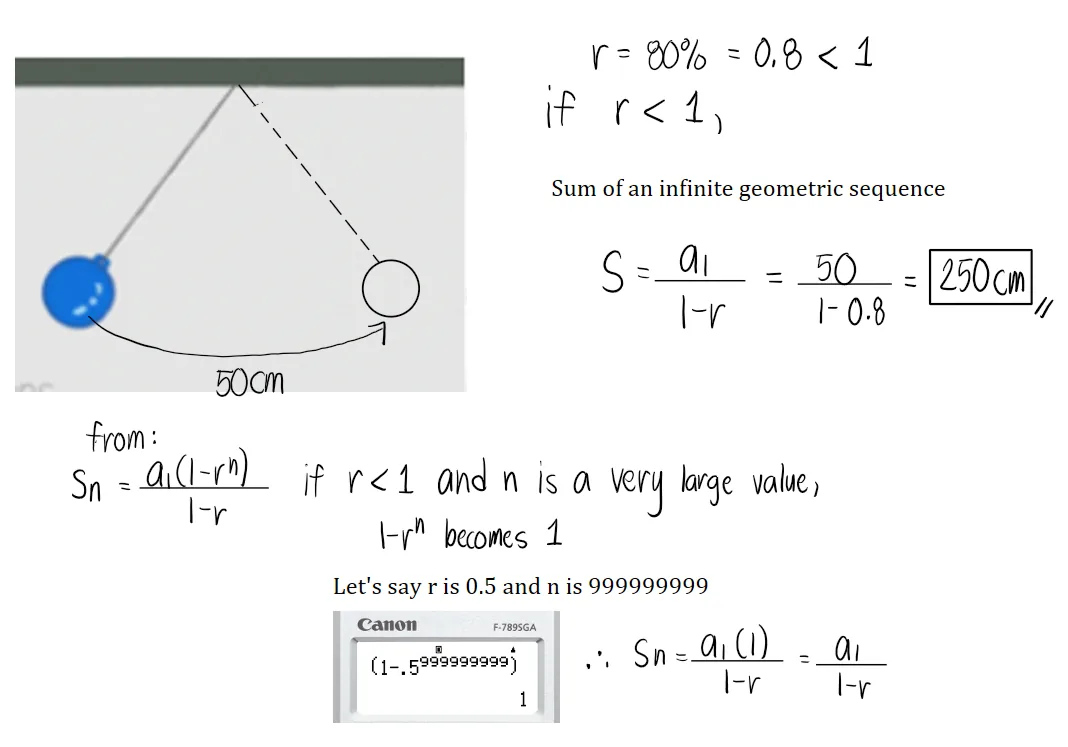
The first swing of the pendulum is 50 cm. If each swing is 80% of the preceding swing, how far does the pendulum travel before coming to rest?
See images:
Problem:
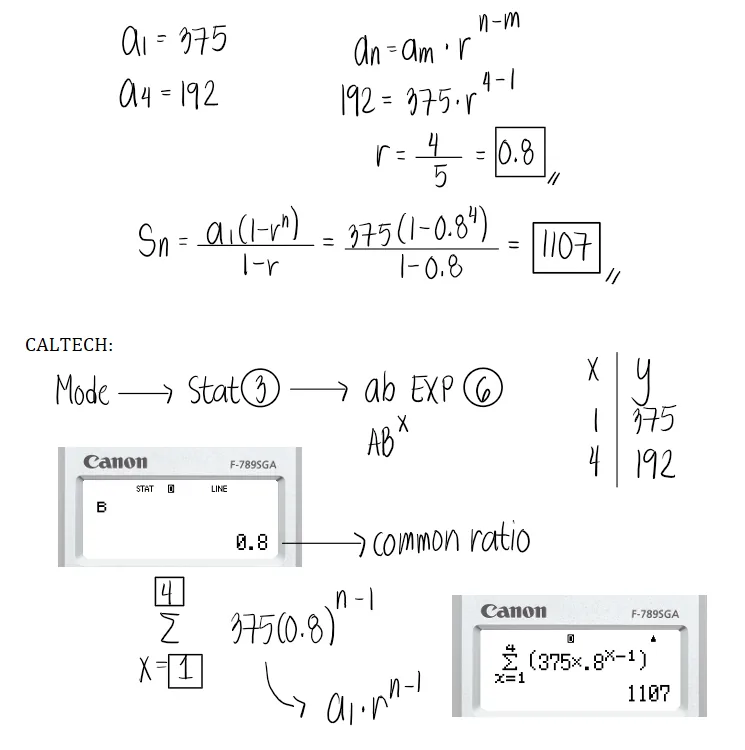
The first term of a geometric sequence is 375 and the fourth term is 192. Find the common ratio and the sum of the first four terms.
See images:
Problem:
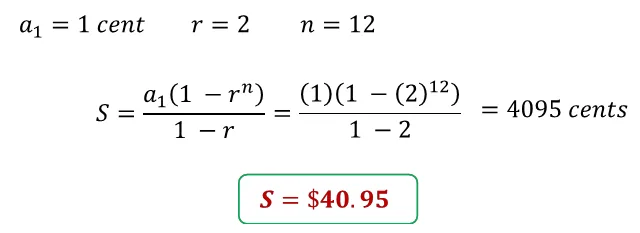
A boy agrees to work at the rate of one cent the first day, two cents the second day, four cents the third day, eight cents the fourth day, etc. How much would he receive at the end of 12 days?
See images:
Problem:
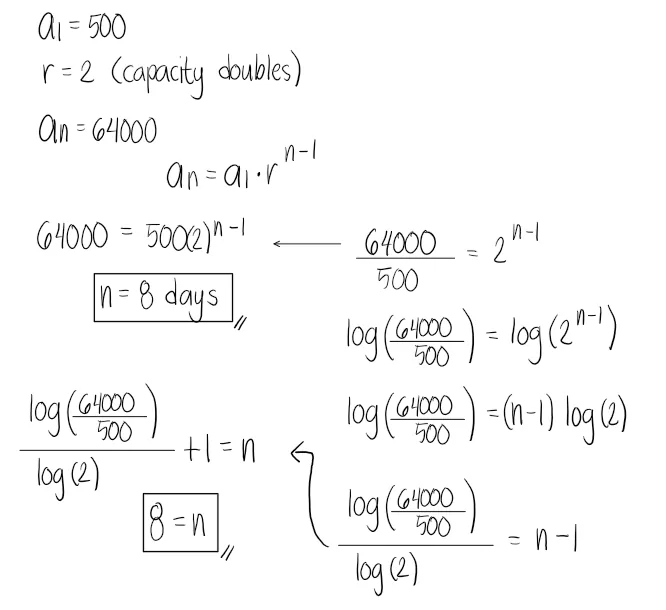
A tech startup launches a new data storage device with cutting-edge compression. On day 1, the device can store 500 MB. Each day, due to software upgrades, its capacity doubles. After how many days will the device be able to store exactly 64,000 MB?
See images:
Problem:
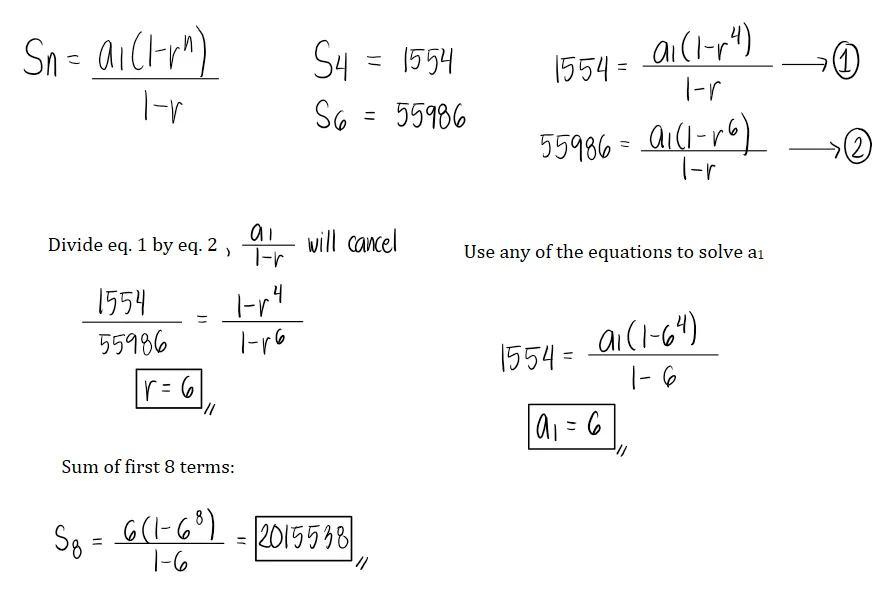
The sum of the first 4 terms of a geometric sequence is 1554. The sum of the first 6 terms is 55986. What is the sum of the first 8 terms?
See images:
-->
Exam Generator Problems
Additional board-style practice items for this topic.
The numbers 28, x + 2, 112 form a geometric progression.
What is the 10th term?
14336
14633
13463
13644
What is the sum of the geometric progression?
28644
24688
25686
26484
Part 1.
For three geometric means, the middle term satisfies: $(x+2)^2=28(112)$ $x+2=56$, so the common ratio is $r=56/28=2$. The 10th term is: $a_{10}=28(2)^9$ $\boxed{14336}$
Part 2.
The sum of the first 10 terms is: $S_{10}=\frac{a(r^{10}-1)}{r-1}$ $S_{10}=\frac{28(2^{10}-1)}{2-1}=28(1023)$ $\boxed{28644}$
The first swing of the pendulum is 50 cm. If each swing is 80% of the preceding swing, how far does the pendulum travel before coming to rest?
Answer:
240
250
220
230
The swing lengths form an infinite geometric series with first term $a=50\text{ cm}$ and common ratio $r=0.80$.
$S_\infty=\dfrac{a}{1-r}=\dfrac{50}{1-0.80}=\boxed{250\text{ cm}}$.
The original 240 key does not satisfy the stated 80% progression; 250 is the correct listed choice.
The sum of the first 4 terms of a geometric sequence is 1554. The sum of the first 6 terms is 55986. What is the sum of the first 8 terms?
Answer:
2015538
2051538
2015583
2051358
For a geometric progression: $S_n=a\frac{r^n-1}{r-1}$ The data are satisfied by $r=6$ because: $S_4=a\frac{6^4-1}{5}=1554$, giving $a=6$. Then: $S_8=6\frac{6^8-1}{5}$ $\boxed{2015538}$
A man wishes to save money by setting aside 1 cent the first day, 2 cents the second day, 4 cents the third day, and so on. Assuming he does not run out of money, what is the total amount saved at the end of 30 days?
Answer:
1,073,741,823
1,370,147,328
1,570,847,920
1,875,465,935
The savings form a geometric series in cents: $1+2+4+\cdots+2^{29}$ $S=\frac{2^{30}-1}{2-1}=2^{30}-1$ $\boxed{1{,}073{,}741{,}823}$
Very few people are aware of the growth pattern of Jack's beanstalk. On the first day, it increased its height by 1/2, on the second day by 1/3, and the third day by 1/4, and so on. How long did it take to achieve its maximum height (100 times its original height)?
Answer:
198 days
99 days
100 days
200 days
### Growth of the beanstalk
Let $H_n$ be the height after day $n$, measured relative to the original height $H_0$. On day 1 the height increases by one-half of its current value, on day 2 by one-third of its current value, and so on. Therefore
$$H_n=H_0\left(1+\frac12\right)\left(1+\frac13\right)\left(1+\frac14\right)cdotsleft(1+\frac1{n+1}\right).$$
Each factor simplifies as
$$1+\frac1k=\frac{k+1}{k}.$$
The product telescopes:
$$\frac32\cdot\frac43\cdot\frac54\cdots\frac{n+2}{n+1}=\frac{n+2}{2}.$$
For the height to be $100$ times the original height,
$$\frac{n+2}{2}=100,$$
$$n=\boxed{198 \text{days}}.$$
The sum of three number in arithmetic progression is 45. If 2 is added to the first number, 3 to the second, and 7 to the third, the new numbers will be in geometrical progression. Find the common difference in arithmetic progression.
Answer:
5
-5
10
6
Let the arithmetic progression be $15-d$, $15$, and $15+d$ since the sum is 45. After adding 2, 3, and 7, the terms become $17-d$, $18$, and $22+d$. For a geometric progression: $18^2=(17-d)(22+d)$ $324=374-5d-d^2$ $d^2+5d-50=0$ $\boxed{d=5}$
A certain ball rebounds 1/3 the distance it falls.
If the ball is dropped from a height of 9 ft, how far does it travel before coming to rest?
18 ft
21 ft
27 ft
15 ft
Total distance is the initial fall plus twice the rebound series: $D=9+2\left(3+1+\frac{1}{3}+\cdots\right)$ The rebound series has first term 3 and ratio 1/3: $S=\frac{3}{1-1/3}=4.5$ $D=9+2(4.5)$ $\boxed{18\text{ ft}}$
Given three positive numbers $a$, $b$, and $c$ such that $a$, $b$, $c$ are in geometric progression. Which of the following is correct?
$2 \log b = \log a - \log c$
$2 \log b = \log (a + c)$
$2 \log b = \log a \times \log c$
$2 \log b = \log a + \log c$
For three positive numbers in geometric progression, the middle term satisfies $b^2=ac$. Taking logarithms: $\log b^2=\log(ac)$ $2\log b=\log a+\log c$ $\boxed{2\log b=\log a+\log c}$
Given the following data set: 14, 19, 20, 1, 2, 7, 10, 24, 10, 11, 23, 24, 3, 4, 7, 26. What is the ratio of the second quartile to the third quartile.
21/40
21/43
23/43
23/40
Arrange the data: $1,2,3,4,7,7,10,10,11,14,19,20,23,24,24,26$ Second quartile $Q_2$ is the median: $Q_2=\frac{10+11}{2}=10.5$. Third quartile $Q_3$ is the median of the upper half: $Q_3=\frac{20+23}{2}=21.5$. $\frac{Q_2}{Q_3}=\frac{10.5}{21.5}=\frac{21}{43}$ $\boxed{\frac{21}{43}}$
Suppose that the amount of time a passenger spends in paying a terminal fee is exponentially distributed with mean 20 seconds. What is the probability that a passenger will spend more than 25 seconds in the booth?
$0.2354$
$0.2916$
$0.3421$
$0.2865$
For an exponential distribution with mean 20 seconds, $\lambda=\frac{1}{20}$. $P(X>25)=e^{-\lambda x}=e^{-25/20}=0.2865$. $\boxed{0.2865}$
At a certain stretch of highway, the speeds of vehicles were found to have a normal distribution with a mean of 54 kph and a standard deviation of 3 on a sample of 25 vehicles. What is the upper two-standard deviation average speed?
$52.8\text{ kph}$
$55.2\text{ kph}$
$53.2\text{ kph}$
$58.2\text{ kph}$
For a sample mean, the standard error is $\frac{\sigma}{\sqrt{n}}=\frac{3}{\sqrt{25}}=0.6$ kph. Upper two-standard-deviation average speed: $54+2(0.6)=55.2$ kph. $\boxed{55.2\text{ kph}}$
Question Bank: t2074
MSTE - Algebra / Geometric Progression / Besavilla CE Pre-Board Math & Surveying
In a geometric progression, the sixth term is 8 times the 3rd term and the sum of the seventh and eighth terms is 192. Determine the sum of the fifth to eleventh terms, inclusive.
2032
2322
2124
2250
2113
Let the geometric progression be $a,ar,ar^2,\ldots$. The sixth term is 8 times the third term: $ar^5=8ar^2 \Rightarrow r^3=8 \Rightarrow r=2$ The seventh and eighth terms are $ar^6$ and $ar^7$. $ar^6+ar^7=192 \Rightarrow a(64+128)=192 \Rightarrow a=1$ Sum from the 5th to 11th terms: $S=2^4+2^5+2^6+2^7+2^8+2^9+2^{10}$ $S=16(1+2+4+8+16+32+64)=16(127)$ $\boxed{2032}$
Question Bank: w66
MSTE - Algebra / Geometric Progression / MSTE November 2019
A pendulum swings a length of 40 inches on its first swing. Each successive swing is $\tfrac{4}{5}$ of the preceding swing. Find the length of the fifth swing.
10.4 in
14.4 in
12.4 in
16.4 in
Geometric progression with first term $a_1 = 40$ in and common ratio $r = \tfrac{4}{5} = 0.8$: $a_n = a_1 r^{\,n-1}$ $a_5 = 40(0.8)^{5-1} = 40(0.8)^4 = 16.38$ in $\boxed{a_5 \approx 16.4\text{ in}}$
Question Bank: w250
MSTE - Algebra / Geometric Progression / MSTE April 2025
A rotating vessel coming to rest makes 30 revolutions in the first minute and in each minute thereafter makes 2/5 as many revolutions as the preceding minute. Find how many revolutions the wheel makes before it comes to rest.
40
30
50
75
The revolutions form an infinite geometric progression (IGP): $30 + \left(\tfrac{2}{5}\right)(30) + \left(\tfrac{2}{5}\right)^{2}(30) + \left(\tfrac{2}{5}\right)^{3}(30) + \ldots$
Since $|r| < 1$, the sum converges: $\text{Sum} = \dfrac{a_1}{1 - r} = \dfrac{30}{1 - 2/5}$ $\boxed{\text{Sum} = 50\ \text{rev}}$
Question Bank: w320
MSTE - Algebra / Geometric Progression / MSTE April 2025
A grant from an alumnus to a university specified that the university was to receive $800,000 during the first year and 75% of the preceding year's donation during each of the following 5 years. Find the total amount donated during the 6 years.
$2,630,486.75
$2,630,468.57
$2,603,468.75
$2,630,468.75
The yearly donations form a geometric progression with $a_1 = 800{,}000$ and $r = 0.75$.
First year: $800{,}000$ Second year: $(800{,}000)(0.75)$ Third year: $[800{,}000(0.75)](0.75)$
Sum of a Geometric Progression: $S = \dfrac{a_1(1 - r^{n})}{1 - r}$