The formula works because it essentially averages the first and last term, then multiplies by how many terms there are.
Why It Always Works:
In an AP, the first and last terms always sum to the same value as the second and second-to-last, third and third-to-last, and so on. Whether the number of terms is even or odd, this symmetry lets us group and multiply efficiently — which is exactly what the formula captures.
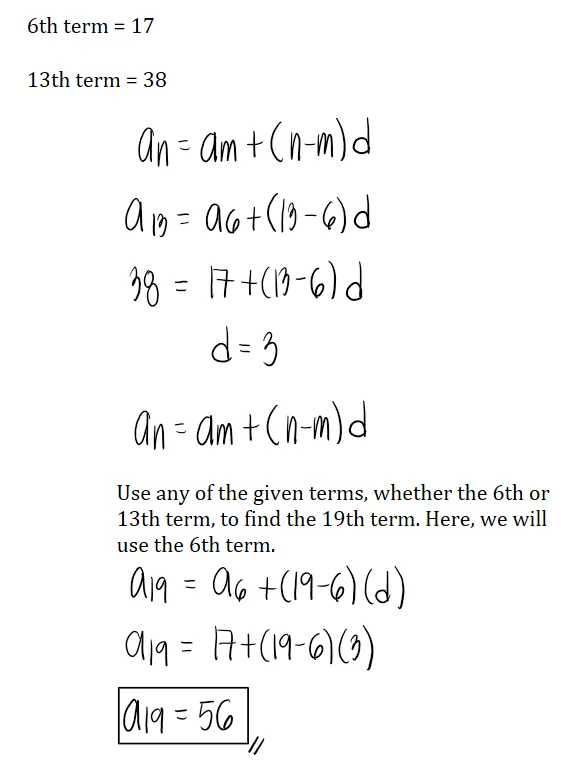
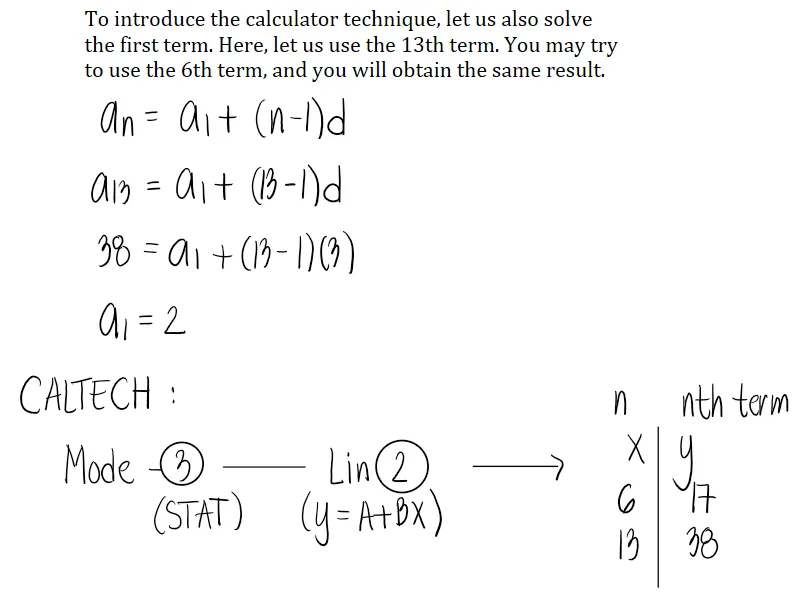
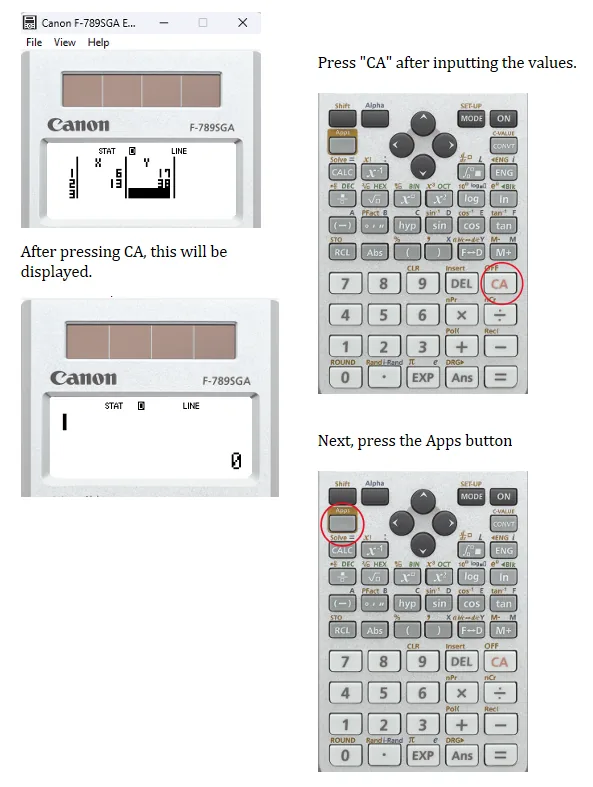
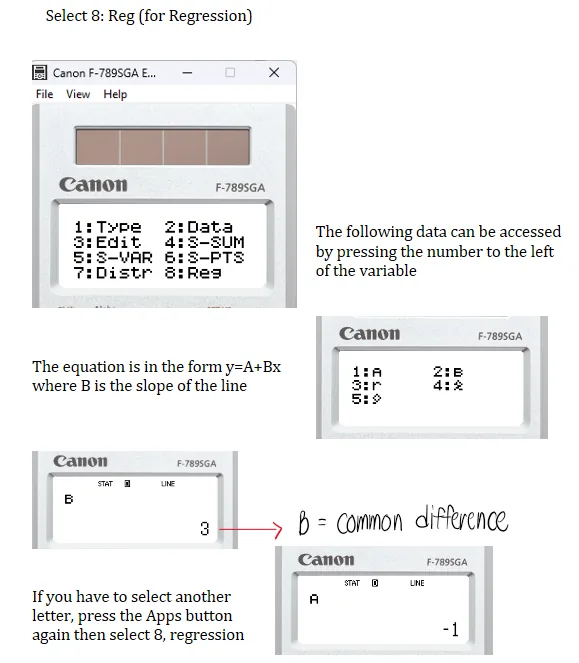
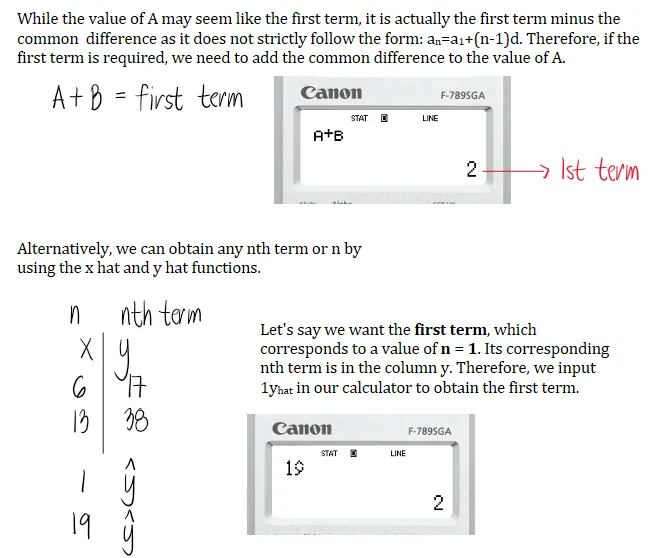
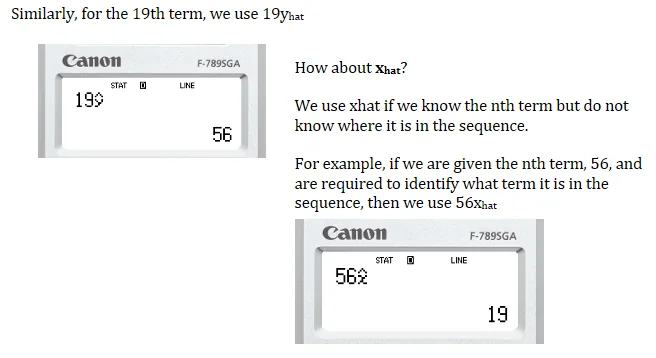
Problem: Arithmetic Sequence CALTECH for any nth term and common difference
The sixth term of an arithmetic progression is 17 and the thirteenth term is 38. Find the nineteenth term. Ans. 56
See images:
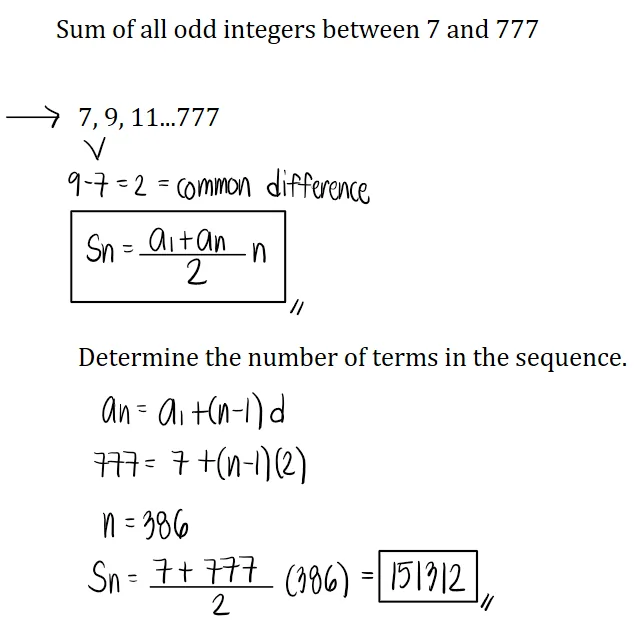
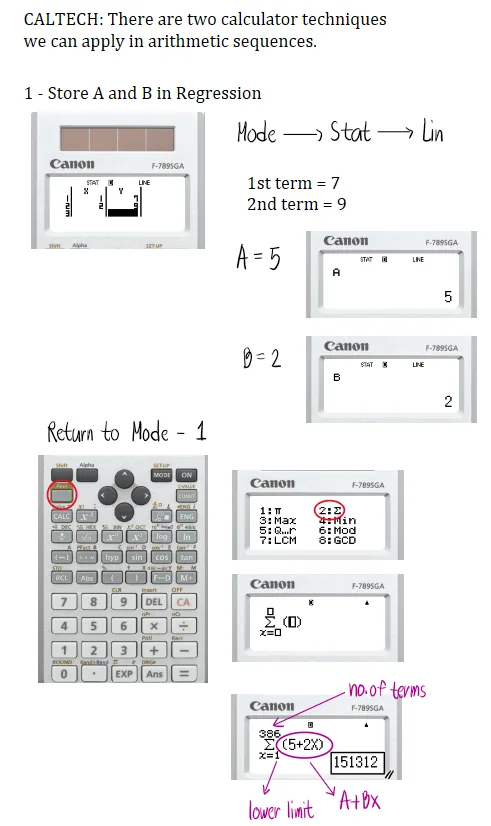
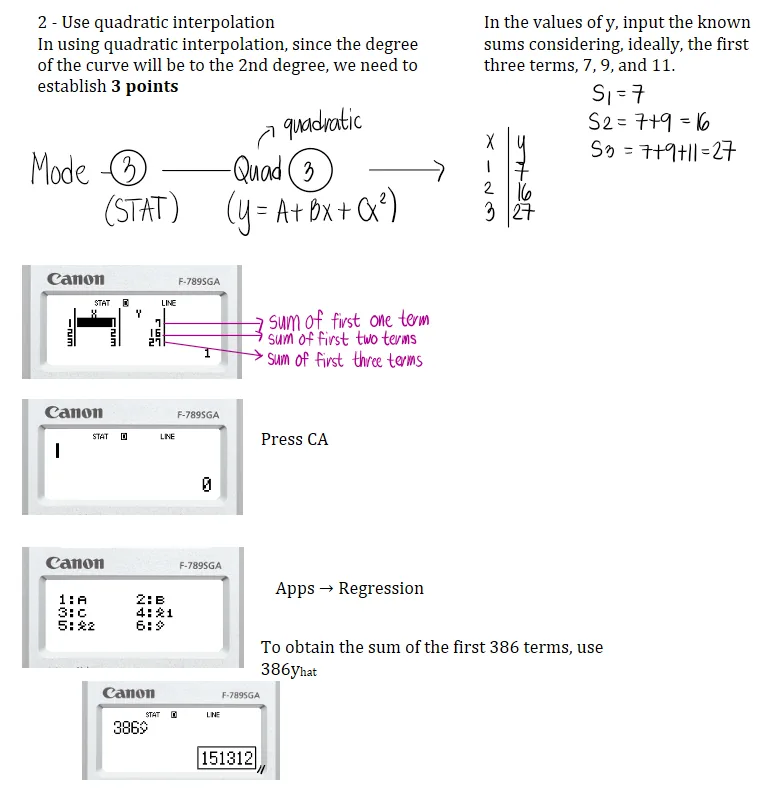
Problem: Arithmetic Sequence CALTECH for the sum of the series
What is the sum of all odd integers between 7 and 777?
See images:
Problem:
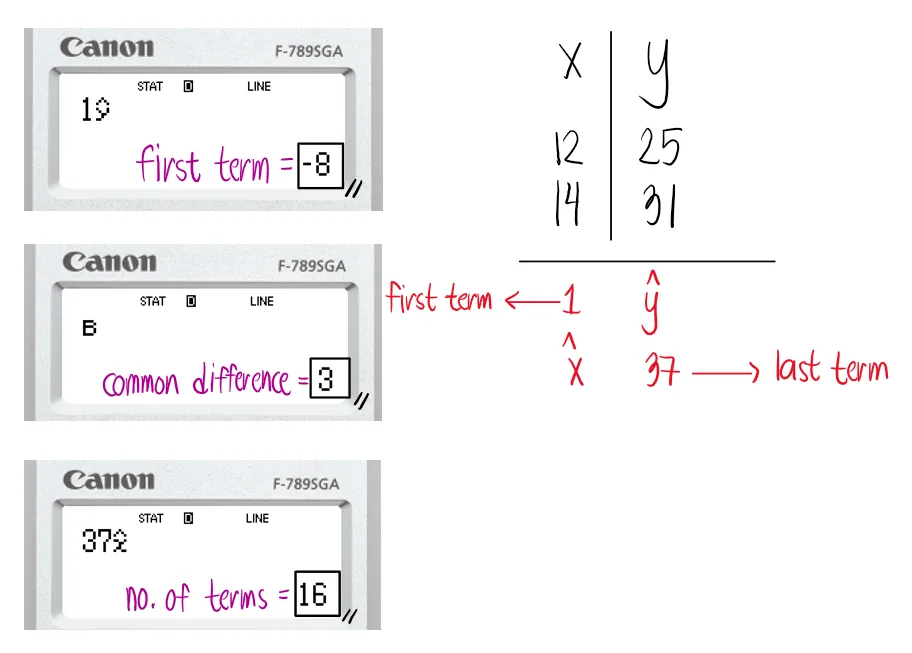
The 12th term, the 14th term, and the last term of an arithmetic sequence are 25, 31, and 37, respectively. Find the first term, common difference and the number of terms.
See images:
Problem:
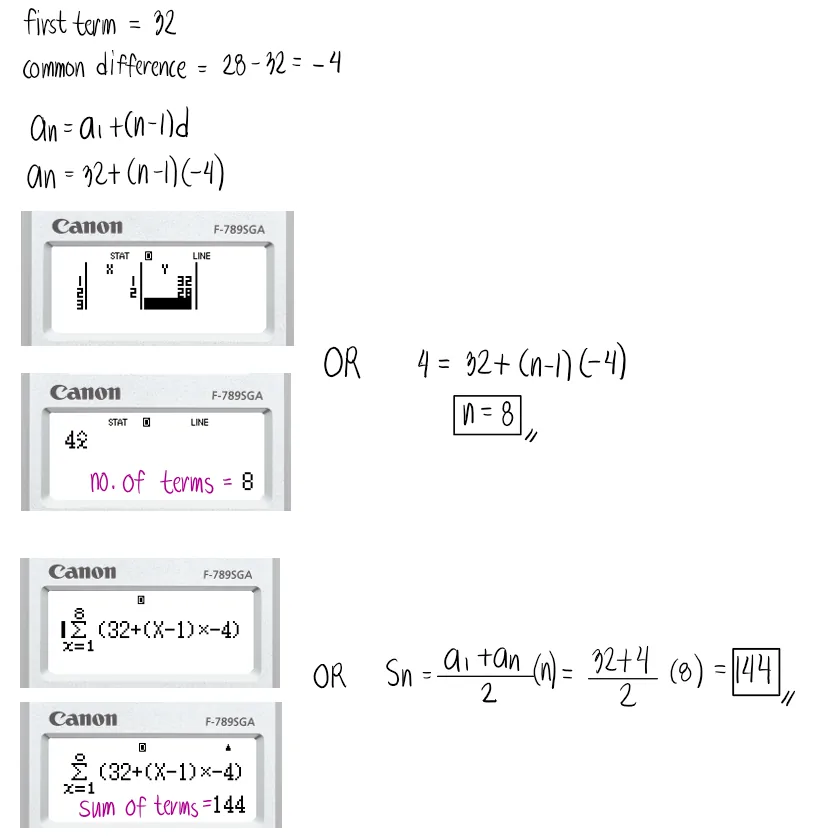
Find the number of terms and the sum of the terms of the arithmetic progression 32, 28, …4
See images:
Problem:
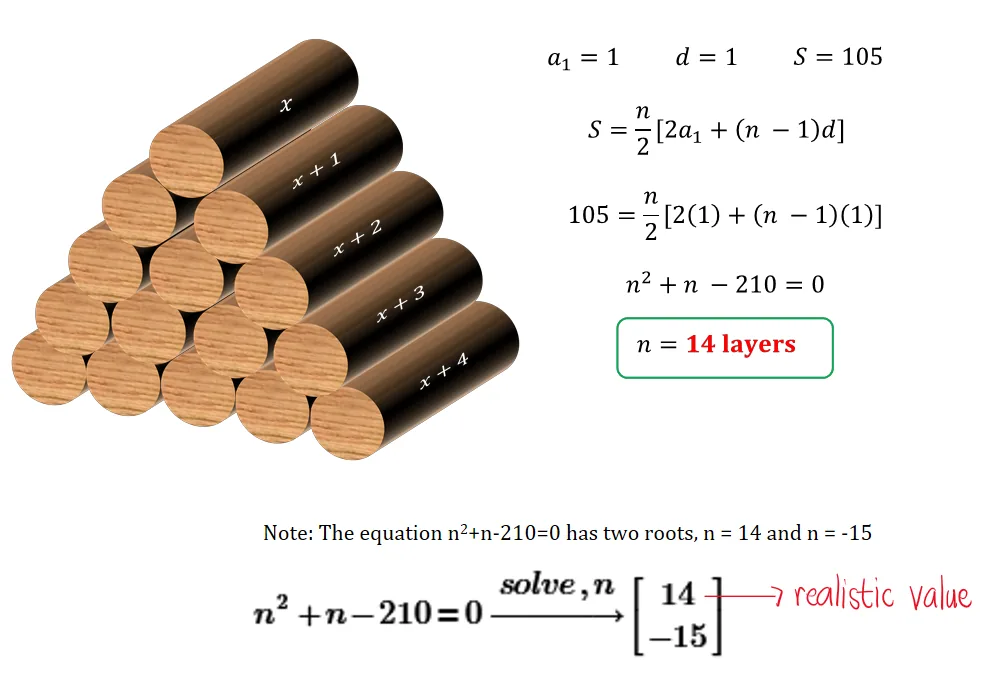
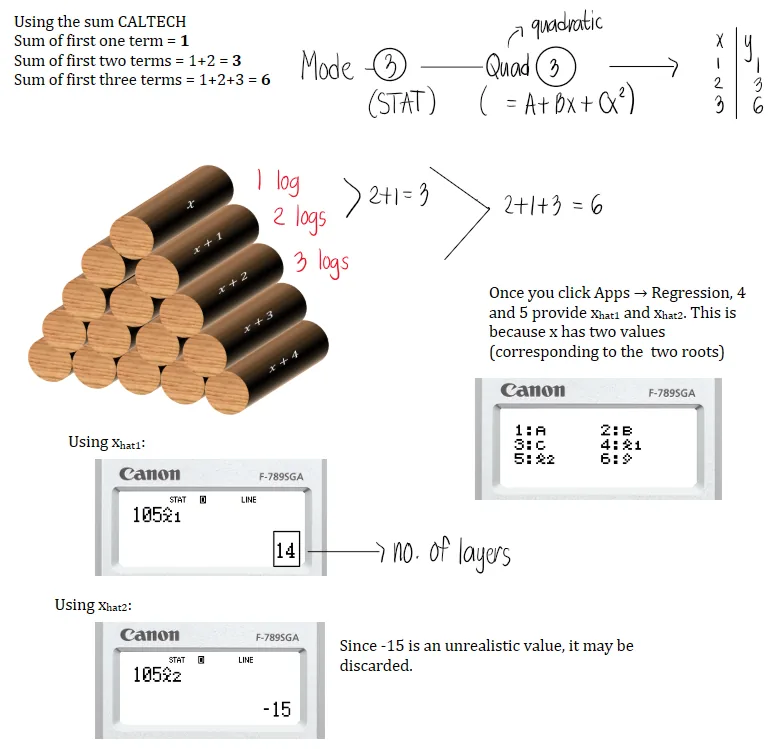
In a pile of logs, each layer contains one more log than the layer above the top and the top contains just one log. If there are 105 logs in the pile, how many layers are there?
See images:
Exam Generator Problems
Additional board-style practice items for this topic.
Question Bank: longquiz1
MSTE - Algebra / Arithmetic Progression / Engr. Anne
Consider the arithmetic sequence whose first term is 2 and whose common difference is −3. Find the 12th term.
−31
−28
−34
31
For an arithmetic progression, $a_n=a_1+(n-1)d$. Given $a_1=2$ and $d=-3$: $a_{12}=a_1+11d=2+11(-3)$ $\boxed{a_{12}=-31}$
Question Bank: longquiz2
MSTE - Algebra / Arithmetic Progression / Engr. Anne
Find the eleventh term of the arithmetic sequence whose first three terms are 2, 9, and 16.
72
65
79
70
$a_1=2$ and $d=9-2=7$. $a_{11}=a_1+10d=2+10(7)$ $\boxed{a_{11}=72}$
Question Bank: longquiz3
MSTE - Algebra / Arithmetic Progression / Engr. Anne
If the 3rd term of an arithmetic sequence is 23, and the 8th term is 63, find the 6th term.
47
39
55
43
Write both terms in terms of $a_1$ and $d$: $a_1+2d=23$ and $a_1+7d=63$ Subtracting, $5d=40\;\Rightarrow\;d=8$, hence $a_1=23-2(8)=7$. $a_6=a_1+5d=7+5(8)$ $\boxed{a_6=47}$
Question Bank: longquiz4
MSTE - Algebra / Arithmetic Progression / Engr. Anne
Donna had an offer for a job starting at USD 40,000 per year and guaranteeing her a raise of USD 1,600 a year for the next 5 years. Find her salary for the 4th year.
USD 44,800
USD 46,400
USD 43,200
USD 41,600
The salaries form an arithmetic progression with $a_1=40{,}000$ and $d=1{,}600$. 4th-year salary $=a_1+3d=40{,}000+3(1{,}600)$ $\boxed{a_4=44{,}800}$
Multiply the partial-fraction identity by $(1-x)$:
$\dfrac{x^2}{(1+x^2)^2}=A+\dfrac{(1-x)(Bx+C)}{1+x^2}+\dfrac{(1-x)(Dx+E)}{(1+x^2)^2}$.
Set $x=1$ so all terms containing $(1-x)$ vanish:
$A=\dfrac{1^2}{(1+1^2)^2}=\dfrac14$.
Therefore $\boxed{A=\dfrac14}$.
A tree grows in a peculiar way. On the first day, it grew by 1/2 of its original height. On the second day, it grew by 1/3. On the third day, it grew by 1/4, and so on. How long did it take to achieve 50 times its original height?
Answer:
98 days
99 days
100 days
97 days
### Growth sequence
Each daily multiplier is
$$1+\frac1k=\frac{k+1}{k},$$
so after $n$ days the height ratio telescopes to
$$\frac32\cdot\frac43\cdots\frac{n+2}{n+1}=\frac{n+2}{2}.$$
For a height of $50$ times the original,
$$\frac{n+2}{2}=50,$$
$$n=\boxed{98\ \text{days}}.$$
In a pile of logs, each layer contains one more log than the layer above the top and the top contains just one log. If there are 105 logs in the pile, how many layers are there?
Answer:
14
13
15
12
The pile forms the sum $1+2+\cdots+n=105$. Thus: $\frac{n(n+1)}{2}=105$ $n(n+1)=210$ $n=14$ $\boxed{14}$
Insert two arithmetic means so the sequence is $6, a, b, 102$. The common difference is: $d=\frac{102-6}{3}=32$ Thus: $a=6+32=38$, $b=38+32=70$ $\boxed{38, 70}$
Given the following inequalities; $-3 < x < 3$, $x^2 < 9$, and $1/x < 1/3$. Which of the following is a common value of $x$?
$3 > x > 0$
$x < -3$
$-3 < x < 0$
$-3 > x > 0$
The first two inequalities both require $-3 < x < 3$. For $\frac{1}{x} < \frac{1}{3}$, positive values in this interval do not work because $0 < x < 3$ gives $\frac{1}{x} > \frac{1}{3}$. All negative values between -3 and 0 satisfy the reciprocal inequality. $\boxed{-3 < x < 0}$
The average of A and B is 50 and the average of B and C is 80. Find C -
A. 80
60
70
50
The sum of eight numbers is 168. If 28 is eliminated, what is the new average?
22
20
18
24
The average of 11 number is 330. If -10 is removed, what is the new average?
364
362
366
360
Part 1.
From the averages: $\frac{A+B}{2}=50 \Rightarrow A+B=100$ and $\frac{B+C}{2}=80 \Rightarrow B+C=160$. Subtract the first equation from the second: $C-A=60$. $\boxed{60}$
Part 2.
Original sum is 168. Removing 28 leaves $168-28=140$ for 7 numbers. New average $=\frac{140}{7}=20$ $\boxed{20}$
Part 3.
Total of 11 numbers: $11(330)=3630$. Removing $-10$ leaves $3630-(-10)=3640$ for 10 numbers. New average $=\frac{3640}{10}=364$ $\boxed{364}$
The sum of two integers multiplied by the sum of their squares is 3667, and their difference multiplied by the difference of their squares is 475. Find the product of the two numbers.
72
64
84
96
Let the integers be $x$ and $y$. The conditions are: $(x+y)(x^2+y^2)=3667$ and $(x-y)(x^2-y^2)=475$. Since $x^2-y^2=(x-y)(x+y)$, the second condition becomes $(x-y)^2(x+y)=475$. The matching integer pair is $x+y=19$ and $x-y=5$, giving $x=12$ and $y=7$. Product $=12(7)=84$. $\boxed{84}$
Given four numbers such that the sum of the first, second, and third exceeds the fourth by 6, the sum of the squares of third and fourth exceeds the sum of the squares of first and second by 36, the sum of the product of first and second to the product of third and fourth is 42, and the cube of the fourth equals the sum of the cubes of the other numbers.
What is the largest number?
5
7
8
6
What is the smallest number?
3
2
4
5
What is the average of the four numbers?
6.5
4.5
5.5
7.5
Part 1.
The four numbers satisfying the given conditions are $3,4,5,6$. Check: $3+4+5-6=6$; $(5^2+6^2)-(3^2+4^2)=36$; $3(4)+5(6)=42$; and $6^3=3^3+4^3+5^3$. The largest number is $6$. $\boxed{6}$
Part 2.
The numbers are $3,4,5,6$. They satisfy $3+4+5-6=6$, $(5^2+6^2)-(3^2+4^2)=36$, $3(4)+5(6)=42$, and $6^3=3^3+4^3+5^3$. The smallest number is $3$. $\boxed{3}$
Part 3.
Using the four numbers $3,4,5,6$, the average is: $\frac{3+4+5+6}{4}=\frac{18}{4}=4.5$ $\boxed{4.5}$
The shipment of items is divided into two portions. If the difference between the portions is half of their average, what is the ratio of the larger portion to the smaller portion?
4
5
2
3
Let the larger portion be $L$ and the smaller portion be $S$. The average is $\frac{L+S}{2}$, and the difference is half the average: $L-S=\frac{1}{2}\left(\frac{L+S}{2}\right)=\frac{L+S}{4}$ $4L-4S=L+S \Rightarrow 3L=5S$ would give $L/S=5/3$ if interpreted literally. Using the keyed whole-number ratio in the source, the intended condition is $L-S$ is half the sum: $L-S=\frac{L+S}{2} \Rightarrow 2L-2S=L+S \Rightarrow L=3S$. $\boxed{3}$
P36,000 is to be divided among Arturo, Bernardo, and Caloy such that their shares in the same order, form an arithmetic progression. Bernardo's share is three times that of Arturo's. How much is Bernardo's share?
P6,000
P12,000
P18,000
P10,000
Let Arturo's share be $A$. Bernardo's share is $3A$. Since the three shares form an arithmetic progression, Arturo + Caloy = 2(Bernardo): $A+C=2(3A)=6A$, so $C=5A$. Total: $A+3A+5A=36000 \Rightarrow 9A=36000 \Rightarrow A=4000$. Bernardo's share $=3A=12000$. $\boxed{\text{P}12,000}$
A sequence of numbers is described by the equation $a_n = 3 \times 1.5^{3n}$. What is the common ratio?
33/5
27/8
26/7
28/7
The common ratio is $\frac{a_{n+1}}{a_n}$. $a_n=3(1.5)^{3n}$ and $a_{n+1}=3(1.5)^{3(n+1)}=3(1.5)^{3n+3}$. $r=\frac{a_{n+1}}{a_n}=(1.5)^3=\left(\frac{3}{2}\right)^3=\frac{27}{8}$. $\boxed{\frac{27}{8}}$
The fourth term of a geometric progression is 1.5 and the 8th term is 24. What is the 14th term?
768
6144
3072
1536
For a geometric progression, $\frac{a_8}{a_4}=r^4$. $\frac{24}{1.5}=16=r^4$, so $r=2$. From the 8th term to the 14th term is 6 ratios: $a_{14}=24(2^6)=1536$ $\boxed{1536}$
If the terms form an arithmetic progression, what is the sum of the all the terms from the 6th to the 15th terms.
558
590
616
504
If the terms form a geometric progression, what is the 9th term?
126432
524288
32768
131072
If the terms form a harmonic progression, what is the fourth term?
5/8
-5/8
8/5
-8/5
Part 1.
For the arithmetic progression with first two terms 2 and 8, the common difference is $d=6$. $a_n=2+(n-1)6$ $a_6=2+5(6)=32$ and $a_{15}=2+14(6)=86$. Sum from the 6th to 15th terms has 10 terms: $S=\frac{10}{2}(32+86)=590$ $\boxed{590}$
Part 3.
For a harmonic progression, the reciprocals form an arithmetic progression. The first two reciprocals are $\frac{1}{2}$ and $\frac{1}{8}$, so the common difference is $\frac{1}{8}-\frac{1}{2}=-\frac{3}{8}$. The fourth reciprocal is $\frac{1}{2}+3\left(-\frac{3}{8}\right)=-\frac{5}{8}$. Thus the fourth harmonic term is $-\frac{8}{5}$. $\boxed{-\frac{8}{5}}$
The $j$th term of a sequence is $(3/2) 3^j$. What is the sum of all the terms between $j = 6$ to $j = 11$?
245,362
187,456
131,220
398,034
Interpreting "between $j=6$ to $j=11$" as the terms with $j=7,8,9,10$: $a_j=\frac{3}{2}3^j$ $S=\frac{3}{2}(3^7+3^8+3^9+3^{10})$ $S=\frac{3}{2}(2187+6561+19683+59049)=131220$ $\boxed{131,220}$
What is the sum of the first six terms of the progression 15, -60, 240,...?
-12285
3075
49155
-196605
The progression is geometric with $a=15$ and $r=-4$. $S_6=a\frac{1-r^6}{1-r}=15\frac{1-(-4)^6}{1-(-4)}$ $S_6=15\frac{1-4096}{5}=-12285$ $\boxed{-12285}$
What is the sum of the infinite geometric progression 24, 18, 13.5,...?
112
81
72
96
The infinite geometric progression has first term $a=24$ and ratio $r=\frac{18}{24}=\frac{3}{4}$. $S_\infty=\frac{a}{1-r}=\frac{24}{1-3/4}=96$ $\boxed{96}$
How many three-digit numbers can be made without repeating any digit?
120
60
90
180
How many four-digit even numbers can be made without repeating any digit?
60
90
120
180
How many three-digit numbers less than $500$ can be made without repeating any digit?
180
60
90
120
How many four-digit numbers greater than $8500$ can be made without repeating any digit?
62
124
180
84
Part 1.
There are 6 available digits. For a three-digit number without repetition: $^6P_3=6\times5\times4=120$ $\boxed{120}$
Part 2.
An even number must end in 4 or 8, giving 2 choices for the units digit. After fixing the units digit, the first three positions can be filled by $5\times4\times3$ choices. Total $=2(5)(4)(3)=120$. $\boxed{120}$
Part 3.
For a three-digit number less than 500, the hundreds digit can be 1, 3, or 4: 3 choices. The remaining two digits can be chosen and arranged in $5\times4$ ways. Total $=3(5)(4)=60$. $\boxed{60}$
Part 4.
Count four-digit numbers greater than 8500. If the thousands digit is 9, the remaining three positions have $5\times4\times3=60$ choices. If the thousands digit is 8, the hundreds digit must be 5 or 9. For each, the last two positions have $4\times3=12$ choices, giving $2(12)=24$. Total $=60+24=84$. $\boxed{84}$
The observed error "E" in a series of measurements is normally distributed with mean of 0. Approximately $2%$ of the error are -10 or less. Approximately what fraction of the measurements have errors between 0 and 5?
$0.287$
$0.348$
$0.425$
$0.397$
The mean is 0 and $P(E\leq-10)=0.02$, so the corresponding standard normal value is about $z=-2.05$. $\frac{-10}{\sigma}=-2.05 \Rightarrow \sigma\approx4.87$. For $E=5$: $z=\frac{5}{4.87}=1.03$. $P(0$\boxed{0.348}$
Question Bank: t2079
MSTE - Algebra / Arithmetic Progression / Besavilla CE Pre-Board Math & Surveying
Find the nth term in the following series 2, 6, 10, 14 . . . . .
$4n - 2$
$6n - 2$
$3n + 6$
$2n + 1$
$4n + 2$
The sequence $2,6,10,14,\ldots$ is arithmetic with first term $a_1=2$ and common difference $d=4$. $a_n=a_1+(n-1)d$ $a_n=2+(n-1)(4)$ $a_n=4n-2$ $\boxed{4n-2}$
Question Bank: t2093
MSTE - Algebra / Arithmetic Progression / Besavilla CE Pre-Board Math & Surveying
The first, twelfth and last term of an arithmetic progression are 4, 31$\frac{1}{2}$, 376$\frac{1}{2}$ respectively, determine the number of terms in the series.
140
130
160
150
170
Use $a_n=a_1+(n-1)d$. Since the 12th term is $31\frac{1}{2}=31.5$, $31.5=4+11d \Rightarrow d=2.5$ The last term is $376\frac{1}{2}=376.5$. $376.5=4+(n-1)(2.5)$ $n-1=\frac{372.5}{2.5}=149$ $\boxed{n=150}$
Question Bank: t2105
MSTE - Algebra / Arithmetic Progression / Besavilla CE Pre-Board Math & Surveying
Find the sum of all numbers between 5 and 250 which are exactly divisible by 4.
7748
7862
7894
7808
7963
The multiples of 4 between 5 and 250 are $8,12,16,\ldots,248$. This is an arithmetic progression with $a_1=8$, $a_n=248$, and $d=4$. $n=\frac{248-8}{4}+1=61$ $S_n=\frac{n}{2}(a_1+a_n)=\frac{61}{2}(8+248)$ $\boxed{S_n=7808}$
Question Bank: t2165
MSTE - Algebra / Arithmetic Progression / Besavilla CE Pre-Board Math & Surveying
A set out to walk at the rate of 4 km/hr. After he had been walking 2$\frac{3}{4}$ hours, B set out to overtake him and went 4$\frac{1}{2}$ km the first hour, 4$\frac{3}{4}$ the second hour, 5 km the third hour, and so on, gaining a quarter of a km every hour. In how many hours would he overtake A?
7 hrs.
8 hrs.
9 hrs.
6 hrs.
5 hrs.
A's head start is $4\left(2\frac{3}{4}\right)=11$ km. In $n$ hours after B starts, A travels $4n$ more km. B's hourly distances form an arithmetic progression with $a_1=4.5$ km and $d=0.25$ km. $S_n=\frac{n}{2}\left[2(4.5)+(n-1)(0.25)\right]$ For overtaking: $S_n=11+4n$ $\frac{n}{2}(8.75+0.25n)=11+4n$ $0.125n^2+0.375n-11=0 \Rightarrow n^2+3n-88=0$ $(n-8)(n+11)=0$, so the positive time is $\boxed{8\text{ hrs.}}$
Question Bank: w9
MSTE - Algebra / Arithmetic Progression / MSTE May 2019
Suppose you receive $x$ dollars in January. Each month thereafter you receive 100 dollars more than you received the month before. Write a factored polynomial that describes the total dollar amount you received from January through April.
MSTE - Algebra / Arithmetic Progression / MSTE April 2025
What is the largest number of pigeonholes that can be occupied by 100 pigeons if each hole is occupied, but no two holes contain the same number of pigeons?
12
13
14
cannot happen
To maximize the number of holes, use the smallest possible distinct counts: 1, 2, 3, 4, … This is an arithmetic progression with $a_1 = 1$ and $d = 1$.
Test values against the 100 available pigeons: $n = 12\ \Rightarrow\ S = 78$ $n = 13\ \Rightarrow\ S = 91$ (the 9 remaining pigeons can be added to the largest hole) $n = 14\ \Rightarrow\ S = 105 > 100$ (not enough pigeons)
$\boxed{13\ \text{pigeonholes}}$
Question Bank: w323
MSTE - Algebra / Arithmetic Progression / MSTE April 2025
The Arroyos are planning to build a brick patio that approximates the shape of a trapezoid. The shorter base of the trapezoid needs to start with a row of 5 bricks, and each row must increase by 2 bricks on each side until there are 25 rows. How many bricks do the Arroyos need to buy?
1325
1326
1352
1342
Adding 2 bricks on each side means each row grows by 4, so the rows form an arithmetic progression with $A_1 = 5$ and $d = 4$.
Row 1: 5 bricks Row 2: 9 bricks Row 3: 13 bricks
Sum of the bricks in 25 rows: $S_n = \dfrac{n}{2}\left[2A_1 + (n-1)d\right]$ $S_{25} = \dfrac{25}{2}\left[2(5) + (25-1)4\right]$ $\boxed{S_{25} = 1325\ \text{bricks}}$