Variation problems describe how one quantity changes in relation to another. These are common in science, engineering, and economics, where quantities are linked proportionally or inversely.
The constant of variation, usually denoted as $k$, defines the strength or rate of the relationship.
Types of Variation:
Direct Variation: As one variable increases, the other increases proportionally.
$$
y = kx
$$
Inverse Variation: As one variable increases, the other decreases proportionally.
$$
y = \frac{k}{x}
$$
Joint Variation: One variable varies directly with the product of two or more variables.
$$
y = kxz
$$
Combined Variation: A combination of direct and inverse variation.
$$
y = \frac{kz}{x}
$$
Variation equations allow us to model relationships like force and acceleration, pressure and volume, population and resources, or resistance and current.
Problem:
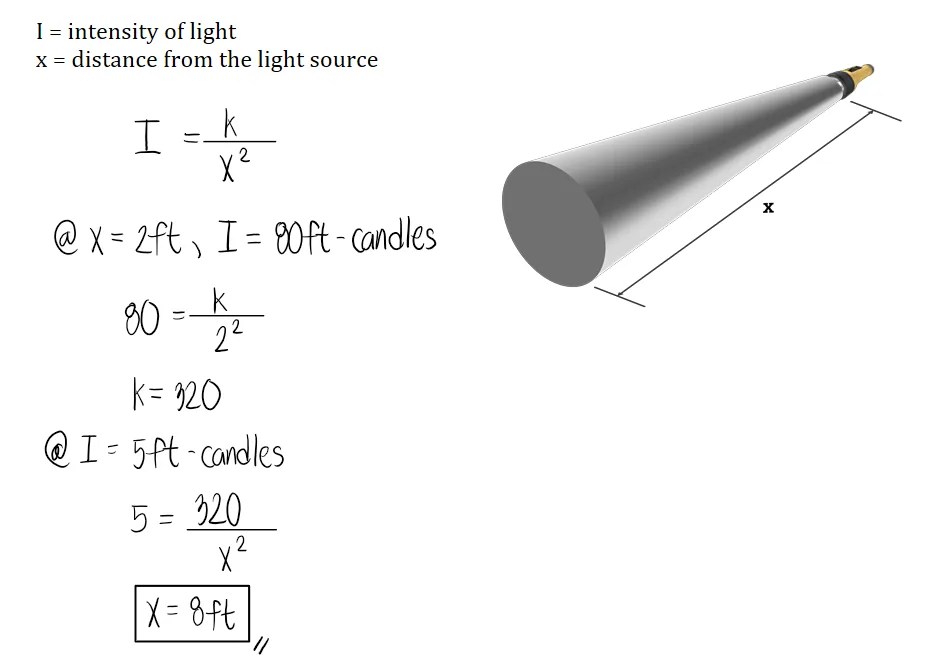
The intensity of light (in foot-candle) varies inversely as the square of x, the distance in feet from the light source. The intensity of light 2 ft from the source is 80 ft-candles. How far away is the source if intensity of light is 5 ft-candles?
See images:
Problem:
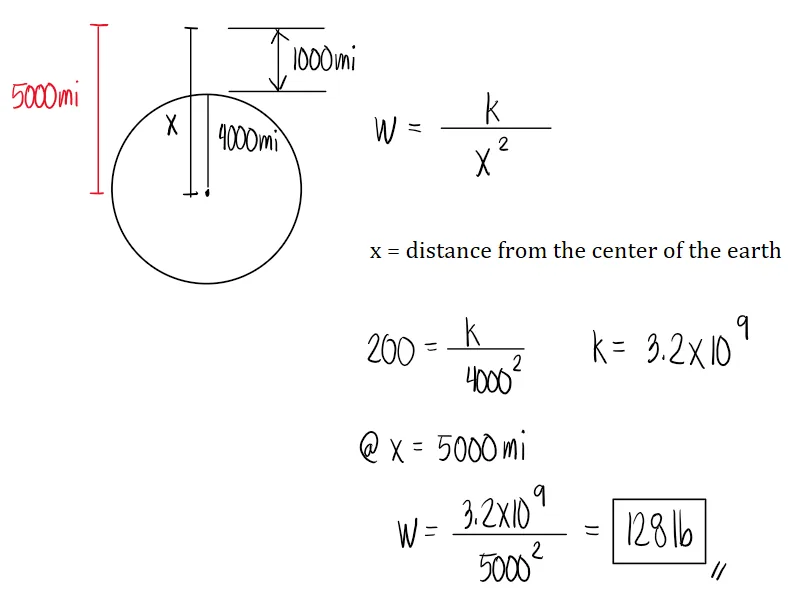
The weight of a body varies inversely as the square of its distance from the center of the earth. If the radius of the earth is 4000 miles, how much would a 200-pound man weigh 1000 miles above the surface of the earth?
See images:
Problem:
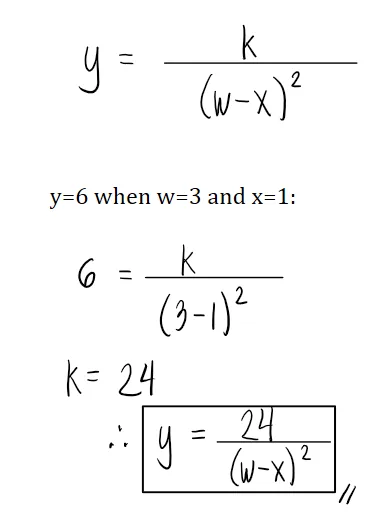
Given that y varies inversely as the square of the difference of w and x, and that y=6 when w=3 and x=1, find the equation for y.
See images:
Problem:
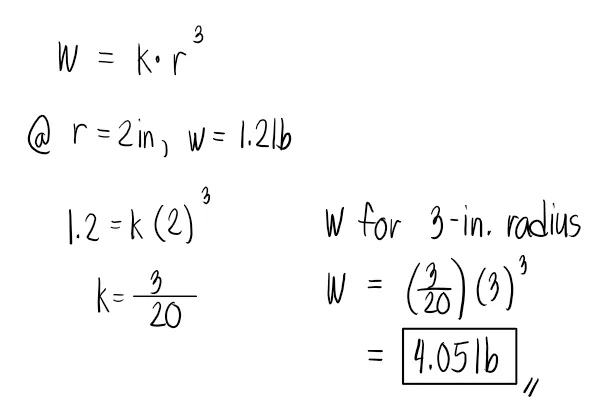
The weight of a synthetic ball varies directly with the cube of its radius. A ball with a radius of 2 inches weighs 1.20 pounds. Find the weight of a ball of the same material with a 3-inch radius.
See images:
Problem:
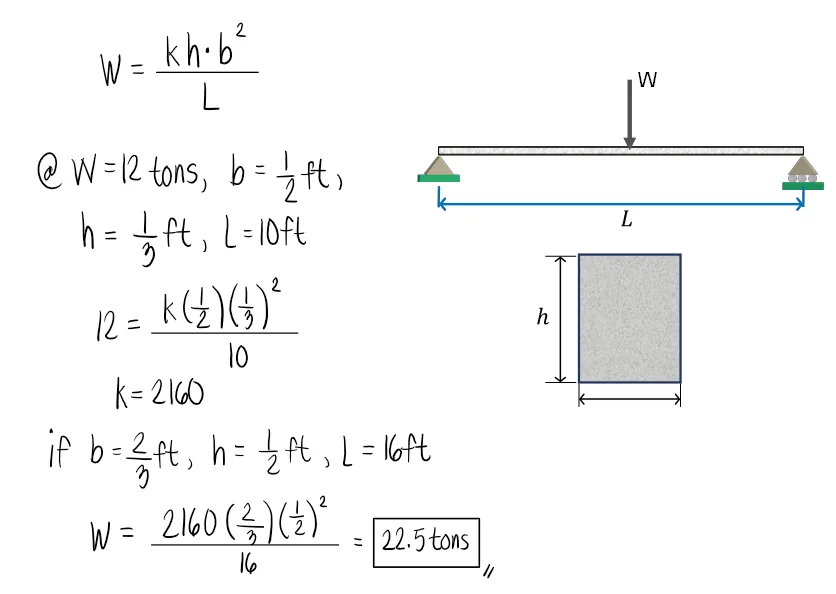
The maximum weight that a rectangular beam can support varies jointly as its width and the square of its height and inversely as its length. If a beam 1/2 foot wide, 1/3 foot high, and 10 feet long can support 12 tons, find how much a similar beam can support if the beam is 2/3 foot wide, 1/2 foot high, and 16 feet long.
See images:
-->
Exam Generator Problems
Additional board-style practice items for this topic.
The intensity of light (in foot-candle) varies inversely as the square of x, the distance in feet from the light source. The intensity of light 2 ft from the source is 80 ft-candles. How far away is the source if intensity of light is 5 ft-candles?
Answer:
8
9
12
13
Since intensity varies inversely as the square of distance: $I=\frac{k}{x^2}$ Using $I=80$ at $x=2$: $80=\frac{k}{2^2}$, so $k=320$. For $I=5$: $5=\frac{320}{x^2}$ $x^2=64$ $\boxed{x=8}$
What is the sum of all odd integers between 7 and 777?
Answer:
150528
152508
158502
152805
The odd integers strictly between 7 and 777 are 9, 11, ..., 775. The count is: $n=\frac{775-9}{2}+1=384$ Average of first and last: $\frac{9+775}{2}=392$ Sum: $384(392)=150528$ $\boxed{150528}$
The weight that can be safely supported by a beam with a rectangular cross section varies directly as the product of the width and square of the depth of the cross section and inversely as the length of the beam. If a 2-inch by 4-inch beam that is 8 feet long safely supports a load of 500 pounds, what weight can be safely supported by a 2-inch by 8-inch beam that is 10 feet long? (Assume that the width is the shorter dimension of the cross section.)
Answer:
1600lb
1200lb
1800lb
1400lb
The safe load varies as $W\propto \frac{bd^2}{L}$. Compare the new beam with the original: $\frac{W_2}{500}=\frac{2(8^2)/10}{2(4^2)/8}$ $\frac{W_2}{500}=3.2$ $\boxed{W_2=1600\text{ lb}}$
Given that w varies directly as the product of x and y and inversely as the square of z and that w=4 when x=2, y=6, and z=3. Find w when x=1, y=4, and z=2.
Answer:
3
1
4
2
The variation model is: $w=k\frac{xy}{z^2}$ Use $w=4$, $x=2$, $y=6$, $z=3$: $4=k\frac{12}{9}$, so $k=3$. For $x=1$, $y=4$, $z=2$: $w=3\frac{(1)(4)}{2^2}=3$ $\boxed{3}$
The intensity of light (in foot-candles) varies inversely as the square of x, the distance in feet from the light source.
The intensity of light 2 feet from the source is 80 foot-candles.
How far away is the source if the intensity of light is 5 foot-candles?
8 ft
7 ft
5 ft
6 ft
Since intensity varies inversely as square distance: $I=\frac{k}{x^2}$ At $x=2$, $80=k/4$, so $k=320$. For $I=5$: $5=320/x^2$ $x=8$ ft $\boxed{8\text{ ft}}$
The amount of pollution P varies directly with population N.
Kansas City has a population of 442,000 and produces 260,000 tons of pollutants.
Find how many tons of pollution we should expect St. Louis to produce if its population is 348,000. Round to the nearest whole ton.
204,706 tons
104,606 tons
204,806 tons
104,706 tons
Direct variation gives: $\frac{P}{N}=\frac{260000}{442000}$ For St. Louis: $P=348000\left(\frac{260000}{442000}\right)$ $\boxed{204{,}706\text{ tons}}$
If the power of an engine grows by 10% when the number of its cylinders is increased by one, which of the following is closest to the ratio of the power of a 9-cylinder engine to that of a 12-cylinder engine?
0.75
0.69
0.71
0.72
If power increases by 10% per added cylinder, then going from 9 to 12 cylinders multiplies by $1.1^3$. Therefore: $\frac{P_9}{P_{12}}=\frac{1}{1.1^3}=0.751$ $\boxed{0.75}$
For a gas at constant temperature, the volume of a fixed mass of gas is inversely proportional to its absolute pressure. If a gas occupies a volume of $1.5 \text{ m}^3$ at a pressure of $200 \times 10^3 \text{ Pascals}$, determine the pressure when the volume is $1.25 \text{ m}^3$.
$220 \times 10^3 \text{ Pa}$
$240 \times 10^3 \text{ Pa}$
$230 \times 10^3 \text{ Pa}$
$250 \times 10^3 \text{ Pa}$
At constant temperature, pressure and volume are inversely proportional: $P_1V_1=P_2V_2$. $(200\times10^3)(1.5)=P_2(1.25)$ $P_2=240\times10^3\text{ Pa}$ $\boxed{240\times10^3\text{ Pa}}$
Ohm's law states that the current flowing in a fixed resistor is directly proportional to the applied voltage. When 30 volts is applied across a resistor the current flowing through the resistor is $2.4 \times 10^{-3} \text{ amperes}$. Determine the following:
The constant of proportionality.
$16 \times 10^{-4}$
$12 \times 10^{-4}$
$8 \times 10^{-5}$
$4 \times 10^{-5}$
The current when the voltage is 52 volts.
$2.84 \times 10^{-3} \text{ amperes}$
$6.82 \times 10^{-3} \text{ amperes}$
$4.16 \times 10^{-3} \text{ amperes}$
$4.85 \times 10^{-3} \text{ amperes}$
The voltage when the current is $3.6 \times 10^{-3} \text{ amperes}$.
45 volts
40 volts
60 volts
50 volts
Part 1.
Direct proportion gives $I=kV$. $k=\frac{I}{V}=\frac{2.4\times10^{-3}}{30}=8\times10^{-5}$ $\boxed{8\times10^{-5}}$
Part 2.
Use $I=kV$ with $k=8\times10^{-5}$. For $V=52$: $I=(8\times10^{-5})(52)=4.16\times10^{-3}\text{ amperes}$ $\boxed{4.16\times10^{-3}\text{ amperes}}$
Part 3.
Use $I=kV$ with $k=8\times10^{-5}$. $V=\frac{I}{k}=\frac{3.6\times10^{-3}}{8\times10^{-5}}=45\text{ volts}$ $\boxed{45\text{ volts}}$
Charles's law states that for a given mass of gas at constant pressure the volume is directly proportional to its thermodynamic temperature. A gas occupies a volume of 2.25 liters at $300^\circ\text{K}$. Determine the following:
The constant of proportionality.
0.00625
0.00525
0.0075
0.0058
The volume at $420^\circ\text{K}$.
3.25 liters
3.15 liters
2.85 liters
3.85 liters
The temperature when the volume is 2.625 liters.
$340^\circ\text{K}$
$380^\circ\text{K}$
$360^\circ\text{K}$
$350^\circ\text{K}$
Part 1.
Charles's law gives direct proportion: $V=kT$. $k=\frac{V}{T}=\frac{2.25}{300}=0.0075$ $\boxed{k=0.0075}$
Part 2.
Use $V=kT$ with $k=0.0075$. At $T=420$: $V=(0.0075)(420)=3.15\text{ liters}$ $\boxed{3.15\text{ liters}}$
Part 3.
Use $V=kT$ with $k=0.0075$. $T=\frac{V}{k}=\frac{2.625}{0.0075}=350^\circ\text{K}$ $\boxed{350^\circ\text{K}}$
Question Bank: t2154
MSTE - Algebra / Variation Problems / Besavilla CE Pre-Board Math & Surveying
Boyle's law states that for a gas at constant temperature, the volume of a fixed mass is inversely proportional to its absolute pressure. If a gas occupies a volume of 1.5 m$^3$ at a pressure of $200 \times 10^3$ Pascals, determine the volume when the pressure is $800 \times 10^3$ Pascals.
0.375 m3
0.558 m3
0.235 m3
0.878 m3
0.735 m3
By Boyle's law at constant temperature, $P_1V_1=P_2V_2$. $(200\times10^3)(1.5)=(800\times10^3)V_2$ $V_2=\frac{(200\times10^3)(1.5)}{800\times10^3}$ $\boxed{V_2=0.375\text{ m}^3}$
Question Bank: w231
MSTE - Algebra / Variation Problems / MSTE April 2025
The intensity of light (in foot-candles) varies inversely as the square of x, the distance in feet from the light source. The intensity of light 2 feet from the source is 80 foot-candles. How far away is the source if the intensity of light is 5 foot-candles?
7 ft
5 ft
6 ft
8 ft
Inverse-square variation: $I = \dfrac{k}{x^{2}}\ \Rightarrow\ k = I x^{2}$ The constant $k$ is the same for both conditions: $I_2 x_2^{2} = I_1 x_1^{2}$ $5x_2^{2} = 80(2)^{2}$ $5x_2^{2} = 320$ $\boxed{x_2 = 8\ \text{ft}}$