Work problems involve calculating how long it takes for individuals or groups to complete a task, either separately or together. The standard model is:
If a person or machine can complete a task in $x$ hours, the rate of work is:
$$
r = \frac{1}{x}
$$
Combined Work Rate:
When multiple agents work together:
$$
r_{\text{total}} = r_1 + r_2 + \dots
$$
Man-Hour or Man-Day Problems:
Another type of work problem involves man-hours or man-days as a unit of work. These problems assume the total work remains the same, and the number of workers and time vary.
$\text{Work} = $ number of tasks or units of output
This method is especially useful when the number of workers or amount of work changes across different scenarios.
Problem:
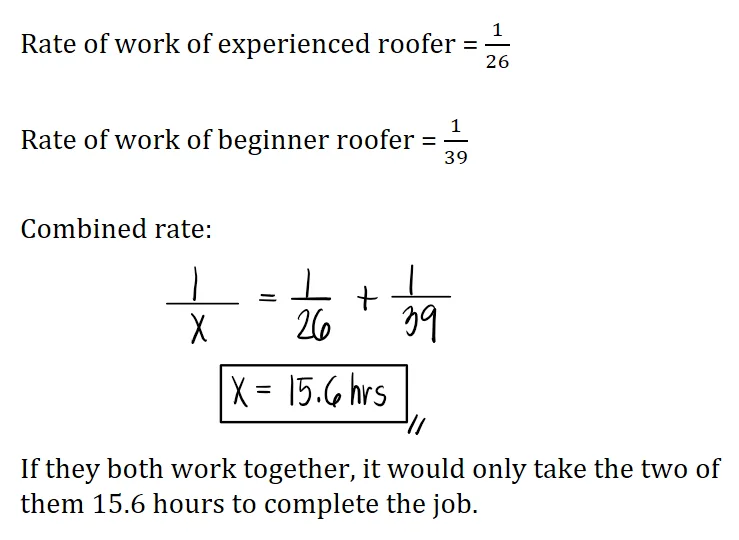
An experienced roofer can roof a house in 26 hours. A beginner roofer needs 39 hours to complete the same job. Find how long it takes for the two to do the job together? Ans. 15.6 hours
See images:
Problem:
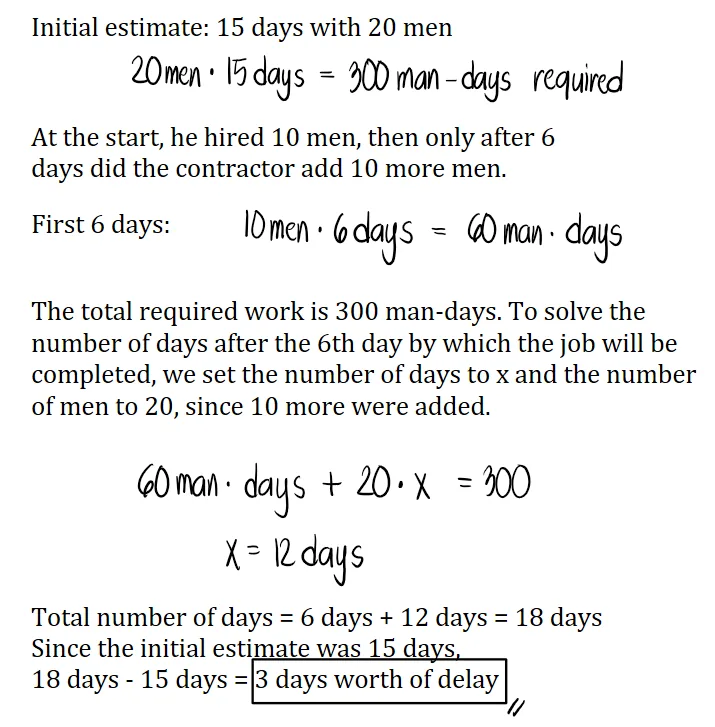
A contractor estimates that he could finish the project in 15 days if he has 20 men. At the start, he hired 10 men, then after 6 days, 10 more men are added. How many days was the project delayed? Ans. 3 days
See images:
Problem:
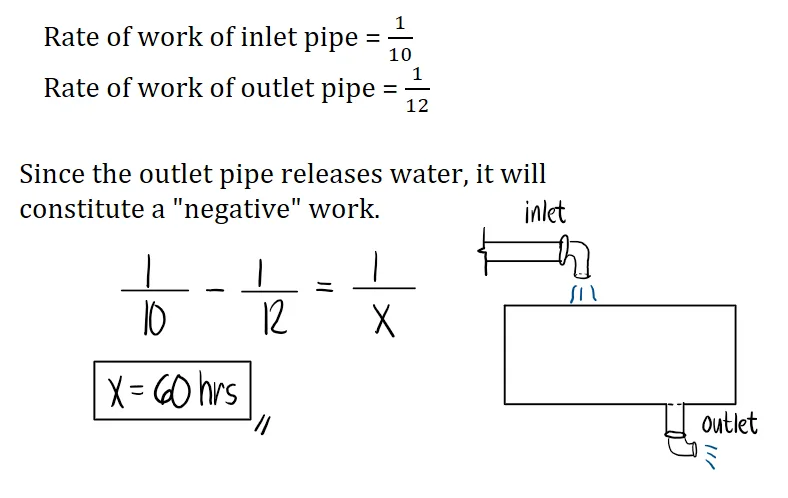
A swimming pool can be filled by an inlet pipe in 10 hours and emptied by an outlet pipe in 12 hours. One day, the pool is empty and the owner opens the inlet pipe to fill the pool, but he forgets to close the outlet. With both pipes open, how long would it take to fill the pool? Ans. 60 hours
See images:
Problem:
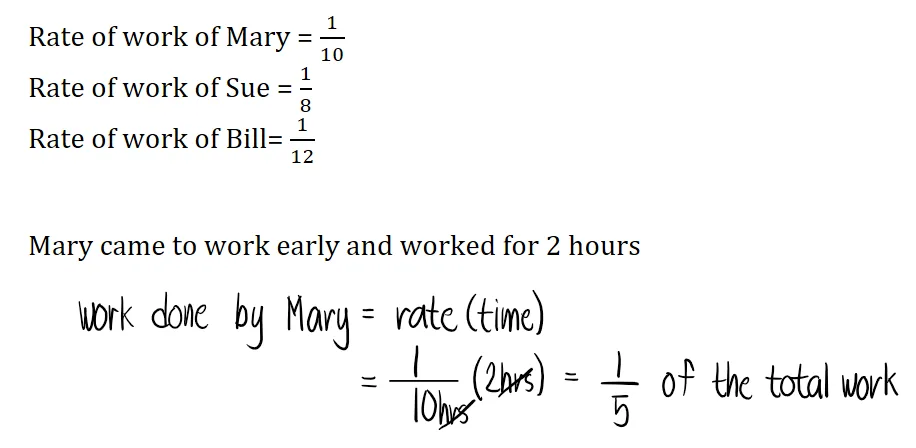
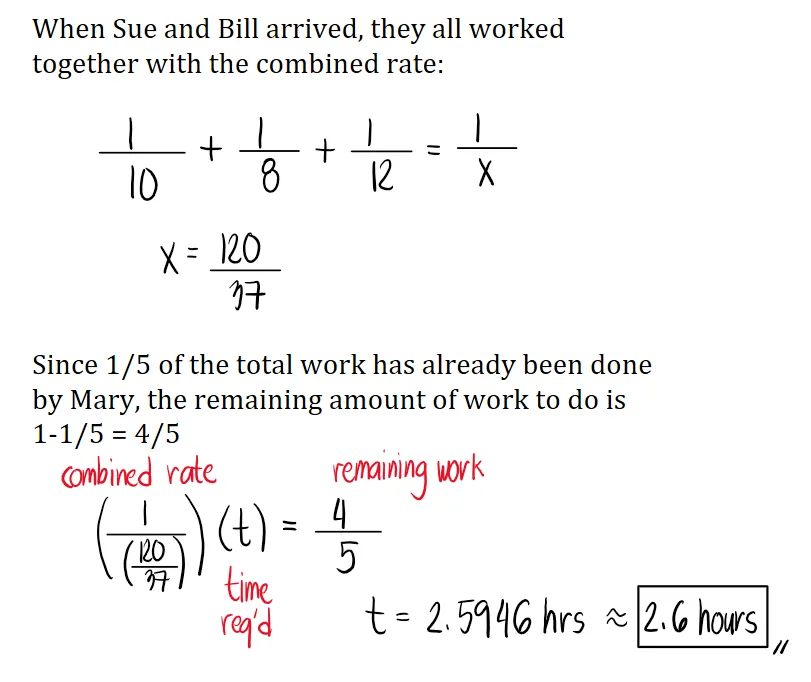
Mary, Sue, and Bill work at a motel. If each worked alone, it would take Mary 10 hours, Sue 8 hours, and Bill 12 hours to clean the whole motel. One day, Mary came to work early and she had cleaned for 2 hours when Sue and Bill arrived and all three finished the job. How long did they take to finish? Ans. 2.6 hours
See images:
-->
Exam Generator Problems
Additional board-style practice items for this topic.
An experienced roofer can roof a house in 26 hours. A beginner roofer needs 39 hours to complete the same job. Find how long it takes for the two to do the job together?
Answer:
15.6
16.5
14.7
17.4
Add the work rates: $\frac{1}{T}=\frac{1}{26}+\frac{1}{39}$ $\frac{1}{T}=\frac{3+2}{78}=\frac{5}{78}$ $T=15.6$ hours $\boxed{15.6}$
A contractor estimates that he could finish the project in 15 days if he has 20 men. At the start, he hired 10 men, then after 6 days, 10 more men are added. How many days was the project delayed?
Answer:
3
4
5
6
Total work is $20(15)=300$ man-days. The first 6 days with 10 men complete: $10(6)=60$ man-days Remaining work: $300-60=240$ man-days With 20 men, remaining time is $240/20=12$ days. Total actual time is $6+12=18$ days, so delay is: $18-15=3$ days $\boxed{3}$
The Jager-Bomb is a popular party-starting shot. Normally a 4.2-ounce mix contains 35% Jägermeister. Arataki Itto likes to act tough and wants to try a mix with 70% Jägermeister. How many ounces of pure Jägermeister must be added to a normal mix to obtain the desired mix?
Answer:
4.9
4.5
5.2
5.6
Let $x$ be ounces of pure J?germeister added. Initial J?germeister is $0.35(4.2)=1.47$ oz. Desired concentration: $\frac{1.47+x}{4.2+x}=0.70$ $1.47+x=2.94+0.70x$ $0.30x=1.47$ $\boxed{x=4.9}$
A pump can pump out a tank in 11 hours. Another pump can pump out the same tank in 20 hours. How long will it take both pumps together to pump out the tank?
Mr. Brown can wash his car in 15 minutes, while his son John takes twice as long as the same job. If they work together, how many minutes can they do the washing?
One pipe can fill a tank in 5 hours and another pipe can fill the same tank in 4 hours. A drainpipe can empty the full content of the tank in 20 hours. With all the three pipes open, how long will it take to fill the tank?
Answer:
2.5 hours
2 hours
1.92 hours
1.8 hours
Fill rates: $\frac{1}{5}$ + $\frac{1}{4}$ per hr; drain: $\frac{1}{20}$ per hr. Net rate: $\frac{1}{5}+\frac{1}{4}-\frac{1}{20} = \frac{4+5-1}{20} = \frac{8}{20} = \frac{2}{5}$ tank/hr $\boxed{t = 2.5 \text{ hours}}$
Three persons can do a piece of work alone in 3 hours, 4 hours, and 6 hours, respectively. What fraction of the job can they finish in one hour working together?
Answer:
3/4
4/3
1/2
2/3
Rates: $\frac{1}{3}$ + $\frac{1}{4}$ + $\frac{1}{6}$ job/hr. In 1 hour: $\frac{1}{3}+\frac{1}{4}+\frac{1}{6} = \frac{4+3+2}{12} = \frac{9}{12}$ $\boxed{= \frac{3}{4} \text{ of the job}}$
A father and his son can dig a well if the father works 6 hours and his son works 12 hours, or they can do it if the father works 9 hours and the son works 8 hours. How long will it take for the son to dig the well alone?
Answer:
20 hours
15 hours
10 hours
25 hours
Let $F$ = father's time alone, $S$ = son's time alone. $ \frac{6}{F}+\frac{12}{S}=1 \quad (1)$ $ \frac{9}{F}+\frac{8}{S}=1 \quad (2)$ Multiply (1) by $\frac{3}{2}$: $\frac{9}{F}+\frac{18}{S}=\frac{3}{2}$ Subtract (2): $\frac{10}{S}=\frac{1}{2}$ $\boxed{S = 20 \text{ hours}}$
CE Board November 1998 A job could be done by eleven workers in 15 days. Five workers started the job. They were reinforced with four more workers at the beginning of the 6th day. Find the total number of days it took them to finish the job.
Answer:
20.56
23.22
22.36
21.42
Total work = $11 \times 15 = 165$ worker-days. First 5 days (5 workers): work done = $5 \times 5 = 25$ wd. Remaining = $165 - 25 = 140$ wd with $5+4 = 9$ workers: Additional days = $\frac{140}{9} = 15.56$ days. Total: $5 + 15.56$ $\boxed{\approx 20.56 \text{ days}}$
Mary, Sue, and Bill work at a motel. If each worked alone, it would take Mary 10 hours, Sue 8 hours, and Bill 12 hours to clean the whole motel. One day, Mary came to work early and she had cleaned for 2 hours when Sue and Bill arrived and all three finished the job. How long did they take to finish?
Answer:
2.6 hours
2.7 hours
2.4 hours
2.5 hours
Rates: Mary $=\frac{1}{10}$, Sue $=\frac{1}{8}$, Bill $=\frac{1}{12}$ motel/hr. Mary works 2 hr alone first: fraction done $= \frac{2}{10} = \frac{1}{5}$. Remaining $= \frac{4}{5}$; combined rate $= \frac{1}{10}+\frac{1}{8}+\frac{1}{12} = \frac{12+15+10}{120} = \frac{37}{120}$ $t = \frac{4/5}{37/120} = \frac{4}{5} \times \frac{120}{37} = \frac{96}{37}$ $\boxed{\approx 2.6 \text{ hours (after all three start)}}$
A father and his son can dig a well if the father works for 6 hours and his son works for 12 hours, or they can do it if the father works 9 hours and the son works 8 hours. How long will it take for the father to dig the well alone?
Answer:
15 hours
10 hours
12 hours
20 hours
Let the father's rate be $f$ and the son's rate be $s$. The two work conditions give: $6f+12s=1$ $9f+8s=1$ Solving gives $f=1/15$, so the father alone needs: $\boxed{15\text{ hours}}$
Nonoy can finish a certain job in 10 days if Imelda will help for 6 days. The same work can be done by Imelda in 12 days if Nonoy helps for 6 days. If they work together, how long will it take for them to do the job?
Answer:
8.4
8.9
9.2
8.0
Let Nonoy's and Imelda's daily work rates be $n$ and $i$. The statements give: $10n+6i=1$ $6n+12i=1$ Solving gives $n=1/14$ and $i=1/21$. Together: $n+i=\frac{1}{14}+\frac{1}{21}=\frac{5}{42}$ $T=\frac{42}{5}=8.4$ days $\boxed{8.4}$
A contractor estimated that one of his two bricklayers would take 9 hours to build a certain wall and the other 10 hours. However, from experience he knew that if they worked together 10 fewer bricks get laid per hour. Since he was in a hurry, he put both men on the job and found it took exactly 5 hours to build the wall.
How many bricks did it contain?
900
800
1000
1100
Let the wall contain $N$ bricks. Working separately, the rates are $N/9$ and $N/10$. The combined actual rate is 10 bricks/hr less than their sum: $\frac{N}{5}=\frac{N}{9}+\frac{N}{10}-10$ $\frac{N}{5}=\frac{19N}{90}-10$ $N=900$ $\boxed{900}$
A contractor has 50 men of the same capacity at work on a job. They can complete the job in 30 days, but the contract expired in 20 days. He decides to put 20 additional men if the men get P600/day for a full or part day and if the liquidated damages are P50,000 for every full or part day the day he requires over his contract time.
How much money does he save or lose by putting 20 additional men?
Save: P376,000
Loss: P376,000
Loss: P650,000
Even
Total work is $50(30)=1500$ man-days. With 70 men, time needed is $1500/70=21.43$, counted as 22 days. Cost with added men: $70(22)(600)+2(50{,}000)=1{,}024{,}000$ Without added men, delay is 10 days, so cost is: $50(30)(600)+10(50{,}000)=1{,}400{,}000$ Savings: $1{,}400{,}000-1{,}024{,}000=376{,}000$ $\boxed{\text{Save: P376,000}}$
A furniture manufacturer has two machines, but only one can be used at a time.
Machine A works the first shift, Machine B works the second shift, and both work half of the third shift.
Machine A can do the job in 12 days working two shifts, and Machine B can do the job in 15 days working two shifts.
How many days will it take to do the job with the current work schedule?
9
14
13
11
Measure work in shifts. Machine A completes the job in 24 shifts, so rate $=1/24$ per shift. Machine B completes it in 30 shifts, so rate $=1/30$ per shift. Each day: A works 1.5 shifts and B works 1.5 shifts. Daily work: $1.5/24+1.5/30=0.1125$ Time: $1/0.1125=8.89$ days $\boxed{9}$
Question Bank: t11
MSTE - Algebra / Work Problems / Civil Engineering Refresher
Cokoy can complete a job in 1 hour, Paul in 2 hours, and Proxy in 3 hours. How long will it take them to finish the job if they all work together?
MSTE - Algebra / Work Problems / Civil Engineering Refresher
A specific job can be finished in 14 days by a crew of 9 men working 10 hours a day. How many days will it take for 12 men working 7 hours a day to complete the same task?
15 days
12 days
18 days
14 days
Total work $= 9 \times 10 \times 14 = 1260$ man-hours. New rate $= 12 \times 7 = 84$ man-hours/day. Days $= \frac{1260}{84}$ $\boxed{= 15 \text{ days}}$
Question Bank: t13
MSTE - Algebra / Work Problems / Civil Engineering Refresher
Three postal workers can sort a stack of mail in 20, 30, and 60 minutes respectively. Find the time required if all three work together.
10 min
15 min
12 min
20 min
Combined rate $= \frac{1}{20} + \frac{1}{30} + \frac{1}{60} = \frac{3 + 2 + 1}{60} = \frac{1}{10}$ per min. Time $= \frac{1}{1/10}$ $\boxed{= 10 \text{ min}}$
Tanya produced three lanterns on her first hour of work. Her boss told her, "DO IT FAST". This made her work even slower making only two lanterns per hour for the next two hours. When her friend Michelle told her "YOU CAN DO IT", it motivated her to make 5 lanterns on the fourth hour. What is her average production speed in lanterns per hour?
2.5
4
3.5
3
Total lanterns made: $3+2+2+5=12$. Total time is 4 hours. Average production speed $=\frac{12}{4}=3$ lanterns per hour. $\boxed{3}$
Kim can do a work in 1 hour, Ken can do it in 2 hours, and Karla can do it in 3 hours. Working together from start, how long can they do the work?
0.5455 hr
0.5623 hr
0.4562 hr
0.6175 hr
Their combined work rate is: $1+\frac{1}{2}+\frac{1}{3}=\frac{11}{6}$ jobs/hr. Time for one job $=\frac{1}{11/6}=\frac{6}{11}=0.5455\text{ hr}$ $\boxed{0.5455\text{ hr}}$
A water tank can be filled in 52 minutes by two pipes running simultaneously. By the larger pipe, it can be filled in 15 minutes less time than by the smaller pipe. Find the time required by the larger pipe to fill the tank.
Eight men can dig 150 ft of trench in 7 hours. Three men can backfill 100 ft of trench in 4 hours. How long will it take 6 men to dig and fill 200 ft of trench, in hours?
16.445
12.345
15.765
14.875
Digging rate per man: $\frac{150}{8(7)}=\frac{75}{28}$ ft/hr. Time for 6 men to dig 200 ft: $\frac{200}{6(75/28)}=12.444$ hr. Backfill rate per man: $\frac{100}{3(4)}=\frac{25}{3}$ ft/hr. Time for 6 men to backfill 200 ft: $\frac{200}{6(25/3)}=4$ hr. Total time $=12.444+4=16.445$ hr. $\boxed{16.445}$
Maria can do a job in 6 hours. Jhul can do the same job in 4 hours more while Vince can do it in twice the time. How many hours can they finish the job if they work together from start?
2.758
2.857
2.785
2.587
Maria's time is 6 hr, Jhul's time is $6+4=10$ hr, and Vince's time is $2(6)=12$ hr. Combined rate $=\frac{1}{6}+\frac{1}{10}+\frac{1}{12}=\frac{7}{20}$ job/hr. Time $=\frac{1}{7/20}=\frac{20}{7}=2.857$ hr. $\boxed{2.857}$
Three persons can do a work in the ratio 2:3:5. Working together, they can finish the work in 120 minutes. What is the difference of the times to finish between the slowest and the fastest person.
372 minutes
248 minutes
124 minutes
324 minutes
Let their individual times be $2x$, $3x$, and $5x$ minutes. Working together: $\frac{1}{2x}+\frac{1}{3x}+\frac{1}{5x}=\frac{1}{120}$ $\frac{31}{30x}=\frac{1}{120} \Rightarrow x=124$ Fastest time $=2x=248$ minutes; slowest time $=5x=620$ minutes. Difference $=620-248=372$ minutes. $\boxed{372\text{ minutes}}$
A building contractor is faced with a problem of possibly paying liquidated damages of P20,000 per day for the delay in the completion of his work. Given the following information: (1) Number of days left on contract time is 30 days. (2) The working force at present is: 40 skilled workers with daily wage of P400 each, 20 unskilled workers with daily wage of P320 each. (3) The daily wage is based on an 8-hour day's work. (4) If he maintains the present workforce, he will finish the work in 50 days. (5) Overtime rate is 25% more than the regular rate.
If he allows the present working force to work overtime for two hours a day, in how many days will he finish the work?
35
40
45
38
How much will he save (in pesos) if he allows the present working force to work overtime for two hours a day?
144,000
158,000
187,000
120,000
If the contractor put additional men (maintaining the ratio of 2 skilled to 1 unskilled), how many skilled workers will he add to finish the work on time without working overtime?
30
36
24
28
Part 1.
Present work requires 50 days at 8 hours/day, so total work is proportional to $50(8)=400$ work-hours per crew. With 2 hours overtime, the crew works 10 hours/day. Days required $=\frac{400}{10}=40$ days. $\boxed{40}$
Part 2.
Regular daily wage: $40(400)+20(320)=22400$. No overtime option: labor $=50(22400)=1120000$ and delay damages $=20(20000)=400000$, total $=1520000$. With overtime: overtime hourly wages are 25% higher. Daily overtime cost for 2 hours is $40(50)(1.25)(2)+20(40)(1.25)(2)=7000$. Daily cost $=22400+7000=29400$; for 40 days, labor $=1176000$. Delay is 10 days, damages $=200000$, total $=1376000$. Savings $=1520000-1376000=144000$. $\boxed{144,000}$
Part 3.
To finish in 30 days instead of 50, the workforce must increase by $\frac{50}{30}=\frac{5}{3}$. Current ratio is 40 skilled to 20 unskilled, or 2:1. Required skilled workers $=40\left(\frac{5}{3}\right)=66.67$. Additional skilled workers needed is about $66.67-40=26.67$. To keep whole workers and the 2:1 ratio, add 28 skilled workers and 14 unskilled workers. $\boxed{28}$
A company has $N$ machines of equal capacity that produces a total of 180 pieces each work day. If two machines break down, the work load of the remaining machines is increased by 3 pieces each per day to maintain production. Find $N$.
12
11
10
9
Original output per machine is $\frac{180}{N}$. After two machines break down, output per remaining machine is $\frac{180}{N-2}$, which is 3 more: $\frac{180}{N-2}=\frac{180}{N}+3$ $180N=(N-2)(180+3N)$ $N^2-2N-120=0 \Rightarrow N=12$ $\boxed{12}$
A freight train leaves a station and travels at the rate of 30 kph. Two hours later, an express train leaves the same station traveling in the same direction at a rate of 50 kph.
In how many hours will the express train be 10 km behind the freight train?
3.5
5
4
4.5
In how many hours will the express train overtake the freight train?
5
3.5
4.5
4
Part 1.
Let $t$ be hours after the freight train leaves. The express train travels for $t-2$ hours. For the express train to be 10 km behind: $50(t-2)=30t-10$ $50t-100=30t-10 \Rightarrow 20t=90 \Rightarrow t=4.5$ hr. $\boxed{4.5}$
Part 2.
Let $t$ be hours after the freight train leaves. At overtake, distances are equal: $50(t-2)=30t$ $50t-100=30t \Rightarrow 20t=100 \Rightarrow t=5$ hr. $\boxed{5}$
The captain of a chess team assigns himself to board 1. If there are six players (including the captain), how many ways can the team be assigned to the boards if there are six chess boards.
720
120
240
60
The captain is fixed on board 1. The remaining 5 players can be assigned to the remaining 5 boards in $5!$ ways. $5!=120$ $\boxed{120}$
Only the generator operates satisfactorily means the generator works and the welding machine does not. $P=0.80(1-0.75)=0.80(0.25)=0.20$ $\boxed{0.20}$
Part 3.
Only the welding machine operates satisfactorily means the welding machine works and the generator does not. $P=(1-0.80)(0.75)=0.20(0.75)=0.15$ $\boxed{0.15}$
A large batch of electric light bulbs have a mean time to failure of 2400 hours and the standard deviation of 60 hours for a batch of 4200 bulbs.
How many light bulbs will likely last more than 2500 hours?
$201$
$256$
$183$
$154$
What percentage of the total number of bulbs will likely last between 2200 hours to 2500 hours?
$92.74%$
$90.28%$
$95.18%$
$96.35%$
What is the probability that any light bulb will last for 2450 hours?
$0.0054$
$0.0031$
$0.0063$
$0.0047$
Part 1.
Assume lifetimes are normally distributed with $\mu=2400$ and $\sigma=60$. For 2500 hours: $z=\frac{2500-2400}{60}=1.67$. $P(X>2500)=1-\Phi(1.67)\approx0.0478$. Expected bulbs $=4200(0.0478)=201$. $\boxed{201}$
Part 2.
$z_{2200}=\frac{2200-2400}{60}=-3.33$ and $z_{2500}=\frac{2500-2400}{60}=1.67$. $P(2200$\approx0.9525-0.0004=0.9518=95.18\%$ $\boxed{95.18\%}$
Part 3.
The keyed value uses the normal density at $x=2450$. $z=\frac{2450-2400}{60}=0.8333$ $f(2450)=\frac{1}{60\sqrt{2\pi}}e^{-z^2/2}=0.0047$ $\boxed{0.0047}$
Studies of a machine component showed that the time the component operates before breaking down is exponentially distributed with a mean of 1000 hours. Calculate the maximum operating hours if the reliability is to be above $99%$.
$9.54\text{ hours}$
$6.58\text{ hours}$
$10.05\text{ hours}$
$12.67\text{ hours}$
For an exponential lifetime with mean 1000 hours, reliability is $R(t)=P(T>t)=e^{-t/1000}$. Set reliability to 99%: $0.99=e^{-t/1000}$ $t=-1000\ln(0.99)=10.05\text{ hours}$. $\boxed{10.05\text{ hours}}$
Question Bank: t2085
MSTE - Algebra / Work Problems / Besavilla CE Pre-Board Math & Surveying
It takes 21 hrs. for 12 men to resurface a stretch of road. Find how many men it takes to resurface a similar stretch of road in 50 hrs. and 24 min, assuming the work rate remains constant.
3 men
5 men
4 men
6 men
7 men
Total work is constant in man-hours. Original work: $12(21)=252$ man-hours Required time: $50\text{ hr }24\text{ min}=50.4$ hr Number of men: $n=\frac{252}{50.4}$ $\boxed{5\text{ men}}$
Question Bank: t2091
MSTE - Algebra / Work Problems / Besavilla CE Pre-Board Math & Surveying
If 3 people can complete a task in 4 hours, find how long will it take 5 people to complete the same task, assuming the rate of work remains constant.
3.6 hrs.
2.4 hrs.
2.2 hrs.
3.2 hrs.
1.7 hrs.
Total work is measured in person-hours. $3\text{ people}\times4\text{ hours}=12\text{ person-hours}$ With 5 people working at the same rate: $t=\frac{12}{5}$ $\boxed{t=2.4\text{ hrs.}}$
Question Bank: w3
MSTE - Algebra / Work Problems / MSTE May 2019
In 2 minutes, a conveyor belt can move 300 pounds of recyclable aluminum from the delivery truck to a storage area. A smaller belt can move the same quantity of cans the same distance in 6 minutes. If both belts are used, find how long it takes to move the cans to the storage area.
2.5 minutes
1 minute
2.0 minutes
1.5 minutes
Let $t$ be the time for both belts working together: $\frac{1}{2}t + \frac{1}{6}t = 1$ $\frac{2}{3}t = 1$ $\boxed{t = 1.5\text{ min}}$