Manning Equation
Open-channel flow has a free surface exposed to atmosphere. For uniform flow, the bed slope, water-surface slope, and energy slope are commonly taken equal.
$$Q=\frac{1}{n}AR^{2/3}S^{1/2}$$$$R=\frac{A}{P}$$

Open-channel flow has a free surface exposed to atmosphere. For uniform flow, the bed slope, water-surface slope, and energy slope are commonly taken equal.
Critical flow separates subcritical and supercritical conditions. For a rectangular channel:
A hydraulic jump is a rapidly varied flow where high-velocity shallow flow changes into deeper slower flow with energy loss.
A rectangular channel carries 3.6 m3/s and is 2.0 m wide. Find critical depth.
Answer: $y_c=0.691\text{ m}$.
A rectangular channel is 3.0 m wide and carries water 1.2 m deep on a slope of 0.0016. If $n=0.015$, find the discharge for uniform flow.
Answer: $Q=7.34\text{ m}^3/\text{s}$.
A rectangular channel must carry 5.0 m3/s with $n=0.014$ and slope $S=0.001$. For the most efficient rectangular section, find the normal depth and width.
For the best rectangular section, $b=2y$, $A=2y^2$, and $R=y/2$.
Answer: $y=1.31\text{ m}$ and $b=2.62\text{ m}$.
In a rectangular channel, supercritical flow has depth $y_1=0.40\text{ m}$ and velocity $V_1=6.0\text{ m/s}$. Find the sequent depth and energy loss across the hydraulic jump.
Answer: $y_2=1.53\text{ m}$ and energy loss is 0.588 m.
A trapezoidal channel has a bottom width of 2.0 m and side slopes of 1.5H:1V (1.5 horizontal to 1 vertical). The channel is lined with concrete (Manning's n = 0.013) and laid on a slope of S = 0.0009. Find the normal discharge when the water depth is 1.20 m.
Compute the geometric elements for a trapezoidal section with b = 2.0 m, z = 1.5 (side slope), y = 1.20 m:
Answer: Normal discharge is Q ≈ 8.46 m³/s. Trapezoidal channels are widely used in irrigation because the sloped sides are stable in soil and the section is close to the most efficient trapezoidal shape (half-hexagon) when $z = 1/\sqrt{3} \approx 0.577$.
Design the most efficient (best hydraulic) trapezoidal channel to carry Q = 10 m³/s with Manning's n = 0.014 on a slope S = 0.0004. The most efficient trapezoidal section is a half-hexagon: side slopes z = 1/√3 ≈ 0.5774, and the relationship b = 2y(√(1+z²) − z) holds. Determine the required bottom width b and normal depth y.
For the most efficient trapezoidal section: $z = 1/\sqrt{3} = 0.5774$, $R = y/2$, and $b = 2y(\sqrt{1+z^2} - z) = 2y(\sqrt{1+1/3} - 1/\sqrt{3}) = 2y(2/\sqrt{3} - 1/\sqrt{3}) = 2y/\sqrt{3}$.
Compute: $\ln(6.407) = 1.857$, $0.375(1.857) = 0.696$, $e^{0.696} = 2.006$ m.
Answer: Normal depth y ≈ 2.01 m and bottom width b ≈ 2.32 m. The most efficient trapezoidal section minimizes wetted perimeter for a given area, reducing excavation and lining costs while maximizing conveyance.
A 4.0 m wide rectangular channel carries a discharge of 12 m³/s at a uniform depth of 1.80 m. Determine: (a) the Froude number and classify the flow, (b) the critical depth, (c) the critical velocity, and (d) the minimum specific energy (critical specific energy).
$Fr < 1$: flow is subcritical (tranquil).
Answer: (a) Fr = 0.397 — subcritical flow. (b) Critical depth = 0.972 m. (c) Critical velocity = 3.09 m/s. (d) Minimum specific energy = 1.457 m. The actual flow depth of 1.80 m is above critical depth (0.972 m), confirming subcritical conditions consistent with Fr < 1.
A 1200 mm diameter concrete sewer pipe (Manning's n = 0.013) is laid on a slope of 0.0008. The pipe flows at a depth of 900 mm (75% full by depth). Find the discharge and flow velocity. Note: for a circular pipe, the geometric properties at partial depth require the central half-angle θ (in radians) where $\cos\theta = 1 - 2d/D$ and $d$ is the depth.
D = 1.2 m, d = 0.9 m, d/D = 0.75. Find the central half-angle θ:
Wait — wetted perimeter uses full angle $2\theta$: $P = D \cdot \theta_{total} = 1.2 \times 4.189/1 = ?$ Let me use $P = D\theta_{half} \times 2 = 1.2(2.094) = 2.513$ m where $\theta_{half}$ is the half-angle from top. Actually: $P = R_0 \cdot 2\theta$ where $R_0 = D/2 = 0.6$ m: $P = 0.6(4.189) = 2.513$ m.
Answer: Discharge Q ≈ 1.01 m³/s and velocity V ≈ 1.11 m/s. Interestingly, a circular pipe flowing about 93% full by depth carries slightly more discharge than when completely full — at 75% full, both Q and V are below their maximum but significantly above the full-pipe values divided by area ratio.
Water flows at Q = 18 m³/s in a 6-m wide rectangular channel. The flow upstream of a sluice gate has depth y₁ = 0.50 m. A hydraulic jump forms downstream. Determine: (a) the upstream velocity and Froude number, (b) the sequent depth y₂, (c) the energy loss in the jump, and (d) the power dissipated (kW) if the channel width is uniform.
$Fr_1 > 1$: supercritical flow — jump will occur.
Answer: (a) V₁ = 6.0 m/s, Fr₁ = 2.71 (supercritical). (b) Sequent depth y₂ = 1.68 m. (c) Energy loss ΔE = 0.491 m. (d) Power dissipated = 86.7 kW. The hydraulic jump converts kinetic energy to heat and turbulence — this energy dissipation is deliberately exploited in stilling basins downstream of spillways and sluice gates to prevent scour.
Additional board-style practice items for this topic.
Water flows through an almost level channel 30 m. wide at 12 m3/s. The depth gradually increases from 1.0 m. to 1.1 m. for a length of flow of 5 m.
What is the head loss?
What is the slope of the energy gradient?
Compute the value of the roughness coefficient.
Determine the critical slope of a rectangular smooth concrete flume 4.5m wide which is to carry 4.5m3/s per meter of width. n = 0.013
Answer:
An irrigation canal with trapezoidal cross-sections has the following dimensions: Bottom width = 2 m, depth of water = 0.90 m., side slope is 1.5 horizontal to vertical, slope of canal bed = 0.001, coefficient of roughness = 0.025. The canal will serve clay-loam Riceland for which the duty of water per hectare in 3 liters/sec. Use Manning's Formula:
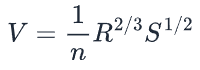
Determine the hydraulic radius of the canal in meters.
Determine the velocity of the water in m/s.
Determine the number of hectares served by the irrigation canal.
Part 1.
For the trapezoidal canal:Part 2.
Using Manning's equation:Part 3.
Discharge in the canal is:Determine the discharge of water over a 60º triangular weir if the measured head is 0.30m.
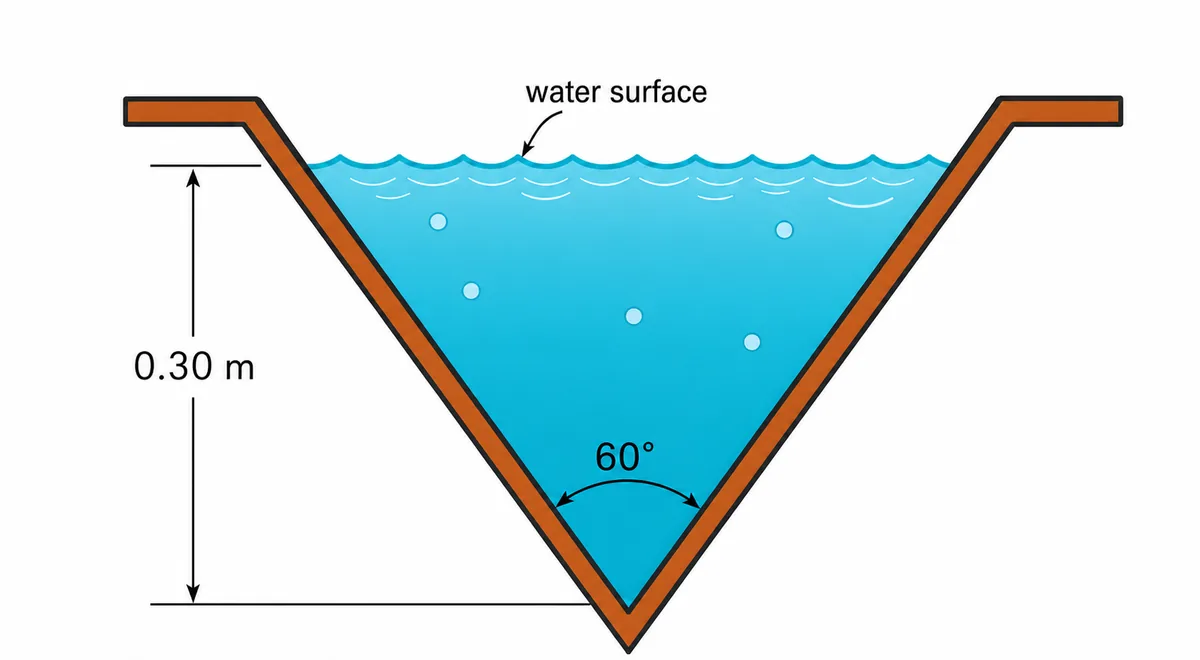
Answer:
An earth canal in good condition is to be constructed with side slopes of 1 ½ horizontal to 1 vertical and a fall of 2 m per 5 km. Determine the depth and the bottom width of the most efficient section if the discharge is 16.2 m3/s. Use n = 0.0225
Answer:
Determine the proper size of a semicircular wood-stove flume that carries 13.5m3/s across a valley with a 900m side with a drop of 0.60m. n = 0.012
Answer:
In order to provide water from a nearby spring, a triangular flume of efficient cross-section was provided on a slope of 0.21 percent. Assuming the roughness coefficient of the channel to be n = 0.018. Obtain the depth of flow in meter(s) of the water in the flume if it is discharging at the rate of 2 m2/sec.
Answer:
An irrigation canal with trapezoidal cross-section has the following dimensions: Bottom width = 2.50 m, depth of water = 0.90 m, side slope = 1.5 horizontal to 1 vertical, slope of the canal bed = 0.001, coefficient of roughness = 0.025. The canal will serve clay-loam Riceland for which the duty of water per hectare is 3.0 liters/sec. Using Manning’s Formula:
Determine the hydraulic radius of the canal, in meters.
Compute the velocity of water in m/s.
Determine the number of hectares served by the irrigation canal.
Part 1.
For the trapezoidal canal:Part 2.
Using Manning's equation:Part 3.
The canal discharge is:A 50mm pipe 15m long extends vertically downward from the bottom of an elevated tank and discharges into air. The entrance from tank to pipe is square-cornered. When the water in the tank is 3m deep over the entrance to the pipe, what is the discharge? Neglect head loss.
Answer:
Water flows through a rectangular irrigation canal 500 mm deep by 1.2 m wide with a mean velocity of 1.7 m/sec. Determine the rate of flow in m3/min.
The discharge is the cross-sectional area times the mean velocity, with depth $d=\dfrac{d_{mm}}{1000}$ in metres:
$$Q=A v=(b\,d)\,v\ \text{m}^3/\text{s}.$$Convert to per-minute by multiplying by 60:
$$Q=(b\,d\,v)\times 60\ \text{m}^3/\text{min}.$$Water flows at 6.5 m3/s under a total head of 11 m. Obtain the horsepower in the flow.
Water flows in a rectangular channel 5.5 m wide at depth 1 m. The bed slope is 0.0012 and Manning roughness is 0.02. Obtain the discharge.
Water flows in an almost level rectangular channel of width 2.7 m at 15 m^3/s. The depth increases from d1 = 0.8 m to d2 = d1 + 0.05 m over a length L = 6 m. Determine the head loss, energy-grade-line slope, and Manning roughness coefficient.
The head loss, in meters.
The slope of the energy grade line.
The roughness coefficient.
Water flows at 18 m3/s at a depth of 0.8 m in a trapezoidal canal having bottom width 5.5 m, side slope 2.5H:1V, and Manning roughness coefficient 0.015.
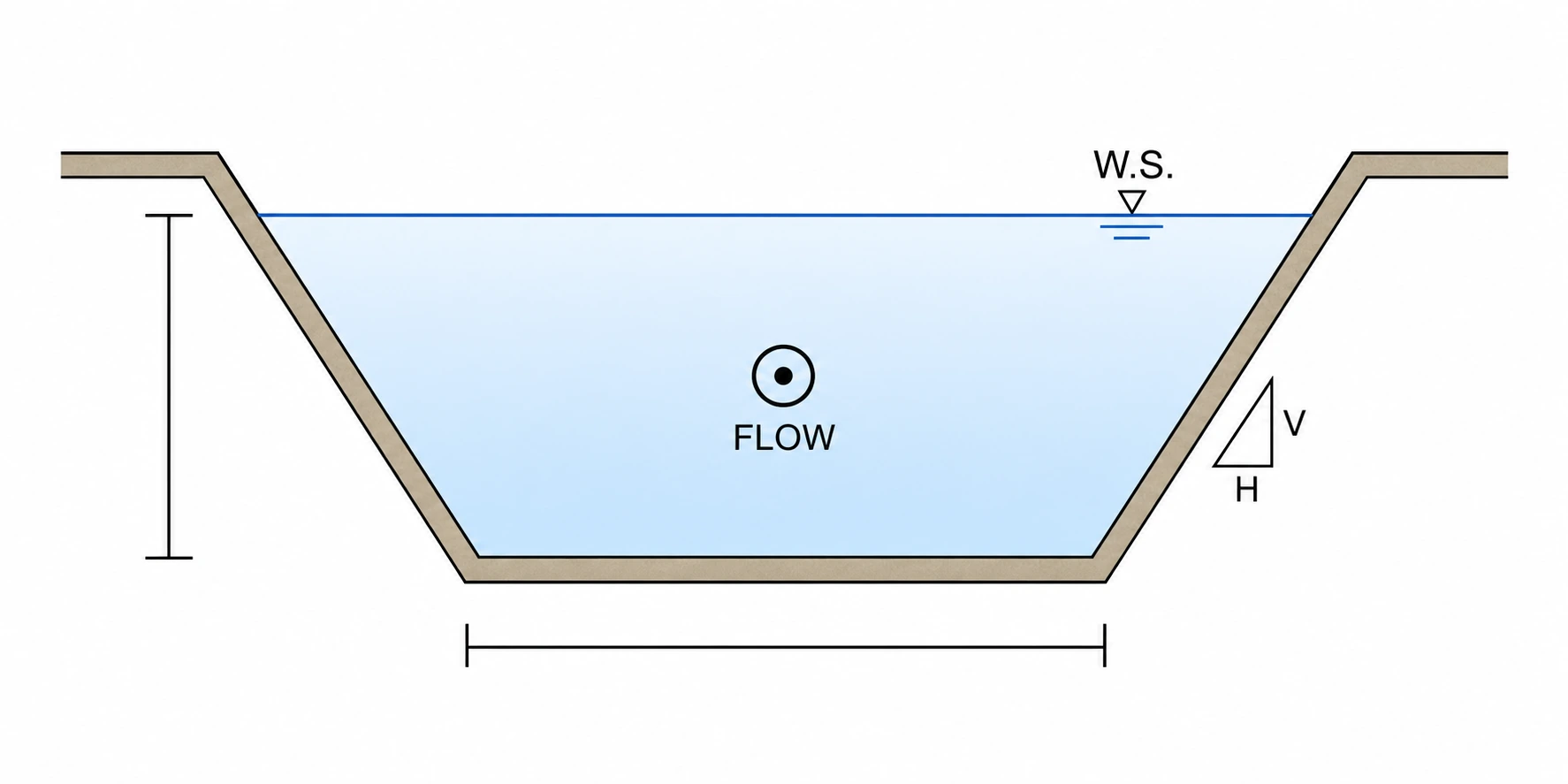
Obtain the specific energy.
Evaluate the canal slope for uniform flow using Manning's formula.
Obtain the boundary shearing stress on the canal surface.
A rectangular open channel carries 0.3 m3/s. Its bottom width is 1 m, flow depth is 0.75 m, and Manning coefficient is 0.014.
Determine the hydraulic radius.
Determine the mean velocity.
Determine the bed slope required for uniform flow.
For a fixed flow area, which open-channel section has the smallest wetted perimeter?
What term describes flow whose depth and mean velocity do not vary from one section to another along the channel?
A rectangular irrigation canal is 7 m wide, carries water 0.8 m deep, has bed slope 0.0008, and Manning coefficient 0.012.
Compute the mean velocity.
Compute the discharge.
For the same area and slope, find the depth of the most efficient rectangular section.
For the hydraulically best trapezoidal channel, how does the sloping-side length compare with one-half of the top width?
What kind of flow has a discharge at a section that is unchanged with time?
What term applies when mean velocity is the same at every cross-section along a reach?
Which term means the same discharge passes every section of a stream at a given instant?
At a given discharge, which open-channel state has minimum specific energy?
A rectangular channel 3.5 m wide and 1.1 m deep and a semicircular channel carry the same uniform-flow discharge with the same slope and roughness. The semicircle is full to its diameter.
Find the semicircular channel diameter.
Which statements describe the most economical trapezoidal channel?
For the most economical rectangular channel, what is the relation between depth and width?
A wide rectangular channel carries 20 m3/s with unit discharge based on width 8 m.
Find the minimum specific energy.
A rectangular canal is 5.75 m wide and 1.2 m deep with Manning n = 0.014 and slope 0.0011.
Compute the discharge.
Estimate the wetted-perimeter saving if rebuilt as the best rectangular section of equal area.
State the excavation-area saving for equal flow area.
Which statement about specific energy in an open channel is incorrect?
What is the principal driving force for ordinary open-channel flow?
A trapezoidal channel has depth 2.6 m, mean velocity 1 m/s, and one of three stated side-slope configurations.
Compute discharge for equal side lengths inclined 60° from horizontal.
Compute discharge when each side slope is 2V:3H.
Compute discharge for the minimum-seepage section with side angle 55°.
For the most economical triangular channel, what angle does each side make with the vertical?
A hydraulically efficient triangular channel has Manning n=0.022, slope 0.0015, and discharge 2 m3/s.
Find flow depth.
A rectangular channel width 3 m has specific energy 1.3 m and actual depth 0.65 m.
Find critical depth.
Return 1 for supercritical and 2 for subcritical.
Find maximum discharge at the given specific energy.
What is the abrupt transition from supercritical to subcritical flow called?
An efficient triangular channel carries 5 m3/s with Manning n=0.014.
Find critical depth.
Find critical velocity.
Find critical slope.
A trapezoidal canal has one vertical side and one side inclined 45°. It carries 19 m3/s at mean velocity 0.85 m/s and is proportioned as a most efficient section.
Estimate required depth.
A hydraulically best rectangular channel carries 4.75 m3/s on slope 0.001 with Manning coefficient 0.014.
Find the optimum channel width.